
Search
found 47 results
Images for earthquake 2011; more images...

Lianne Dalziel apologises for earthquake deaths
Audio, Radio New Zealand
About two hundred of those who lost loved ones in collapsed buildings in Christchurch's 2011 earthquake, heard an apology from the city's mayor, Lianne Dalziel yesterday. A royal commission in to faulty buildings found serious errors by engineers and the Christchurch City Council 185 people died during the earthquake on the 22nd of February, 2011. David Selway who lost his sister Susan Selway in the CTV Building, said it was good to hear a heartfelt apology from the mayor for the role her council played in signing off the building as safe.
Transcript of Sarah Shaw's earthquake story
Articles, UC QuakeStudies
A pdf transcript of Sarah Shaw's second earthquake story, captured by the UC QuakeBox Take 2 project. Interviewer: Samuel Hope. Transcriber: Samuel Hope.
Strategies for earthquake strengthening vintage clay-brick unreinforced ma…
Research papers, The University of Auckland Library
This thesis describes the strategies for earthquake strengthening vintage clay bricks unreinforced masonry (URM) buildings. URM buildings are well known to be vulnerable to damage from earthquake-induced lateral forces that may result in partial or full building collapse. The 2010/2011 Canterbury earthquakes are the most recent destructive natural disaster that resulted in the deaths of 185 people. The earthquake events had drawn people’s attention when URM failure and collapse caused about 39 of the fatality. Despite the poor performance of URM buildings during the 2010/2011 Canterbury earthquakes, a number of successful case study buildings were identified and their details research in-depth. In order to discover the successful seismic retrofitting techniques, two case studies of retrofitted historical buildings located in Christchurch, New Zealand i.e. Orion’s URM substations and an iconic Heritage Hotel (aka Old Government Building) was conducted by investigating and evaluating the earthquake performance of the seismic retrofitting technique applied on the buildings prior to the 2010/2011 Canterbury earthquakes and their performance after the earthquakes sequence. The second part of the research reported in this thesis was directed with the primary aim of developing a cost-effective seismic retrofitting technique with minimal interference to the vintage clay-bricks URM buildings. Two retrofitting techniques, (i) near-surface mounted steel wire rope (NSM-SWR) with further investigation on URM wallettes to get deeper understanding the URM in-plane behaviour, and (ii) FRP anchor are reported in this research thesis
Digital Photograph: Cathedral of the Blessed Sacrament being demolished
Images, Canterbury Museum
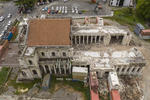
One digital photograph taken by drone showing the Cathedral of the Blessed Sacrament partially demolished. Taken by the Catholic Diocese of Christchurch in 2020.
Help Is On The Way: TV doco remembers the 2011 Christchurch earthquake
Audio, Radio New Zealand
On 22 February 2011, Christchurch police sargeant Dave Harvey was outside the earthquake-damaged Hotel Grand Chancellor on Cashel Street, unsure if anyone was trapped inside. In case they were, he grabbed a can of spray paint and painted 'Help is on the way' in one-metre high letters on the road. Harvey's quick thinking really helped the people trapped in the hotel, says Clare Mackey, producer of the new documentary Help is on the Way.
Digital Photograph: Cathedral of the Blessed Sacrament being demolished by…
Images, Canterbury Museum
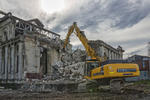
One digital photograph showing the Cathedral of the Blessed Sacrament being demolished with a yellow digger. Taken by photographer Helen McLeod in September 2020.
The Rebuild 326-366
Images, eqnz.chch.2010
This is St Peters Riccarton. It was damaged in one of the two big Earthquakes to hit Christchurch in September 2010 and February 2011. Its taken a LONG time for work to really get going, but now that it is, they are also upgrading and extending the church with a modern annexe.
Digital Photograph: Cathedral of the Blessed Sacrament partially demolished
Images, Canterbury Museum
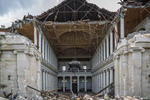
One digital photograph showing the Cathedral of the Blessed Sacrament partially demolished. The interior is visible and lined with intact columns. Taken by photographer Helen McLeod in October 2020.
Digital Photograph: Cathedral of the Blessed Sacrament interior during dem…
Images, Canterbury Museum
One digital photograph showing the Cathedral of the Blessed Sacrament interior during demolition. The nave columns are still intact but debris lines the floor. Taken by photographer Helen McLeod in November 2020.
Digital Photograph: Cathedral of the Blessed Sacrament exterior angels sal…
Images, Canterbury Museum
One digital photograph showing a crane and workers in a cage during the salvage of the exterior angels from atop the Cathedral of the Blessed Sacrament. Taken by the Catholic Diocese of Christchurch in August 2020.
Digital Photograph: Cathedral of the Blessed Sacrament during demolition b…
Images, Canterbury Museum
One digital photograph showing the Cathedral of the Blessed Sacrament during demolition. A yellow digger arm and nibbler claw can be seen along with stone falling from an exterior wall. Taken by photographer Helen McLeod in December 2020.
Digital Photograph: Cathedral of the Blessed Sacrament exterior angels sal…
Images, Canterbury Museum
One digital photograph showing a crane arm and workers in a cage during the salvage of the exterior angels from atop the Cathedral of the Blessed Sacrament. The large intact columns at the entrance of the Cathedral can be seen in the photograph. Taken by the Catholic Diocese of Christchurch in September 2020.
Digital Photograph: Cathedral of the Blessed Sacrament exterior angels
Images, Canterbury Museum
One digital photograph showing the two angels atop the Cathedral of the Blessed Sacrament. The plinth that supports the cross stands empty between the angels. Taken by the Catholic Diocese of Christchurch in August 2020 before the angels were salvaged from the building.
Digital Photograph: Cathedral of the Blessed Sacrament exterior angels sal…
Images, Canterbury Museum
One digital photograph showing the salvage of the exterior angels from the Cathedral of the Blessed Sacrament. Two crane arms and strapping around one of the angels can be seen in the photograph. Taken by the Catholic Diocese of Christchurch in September 2020.
Digital Photograph: Cathedral of the Blessed Sacrament demolition
Images, Canterbury Museum
One digital photograph showing the demolition of the Cathedral of the Blessed Sacrament. A digger arm and nibbler claw can be seen in the photograph removing stone from the exterior, intact columns and ionic column capitals can be seen inside. Taken by the Catholic Diocese of Christchurch in September 2020.
Christ Church Cathedral's day of restoration
Audio, Radio New Zealand
A momentous day in Christchurch as a huge steel frame was installed as part of the stabilisation work for Christ Church Cathedral. Karyn speaks with project director Keith Paterson about the plans to return the famed rose window extensively damage in the 2011 earthquake.
CH Earthquake:CTV victims' families continue push for justice
Audio, Radio New Zealand
The families of those who died in the CTV building's collapse during the Christchurch Earthquake in February of 2011 are vowing to continue their Fight For Justice after The Independent Police Conduct Authority rejected their complaint about the Police Investigation . The Police decided 3 years ago not to lay charges against the building's designer. Yesterday the families announced that the IPCA, the body that advised the Police, had told them that it had no jurisdiction over Crown Law. Families spokesperson, Maan Alkaisi, told reporter Conan Young that they will continue to push for somebody to be held to account. He wants a retired judge to take another look at the decision not to prosecute.
Shake Table Testing of a Near Full Scale Three-storey Friction Based Low D…
Research papers, University of Canterbury Library
Recent severe earthquakes, such as the 2010-2011 Christchurch earthquake series, have put emphasis on building resilience all over the world. To achieve such resilience, procedures for low damage seismic design have been developed to satisfy both life safety requirements and the need to minimize undesirable economic effects of required building repair or structural member replacement following a major earthquake. Seismic resisting systems following this concept are expected to withstand severe earthquakes without requiring major post-earthquake repairs, using isolating mechanisms or sacrificial systems that either do not need repair or are readily repairable or replaceable. These include the sliding hinge joint with asymmetric friction connections (SHJAFCs) in beam-to-column connections of the moment resisting steel frames (MRSFs) and symmetric friction connections (SFCs) in braces of the braced frames. A 9 m tall, configurable three-storey steel framed composite floor building incorporating frictionbased connections is to be tested using two linked bi-directional shake tables at the International joint research Laboratory of Earthquake Engineering (ILEE) facilities, Shanghai, China. The structural systems are configurable, allowing different moment and braced frame structural systems tested in two horizontal directions. The structure is designed and detailed to undergo, at worst, minor damage under a planned series of severe earthquakes.
Change could be on the way for EQC after inquiry
Audio, Radio New Zealand
A scathing inquiry into the Earthquake Commission's handling of the 2010 and 2011 Canterbury earthquakes could mean huge change for how it handles claims. The Government says it's committed to implementing all of the recommendations from the inquiry, including improving its communication, planning and preparedness and dispute resolution. John Goddard, an insurance and employment law barrister who dealt with more than 4000 claims at the time, says repairs were handled poorly and the new recommendations won't cover all the bases. John Goddard and Melanie Bourke of EQC Fix speak to Corin Dann.
Seismic isolation of light frame wood buildings in New Zealand
Research papers, University of Canterbury Library
Seismic isolation is an effective technology for significantly reducing damage to buildings and building contents. However, its application to light-frame wood buildings has so far been unable to overcome cost and technical barriers such as susceptibility of light-weight buildings to movement under high-wind loading. The 1994 Northridge Earthquake (6.7 MW) in the United States, 1995 Kobe Earthquake (6.9 MW) in Japan and 2011 Christchurch Earthquake (6.7 Mw) all highlighted significant loss to light-frame wood buildings with over half of earthquake recovery costs allocated to their repair and reconstruction. This poster presents a value case to highlight the benefits of seismically isolated residential buildings compared to the standard fixed-base dwellings for the Wellington region. Loss data generated by insurance claim information from the 2011 Christchurch Earthquake has been used to determine vulnerability functions for the current light-frame wood building stock. By using a simplified single degree of freedom (SDOF) building model, methods for determining vulnerability functions for seismic isolated buildings are developed. Vulnerability functions are then applied directly in a loss assessment to determine the Expected Annual Loss. Vulnerability was shown to dramatically reduce for isolated buildings compared to an equivalent fixed-base building resulting in significant monetary savings, justifying the value case. A state-of-the-art timber modelling software, Timber3D, is then used to model a typical residential building with and without seismic isolation to assess the performance of a proposed seismic isolation system which addresses the technical and cost issues.
EVALUATING LIQUEFACTION POTENTIAL OF PUMICEOUS DEPOSITS THROUGH FIELD TEST…
Research papers, University of Canterbury Library
Pumice materials, which are problematic from an engineering viewpoint, are widespread in the central part of the North Island. Considering the impacts of the 2010-2011 Christchurch earthquakes, a clear understanding of their properties under earthquake loading is necessary. For example, the 1987 Edgecumbe earthquake showed evidence of localised liquefaction of sands of volcanic origin. To elucidate on this, research was undertaken to investigate whether existing empirical field-based methods to evaluate the liquefaction potential of sands, which were originally developed for hard-grained soils, are applicable to crushable pumice-rich deposits. For this purpose, two sites, one in Whakatane and another in Edgecumbe, were selected where the occurrence of liquefaction was reported following the Edgecumbe earthquake. Manifestations of soil liquefaction, such as sand boils and ejected materials, have been reported at both sites. Field tests, including cone penetration tests (CPT), shear-wave velocity profiling, and screw driving sounding (SDS) tests were performed at the sites. Then, considering estimated peak ground accelerations (PGAs) at the sites based on recorded motions and possible range of ground water table locations, liquefaction analysis was conducted at the sites using available empirical approaches. To clarify the results of the analysis, undisturbed soil samples were obtained at both sites to investigate the laboratory-derived cyclic resistance ratios and to compare with the field-estimated values. Research results clearly showed that these pumice-rich soils do not fit existing liquefaction assessment frameworks and alternate methods are necessary to characterise them.
Christ Church Cathedral restoration: Massive steel frame being installed t…
Audio, Radio New Zealand
Moves towards returning the famed rose window to Christ Church Cathedral begin today. An eighteen-tonne steel frame is being installed onto the cathedral's west facade as part of restoration work. It will eventually housing the rose window. The cathedral was critically damaged in the Christchurch earthquake of 2011. Project director Keith Paterson is in Cathedral Square. He speaks to Susie Ferguson.
Research Programme on Seismic Performance of Reinforced Concrete Walls: Ke…
Research papers, University of Canterbury Library
A wide range of reinforced concrete (RC) wall performance was observed following the 2010/2011 Canterbury earthquakes, with most walls performing as expected, but some exhibiting undesirable and unexpected damage and failure characteristics. A comprehensive research programme, funded by the Building Performance Branch of the New Zealand Ministry of Business, Innovation and Employment, and involving both numerical and experimental studies, was developed to investigate the unexpected damage observed in the earthquakes and provide recommendations for the design and assessment procedures for RC walls. In particular, the studies focused on the performance of lightly reinforced walls; precast walls and connections; ductile walls; walls subjected to bi-directional loading; and walls prone to out-of-plane instability. This paper summarises each research programme and provides practical recommendations for the design and assessment of RC walls based on key findings, including recommended changes to NZS 3101 and the NZ Seismic Assessment Guidelines.
Council apology doesn't make grief easier - Quake victim's daughter
Audio, Radio New Zealand
A Christchurch woman whose mother died in the 2011 earthquake says an apology from the Christchurch mayor Lianne Dalziel does not lessen her grief. Yesterday - nine years and one day since the quake killed 185 people - Dalziel invited their families for a private apology. She acknowledged errors made by engineers and the city council in regards to the CTV building. Julie Hibbs lost her mother in the collapse of the building. She speaks to Susie Ferguson.
Meet local hero 86 year old Māori warden Peggy Hughes
Audio, Radio New Zealand
Meet a local town hero from Auckland's Northshore - 86-year-old Māori Warden Peggy Hughes. Peggy has been serving in her community as a volunteer for about 60 years and officially as a Māori Warden for almost 50 years. She's won dozens of awards for her services - from working at the 1981 Springbok tour protests, supporting Christchurch residents after the 2011 earthquakes, serving at many memorable Waitangi Day events to the recent Black Lives Matter protests.
Vegetation change and native forest restoration in urban environments: Man…
Research papers, Lincoln University
Global biodiversity is threatened by human actions, including in urban areas. Urbanisation has removed and fragmented indigenous habitats. As one of the 25 biodiversity ’hot spots’, New Zealand is facing the problems of habitat loss and indigenous species extinction. In New Zealand cities, as a result of the land clearance and imported urban planning precepts, many urban areas have little or no original native forest remaining. Urbanisation has also been associated with the introduction of multitudes of species from around the world. Two large earthquakes shook Christchurch in 2010 and 2011 and caused a lot of damage. Parts of the city suffered from soil liquefaction after the earthquakes. In the most damaged parts of Christchurch, particularly in the east, whole neighbourhoods were abandoned and later demolished except for larger trees. Christchurch offers an excellent opportunity to study the biodiversity responses to an urban area with less intensive management, and to learn more about the conditions in urban environments that are most conducive to indigenous plant biodiversity. This study focuses on natural woody plant regeneration of forested sites in Christchurch city, many of which were also surveyed prior to the earthquakes. By repeating the pre-earthquake surveys, I am able to describe the natural regeneration occurring in Christchurch forested areas. By combining this with the regeneration that has occurred in the Residential Red Zone, successional trajectories can be described under a range of management scenarios. Using a comprehensive tree map of the Residential Red Zone, I was also able to document minimum dispersal distances of a range of indigenous trees in Christchurch. This is important for planning reserve connectivity. Moreover, I expand and improve on a previous analysis of the habitat connectivity of Christchurch (made before the earthquakes) to incorporate the Residential Red Zone, to assess the importance for habitat connectivity of restoring the indigenous forest in this area. In combination, these data sets are used to provide patch scenarios and some management options for biodiversity restoration in the Ōtākaro-Avon Red Zone post-earthquake.
“It’s about the most needy children”: A Foucauldian analysis of school soc…
Research papers, University of Canterbury Library
INTRODUCTION: After the 2011 Canterbury earthquake, the provision of school social work was extended into a larger number of schools in the greater Christchurch region to support discussions of their practice priorities and responses in post-earthquake schools. FINDINGS: Two main interpretations of need are reflected in the school social workers’ accounts of their work with children and families. Firstly, hardship-focused need, which represented children as adversely influenced by their home circumstances; the interventions were primarily with parents. These families were mainly from schools in low socioeconomic areas. Secondly, anxiety-based need, a newer practice response, which emphasised children who were considered particularly susceptible to the impacts of the disaster event. This article considers how these practitioners conceptualised and responded to the needs of the children and their families in this context. METHOD: A qualitative study examining recovery policy and school social work practice following the earthquakes including 12 semi-structured interviews with school social workers. This article provides a Foucauldian analysis of the social worker participants’ perspectives on emotional and psychological issues for children, particularly those from middle-class families; the main interventions were direct therapeutic work with children themselves. Embedded within these practice accounts are moments in which the social workers contested the predominant, individualising conceptualisations of need to enable more open-ended, negotiable, interconnected relationships in post-earthquake schools. IMPLICATIONS: In the aftermath of disasters, school social workers can reflect on their preferred practice responses and institutional influences in schools to offer children and families opportunities to reject the prevalent norms of risk and vulnerability.
Modelling of vertical control in magnetic levitation for building isolatio…
Research papers, University of Canterbury Library
Earthquakes cause significant damage to buildings due to strong vibration of the ground. Levitating houses using magnets and electromagnets would provide a complete isolation of ground motion for protecting buildings from seismic damage. Two types of initial configuration for the electromagnet system were proposed with the same air gap (10mm) between the electromagnet and reluctance plate. Both active and passive controller are modelled to investigate the feasibility of using a vibration control system for stabilizing the magnetic system within the designed air gap (10mm) in the vertical direction. A nonlinear model for the magnetic system is derived to implement numerical simulation of structural response under the earthquake record in Christchurch Botanic Gardens on 21 February 2011. The performance of the uncontrolled and the controlled systems are compared and the optimal combination of control gains are determined for the PID active controller. Simulation results show both active PID controller with constant and nonlinear attracting force are able to provide an effective displacement control within the required air gap (+/-5mm). The maximum control force demand for the PID controller in the presence of nonlinear attracting force is 4.1kN, while the attracting force in equilibrium position is 10kN provided by the electromagnet. These results show the feasibility of levitating a house using the current electromagnet and PID controller. Finally, initial results of passive control using two permanent magnets or dampers show the structural responses can be effectively reduced and centralized to +/-1mm using a nonlinear centring barrier function.
Christchurch Cathedral restoration cost jumps $51m
Audio, Radio New Zealand
The company running the restoration of Christchurch's Anglican Cathedral is confident it will be able to raise the extra $51 million still needed to finish the job, and says potential large donors are already being approached here and overseas. The building has sat derelict since the 2011 earthquake and now the cost to fix it has soared from an original estimate of $104 million to $154 million. Some Cantabrians are finding the price hard to justify. The director of the restoration project Keith Paterson speaks to Corin Dann.
The Role of Central Government following the Lombok Earthquake 2018: the p…
Research papers, Lincoln University
Recovery from disasters is a significant issue faced by all countries in the world at various times. Governments, including central and local governments, are the key actors regarding post-disaster recovery because they have the authority and responsibility to rescue affected people and recover affected areas (Yang, 2010). Planning is a critical step in the recovery process and provides the basis for defining a shared vision for recovery, clear objectives and intended results. Subsequently, the concept of collaborative planning and ‘build back better’ are highly desirable in recovery planning. However, in practice, these concepts are difficult to achieve. A brief description of the recovery planning in Christchurch City following the Canterbury earthquakes 2011 is provided as an example and comparison. This research aims to analyse the planning process to develop a post-disaster recovery plan in Indonesia using Mataram City’s recovery plan following the Lombok Earthquakes 2018 as the case study. It will emphasise on the roles of the central and local governments and whether they collaborate or not, and the implications of decentralisation for recovery planning. The methodology comprised a combination of legislation analysis and semi-structure interviews with the representatives of the central and local governments who were involved in the planning process. The results indicate that there was no collaboration between the central and local governments when developing the recovery plan, with the former tend to dominate and control the planning process. It is because there are regulatory and institutional problems concerning disaster management in Indonesia. In order to improve the implementation of disaster management and develop a better recovery plan, some recommendations are proposed. These include amendments the disaster management law and regulations to provide a clear guideline regarding the roles and responsibilities of both the central and local governments. It is also imperative to improve the capacity and capability of the local governments in managing disaster.
- 1
- »