
Search
found 114 results
Images for Earthquake Services; more images...


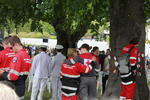
Digital Photograph: First Responders at the Canterbury Earthquake Memorial…
Images, Canterbury Museum
One landscape colour digital photograph taken 22 February 2017 showing first responders at the Canterbury Earthquake Memorial Service.
Digital Photograph: Guests Arriving at the Canterbury Earthquake Memorial …
Images, Canterbury Museum
One landscape colour digital photograph taken 22 February 2017 showing guests being seated prior to the Canterbury Earthquake Memorial Service.
Digital Photograph: Members of the Media at the Canterbury Earthquake Memo…
Images, Canterbury Museum
One landscape colour digital photograph taken 22 February 2017 showing cameramen and journalists at the Canterbury Earthquake Memorial Service.
Digital Photograph: Commemoration Board at the Canterbury Earthquake Memor…
Images, Canterbury Museum
One landscape colour digital photograph taken 22 February 2017 showing a gentleman reading messages on a commemoration board at the Canterbury Earthquake Memorial Service.
Digital Photograph: Media Viewing Area at the Canterbury Earthquake Memori…
Images, Canterbury Museum
One landscape colour digital photograph taken 22 February 2017 showing the appointed media viewing area at the Canterbury Earthquake Memorial Service.
Digital Photograph: First Responders Laying Wreaths at the Canterbury Eart…
Images, Canterbury Museum
One landscape colour digital photograph taken 22 February 2017 showing first responders laying wreaths at the Canterbury Earthquake Memorial Service.
Digital Photograph: Brass Band at the Canterbury Earthquake Memorial Servi…
Images, Canterbury Museum
One landscape colour digital photograph taken 22 February 2017 showing brass band members at the Canterbury Earthquake Memorial Service. Behind the band is a digital screen showing words of thanks from survivors.
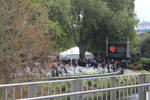
Digital Photograph: First Responders and Public Viewing Areas at the Cante…
Images, Canterbury Museum
One landscape colour digital photograph taken 22 February 2017 showing the appointed first responders and public viewing areas at the Canterbury Earthquake Memorial Service.
Digital Photograph: Brass Band at the Canterbury Earthquake Memorial Servi…
Images, Canterbury Museum
One landscape colour digital photograph taken 22 February 2017 showing brass band members at the Canterbury Earthquake Memorial Service. Behind the band is a digital screen showing an image of flowers floating in the Avon River.
Insuring earthquakes: How would the Californian and Japanese insurance pro…
Research papers, Victoria University of Wellington
Earthquakes are insured only with public sector involvement in high-income countries where the risk of earthquakes is perceived to be high. The proto-typical examples of this public sector involvement are the public earthquake insurance schemes in California, Japan, and New Zealand (NZ). Each of these insurance programs is structured differently, and the purpose of this paper is to examine these differences using a concrete case-study, the sequence of earthquakes that occurred in the Christchurch, New Zealand, in 2011. This event turned out to have been the most heavily insured earthquake event in history. We examine what would have been the outcome of the earthquakes had the system of insurance in NZ been different. In particular, we focus on the public earthquake insurance programs in California (the California Earthquake Authority - CEA), and in Japan (Japanese Earthquake Reinsurance - JER). Overall, the aggregate cost to the public insurer in NZ was $NZ 11.1 billion in its response to the earthquakes. If a similar-sized disaster event had occurred in Japan and California, homeowners would have received $NZ 2.5 billion and $NZ 1.4 billion from the JER and CEA, respectively. We further describe the spatial and distributive patterns of these different scenarios.
Digital Photograph: Flowers Floating in the Avon River
Images, Canterbury Museum
One landscape colour digital photograph taken 22 February 2017 showing flowers floating in the Avon River as part of the Canterbury Earthquake Memorial Service.
Digital Photograph: Sunflower Atop a Road Works Cone
Images, Canterbury Museum
One landscape colour digital photograph taken 22 February 2017 showing a sunflower sitting atop a road works cone as part of the Canterbury Earthquake Memorial Service.
Transport infrastructure performance and management in the South Island of…
Research papers, University of Canterbury Library
At 00:02 on 14th November 2016, a Mw 7.8 earthquake occurred in and offshore of the northeast of the South Island of New Zealand. Fault rupture, ground shaking, liquefaction, and co-seismic landslides caused severe damage to distributed infrastructure, and particularly transportation networks; large segments of the country’s main highway, State Highway 1 (SH1), and the Main North Line (MNL) railway line, were damaged between Picton and Christchurch. The damage caused direct local impacts, including isolation of communities, and wider regional impacts, including disruption of supply chains. Adaptive measures have ensured immediate continued regional transport of goods and people. Air and sea transport increased quickly, both for emergency response and to ensure routine transport of goods. Road diversions have also allowed critical connections to remain operable. This effective response to regional transport challenges allowed Civil Defence Emergency Management to quickly prioritise access to isolated settlements, all of which had road access 23 days after the earthquake. However, 100 days after the earthquake, critical segments of SH1 and the MNL remain closed and their ongoing repairs are a serious national strategic, as well as local, concern. This paper presents the impacts on South Island transport infrastructure, and subsequent management through the emergency response and early recovery phases, during the first 100 days following the initial earthquake, and highlights lessons for transportation system resilience.
Empirical vulnerability assessment of reinforced concrete frame with mason…
Research papers, The University of Auckland Library
During the 2010/2011 Canterbury earthquakes, Reinforced Concrete Frame with Masonry Infill (RCFMI) buildings were subjected to significant lateral loads. A survey conducted by Christchurch City Council (CCC) and the Canterbury Earthquake Recovery Authority (CERA) documented 10,777 damaged buildings, which included building characteristics (building address, the number of storeys, the year of construction, and building use) and post-earthquake damage observations (building safety information, observed damage, level of damage, and current state of the buildings). This data was merged into the Canterbury Earthquake Building Assessment (CEBA) database and was utilised to generate empirical fragility curves using the lognormal distribution method. The proposed fragility curves were expected to provide a reliable estimation of the mean vulnerability for commercial RCFMI buildings in the region http://www.13thcms.com/wp-content/uploads/2017/05/Symposium-Info-and-Presentation-Schedule.pdf VoR - Version of Record
Investigation of systematic ground motion effects through ground motion si…
Research papers, University of Canterbury Library
Decision-Making for Resilient Solutions Associated with Heritage, Earthqua…
Research papers, University of Canterbury Library
he 2016 Building (Earthquake Prone Building) Amendment Act aims to improve the system for managing earthquake-prone buildings. The proposed changes to the Act were precipitated by the Canterbury earthquakes, and the need to improve the seismic safety of New Zealand’s building stock. However, the Act has significant ramifications for territorial authorities, organisations and individuals in small New Zealand towns, since assessing and repairing heritage buildings poses a major cost to districts with low populations and poor rental returns on commercial buildings.
Site-Specific Probabilistic Seismic Hazard Maps of New Zealand for 475 yea…
Research papers, University of Canterbury Library
The latest two great earthquake sequences; 2010- 2011 Canterbury Earthquake and 2016 Kaikoura Earthquake, necessitate a better understanding of the New Zealand seismic hazard condition for new building design and detailed assessment of existing buildings. It is important to note, however, that the New Zealand seismic hazard map in NZS 1170.5.2004 is generalised in effort to cover all of New Zealand and limited to a earthquake database prior to 2001. This is “common” that site-specific studies typically provide spectral accelerations different to those shown on the national map (Z values in NZS 1170.5:2004); and sometimes even lower. Moreover, Section 5.2 of Module 1 of the Earthquake Geotechnical Engineering Practice series provide the guidelines to perform site- specific studies.
Science to Emergency Management Response: Kaikoura Earthquakes 2016
Research papers, University of Canterbury Library
The M7.8 Kaikoura Earthquake in 2016 presented a number of challenges to science agencies and institutions throughout New Zealand. The earthquake was complex, with 21 faults rupturing throughout the North Canterbury and Marlborough landscape, generating a localised seven metre tsunami and triggering thousands of landslides. With many areas isolated as a result, it presented science teams with logistical challenges as well as the need to coordinate efforts across institutional and disciplinary boundaries. Many research disciplines, from engineering and geophysics to social science, were heavily involved in the response. Coordinating these disciplines and institutions required significant effort to assist New Zealand during its most complex earthquake yet recorded. This paper explores that effort and acknowledges the successes and lessons learned by the teams involved.
The continued response of the New Zealand Government to the Canterbury ear…
Research papers, University of Canterbury Library
The Canterbury earthquakes of 2010 and 2011 caused significant damage and disruption to the city of Christchurch, New Zealand. A Royal Commission was established to report on the causes of building failure as a result of the earthquakes as well as look at the legal and best-practice requirements for buildings in New Zealand Central Business Districts. The Royal Commission made 189 recommendations on a variety of matters including managing damaged buildings after an earthquake, the adequacy of building codes and standards, and the processes of seismic assessments of existing buildings to determine their earthquake vulnerability. In response the Ministry of Business, Innovation and Employment, the agency responsible for administering building regulation in New Zealand, established a work programme to assist with the Canterbury rebuild and to implement the lessons learned throughout New Zealand. The five primary work streams in the programme are: • Facilitating the Canterbury Rebuild • Structural Performance and Design Standards • Geotechnical and structural guidance • Existing Building Resilience • Post Disaster Building Management This paper provides more detail on each of the work streams. There has been significant collaboration between the New Zealand Government and the research community, technical societies, and engineering consultants, both within New Zealand and internationally, to deliver the programme and improve the resilience of the New Zealand built environment. This has presented major challenges for an extremely busy industry in the aftermath of the Canterbury earthquakes. The paper identifies the items of work that have been completed and the work that is still in progress at the time of writing.
Landslides caused by the mw7.8 Kaikōura earthquake and the immediate respo…
Research papers, University of Canterbury Library
Tens of thousands of landslides were generated over 10, 000 km2 of North Canterbury and Marlborough as a consequence of the 14 November 2016, MW7.8 Kaikōura Earthquake. The most intense landslide damage was concentrated in 3500 km2 around the areas of fault rupture. Given the sparsely populated area affected by landslides, only a few homes were impacted and there were no recorded deaths due to landslides. Landslides caused major disruption with all road and rail links with Kaikōura being severed. The landslides affecting State Highway 1 (the main road link in the South Island of New Zealand) and the South Island main trunk railway extended from Ward in Marlborough all the way to the south of Oaro in North Canterbury. The majority of landslides occurred in two geological and geotechnically distinct materials reflective of the dominant rock types in the affected area. In the Neogene sedimentary rocks (sandstones, limestones and siltstones) of the Hurunui District, North Canterbury and around Cape Campbell in Marlborough, first-time and reactivated rock-slides and rock-block slides were the dominant landslide type. These rocks also tend to have rock material strength values in the range of 5-20 MPa. In the Torlesse 'basement' rocks (greywacke sandstones and argillite) of the Kaikōura Ranges, first-time rock and debris avalanches were the dominant landslide type. These rocks tend to have material strength values in the range of 20-50 MPa. A feature of this earthquake is the large number (more than 200) of valley blocking landslides it generated. This was partly due to the steep and confined slopes in the area and the widely distributed strong ground shaking. The largest landslide dam has an approximate volume of 12(±2) M m3 and the debris from this travelled about 2.7 km2 downslope where it formed a dam blocking the Hapuku River. The long-term stability of cracked slopes and landslide dams from future strong earthquakes and large rainstorms are an ongoing concern to central and local government agencies responsible for rebuilding homes and infrastructure. A particular concern is the potential for debris floods to affect downstream assets and infrastructure should some of the landslide dams breach catastrophically. At least twenty-one faults ruptured to the ground surface or sea floor, with these surface ruptures extending from the Emu Plain in North Canterbury to offshore of Cape Campbell in Marlborough. The mapped landslide distribution reflects the complexity of the earthquake rupture. Landslides are distributed across a broad area of intense ground shaking reflective of the elongate area affected by fault rupture, and are not clustered around the earthquake epicentre. The largest landslides triggered by the earthquake are located either on or adjacent to faults that ruptured to the ground surface. Surface faults may provide a plane of weakness or hydrological discontinuity and adversely oriented surface faults may be indicative of the location of future large landslides. Their location appears to have a strong structural geological control. Initial results from our landslide investigations suggest predictive models relying only on ground-shaking estimates underestimate the number and size of the largest landslides that occurred.
Strong ground motion observations of engineering interest from the 14 Nove…
Research papers, University of Canterbury Library
This paper provides a brief discussion of observed strong ground motions from the 14 November 2016 Mw7.8 Kaikoura earthquake. Specific attention is given to examining observations in the near-source region where several ground motions exceeding 1.0g horizontal are recorded, as well as up to 2.7g in the vertical direction at one location. Ground motion response spectra in the near-source, North Canterbury, Marlborough and Wellington regions are also examined and compared with design levels. Observed spectral amplitudes are also compared with predictions from empirical and physics-based ground motion modelling.
On-going challenges in physics-based ground motion prediction and insights…
Research papers, University of Canterbury Library
This paper presents on-going challenges in the present paradigm shift of earthquakeinduced ground motion prediction from empirical to physics-based simulation methods. The 2010-2011 Canterbury and 2016 Kaikoura earthquakes are used to illustrate the predictive potential of the different methods. On-going efforts on simulation validation and theoretical developments are then presented, as well as the demands associated with the need for explicit consideration of modelling uncertainties. Finally, discussion is also given to the tools and databases needed for the efficient utilization of simulated ground motions both in specific engineering projects as well as for near-real-time impact assessment.
An empirical analysis of the Christchurch residential mortgage market: pos…
Research papers, Lincoln University
The housing and mortgage market in Christchurch experienced significant changes since the 2011 earthquake, especially after the reconstruction of the city. The increasing speed of Christchurch average house price exceed the average house price of the whole country, as well as the number of new dwellings. By this regard, this study surveyed the households in Christchurch to analyze the effect of the earthquake on housing and mortgage market. This includes factors such as housing price, interest rate, government policy and socioeconomic factors in terms of age, gender, educational attainment, income, marital status and family life cycle. Logistic regression model is used to analyze the data. The study provides an overview of the housing market and mortgage market in Christchurch. The logistic regression, results show changes on sensitivity between the socio-economic factors and house purchase, as well as mortgage borrowing pre- and post-earthquake. The result indicates that the earthquake in Christchurch has affected households’ decision on house purchase and mortgage borrowing.
Liquefaction Performance & Characterisation of 55 Chrictchurch Sites
Research papers, University of Canterbury Library
To identify key ground characteristics that led to different liquefaction manifestations during the Canterbury earthquakes
Building resilience in transient rural communities – a post-earthquake reg…
Research papers, Lincoln University
The Kaikoura earthquake in November 2016 highlighted the vulnerability of New Zealand’s rural communities to locally-specific hazard events, which generate regional and national scale impacts. Kaikoura was isolated with significant damage to both the east coast road (SH1) and rail corridor, and the Inland Road (Route 70). Sea bed uplift along the coast was significant – affecting marine resources and ocean access for marine operators engaged in tourism and harvesting, and recreational users. While communities closest to the earthquake epicentre (e.g., Kaikoura, Waiau, Rotherham and Cheviot) suffered the most immediate earthquake damage, the damage to the transport network, and the establishment of an alternative transport route between Christchurch and Picton, has significantly impacted on more distant communities (e.g., Murchison, St Arnaud and Blenheim). There was also considerable damage to vineyard infrastructure across the Marlborough region and damage to buildings and infrastructure in rural settlements in Southern Marlborough (e.g., Ward and Seddon).
Post-Earthquake Real Estate Decision-Making : Repair or Replace?
Research papers, University of Canterbury Library
Many buildings with relatively low damage from the 2010-2011 Canterbury were deemed uneconomic to repair and were replaced [1,2]. Factors that affected commercial building owners’ decisions to replace rather than repair, included capital availability, uncertainty with regards to regional recovery, local market conditions and ability to generate cash flow, and repair delays due to limited property access (cordon). This poster provides a framework for modeling decision-making in a case where repair is feasible but replacement might offer greater economic value – a situation not currently modeled in engineering risk analysis.
A System Dynamic Model of Post-Earthquake Reconstruction pathways
Research papers, University of Canterbury Library
Objectives • To develop a system dynamics model of Christchurch post-quake reconstruction process that captures all the critical dynamics influencing its pathway • To investigate the implications of current rebuild pathway • To build a reconstruction module to be integrated in MERIT (Measuring the Economics of Resilient Infrastructure Tool)
Christchurch Earthquake Recovery - An Example of Resilience and Sustainabi…
Research papers, University of Canterbury Library
The term resilience‘’is increasingly being used in a multitude of contexts. Seemingly the latest buzz‘’word, it can mean many things to many people, in many different situations. In a natural hazard context, the terms sustainable planning‘’, and resilience‘planning are now’being used, often interchangeably. This poster provides an overview of resilience and sustainability within a land use planning and natural hazard context, and discusses how they are interrelated in the situation of the earthquake impacted city of Christchurch, New Zealand.
Creating healthy urban communities: lessons from Christchurch’s earthquake…
Research papers, University of Canterbury Library
Relative efficacy of CPT- versus Vs-based simplified liquefaction evaluati…
Research papers, University of Canterbury Library
The focus of the study presented herein is an assessment of the relative efficacy of recent Cone Penetration Test (CPT) and small strain shear wave velocity (Vs) based variants of the simplified procedure. Towards this end Receiver Operating Characteristic (ROC) analyses were performed on the CPT- and Vs-based procedures using the field case history databases from which the respective procedures were developed. The ROC analyses show that Factors of Safety (FS) against liquefaction computed using the most recent Vs-based simplified procedure is better able to separate the “liquefaction” from the “no liquefaction” case histories in the Vs liquefaction database than the CPT-based procedure is able to separate the “liquefaction” from the “no liquefaction” case histories in the CPT liquefaction database. However, this finding somewhat contradicts the assessed predictive capabilities of the CPT- and Vs-based procedures as quantified using select, high quality liquefaction case histories from the 20102011 Canterbury, New Zealand, Earthquake Sequence (CES), wherein the CPT-based procedure was found to yield more accurate predictions. The dichotomy of these findings may result from the fact that different liquefaction field case history databases were used in the respective ROC analyses for Vs and CPT, while the same case histories were used to evaluate both the CPT- and Vs-based procedures.