
Search
found 17 results
Images for 22; more images...
Digital Photograph: Cathedral of the Blessed Sacrament exterior angels sal…
Images, Canterbury Museum
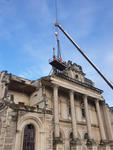
One digital photograph showing a crane arm and workers in a cage during the salvage of the exterior angels from atop the Cathedral of the Blessed Sacrament. The large intact columns at the entrance of the Cathedral can be seen in the photograph. Taken by the Catholic Diocese of Christchurch in September 2020.
Digital Photograph: Cathedral of the Blessed Sacrament being demolished
Images, Canterbury Museum
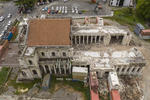
One digital photograph taken by drone showing the Cathedral of the Blessed Sacrament partially demolished. Taken by the Catholic Diocese of Christchurch in 2020.
Digital Photograph: Cathedral of the Blessed Sacrament partially demolished
Images, Canterbury Museum
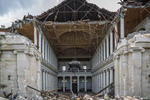
One digital photograph showing the Cathedral of the Blessed Sacrament partially demolished. The interior is visible and lined with intact columns. Taken by photographer Helen McLeod in October 2020.
Digital Photograph: Cathedral of the Blessed Sacrament being demolished by…
Images, Canterbury Museum
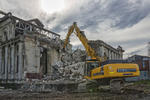
One digital photograph showing the Cathedral of the Blessed Sacrament being demolished with a yellow digger. Taken by photographer Helen McLeod in September 2020.
Digital Photograph: Cathedral of the Blessed Sacrament interior during dem…
Images, Canterbury Museum
One digital photograph showing the Cathedral of the Blessed Sacrament interior during demolition. The nave columns are still intact but debris lines the floor. Taken by photographer Helen McLeod in November 2020.
Digital Photograph: Cathedral of the Blessed Sacrament during demolition b…
Images, Canterbury Museum
One digital photograph showing the Cathedral of the Blessed Sacrament during demolition. A yellow digger arm and nibbler claw can be seen along with stone falling from an exterior wall. Taken by photographer Helen McLeod in December 2020.
Digital Photograph: Cathedral of the Blessed Sacrament exterior angels
Images, Canterbury Museum
One digital photograph showing the two angels atop the Cathedral of the Blessed Sacrament. The plinth that supports the cross stands empty between the angels. Taken by the Catholic Diocese of Christchurch in August 2020 before the angels were salvaged from the building.
Digital Photograph: Cathedral of the Blessed Sacrament exterior angels sal…
Images, Canterbury Museum
One digital photograph showing a crane and workers in a cage during the salvage of the exterior angels from atop the Cathedral of the Blessed Sacrament. Taken by the Catholic Diocese of Christchurch in August 2020.
Digital Photograph: Cathedral of the Blessed Sacrament exterior angels sal…
Images, Canterbury Museum
One digital photograph showing the salvage of the exterior angels from the Cathedral of the Blessed Sacrament. Two crane arms and strapping around one of the angels can be seen in the photograph. Taken by the Catholic Diocese of Christchurch in September 2020.
Digital Photograph: Cathedral of the Blessed Sacrament demolition
Images, Canterbury Museum
One digital photograph showing the demolition of the Cathedral of the Blessed Sacrament. A digger arm and nibbler claw can be seen in the photograph removing stone from the exterior, intact columns and ionic column capitals can be seen inside. Taken by the Catholic Diocese of Christchurch in September 2020.
Help Is On The Way: TV doco remembers the 2011 Christchurch earthquake
Audio, Radio New Zealand
On 22 February 2011, Christchurch police sargeant Dave Harvey was outside the earthquake-damaged Hotel Grand Chancellor on Cashel Street, unsure if anyone was trapped inside. In case they were, he grabbed a can of spray paint and painted 'Help is on the way' in one-metre high letters on the road. Harvey's quick thinking really helped the people trapped in the hotel, says Clare Mackey, producer of the new documentary Help is on the Way.
Lianne Dalziel apologises for earthquake deaths
Audio, Radio New Zealand
About two hundred of those who lost loved ones in collapsed buildings in Christchurch's 2011 earthquake, heard an apology from the city's mayor, Lianne Dalziel yesterday. A royal commission in to faulty buildings found serious errors by engineers and the Christchurch City Council 185 people died during the earthquake on the 22nd of February, 2011. David Selway who lost his sister Susan Selway in the CTV Building, said it was good to hear a heartfelt apology from the mayor for the role her council played in signing off the building as safe.
Developing guidelines for the seismic assessment of glazing systems
Research papers, University of Canterbury Library
There is an increasing recognition that the seismic performance of buildings will be affected by the behaviour of both structural and non-structural elements. In light of this, work has been progressing at the University of Canterbury to develop guidelines for the seismic assessment of commercial glazing systems. This paper reviews the seismic assessment guidelines prescribed in Section C10 of the MBIE building assessment guidelines. Subsequently, the C10 approach is used to assess the drift capacity of a number of glazing units recently tested at the University of Canterbury. Comparing the predicted and observed drift capacities, it would appear that the C10 guidelines may lead to nonconservative estimates of drift capacity. Furthermore, the experimental results indicate that watertightness may be lost at very low drift demands, suggesting that guidance for the assessment of serviceability performance would also be beneficial. As such, it is proposed that improved guidance be provided to assist engineers in considering the possible impact that glazing could have on the structural response of a building in a large earthquake.
ROBUST friction building shaking table testing overview
Research papers, University of Canterbury Library
Shaking table testing of a full-scale three storey resilient and reparable complete composite steel framed building system is being conducted. The building incorporates a number of interchangeable seismic resisting systems of New Zealand and Chinese origin. The building has a steel frame and cold formed steel-concrete composite deck. Energy is dissipated by means of friction connections. These connections are arranged in a number of structural configurations. Typical building nonskeletal elements (NSEs) are also included. Testing is performed on the Jiading Campus shaking table at Tongji University, Shanghai, China. This RObust BUilding SysTem (ROBUST) project is a collaborative China-New Zealand project sponsored by the International Joint Research Laboratory of Earthquake Engineering (ILEE), Tongji University, and a number of agencies and universities within New Zealand including BRANZ, Comflor, Earthquake Commission, HERA, QuakeCoRE, QuakeCentre, University of Auckland, and the University of Canterbury. This paper provides a general overview of the project describing a number of issues encountered in the planning of this programme including issues related to international collaboration, the test plan, and technical issues.
Modelling of vertical control in magnetic levitation for building isolatio…
Research papers, University of Canterbury Library
Earthquakes cause significant damage to buildings due to strong vibration of the ground. Levitating houses using magnets and electromagnets would provide a complete isolation of ground motion for protecting buildings from seismic damage. Two types of initial configuration for the electromagnet system were proposed with the same air gap (10mm) between the electromagnet and reluctance plate. Both active and passive controller are modelled to investigate the feasibility of using a vibration control system for stabilizing the magnetic system within the designed air gap (10mm) in the vertical direction. A nonlinear model for the magnetic system is derived to implement numerical simulation of structural response under the earthquake record in Christchurch Botanic Gardens on 21 February 2011. The performance of the uncontrolled and the controlled systems are compared and the optimal combination of control gains are determined for the PID active controller. Simulation results show both active PID controller with constant and nonlinear attracting force are able to provide an effective displacement control within the required air gap (+/-5mm). The maximum control force demand for the PID controller in the presence of nonlinear attracting force is 4.1kN, while the attracting force in equilibrium position is 10kN provided by the electromagnet. These results show the feasibility of levitating a house using the current electromagnet and PID controller. Finally, initial results of passive control using two permanent magnets or dampers show the structural responses can be effectively reduced and centralized to +/-1mm using a nonlinear centring barrier function.
Shake Table Testing of a Near Full Scale Three-storey Friction Based Low D…
Research papers, University of Canterbury Library
Recent severe earthquakes, such as the 2010-2011 Christchurch earthquake series, have put emphasis on building resilience all over the world. To achieve such resilience, procedures for low damage seismic design have been developed to satisfy both life safety requirements and the need to minimize undesirable economic effects of required building repair or structural member replacement following a major earthquake. Seismic resisting systems following this concept are expected to withstand severe earthquakes without requiring major post-earthquake repairs, using isolating mechanisms or sacrificial systems that either do not need repair or are readily repairable or replaceable. These include the sliding hinge joint with asymmetric friction connections (SHJAFCs) in beam-to-column connections of the moment resisting steel frames (MRSFs) and symmetric friction connections (SFCs) in braces of the braced frames. A 9 m tall, configurable three-storey steel framed composite floor building incorporating frictionbased connections is to be tested using two linked bi-directional shake tables at the International joint research Laboratory of Earthquake Engineering (ILEE) facilities, Shanghai, China. The structural systems are configurable, allowing different moment and braced frame structural systems tested in two horizontal directions. The structure is designed and detailed to undergo, at worst, minor damage under a planned series of severe earthquakes.
Robustness and accuracy of model-free structural health monitoring
Research papers, University of Canterbury Library
Rapid, accurate structural health monitoring (SHM) assesses damage to optimise decision-making. Many SHM methods are designed to track nonlinear stiffness changes as damage. However, highly nonlinear pinched hysteretic systems are problematic in SHM. Model-based SHM often fails as any mismatch between model and measured response dynamics leads to significant error. Thus, modelfree methods of hysteresis loop tracking methods have emerged. This study compares the robustness and accuracy in the presence of significant measurement noise of the proven hysteresis loop analysis (HLA) SHM method with 3 emerging model-free methods and 2 further novel adaptations of these methods using a highly nonlinear, 6-story numerical structure to provide a known ground-truth. Mean absolute errors in identifying a known nonlinear stiffness trajectory assessed at four points over two successive ground motion inputs from September 2010 and February 2011 in Christchurch range from 1.71-10.52%. However, the variability is far wider with maximum errors ranging from 3.90-49.72%, where the second largest maximum absolute error was still 19.74%. The lowest mean and maximum absolute errors were for the HLA method. The next best method had mean absolute error of 2.92% and a maximum of 10.51%. These results show the clear superiority of the HLA method over all current emerging model-free methods designed to manage the highly nonlinear pinching responses common in reinforced concrete structures. These results, combined with high robustness and accuracy in scaled and fullscale experimental studies, provide further validation for using HLA for practical implementation.
- 1