
Search
found 41 results
Images for 2011; more images...
Digital Photograph: Cathedral of the Blessed Sacrament exterior angels sal…
Images, Canterbury Museum
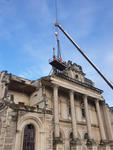
One digital photograph showing a crane arm and workers in a cage during the salvage of the exterior angels from atop the Cathedral of the Blessed Sacrament. The large intact columns at the entrance of the Cathedral can be seen in the photograph. Taken by the Catholic Diocese of Christchurch in September 2020.
Digital Photograph: Cathedral of the Blessed Sacrament being demolished
Images, Canterbury Museum
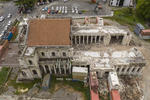
One digital photograph taken by drone showing the Cathedral of the Blessed Sacrament partially demolished. Taken by the Catholic Diocese of Christchurch in 2020.
Digital Photograph: Cathedral of the Blessed Sacrament partially demolished
Images, Canterbury Museum
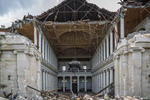
One digital photograph showing the Cathedral of the Blessed Sacrament partially demolished. The interior is visible and lined with intact columns. Taken by photographer Helen McLeod in October 2020.
Digital Photograph: Cathedral of the Blessed Sacrament being demolished by…
Images, Canterbury Museum
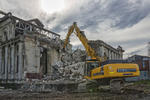
One digital photograph showing the Cathedral of the Blessed Sacrament being demolished with a yellow digger. Taken by photographer Helen McLeod in September 2020.
Digital Photograph: Cathedral of the Blessed Sacrament interior during dem…
Images, Canterbury Museum
One digital photograph showing the Cathedral of the Blessed Sacrament interior during demolition. The nave columns are still intact but debris lines the floor. Taken by photographer Helen McLeod in November 2020.
Digital Photograph: Cathedral of the Blessed Sacrament during demolition b…
Images, Canterbury Museum
One digital photograph showing the Cathedral of the Blessed Sacrament during demolition. A yellow digger arm and nibbler claw can be seen along with stone falling from an exterior wall. Taken by photographer Helen McLeod in December 2020.
Digital Photograph: Cathedral of the Blessed Sacrament exterior angels
Images, Canterbury Museum
One digital photograph showing the two angels atop the Cathedral of the Blessed Sacrament. The plinth that supports the cross stands empty between the angels. Taken by the Catholic Diocese of Christchurch in August 2020 before the angels were salvaged from the building.
Digital Photograph: Cathedral of the Blessed Sacrament exterior angels sal…
Images, Canterbury Museum
One digital photograph showing a crane and workers in a cage during the salvage of the exterior angels from atop the Cathedral of the Blessed Sacrament. Taken by the Catholic Diocese of Christchurch in August 2020.
Digital Photograph: Cathedral of the Blessed Sacrament exterior angels sal…
Images, Canterbury Museum
One digital photograph showing the salvage of the exterior angels from the Cathedral of the Blessed Sacrament. Two crane arms and strapping around one of the angels can be seen in the photograph. Taken by the Catholic Diocese of Christchurch in September 2020.
Digital Photograph: Cathedral of the Blessed Sacrament demolition
Images, Canterbury Museum
One digital photograph showing the demolition of the Cathedral of the Blessed Sacrament. A digger arm and nibbler claw can be seen in the photograph removing stone from the exterior, intact columns and ionic column capitals can be seen inside. Taken by the Catholic Diocese of Christchurch in September 2020.
Christ Church Cathedral's day of restoration
Audio, Radio New Zealand
A momentous day in Christchurch as a huge steel frame was installed as part of the stabilisation work for Christ Church Cathedral. Karyn speaks with project director Keith Paterson about the plans to return the famed rose window extensively damage in the 2011 earthquake.
The Rebuild 326-366
Images, eqnz.chch.2010
This is St Peters Riccarton. It was damaged in one of the two big Earthquakes to hit Christchurch in September 2010 and February 2011. Its taken a LONG time for work to really get going, but now that it is, they are also upgrading and extending the church with a modern annexe.
Christ Church Cathedral restoration: Massive steel frame being installed t…
Audio, Radio New Zealand
Moves towards returning the famed rose window to Christ Church Cathedral begin today. An eighteen-tonne steel frame is being installed onto the cathedral's west facade as part of restoration work. It will eventually housing the rose window. The cathedral was critically damaged in the Christchurch earthquake of 2011. Project director Keith Paterson is in Cathedral Square. He speaks to Susie Ferguson.
Strategies for earthquake strengthening vintage clay-brick unreinforced ma…
Research papers, The University of Auckland Library
This thesis describes the strategies for earthquake strengthening vintage clay bricks unreinforced masonry (URM) buildings. URM buildings are well known to be vulnerable to damage from earthquake-induced lateral forces that may result in partial or full building collapse. The 2010/2011 Canterbury earthquakes are the most recent destructive natural disaster that resulted in the deaths of 185 people. The earthquake events had drawn people’s attention when URM failure and collapse caused about 39 of the fatality. Despite the poor performance of URM buildings during the 2010/2011 Canterbury earthquakes, a number of successful case study buildings were identified and their details research in-depth. In order to discover the successful seismic retrofitting techniques, two case studies of retrofitted historical buildings located in Christchurch, New Zealand i.e. Orion’s URM substations and an iconic Heritage Hotel (aka Old Government Building) was conducted by investigating and evaluating the earthquake performance of the seismic retrofitting technique applied on the buildings prior to the 2010/2011 Canterbury earthquakes and their performance after the earthquakes sequence. The second part of the research reported in this thesis was directed with the primary aim of developing a cost-effective seismic retrofitting technique with minimal interference to the vintage clay-bricks URM buildings. Two retrofitting techniques, (i) near-surface mounted steel wire rope (NSM-SWR) with further investigation on URM wallettes to get deeper understanding the URM in-plane behaviour, and (ii) FRP anchor are reported in this research thesis
Transcript of Sarah Shaw's earthquake story
Articles, UC QuakeStudies
A pdf transcript of Sarah Shaw's second earthquake story, captured by the UC QuakeBox Take 2 project. Interviewer: Samuel Hope. Transcriber: Samuel Hope.
Meet local hero 86 year old Māori warden Peggy Hughes
Audio, Radio New Zealand
Meet a local town hero from Auckland's Northshore - 86-year-old Māori Warden Peggy Hughes. Peggy has been serving in her community as a volunteer for about 60 years and officially as a Māori Warden for almost 50 years. She's won dozens of awards for her services - from working at the 1981 Springbok tour protests, supporting Christchurch residents after the 2011 earthquakes, serving at many memorable Waitangi Day events to the recent Black Lives Matter protests.
Change could be on the way for EQC after inquiry
Audio, Radio New Zealand
A scathing inquiry into the Earthquake Commission's handling of the 2010 and 2011 Canterbury earthquakes could mean huge change for how it handles claims. The Government says it's committed to implementing all of the recommendations from the inquiry, including improving its communication, planning and preparedness and dispute resolution. John Goddard, an insurance and employment law barrister who dealt with more than 4000 claims at the time, says repairs were handled poorly and the new recommendations won't cover all the bases. John Goddard and Melanie Bourke of EQC Fix speak to Corin Dann.
Christchurch Cathedral restoration cost jumps $51m
Audio, Radio New Zealand
The company running the restoration of Christchurch's Anglican Cathedral is confident it will be able to raise the extra $51 million still needed to finish the job, and says potential large donors are already being approached here and overseas. The building has sat derelict since the 2011 earthquake and now the cost to fix it has soared from an original estimate of $104 million to $154 million. Some Cantabrians are finding the price hard to justify. The director of the restoration project Keith Paterson speaks to Corin Dann.
The effects of managed retreat (red zoning) on the relocated households in…
Research papers, University of Canterbury Library
The question of whether forced relocation is beneficial or detrimental to the displaced households is a controversial and important policy question. After the 2011 earthquake in Christchurch, the government designated some of the worst affected areas as Residential Red Zones. Around 20,000 people were forced to move out of these Residential Red Zone areas, and were compensated for that. The objective of this paper is twofold. First, we aim to estimate the impact of relocation on the displaced households in terms of their income, employment, and their mental and physical health. Second, we evaluate whether the impact of relocation varies by the timing of to move, the destination (remaining within the Canterbury region or moving out of it) and demographic factors (gender, age, ethnicity). StatisticsNZ’s Integrated Data Infrastructure (IDI) from 2008 to 2017, which includes data on all households in Canterbury, and a difference-in-difference (DID) technique is used to answer these questions. We find that relocation has a negative impact on the income of the displaced household group. This adverse impact is more severe for later movers. Compared to the control group (that was not relocated), the income of relocated households was reduced by 3% for people who moved immediately after the earthquake in 2011, and 14% for people who moved much later in 2015.
Residents fed up with red zone rubbish
Audio, Radio New Zealand
Christchurch red zone residents say the area is experiencing an increasing amount of petty crime and dumped rubbish, due to a lack of people. The red zone was established after thousands of houses - and the land underneath them - suffered severe damage in the 2010 and 2011 earthquakes. Last year (2019), a Regeneration Plan for the area was signed off by the government - which included building walkways, cycleways, forests, wetlands, and sport and recreation areas. That's all designed to get people back into the red zone area - but much of the work is still years away. Logan Church met a resident who told him that in the meantime, things are deteriorating.
Seismic isolation of light frame wood buildings in New Zealand
Research papers, University of Canterbury Library
Seismic isolation is an effective technology for significantly reducing damage to buildings and building contents. However, its application to light-frame wood buildings has so far been unable to overcome cost and technical barriers such as susceptibility of light-weight buildings to movement under high-wind loading. The 1994 Northridge Earthquake (6.7 MW) in the United States, 1995 Kobe Earthquake (6.9 MW) in Japan and 2011 Christchurch Earthquake (6.7 Mw) all highlighted significant loss to light-frame wood buildings with over half of earthquake recovery costs allocated to their repair and reconstruction. This poster presents a value case to highlight the benefits of seismically isolated residential buildings compared to the standard fixed-base dwellings for the Wellington region. Loss data generated by insurance claim information from the 2011 Christchurch Earthquake has been used to determine vulnerability functions for the current light-frame wood building stock. By using a simplified single degree of freedom (SDOF) building model, methods for determining vulnerability functions for seismic isolated buildings are developed. Vulnerability functions are then applied directly in a loss assessment to determine the Expected Annual Loss. Vulnerability was shown to dramatically reduce for isolated buildings compared to an equivalent fixed-base building resulting in significant monetary savings, justifying the value case. A state-of-the-art timber modelling software, Timber3D, is then used to model a typical residential building with and without seismic isolation to assess the performance of a proposed seismic isolation system which addresses the technical and cost issues.
CH Earthquake:CTV victims' families continue push for justice
Audio, Radio New Zealand
The families of those who died in the CTV building's collapse during the Christchurch Earthquake in February of 2011 are vowing to continue their Fight For Justice after The Independent Police Conduct Authority rejected their complaint about the Police Investigation . The Police decided 3 years ago not to lay charges against the building's designer. Yesterday the families announced that the IPCA, the body that advised the Police, had told them that it had no jurisdiction over Crown Law. Families spokesperson, Maan Alkaisi, told reporter Conan Young that they will continue to push for somebody to be held to account. He wants a retired judge to take another look at the decision not to prosecute.
A changing tourism system in post-disaster recovery: Developing anime tour…
Research papers, Lincoln University
Oarai is a coastal town in Ibaraki Prefecture, Japan, affected by the Great East Japan Earthquake in 2011. The disaster severely damaged local industries, and the local tourism sector faced a sharp decline followed the event. To overcome the conundrum, the local tourism businesses have taken the opportunity to collaborate with an anime called Girls und Panzer, which has been developed by an external animation production studio. This collaboration has resulted in huge success, and the drop in the local tourism industry had been largely reversed, but has resulted in a significant change to the tourism system. This thesis explores the activities and outcomes of this tourism industry reimagining. A mixed-method approach was used to investigate the perception of local tourism businesses to the current Oarai tourism system, and examine the transformative effect of the disaster and its aftermath. Perceptions of disaster impact and anime tourism development were analysed through surveys (n=73) and interviews (n=2) which focused on tourism business operators, while participant observation was conducted to create the image of anime tourism operation in Oarai. Results show that the development of anime tourism in Oarai successfully helped the local tourism businesses to recover from the disaster. As new agencies and organisations joined the anime tourism network, anime tourism increased communication between stakeholders, and improved the resilience of the community. The new tourism development has transformed the local tourism industry, to some extent, however. the future trajectory of anime tourism in Oarai is difficult to forecast, and there is scope for longitudinal research of this tourism system.
Research Programme on Seismic Performance of Reinforced Concrete Walls: Ke…
Research papers, University of Canterbury Library
A wide range of reinforced concrete (RC) wall performance was observed following the 2010/2011 Canterbury earthquakes, with most walls performing as expected, but some exhibiting undesirable and unexpected damage and failure characteristics. A comprehensive research programme, funded by the Building Performance Branch of the New Zealand Ministry of Business, Innovation and Employment, and involving both numerical and experimental studies, was developed to investigate the unexpected damage observed in the earthquakes and provide recommendations for the design and assessment procedures for RC walls. In particular, the studies focused on the performance of lightly reinforced walls; precast walls and connections; ductile walls; walls subjected to bi-directional loading; and walls prone to out-of-plane instability. This paper summarises each research programme and provides practical recommendations for the design and assessment of RC walls based on key findings, including recommended changes to NZS 3101 and the NZ Seismic Assessment Guidelines.
FRONTLINE: The nexus of political documentary and alternative journalism:
Research papers, The University of Auckland Library
<jats:p>This article is a critical commentary of how political documentary embodies the traits and functions of alternative journalism. I explore this notion through Obrero (‘worker’) my independent documentary project about the labour migration of Filipino workers to Christchurch, Aotearoa New Zealand, after the earthquake in 2011. This article maps out the points at where the theories and practices of alternative media and documentary intersect. Analysing political documentary as a format of alternative journalism has links to the long tradition of film and video production as a tool for social critique. As a form of practice-based research, Obrero falls under the rubric of alternative journalism—able to represent the politically marginal sectors of the polity and report on issues underreported in the mainstream press. This article concludes that a distribution plan that is responsive to fragmenting audiences works best when alternative journalism no longer targets a niche but transborder audiences.</jats:p>
Wall-to-floor connection behaviour in a low-damage concrete wall building
Research papers, University of Canterbury Library
Following the 2010/2011 Canterbury earthquakes, approximately 60% of multi-story buildings with reinforced concrete walls required demolition. Both practitioners and researchers have increasingly realized that low-damage structural systems could be an alternative to improve the seismic behaviour of concrete buildings and to reduce the economic and social impact of structural damage in future earthquakes. To verify the seismic response of a low-damage concrete wall building representing state-of-art design practice, a shake table test on a two-story concrete building was recently conducted as part of an ILEE-QuakeCoRE collaborative research program. The building utilized flexible wall-to-floor connections in the long span direction and isolating wall-to-floor devices in the short span direction to provide a comparison of their respective behaviour. Additionally, the wall-to-floor interaction such as effects of wall uplift on the link slab, and force transfer mechanism from floor to the wall will be discussed in this paper.
Teaching together: Reflections on developing a collaborative interdiscipli…
Research papers, University of Canterbury Library
The Bachelor of Youth and Community Leadership (BYCL) was launched by the University of Canterbury (UC) in 2020. The genesis of this new degree was a Stage One service-learning course that, in turn, arose from the innovative and active response of many of the university’s students in the aftermath of the Christchurch earthquakes in 2010 and 2011. That innovative action saw the formation of the Student Volunteer Army as well as the adoption of a new set of Graduate Attributes for every undergraduate at the university. The idea of a specialist undergraduate degree that captured this unique chain of events began to take form from 2016. The resulting degree was developed as a flexible, transdisciplinary programme for young (and not so young) leaders wanting an academic grounding for their passions in community leadership and social action. In 2020, the inaugural intake of students commenced their studies. In this reflection, we discuss our experience of teaching within the BYCL for the first time, using a collaborative approach to teaching that we based on what we understand, individually and collectively, to draw on principles of democratic pedagogy.
Shake Table Testing of a Near Full Scale Three-storey Friction Based Low D…
Research papers, University of Canterbury Library
Recent severe earthquakes, such as the 2010-2011 Christchurch earthquake series, have put emphasis on building resilience all over the world. To achieve such resilience, procedures for low damage seismic design have been developed to satisfy both life safety requirements and the need to minimize undesirable economic effects of required building repair or structural member replacement following a major earthquake. Seismic resisting systems following this concept are expected to withstand severe earthquakes without requiring major post-earthquake repairs, using isolating mechanisms or sacrificial systems that either do not need repair or are readily repairable or replaceable. These include the sliding hinge joint with asymmetric friction connections (SHJAFCs) in beam-to-column connections of the moment resisting steel frames (MRSFs) and symmetric friction connections (SFCs) in braces of the braced frames. A 9 m tall, configurable three-storey steel framed composite floor building incorporating frictionbased connections is to be tested using two linked bi-directional shake tables at the International joint research Laboratory of Earthquake Engineering (ILEE) facilities, Shanghai, China. The structural systems are configurable, allowing different moment and braced frame structural systems tested in two horizontal directions. The structure is designed and detailed to undergo, at worst, minor damage under a planned series of severe earthquakes.
Obrero (“worker”): Practising and theorising political documentary across …
Research papers, The University of Auckland Library
This thesis is a creative and critical exploration of how transmedia storytelling meshes with political documentary’s nature of representing social realities and goals to educate and promote social change. I explore this notion through Obrero (“worker”), my independently produced transmedia and transjournalistic documentary project that explores the conditions and context of the Filipino rebuild workers who migrated to Christchurch, New Zealand after the earthquake in 2011. While the project should appeal to New Zealanders, it is specifically targeted at an audience from the Philippines. Obrero began as a film festival documentary that co-exists with strategically refashioned Web 2.0 variants, a social network documentary and an interactive documentary (i-doc). Using data derived from the production and circulation of Obrero, I interrogate how the documentary’s variants engage with differing audiences and assess the extent to which this engagement might be effective. This thesis argues that contemporary documentary needs to re-negotiate established film aesthetics and practices to adapt in the current period of shifting technologies and fragmented audiences. Documentary’s migration to new media platforms also creates a demand for filmmakers to work with a transmedia state of mind—that is, the capacity to practise the old canons of documentary making while comfortably adjusting to new media production praxis, ethics, and aesthetics. Then Obrero itself, as the creative component of this thesis, becomes an instance of research through creative practice. It does so in two respects: adding new knowledge about the context, politics, and experiences of the Filipino workers in New Zealand; and offering up a broader model for documentary engagement, which I analyse for its efficacy in the digital age
Pathways to urban health and well-being: measuring and modelling of commun…
Research papers, University of Canterbury Library
<jats:p>Social and natural capital are fundamental to people’s wellbeing, often within the context of local community. Developing communities and linking people together provide benefits in terms of mental well-being, physical activity and other associated health outcomes. The research presented here was carried out in Christchurch - Ōtautahi, New Zealand, a city currently re-building, after a series of devastating earthquakes in 2010 and 2011. Poor mental health has been shown to be a significant post-earthquake problem, and social connection has been postulated as part of a solution. By curating a disparate set of community services, activities and facilities, organised into a Geographic Information Systems (GIS) database, we created i) an accessibility analysis of 11 health and well-being services, ii) a mobility scenario analysis focusing on 4 general well-being services and iii) a location-allocation model focusing on 3 primary health care and welfare location optimisation. Our results demonstrate that overall, the majority of neighbourhoods in Christchurch benefit from a high level of accessibility to almost all the services; but with an urban-rural gradient (the further away from the centre, the less services are available, as is expected). The noticeable exception to this trend, is that the more deprived eastern suburbs have poorer accessibility, suggesting social inequity in accessibility. The findings presented here show the potential of optimisation modelling and database curation for urban and community facility planning purposes.</jats:p>
- 1
- »