

Search
found 834 results
Images for Canterbury earthquake; more images...
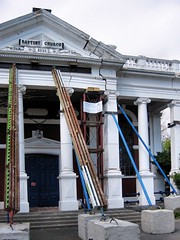


Damage to the Librarian's house
Images, eqnz.chch.2010
The original City Librarian's house at Canterbury Public Library. File reference: CCL-2011-08-12-CanterburyPublic Library pre-demolition-002 From the collection of Christchurch City Libraries.
011
Images, eqnz.chch.2010
Shipping containers against the cliff on the road to Sumner, Christchurch. File reference: CCL-2012-05-12-Around-Sumner-May-2012 DSC_011.JPG From the collection of Christchurch City Libraries.
At the top of the cliff, Sumner
Images, eqnz.chch.2010
Damaged house on the cliff on the road to Sumner, Christchurch. File reference: CCL-2012-05-12-Around-Sumner-May-2012 DSC_019.JPG From the collection of Christchurch City Libraries.
sand volcano in our front lawn
Images, eqnz.chch.2010
The earthquake knocked over the bird bath.
sand volcano
Images, eqnz.chch.2010
Debra points at the beginnings of a sand volcano not long after the big earthquake.
Observatory Tower Photograph 01
Images, UC QuakeStudies
A photograph of the Observatory tower at the Christchurch Arts Centre, taken before the 2010 and 2011 Canterbury earthquakes.
Decision-Making for Resilient Solutions Associated with Heritage, Earthqua…
Research papers, University of Canterbury Library
he 2016 Building (Earthquake Prone Building) Amendment Act aims to improve the system for managing earthquake-prone buildings. The proposed changes to the Act were precipitated by the Canterbury earthquakes, and the need to improve the seismic safety of New Zealand’s building stock. However, the Act has significant ramifications for territorial authorities, organisations and individuals in small New Zealand towns, since assessing and repairing heritage buildings poses a major cost to districts with low populations and poor rental returns on commercial buildings.
Di Madgin's Red Zone photograph 9
Images, UC QuakeStudies
A scanned copy of a photograph of the garden of Di Madgin's former home in the Red Zone, taken before the earthquakes. The Avon River is in the background.
Women's place-making through craft in in post earthquake Canterbury
Research papers, University of Canterbury Library
INTRODUCTION: There is little research on the role of creative arts and craft in disaster recovery. This article reports findings about the emergent role of crafting from research conducted after the 2010–2011 series of earthquakes in Christchurch and surrounding districts in Aotearoa New Zealand. In particular, the article focuses on the significance and differing interpretations of the notion of place expressed by participants through their craftwork, in this case led by women and mediated by the post-earthquake geographic and temporal context. METHOD: This qualitative research included nine individual interviews and five focus group interviews with crafters from Christchurch and surrounding districts. There were 35 participants in total, 33 were women. Applied thematic analysis was used to code the data and identify themes. These themes included connection to place, the symbolism of craft, the healing experience of craft groups and places for women. The notion of place was evident across all three themes. FINDINGS: The findings from the research demonstrate differing ways in which the significance of place was reflected in the craftwork. Participants interpreted the concept of place in descriptive, symbolic, and therapeutic ways. IMPLICATIONS: More understanding about the way creative endeavours like crafting can be used to help ameliorate the impact of natural disasters is needed. Social work practitioners are encouraged to explore place-based wellbeing during their work with service users and to include aspects of artistry, craft and creativity.
Kirkwood Village University of Canterbury Photograph 6
Images, UC QuakeStudies
A photograph of students outside one of the "pods" of temporary classrooms and offices at Kirkwood Village. The pods were constructed at the University of Canterbury campus following the 22 February 2011 earthquake.
Townsend Telescope Pre-Earthquake Photographs 04
Images, UC QuakeStudies
A photograph of the Townsend Telescope in the Observatory at the Christchurch Arts Centre. Graeme Kershaw, Technician at the University of Canterbury Department of Astronomy and Physics, is standing to the left. This image was used by Kershaw to identify the telescope's parts after the 22 February 2011 earthquake.
Townsend Telescope Pre-Earthquake Photographs 06
Images, UC QuakeStudies
A photograph of the clock drive of the Townsend Telescope. The telescope is in the Observatory at the Christchurch Arts Centre. This image was used by Graeme Kershaw, Technician at the University of Canterbury Department of Physics and Astronomy, to identify the telescope's parts after the 22 February 2011 earthquake.
Townsend Telescope Pre-Earthquake Photographs 07
Images, UC QuakeStudies
A photograph of the middle section of the Townsend Telescope. The telescope is in the Observatory at the Christchurch Arts Centre. This image was used by Graeme Kershaw, Technician at the University of Canterbury Department of Physics and Astronomy, to identify the telescope's parts after the 22 February 2011 earthquake.
Di Madgin's Red Zone photograph 5
Images, UC QuakeStudies
A scanned copy of a photograph of the garden of Di Madgin's former home in the Red Zone, taken before the earthquakes. The Avon River is in flood in the background.
Tour bus
Images, eqnz.chch.2010
Tour bus on Cambridge Terrace. File reference: CCL-2011-08-12-CanterburyPublic Library pre-demolition-042 From the collection of Christchurch City Libraries.
sand volcano
Images, eqnz.chch.2010
(I righted the bird bath after the initial earthquake. None of the after-shocks were sufficient to knock it over again.)
sand volcano
Images, eqnz.chch.2010
None
sand volcano
Images, eqnz.chch.2010
None
sand volcano
Images, eqnz.chch.2010
None
sand volcano
Images, eqnz.chch.2010
None
sand volcano
Images, eqnz.chch.2010
None
Canterbury Earthquakes Symposium - Social Recovery 101 – Waimakariri Distr…
Articles, UC QuakeStudies
Canterbury Earthquakes Symposium - Social Recovery 101 – Waimakariri District Council's social recovery framework and lessons learnt from the Greater Christchurch earthquakes This panel discussion was presented by Sandra James, Director (Connecting People) The Canterbury Earthquakes Symposium, jointly hosted by the Department of the Prime Minister and Cabinet and the Christchurch City Council, was held on 29-30 November 2018 at the University of Canterbury in Christchurch. The purpose of the event was to share lessons from the Canterbury earthquakes so that New Zealand as a whole can be better prepared in future for any similar natural disasters. Speakers and presenters included Greater Christchurch Regeneration Minister, Hon Dr Megan Woods, Christchurch Mayor, Lianne Dalziel, Ngāi Tahu chief executive, Arihia Bennett, head of the public inquiry into EQC, Dame Sylvia Cartwright, urban planner specialising in disaster recovery and castrophe risk management, Dr Laurie Johnson; Christchurch NZ chief executive and former Press editor, Joanna Norris; academic researcher and designer, Barnaby Bennett; and filmmaker, Gerard Smyth. About 300 local and national participants from the public, private, voluntary sectors and academia attended the Symposium. They represented those involved in the Canterbury recovery effort, and also leaders of organisations that may be impacted by future disasters or involved in recovery efforts. The focus of the Symposium was on ensuring that we learn from the Canterbury experience and that we can apply those learnings.
Paul and Sam Corliss's Street Art Photograph (2009:10:12 02:14:40)
Images, UC QuakeStudies
A photograph of street art at the Addington Saleyards, taken before the Canterbury earthquakes. The artwork is signed by "ZM Clan".
Paul and Sam Corliss's Street Art Photograph (2009:10:12 02:14:17)
Images, UC QuakeStudies
A photograph of street art at the Addington Saleyards, taken before the Canterbury earthquakes. The artwork is signed by "ZM Clan".
Paul and Sam Corliss's Street Art Photograph (2009:10:12 02:09:56)
Images, UC QuakeStudies
A photograph of street art at the Addington Saleyards, taken before the Canterbury earthquakes. The artwork is signed by "ZM Clan".
Paul and Sam Corliss's Street Art Photograph (2009:10:12 01:54:31)
Images, UC QuakeStudies
A photograph of street art at the Addington Saleyards, taken before the Canterbury earthquakes. The photographer attributes the work to Font.
Townsend Telescope Pre-Earthquake Photographs 02
Images, UC QuakeStudies
A photograph of the Townsend Telescope in the Observatory at the Christchurch Arts Centre. In the bottom right-hand corner of the photograph is a pulley for the telescope's clock drive. This is one of the pieces that went missing when the Observatory tower collapsed in the 22 February 2011 earthquake. This image was used by Graeme Kershaw, Technician at the University of Canterbury Department of Physics and Astronomy, to identify the telescope's parts after the 22 February 2011 earthquake.
Townsend Telescope Pre-Earthquake Photographs 09
Images, UC QuakeStudies
A photograph of the middle section of the Townsend Telescope. The telescope is in the Observatory at the Christchurch Arts Centre. A plate on the side reads, "T Cook & Sons, 1864, York & London". This image was used by Graeme Kershaw, Technician at the University of Canterbury Department of Physics and Astronomy, to identify the telescope's parts after the 22 February 2011 earthquake.
Townsend Telescope Pre-Earthquake Photographs 01
Images, UC QuakeStudies
A photograph of Wayne Smith and Ken Vickery inside the Observatory at the Christchurch Arts Centre, taken in the 1970s. Smith and Vickery are pictured next to the Townsend Telescope, which they have just refurbished. No repair work was necessary during this process.
Townsend Telescope Pre-Earthquake Photographs 08
Images, UC QuakeStudies
A photograph of the middle section of the Townsend Telescope. The telescope is in the Observatory at the Christchurch Arts Centre. A plate on the side reads, "T Cook & Sons, 1864, York & London". This image was used by Graeme Kershaw, Technician at the University of Canterbury Department of Physics and Astronomy, to identify the telescope's parts after the 22 February 2011 earthquake.