
Search
found 6322 results
Images for CANTERBURY EARTHQUAKE; more images...

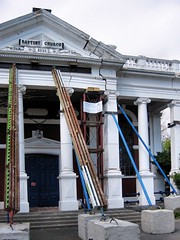
Damage to the Canterbury Public Library building
Images, eqnz.chch.2010
File reference: CCL-2011-08-12-CanterburyPublic Library pre-demolition-015 From the collection of Christchurch City Libraries.
Damage to the Canterbury Public Library building
Images, eqnz.chch.2010
File reference: CCL-2011-08-12-CanterburyPublic Library pre-demolition-009 From the collection of Christchurch City Libraries.
Damage to the Canterbury Public Library building
Images, eqnz.chch.2010
File reference: CCL-2011-08-12-CanterburyPublic Library pre-demolition-010 From the collection of Christchurch City Libraries.
Damage to the Canterbury Public Library building
Images, eqnz.chch.2010
File reference: CCL-2011-08-12-CanterburyPublic Library pre-demolition-018 From the collection of Christchurch City Libraries.
Damage to the Canterbury Public Library building
Images, eqnz.chch.2010
File reference: CCL-2011-08-12-CanterburyPublic Library pre-demolition-017 From the collection of Christchurch City Libraries.
Damage to the Canterbury Public Library building
Images, eqnz.chch.2010
File reference: CCL-2011-08-12-CanterburyPublic Library pre-demolition-008 From the collection of Christchurch City Libraries.
Damage to the Canterbury Public Library building
Images, eqnz.chch.2010
File reference: CCL-2011-08-12-CanterburyPublic Library pre-demolition-023 From the collection of Christchurch City Libraries.
Damage to the Canterbury Public Library building
Images, eqnz.chch.2010
File reference: CCL-2011-08-12-CanterburyPublic Library pre-demolition-013 From the collection of Christchurch City Libraries.
Damage to the Canterbury Public Library building
Images, eqnz.chch.2010
File reference: CCL-2011-08-12-CanterburyPublic Library pre-demolition-019 From the collection of Christchurch City Libraries.
Damage to the Canterbury Public Library building
Images, eqnz.chch.2010
File reference: CCL-2011-08-12-CanterburyPublic Library pre-demolition-011 From the collection of Christchurch City Libraries.
Damage to the Canterbury Public Library building
Images, eqnz.chch.2010
File reference: CCL-2011-08-12-CanterburyPublic Library pre-demolition-007 From the collection of Christchurch City Libraries.
Damage to the Canterbury Public Library building
Images, eqnz.chch.2010
File reference: CCL-2011-08-12-CanterburyPublic Library pre-demolition-021 From the collection of Christchurch City Libraries.
Damage to the Canterbury Public Library building
Images, eqnz.chch.2010
File reference: CCL-2011-08-12-CanterburyPublic Library pre-demolition-025 From the collection of Christchurch City Libraries.
Damage to the Canterbury Public Library building
Images, eqnz.chch.2010
File reference: CCL-2011-08-12-CanterburyPublic Library pre-demolition-012 From the collection of Christchurch City Libraries.
EXAMPLES OF RECOGNITION OF VULNERABILITY IN NATURAL DISASTER CONTEXTS (ESP…
Research papers, University of Canterbury Library
These research papers explore the concept of vulnerability in international human rights law. In the wake of the Christchurch earthquakes of 2010-2011, this research focuses on how "vulnerability" has been used and developed within the wider human rights discourse. They also examine jurisprudence of international human rights bodies, and how the concept of "vulnerability" has been applied. The research also includes a brief investigation into the experiences of vulnerable populations in disaster contexts, focusing primarily on the experiences of "vulnerable persons" in the Christchurch earthquakes and their aftermath.
Accounting for building torsional behaviour during strong earthquake shaki…
Research papers, University of Canterbury Library
In major seismic events, a number of plan-asymmetric buildings which experienced element failure or structural collapse had twisted significantly about their vertical axis during the earthquake shaking. This twist, known as “building torsion”, results in greater demands on one side of a structure than on the other side. The Canterbury Earthquakes Royal Commission’s reports describe the response of a number of buildings in the February 2011 Christchurch earthquakes. As a result of the catastrophic collapse of one multi-storey building with significant torsional irregularity, and significant torsional effects also in other buildings, the Royal Commission recommended that further studies be undertaken to develop improved simple and effective guides to consider torsional effects in buildings which respond inelastically during earthquake shaking. Separately from this, as building owners, the government, and other stakeholders, are planning for possible earthquake scenarios, they need good estimates of the likely performance of both new and existing buildings. These estimates, often made using performance based earthquake engineering considerations and loss estimation techniques, inform decision making. Since all buildings may experience torsion to some extent, and torsional effects can influence demands on building structural and non-structural elements, it is crucial that demand estimates consider torsion. Building seismic response considering torsion can be evaluated with nonlinear time history analysis. However, such analysis involves significant computational effort, expertise and cost. Therefore, from an engineers’ point of view, simpler analysis methods, with reasonable accuracy, are beneficial. The consideration of torsion in simple analysis methods has been investigated by many researchers. However, many studies are theoretical without direct relevance to structural design/assessment. Some existing methods also have limited applicability, or they are difficult to use in routine design office practice. In addition, there has been no consensus about which method is best. As a result, there is a notable lack of recommendations in current building design codes for torsion of buildings that respond inelastically. There is a need for building torsion to be considered in yielding structures, and for simple guidance to be developed and adopted into building design standards. This study aims to undertaken to address this need for plan-asymmetric structures which are regular over their height. Time history analyses are first conducted to quantify the effects of building plan irregularity, that lead to torsional response, on the seismic response of building structures. Effects of some key structural and ground motion characteristics (e.g. hysteretic model, ground motion duration, etc.) are considered. Mass eccentricity is found to result in rather smaller torsional response compared to stiffness/strength eccentricity. Mass rotational inertia generally decreases the torsional response; however, the trend is not clearly defined for torsionally restrained systems (i.e. large λty). Systems with EPP and bilinear models have close displacements and systems with Takeda, SINA, and flag-shaped models yield almost the same displacements. Damping has no specific effect on the torsional response for the single-storey systems with the unidirectional eccentricity and excitation. Displacements of the single-storey systems subject to long duration ground motion records are smaller than those for short duration records. A method to consider torsional response of ductile building structures under earthquake shaking is then developed based on structural dynamics for a wide range of structural systems and configurations, including those with low and high torsional restraint. The method is then simplified for use in engineering practice. A novel method is also proposed to simply account for the effects of strength eccentricity on response of highly inelastic systems. A comparison of the accuracy of some existing methods (including code-base equivalent static method and model response spectrum analysis method), and the proposed method, is conducted for single-storey structures. It is shown that the proposed method generally provides better accuracy over a wide range of parameters. In general, the equivalent static method is not adequate in capturing the torsional effects and the elastic modal response spectrum analysis method is generally adequate for some common parameters. Record-to-record variation in maximum displacement demand on the structures with different degrees of torsional response is considered in a simple way. Bidirectional torsional response is then considered. Bidirectional eccentricity and excitation has varying effects on the torsional response; however, it generally increases the weak and strong edges displacements. The proposed method is then generalized to consider the bidirectional torsion due to bidirectional stiffness/strength eccentricity and bidirectional seismic excitation. The method is shown to predict displacements conservatively; however, the conservatism decreases slightly for cases with bidirectional excitation compared to those subject to unidirectional excitation. In is shown that the roof displacement of multi-storey structures with torsional response can be predicted by considering the first mode of vibration. The method is then further generalized to estimate torsional effects on multi-storey structure displacement demands. The proposed procedure is tested multi-storey structures and shown to predict the displacements with a good accuracy and conservatively. For buildings which twist in plan during earthquake shaking, the effect of P-Δλ action is evaluated and recommendations for design are made. P-Δλ has more significant effects on systems with small post- yield stiffness. Therefore, system stability coefficient is shown not to be the best indicator of the importance of P-Δλ and it is recommended to use post-yield stiffness of system computed with allowance for P-Δλ effects. For systems with torsional response, the global system stability coefficient and post- yield stiffness ration do not reflect the significance of P-Δλ effects properly. Therefore, for torsional systems individual seismic force resisting systems should be considered. Accuracy of MRSA is investigated and it is found that the MRSA is not always conservative for estimating the centre of mass and strong edge displacements as well as displacements of ductile systems with strength eccentricity larger than stiffness eccentricity. Some modifications are proposed to get the MRSA yields a conservative estimation of displacement demands for all cases.
Nisbet, Alistair, 1958- :Why not have a mobile CBD?. 10 January 2012
Images, Alexander Turnbull Library
The cartoon shows a mobile CBD (central business district) which is mounted on tractor tracks and will be great for dodging aftershocks. Refers to problems and questions about the rebuilding of the Christchurch CBD after the earthquakes and while aftershocks continue. Quantity: 1 digital cartoon(s).
Toy: Tractor
Images, Canterbury Museum
Plastic red and black toy tractor branded as the Case IH Quadtrac 535. Tractor is articulated and runs on four track assemblies.
Tribute: Floral
Images, Canterbury Museum
A pink and a purple artificial fabric flowers with plastic stems and fabric leaves tied together with pink metallic string.
Tribute: Floral
Images, Canterbury Museum
A pink and a purple artificial fabric rose with plastic stems and fabric leaves tied together with pink metallic string.
Tribute: Artificial flower
Images, Canterbury Museum
White fabric artificial rose flower head, without stem.Has a ring of plastic stamens between layers of petals. Plastic sepals.
Basket: White painted
Images, Canterbury Museum
A rectangular white painted woven basket with handles at either short end and two pieces of wood screwed to the bottom.
Balancing recovery governance with disasters in close proximity : the Kaik…
Research papers, University of Canterbury Library
On November 14 2016 a magnitude 7.8 earthquake struck the south island of New Zealand. The earthquake lasted for just two minutes with severe seismic shaking and damage in the Hurunui and Kaikōura districts. Although these are predominantly rural areas, with scattered small towns and mountainous topography, they also contain road and rail routes that are essential parts of the national transport infrastructure. This earthquake and the subsequent recovery are of particular significance as they represent a disaster following in close proximity to another similar disaster, with the Canterbury earthquakes occurring in a neighboring district five years earlier. The research used an inductive qualitative case study to explore the nature of the Kaikōura recovery. That recovery process involved a complex interplay between the three parties; (a) the existing local government in the district, (b) central government agencies funding the recovery of the local residents and the national transport infrastructure, and (c) recovery leaders arriving with recent expertise from the earlier Canterbury disaster. It was evident that three groups: locals, government, and experts represented a multi-party governance debate in which the control of the Kaikōura earthquake recovery was shared amongst them. Each party had their own expertise, adgenda and networks that they brought to the Kaikōura recovery, but this created tensions between external expertise and local, community leadership. Recent earthquake research suggests that New Zealand is currently in the midst of an earthquake cluster, with further seismic disasters likely to occur in relatively close succession. This is likely to be compounded by the increasing frequency of other natural disasters with the effects of climate change. The present study investigates a phenomenon that may become increasingly common, with the transfer of disaster expertise from one event to another, and the interface between those experts with local and national government in directing recoveries. The findings of this study have implications for practitioners and policy makers in NZ and other countries where disasters are experienced in close spatial and temporal proximity.
Paul Millar - CEISMIC Thinking
Audio, Radio New Zealand
Paul Millar, associate professor at Canterbury University, is concerned that future generations won't have access to the full picture of the Canterbury earthquakes, so he got the CEISMIC Project under way. The project is an archive of earthquake-related digital material and includes resources from the National Library, the Ministry for Culture and Heritage, the Canterbury Earthquake Recovery Authority, Christchurch City Libraries, Te Papa, NZ On Screen, the Canterbury Museum and the Ngai Tahu Research Centre. Paul says the aim is to document the impact of the disaster and the process of recovery, and make all that material available for free.
Commission witnesses questioned about Cashel Street building
Audio, Radio New Zealand
Witnesses before the Canterbury Earthquakes Royal Commission have been questioned about why a building known to be earthquake prone was allowed to reopen, despite several red flags.
Christchurch Earthquake 22/02/11
Images, eqnz.chch.2010
Manchester Street looking north-ish, towards the intersection with Armagh Street.
Earthquakes expose hidden artefacts in central Christchurch
Audio, Radio New Zealand
When the Canterbury earthquakes brought about the destruction of almost all of the buildings in central Christchurch, it created a unique opportunity for an insight into the past.
Webb, Murray, 1947- :[Roger Sutton]. 2 June 2011
Images, Alexander Turnbull Library
Caricature of Roger Sutton, the State Services Commissioner, who has been appointed chief executive of the Canterbury Earthquake Recovery Authority (CERA). Quantity: 1 digital cartoon(s).
King Kapisi & Che Fu
Images, eqnz.chch.2010
Band Together - Concert for Canterbury www.bandtogetherforcanterbury.co.nz 23rd October 2010 Free concrete in Hagley Park following the 4th September 2010 earthquake
Consistency of Seismicity and Ground Motion Modelling with the Canterbury …
Research papers, University of Canterbury Library
This paper examines the consistency of seismicity and ground motion models, used for seismic hazard analysis in New Zealand, with the observations in the Canterbury earthquakes. An overview is first given of seismicity and ground motion modelling as inputs of probabilistic seismic hazard analysis, whose results form the basis for elastic response spectra in NZS1170.5:2004. The magnitude of earthquakes in the Canterbury earthquake sequence are adequately allowed for in the current NZ seismicity model, however the consideration of ‘background’ earthquakes as point sources at a minimum depth of 10km results in up to a 60% underestimation of the ground motions that such events produce. The ground motion model used in conventional NZ seismic hazard analysis is shown to provide biased predictions of response spectra (over-prediction near T=0.2s , and under-predictions at moderate-to-large vibration periods). Improved ground motion prediction can be achieved using more recent NZ-specific models.