
Search
found 4819 results
Images for earthquake damage; more images...


Photo of earthquake damage in Christchurch taken by James Thompson, 6 Sept…
Images, UC QuakeStudies
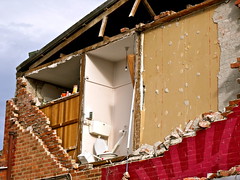
Photo of earthquake damage in Christchurch taken by James Thompson, 6 September 2010.
Photo of earthquake damage in Christchurch taken by Paul Gofton, 6 Septemb…
Images, UC QuakeStudies
Photo of earthquake damage in Christchurch taken by Paul Gofton, 6 September 2010.
Northern Motorway after earthquake
Images, eqnz.chch.2010
Damage from the Christchurch 7.1 earthquake on 4th Sept 2010
Performance of ceilings in the February 2011 Christchurch earthquake
Research papers, University of Canterbury Library
This paper describes the performance of (or damage to) ceilings in buildings during the 22nd February 2011 Christchurch earthquake and the subsequent aftershocks. In buildings that suffered severe structural damage, ceilings and other non-structural components (rather expectedly) failed, but even in buildings with little damage to their structural systems, ceilings were found to be severely damaged. The extent of ceiling damage, where the ceilings were subject to severe shaking, depended on the type of the ceiling system, the size and weight of the ceilings and the interaction of ceilings with other elements. The varieties and extent of observed ceiling damage are discussed in this paper with the help of photographs taken after the earthquake.
Alpine Fault quake would severely damage Canterbury
Audio, Radio New Zealand
New research says Canterbury would suffer severe damage in an Alpine Fault earthquake.
Performance of masonry buildings during the 2010 Darfield (New Zealand) ea…
Research papers, The University of Auckland Library
The M7.1 Darfield earthquake shook the town of Christchurch (New Zealand) in the early morning on Saturday 4th September 2010 and caused damage to a number of heritage unreinforced masonry buildings. No fatalities were reported directly linked to the earthquake, but the damage to important heritage buildings was the most extensive to have occurred since the 1931 Hawke‟s Bay earthquake. In general, the nature of damage was consistent with observations previously made on the seismic performance of unreinforced masonry buildings in large earthquakes, with aspects such as toppled chimneys and parapets, failure of gables and poorly secured face-loaded walls, and in-plane damage to masonry frames all being extensively documented. This report on the performance of the unreinforced masonry buildings in the 2010 Darfield earthquake provides details on typical building characteristics, a review of damage statistics obtained by interrogating the building assessment database that was compiled in association with post-earthquake building inspections, and a review of the characteristic failure modes that were observed
Christchurch Press Image: Richard Cosgrove, 2011:02:22 12:44:41
Images, UC QuakeStudies
Photograph captioned by Fairfax, "Earthquake damage in central Christchurch after a 6.3 earthquake. Peter Beck, Dean of Christchurch Cathedral, beside the damaged Cathedral".
Transcript of Participant number EG138's earthquake story
Articles, UC QuakeStudies
A pdf transcript of Participant number EG138's earthquake story, captured by the UC QuakeBox project.
Ruth Gardner's Blog 22/03/2012: Lamenting the Loss
Articles, UC QuakeStudies
An entry from Ruth Gardner's blog for 22 March 2012 entitled, "Lamenting the Loss".
Lyttelton Harbour Review 15 April 2013
Articles, UC QuakeStudies
The "Lyttelton Harbour Review" newsletter for 15 April 2013, produced by the Lyttelton Harbour Information Centre.
Lyttelton Harbour Review 18 March 2013
Articles, UC QuakeStudies
The "Lyttelton Harbour Review" newsletter for 18 March 2013, produced by the Lyttelton Harbour Information Centre.
Lyttelton Review 26 November 2012
Articles, UC QuakeStudies
The "Lyttelton Review" newsletter for 26 November 2012, produced by the Lyttelton Harbour Information Centre.
Lyttelton Harbour Review 8 April 2013
Articles, UC QuakeStudies
The "Lyttelton Harbour Review" newsletter for 8 April 2013, produced by the Lyttelton Harbour Information Centre.
Quake Damage
Images, eqnz.chch.2010
When I lived in Christchurch back in 2004-2005, this was a building I went past on the bus every day to get to and from work in the city. After the big quake on 04/09/10 (7.1 magnitude), its been seriously damaged. As have many more of the shops in this area. Thankfully no lives were lost in the quake, and I'm glad I wasnt there to feel it eith...
Christchurch Press Image: Richard Cosgrove 2010:09:07 14:14:05
Images, UC QuakeStudies
Photograph captioned by Fairfax, "Earthquake damage following the September 4th earthquake".
Photo of earthquake damage in Christchurch taken by Paul Gofton, 6 Septemb…
Images, UC QuakeStudies
Photo of earthquake damage in Christchurch taken by Paul Gofton, 6 September 2010.
Photo of earthquake damage in Christchurch taken by Paul Gofton, 6 Septemb…
Images, UC QuakeStudies
Photo of earthquake damage in Christchurch taken by Paul Gofton, 6 September 2010.
Photo of earthquake damage in Christchurch taken by James Thompson, 6 Sept…
Images, UC QuakeStudies
Photo of earthquake damage in Christchurch taken by James Thompson, 6 September 2010.
Photo of earthquake damage in Christchurch taken by Paul Gofton, 6 Septemb…
Images, UC QuakeStudies
Photo of earthquake damage in Christchurch taken by Paul Gofton, 6 September 2010.
Photo of earthquake damage in Christchurch taken by Paul Gofton, 6 Septemb…
Images, UC QuakeStudies
Photo of earthquake damage in Christchurch taken by Paul Gofton, 6 September 2010.
Photo of earthquake damage in Christchurch taken by Paul Gofton, 6 Septemb…
Images, UC QuakeStudies
Photo of earthquake damage in Christchurch taken by Paul Gofton, 6 September 2010.
Photo of earthquake damage in Christchurch taken by Paul Gofton, 6 Septemb…
Images, UC QuakeStudies
Photo of earthquake damage in Christchurch taken by Paul Gofton, 6 September 2010.
Photo of earthquake damage in Christchurch taken by Paul Gofton, 6 Septemb…
Images, UC QuakeStudies
Photo of earthquake damage in Christchurch taken by Paul Gofton, 6 September 2010.
Ruth Gardner's Blog 08/09/2010: Earthquake Day Five
Articles, UC QuakeStudies
An entry from Ruth Gardner's blog for 8 September 2010 entitled, "Earthquake Day Five".
Photo of earthquake damage in Christchurch taken by Paul Gofton, 6 Septemb…
Images, UC QuakeStudies
Photo of earthquake damage in Christchurch taken by Paul Gofton, 6 September 2010.
Photo of earthquake damage in Christchurch taken by Paul Gofton, 6 Septemb…
Images, UC QuakeStudies
Photo of earthquake damage in Christchurch taken by Paul Gofton, 6 September 2010.
Photo of earthquake damage in Christchurch taken by James Thompson, 6 Sept…
Images, UC QuakeStudies
Photo of earthquake damage in Christchurch taken by James Thompson, 6 September 2010.
Photo of earthquake damage in Christchurch taken by James Thompson, 6 Sept…
Images, UC QuakeStudies
Photo of earthquake damage in Christchurch taken by James Thompson, 6 September 2010.
Photo of earthquake damage in Christchurch taken by James Thompson, 6 Sept…
Images, UC QuakeStudies
Photo of earthquake damage in Christchurch taken by James Thompson, 6 September 2010.
Photo of earthquake damage in Christchurch taken by James Thompson, 6 Sept…
Images, UC QuakeStudies
Photo of earthquake damage in Christchurch taken by James Thompson, 6 September 2010.