
Search
found 319 results
Images for Earthquake aftershocks; more images...
Fairfax Video, August 2011 (2)
Videos, UC QuakeStudies
A video about engineers recovering the internal copper dome of the Cathedral of the Blessed Sacrament by lifting it out in one piece. The dome was undamaged after the 22 February 2011 earthquakes, but lost most of its supporting columns. Engineers have decided to remove the dome to ensure it will not be damaged during further aftershocks.
Christchurch Press Image: Carys Monteath 2010:09:08 09:38:30
Images, UC QuakeStudies
Photograph captioned by Fairfax, "Christchurch Earthquake. Christchurch was rocked by a large aftershock shortly after 8am this morning. Social Development Minister Paula Bennett has donated money to the thousand of students who have filled the suburbs lending a hand to residents to clean up their properties. Bennett gets a lift with volunteer Bernie Shaperio in his Jeep".
Mark Lincoln Photograph 021
Images, UC QuakeStudies
A police officer talks to the driver of a NZ Post truck at a cordon across Tuam Street. Military personnel stand nearby. The photographer comments, "this was taken shortly after the 4th September earthquake. Police allowed us free access past the cordon and simply advised us to watch out for falling masonry. The access situation was much different after the February aftershock".
Six years after quake, stress remains part of daily life
Audio, Radio New Zealand
Six years on from the Christchurch earthquakes, one in five residents of the city say the disaster is still taking its toll. The latest wellbeing survey by the Canterbury DHB found people living in north-east and east Christchurch were the most likely to be suffering from issues such as anxiety, from ongoing aftershocks, being in a damaged environment, and surrounded by construction.
Hubbard, James, 1949- :"The aftershock.. The shake-up. The waiting and anx…
Images, Alexander Turnbull Library
The cartoon shows the leader of the new Mana Party, Hone Harawira, in four frames that illustrate 'The aftershock', 'the shake-up', 'the waiting & anxiety!...' and in the last frame 'the liquefaction...' as he sinks up to his chest in 'Poll Street'. Context - In fact Hone Harawira won the Te Tai Tokerau by-election with a majority of 1,117 votes, followed fairly closely by Kelvin Davis (Labour). The Labour and Mana candidates seemed to be neck and neck just before the election on 26 June 2011. The cartoon uses earthquake imagery to illustrate the emotional roller-coaster for Hone Harawira. Quantity: 1 digital cartoon(s).
Christchurch Press Image: Carys Monteath 2010:09:08 09:38:17
Images, UC QuakeStudies
Photograph captioned by Fairfax, "Christchurch Earthquake. Christchurch was rocked by a large aftershock shortly before 8am this morning. Social Development Minister Paula Bennett has donated money to the thousand of students who have filled the suburbs lending a hand to residents to clean up their properties. Bennett gets a lift with volunteer Bernie Shapiro in his Jeep, on Broomfield Terrace, Burwood".
Evans, Malcolm Paul, 1945- :'A tent, ground sheet, sleeping bags, a gas co…
Images, Alexander Turnbull Library
A boy writes a list of items that seem to be for a camping holiday but it turns out that he lives in Christchurch and these items; a tent, a groundsheet, sleeping bags, a gas cooker and lamp and a chemical toilet are what may be needed because of earthquakes. Context: quakes and aftershocks continue unabated over Christmas and into the new year. Colour and black and white versions available Quantity: 2 digital cartoon(s).
Nisbet, Alistair, 1958-: "Don't be upset dear... we'll get the World Cup s…
Images, Alexander Turnbull Library
A man reading a newspaper wails and sobs when he discovers that Christchurch will not be hosting any Rugby World Cup games. The newspaper is covered with real disaster news like the Japanese earthquake and potential nuclear disaster, economy problems , and 'aftershock anxiety'. Context - The Christchurch earthquakes of 4 September 2010 and 22 February 2011 that have led to the decision that because of the amount of damage to the venue plus infrastructures and accommodation for visitors the Rugby World Cup will not be played in Christchurch. Quantity: 1 digital cartoon(s).
Christchurch Press Image: Carys Monteath 2010:09:08 09:53:54
Images, UC QuakeStudies
Photograph captioned by Fairfax, "Christchurch Earthquake. Christchurch was rocked by a large aftershock shortly after 8am this morning. Social Development Minister Paula Bennett has donated money to the thousand of students who have filled the suburbs lending a hand to residents to clean up their properties. Bennett chats to volunteers (L-R) Lauren Baker, Kirsten Glasson, Shannon Ronald, Laura Jackson and Sophie Cornish".
Christchurch Press Image: Carys Monteath 2010:09:08 09:53:55
Images, UC QuakeStudies
Photograph captioned by Fairfax, "Christchurch Earthquake. Christchurch was rocked by a large aftershock shortly after 8am this morning. Social Development Minister Paula Bennett has donated money to the thousand of students who have filled the suburbs lending a hand to residents to clean up their properties. Bennett chats to volunteers (L-R) Lauren Baker, Kirsten Glasson, Shannon Ronald, Laura Jackson and Sophie Cornish".
Christchurch Press Image: Carys Monteath 2010:09:08 09:53:40
Images, UC QuakeStudies
Photograph captioned by Fairfax, "Christchurch Earthquake. Christchurch was rocked by a large aftershock shortly before 8am this morning. Social Development Minister Paula Bennett has donated money to the thousand of students who have filled the suburbs lending a hand to residents to clean up their properties. Bennett chats to volunteers (L-R) Ashley Cornish, Laura Jackson, Shannon Ronald, Kirsten Glasson and Lauren Baker".
Mark Lincoln Photograph 025
Images, UC QuakeStudies
People walk along Tuam Street carrying bags and boxes. Brick dust covers the street where fallen bricks have been cleared, and on the left emergency tapes cordons off Manchester Street. The photographer comments, "This was taken shortly after the 4th September earthquake. Police allowed us free access past the cordon and simply advised us to watch out for falling masonry. The access situation was much different after the February aftershock".
Spectrum for 4 September 2011
Audio, Radio New Zealand
A year after the first earthquake on 4 September 2010, aftershocks continue to be felt in Canterbury, and they're not always seismic ones. When buildings collapse or are cordoned off, or even just closed for repairs - what happens to the lives and livelihoods of those who used to fill them with noise and energy? Kris Vavasour returns to Lyttelton to catch up with performers and friends, to hear about life in an altered landscape.
Unexpected faults: Managing entomology collections through the 2010/11 Can…
Research papers, Lincoln University
On 4 September 2010, a 7.1 magnitude earthquake struck near Darfield, 40 kilometres west of Christchurch, New Zealand. The quake caused significant damage to land and buildings nearby, with damage extending to Christchurch city. On 22 February 2011, a 6.3 magnitude earthquake struck Christchurch, causing extensive and significant damage across the city and with the loss of 185 lives. Years on from these events, occasional large aftershocks continue to shake the region. Two main entomological collections were situated within close proximity to the 2010/11 Canterbury earthquakes. The Lincoln University Entomology Research Collection, which is housed on the 5th floor of a 7 storey building, was 27.5 km from the 2010 Darfield earthquake epicentre. The Canterbury Museum Entomology Collection, which is housed in the basement of a multi-storeyed heritage building, was 10 km from the 2011 Christchurch earthquake epicentre. We discuss the impacts of the earthquakes on these collections, the causes of the damage to the specimens and facilities, and subsequent efforts that were made to prevent further damage in the event of future seismic events. We also discuss the wider need for preparedness against the risks posed by natural disasters and other catastrophic events.
Nisbet, Alistair, 1958-: [Debate about the fate of heritage buildings afte…
Images, Alexander Turnbull Library
Text at top left reads 'Don't forget rubbish day' The cartoon is a large wheelie bin stacked high with debris from 'old dunger buildings'. Someone in a damaged house nearby says 'Good riddance!' Context - Two earthquakes and hundreds of aftershocks have hit Christchurch, the first on 4 September 2010 and a second more devastating one on 22 February 2011. Earthquake Recovery Minister Gerry Brownlee may or may not have actually used the words 'old dungers' to describe some of Christchurch's heritage buildings that are not worth keeping but he might as well have done because many people believe that this is the way he thinks. Debate about which heritage buildings should be kept and which demolished has begun along with debate about how the city should be rebuilt. Quantity: 1 digital cartoon(s).
Tremain, Garrick 1941- :"You have reached the quake helpline..." 19 June 2…
Images, Alexander Turnbull Library
A man wearing shorts and gumboots stands surrounded by liquefaction beside his collapsing house. He tries to phone the 'Quake helpline' for assistance and gets the response 'You have reached the quake helpline... If you're up to your knees in liquefaction... Press 1. If your house is down around your ears... Press 2. If you're looking for assistance or answers press on'. Context - The increasing frustration and misery of many Christchurch residents who are experiencing huge difficulty getting assistance after months of delays and continuing aftershocks following the Christchurch earthquakes of 4th September, 22 February and the two most recent ones on 13 June. Quantity: 1 digital cartoon(s).
Fairfax Video, December 2011 (9)
Videos, UC QuakeStudies
A video about the reactions of animals at the Orana Wildlife Park to the 22 February 2011 earthquake. The video includes an interview with Nieka George, Primate Keeper, about the reaction of the spider monkey Jackie Chan, who had arrived from Wellington Zoo three days prior. It also includes an interview with Aaron Gilmore, Head Keeper of Exotic Mammals, about the reactions of the giraffes. Both species were initially alarmed by the earthquakes, but have got used to them quickly and have barely reacted to the aftershocks in the following weeks.
Analysing cascading hazard impacts and recovery at farm level : Hurunui Di…
Research papers, University of Canterbury Library
Farming and urban regions are impacted by earthquake disasters in different ways, and feature a range of often different recovery requirements. In New Zealand, and elsewhere, most earthquake impact and recovery research is urban focused. This creates a research deficit that can lead to the application of well-researched urban recovery strategies in rural areas to suboptimal effect. To begin to reduce this deficit, in-depth case studies of the earthquake impacts and recovery of three New Zealand farms severely impacted by the 14th November 2016, M7.8 Hurunui-Kaikōura earthquake were conducted. The initial earthquake, its aftershocks and coseismic hazards (e.g., landslides, liquefaction, surface rupture) affected much of North Canterbury, Marlborough and the Wellington area. The three case study farms were chosen to broadly represent the main types of farming and topography in the Hurunui District in North Canterbury. The farms were directly and indirectly impacted by earthquakes and related hazards. On-farm infrastructure (e.g., woolsheds, homesteads) and essential services (e.g., water, power), frequently sourced from distributed networks, were severely impacted. The earthquake occurred after two years of regional drought had already stressed farm systems and farmers to restructuring or breaking point. Cascading interlinked hazards stemming from the earthquakes and coseismic hazards continued to disrupt earthquake recovery over a year after the initial earthquake. Semi-structured interviews with the farmers were conducted nine and fourteen months after the initial earthquake to capture the timeline of on-going impacts and recovery. Analysis of both geological hazard data and interview data resulted in the identification of key factors influencing farm level earthquake impact and recovery. These include pre-existing conditions (e.g., drought); farm-specific variations in recovery timelines; and resilience strategies for farm recovery resources. The earthquake recovery process presented all three farms with opportunities to change their business plans and adapt to mitigate on-going and future risk.
Christchurch Press Image: Carys Monteath 2010:09:08 09:53:41
Images, UC QuakeStudies
Photograph captioned by Fairfax, "Christchurch Earthquake. Christchurch was rocked by a large aftershock shortly after 8am this morning. Social Development Minister Paula Bennett has donated money to the thousand of students who have filled the suburbs lending a hand to residents to clean up their properties. Bennett chats to volunteers (L-R) Sophie Cornish, Ashley Cornish, Laura Jackson, Shannon Ronald, Kirsten Glasson and Lauren Baker".
Where will homeless earthquake victims stay?... "Perfect! And the only pot…
Images, Alexander Turnbull Library
Homeless earthquake victims arrive in Hobbiton with their bags when it seems that New Zealand is going to lose The Hobbit to another country. Refers to the dispute between Warner Brothers, represented by Peter Jackson, and NZ Actors Equity over a union demand for negotiations over the terms and conditions offered in the contracts for actors and others working on the film very nearly caused the film to be made somewhere else. The battle, which was eventually resolved successfully after meetings between PM John Key and Warner Brothers representatives, divided New Zealanders. Refers also to the Canterbury earthquake of 4th September and its aftershocks that have left many houses uninhabitable. Quantity: 1 digital cartoon(s).
A summary of strong ground motions observed in the Canterbury earthquake s…
Research papers, University of Canterbury Library
This paper provides a summary of the ground motions observed in the recent Canterbury, New Zealand earthquake sequence. The sequence occurred in a region of relatively moderate seismicity, 130km to the east of the Alpine Fault, the major plate-boundary in the region. From an engineering perspective, the sequence has been primarily comprised of the initial 04/09/2010 Darfield earthquake (Mw7.1) followed by the 22/02/2011 Christchurch earthquake (Mw6.3), and two aftershocks on 13/06/ 2011 (Mw5.3 and 6.0, respectively). The dense spacing of strong motions in the region, and their close proximity to the respective causative faults, has resulted in strong ground motions far exceeding the previous catalogue of strong motion observed in New Zealand. The observed ground motions have exhibited clear evidence of: (i) near-source directivity; (ii) sedimentary basin focusing, amplification and basin effect refraction; (iii) non-linear site response; (iv) cyclic mobility postliquefaction; and (v) extreme vertical ground motions exceeding 2g, among others.
Earthquake response #1: Enquiry, research, design and community projects, …
Research papers, Lincoln University
The September and February earthquakes were terrifying and devastating. In February, 185 people were killed (this number excludes post earthquake related deaths) and several thousand injured. Damage to infrastructure above and below ground in and around Christchurch was widespread and it will take many years and billions of dollars to rebuild. The ongoing effects of the big quakes and aftershocks are numerous, with the deepest impact being on those who lost family and friends, their livelihoods and homes. What did Cantabrians do during the days, weeks and months of uncertainty and how have we responded? Many grieved, some left, some stayed, some arrived, many shovelled (liquefaction left thousands of tons of silt to be removed from homes and streets), and some used their expertise or knowledge to help in the recovery. This book highlights just some of the projects staff and students from The Faculty of Environment, Society and Design have been involved in from September 2010 to October 2012. The work is ongoing and the plan is to publish another book to document progress and new projects.
Mark Lincoln Photograph 026
Images, UC QuakeStudies
Two men carry backpacks and shopping bags along Tuam Street, stepping over emergency tape that lies across the road. Brick dust covers the street where fallen bricks have been cleared. The photographer comments, "Two members of our office carrying gear through the cordon. This was taken shortly after the 4th September earthquake. Police allowed us free access past the cordon and simply advised us to watch out for falling masonry. The access situation was much different after the February aftershock".
Down and Out
Images, UC QuakeStudies
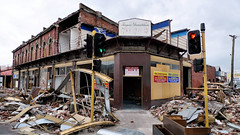
A digitally manipulated photograph of a letterbox lying on the ground in front of a red-stickered house. The photographer comments, "An abandoned red stickered house just outside the four avenues that surround Christchurch CBD. The letterbox came down when the wall it was attached to collapsed. The occupants would have had strict instructions to stay out as the property is too dangerous to enter in case there is another earthquake or big aftershock".
Photograph by Jocelyn Kinghorn 2671
Images, UC QuakeStudies
A information board on the fence around the Homestead at Mona Vale. It says 'This hertiage building is managed by the Christchurch City Council on behalf of the city's residents. Until recently it served as a restaurant and function centre. This building was damaged in the 2010/2011 Canterbury earthquakes and ongoing aftershocks. Propping walls and other support is designed to keep the building weather-proof until a decision about its future can be made'.
Nisbet, Alistair, 1958-: "Easy to access... easy to repair!" 2 April 2011
Images, Alexander Turnbull Library
Text reads 'Solution to Christchurch sewage problems?...' A woman, with a roll of toilet paper in her hand, climbs a ladder to a toilet that is positioned on a sewage pipe high above the ground. There are further toilets at intervals on the pipe. Her husband stands in the garden and observes that it is 'Easy to access and easy to repair'. Context - the Christchurch earthquakes and continuing aftershocks have done huge damage to sewage infrastructures which suggests having the pipes above ground as a solution. Quantity: 1 digital cartoon(s).
Assessing collapse capacity and risk in subsequent ground motions using SH…
Research papers, University of Canterbury Library
Predicting building collapse due to seismic motion is critical in design and more so after a major event. Damaged structures can appear sound, but collapse under following major events. There can thus be significant risk in decision making after a major seismic event concerning the safe occupation of a building or surrounding areas, versus the unknown impact of unknown major aftershocks. Model-based pushover analyses are effective if the structural properties are well understood, which is not valid post-event when this risk information is most useful. This research combines Hysteresis Loop Analysis (HLA) structural health monitoring (SHM) and Incremental Dynamic Analysis (IDA) methods to determine collapse capacity and probability of collapse for a specific structure, at any time, a range of earthquake excitations to ensure robustness. The nonlinear dynamic analysis method presented enables constant updating of building performance predictions using post-event SHM results. The resulting combined methods provide near real-time updating of collapse fragility curves as events progress, quantifying the change of collapse probability or seismic induced losses for decision-making - a novel, higher resolution risk analysis than previously available. The methods are not computationally expensive and there is no requirement for a validated numerical model. Results show significant potential benefits and a clear evolution of risk. They also show clear need for extending SHM toward creating improved predictive models for analysis of subsequent events, where the Christchurch series of 2010-2011 had significant post-event aftershocks after each main event. Finally, the overall method is generalisable to any typical engineering demand parameter.
Urban Disaster Recovery in Christchurch: The Central Business District Cor…
Research papers, University of Canterbury Library
Copyright 2014. Earthquake Engineering Research Institute. This article may be downloaded for personal use only. Any other use requires prior permission of the Earthquake Engineering Research Institute.The Canterbury earthquakes, which involved widespread damage in the February 2011 event and ongoing aftershocks near the Christchurch central business district (CBD), presented decision-makers with many recovery challenges. This paper identifies major government decisions, challenges, and lessons in the early recovery of Christchurch based on 23 key-informant interviews conducted 15 months after the February 2011 earthquake. It then focuses on one of the most important decisions – maintaining the cordon around the heavily damaged CBD – and investigates its impacts. The cordon displaced 50,000 central city jobs, raised questions about (and provided new opportunities for) the long-term viability of downtown, influenced the number and practice of building demolitions, and affected debris management; despite being associated with substantial losses, the cordon was commonly viewed as necessary, and provided some benefits in facilitating recovery. Management of the cordon poses important lessons for planning for catastrophic urban earthquakes around the world.
Experimental Modal Identification of Structures under Earthquake Excitation
Research papers, The University of Auckland Library
Micro - electro - mechanical system (MEMS) based accelerometers are now frequently used in many different parts of our day - to - day lives. It is also increasingly being used for structural testing applications. Researchers have had res ervation of using these devices as they are relatively untested, but now with the wider adoption, it provides a much cheaper and more versatile tool for structural engineering researchers. A number of damaged buildings in the Christchurch Central Business District (CBD) were instrumented with a number of low - cost MEMS accelerometers after the major Christchurch earthquakes. The accelerometers captured extremely high quality building response data as the buildings experienced thousands of aftershocks. This d ata set was amongst one of only a handful of data set s available around the world which provides building response data subjected to real ground motion. Furthermore, due to technological advances, a much larger than usual number of accelerometers has been deployed making the data set one of the most comprehensive available. This data set is utilised to extract modal parameters of the buildings. This paper summarises the operating requirements and preference for using such accelerometers for experimental mod al analysis. The challenges for adapting MEMS based devices for successful modal parameters identification are also discussed
The landscape record of blind fault earthquakes
Research papers, University of Canterbury Library
Active faults capable of generating highly damaging earthquakes may not cause surface rupture (i.e., blind faults) or cause surface ruptures that evade detection due to subsequent burial or erosion by surface processes. Fault populations and earthquake frequency-‐magnitude distributions adhere to power laws, implying that faults too small to cause surface rupture but large enough to cause localized strong ground shaking densely populate continental crust. The rupture of blind, previously undetected faults beneath Christchurch, New Zealand in a suite of earthquakes in 2010 and 2011, including the fatal 22 February 2011 moment magnitude (Mw) 6.2 Christchurch earthquake and other large aftershocks, caused a variety of environmental impacts, including major rockfall, severe liquefaction, and differential surface uplift and subsidence. All of these effects occurred where geologic evidence for penultimate effects of the same nature existed. To what extent could the geologic record have been used to infer the presence of proximal, blind and / or unidentified faults near Christchurch? In this instance, we argue that phenomena induced by high intensity shaking, such as rock fragmentation and rockfall, revealed the presence of proximal active faults in the Christchurch area prior to the recent earthquake sequence. Development of robust earthquake shaking proxy datasets should become a higher scientific priority, particularly in populated regions.