
Search
found 319 results
Images for Earthquake aftershocks; more images...
Photograph by Neil Macbeth 167
Images, UC QuakeStudies
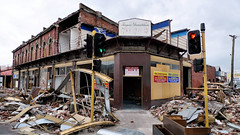
A view looking south down Durham Street during the aftermath of the 22 February 2011 earthquake. On the left are the ruins of the historic stone Provincial Council Legislative Chamber. The building's roof and walls have already collapsed, as has the scaffolding which was erected to repair it after the 4 September 2010 earthquake. An aftershock has caused masonry to dislodge from the building, sending dust into the air.
Photograph by Neil Macbeth 168
Images, UC QuakeStudies
A view looking south down Durham Street during the aftermath of the 22 February 2011 earthquake. On the left are the ruins of the historic stone Provincial Council Legislative Chamber. The building's roof and walls have already collapsed, as has the scaffolding which was erected to repair it after the 4 September 2010 earthquake. An aftershock has caused masonry to dislodge from the building, sending dust into the air.
Nisbet, Alistair, 1958- :"Is it my turn yet?" 7 June 2011
Images, Alexander Turnbull Library
Two huge wrestlers, one representing 'Port Hills fault' and the other 'Greendale fault' struggle together over a broken Christchurch. Another wrestler, representing 'Other faults' appears in the distance yelling 'Is it my turn yet?' Context - Christchurch has now had three major earthquakes and thousands of aftershocks. It now appears likely that the Christchurch quakes resulted from activity on a fault extending directly eastward from the Alpine fault that remained unknown until last year, says Roger Musson, a seismologist at the British Geological Survey in Edinburgh. The new fault first came to light last September (4th) when a stronger but less calamitous quake shook Darfield, 40 kilometres west of Christchurch. Musson says the latest quake (Feb 22, 2011) probably resulted from an eastward continuation of activity on the same fault. "It has probably not moved for tens of thousands of years, so lots of strain built up," says Musson. The third major quake happened on 13th June 2011. (New Scientist - February 22, 2011) Quantity: 1 digital cartoon(s).
Scott, Thomas, 1947-:'Relax, it's not an aftershock. It's the Canterbury E…
Images, Alexander Turnbull Library
Refers to the government's earthquake response legislation and the Rugby World Cup 2011 (Empowering) Bill. 26 experts in constitutional law from all six of the country's law faculties have penned a letter condemning the Government's earthquake response legislation. No sooner was their work in the public eye than the similarly flawed Rugby World Cup 2011 (Empowering) Bill was reported back from a select committee, with a recommendation that it pass. It also goes far beyond what is required to get things done. In bypassing the normal consent process, the bill says the authority does not have to hold hearings on applications and that its decisions can be challenged in the High Court only on points of law. Effectively, the legislation asks New Zealanders to accept that the Rugby World Cup Minister knows best. It is he who knows how the event must be run. Precisely the same attitude pervades the Canterbury Earthquake Response and Recovery Act. This hands individual Government ministers the power to change almost every law, thereby handing Parliament's normal law-making role to the Executive. Their decisions cannot be challenged in any court'. (NZ Herald editorial - 1 October 2010) Quantity: 1 digital cartoon(s).
Nisbet, Alistair, 1958-:The advantages of life in Christchurch during the …
Images, Alexander Turnbull Library
Text across the top of the cartoon reads 'You know you live in Christchurch when...' Six cameos follow reading 'You can stir a cup of coffee without a spoon' - a cup of coffee is shaken; 'after 30 years you finally know your neighbours' - a group of people get to know one another; 'the latest fitness craze is sandba' - a couple shovel a heap of liquefaction to music from their transistor; 'everyone gets to drive a slalom' - someone weaves along a road avoiding cracks and mud in their car; 'there's a craze in "unique garden features"' - a longdrop has been dug in the garden; and lastly 'you have tea under a doorframe' - a couple eats and drinks under a doorframe for safety. Context - the Christchurch earthquake of 22 February 2011. Published in The Press Quantity: 1 digital cartoon(s).
NZ Raw blog post 4 September 2010 'Christchurch Earthquake Photos'
Articles, UC QuakeStudies
A post on the NZ Raw blog written by Mark Lincoln on 4 September 2010. Mark says, "This is the first [blog post] I wrote on 4th Sept. I always remember an announcer on the radio having the first on-air interview with Geonet/EQC (obviously only 1 or 2 staff members at that stage!). The announcer asked if the aftershocks would carry on for much longer and the Geonet guy said they could carry on for a few weeks. Radio announcer seemed shocked".
Webb, Murray, 1947- :[Mayor Bob Parker] 10 March 2011
Images, Alexander Turnbull Library
Caricature of Mayor Bob Parker dissolving into quakes; below the image is the name 'Christchurch' in very quavery letters. A second version shows Bob Parker without the shakes and without the name 'Christchurch'. Context - Opinion seems to be that Mayor Bob Parker has shown excellent leadership during the earthquakes and aftershocks in Christchurch. The earthquakes were on 4 September and 22 February. Two versions of this cartoon are available Quantity: 2 digital cartoon(s).
Nisbet, Alistair, 1958- :'Hopefully it'll be softer and fuzzier than the l…
Images, Alexander Turnbull Library
Shows an egg that represents '2012' with a chick beginning to peck its way out. In the background storms rage. Someone hopes that it will 'be softer and fuzzier than the last one!' Context: Refers to the difficulties and disasters of 2011 in New Zealand. Christchurch earthquakes and aftershocks continue with complicating rebuilding and insurance issues, the wreck of the Rena, and various weather events and political issues. Quantity: 1 digital cartoon(s).
Performance of ceilings in the February 2011 Christchurch earthquake
Research papers, University of Canterbury Library
This paper describes the performance of (or damage to) ceilings in buildings during the 22nd February 2011 Christchurch earthquake and the subsequent aftershocks. In buildings that suffered severe structural damage, ceilings and other non-structural components (rather expectedly) failed, but even in buildings with little damage to their structural systems, ceilings were found to be severely damaged. The extent of ceiling damage, where the ceilings were subject to severe shaking, depended on the type of the ceiling system, the size and weight of the ceilings and the interaction of ceilings with other elements. The varieties and extent of observed ceiling damage are discussed in this paper with the help of photographs taken after the earthquake.
Christchurch Press 17 June 2011: Section A, Page 4 (South Island Edition)
Articles, UC QuakeStudies
Page 4 of Section A of the South Island edition of the Christchurch Press, published on Friday 17 June 2011.
Top Stories for Tuesday 7 September 2010
Audio, Radio New Zealand
Strong aftershocks felt in Canterbury, Quake firms to seek government wage subsidy, More services, access to buildings being restored in Christchurch, Minister for Earthquake Recovery discusses plans, Heavy rain causes flooding and road closures in Lower North Island, Building codes minimised quake's injuries and damage, Glass supply freezes as Christchurch companies clean up.
Earthquake News “Geotechnical Damage due to the 2011 Christchurch, New Zea…
Research papers, University of Canterbury Library
On 22 February 2011,a magnitude Mw 6.3 earthquake occurred with an epicenter located near Lyttelton at about 10km from Christchurch in Canterbury region on the South Island of New Zealand (Figure 1). Since this earthquake occurred in the midst of the aftershock activity which had continued since the 4 September 2010 Darfield Earthquake occurrence, it was considered to be an aftershock of the initial earthquake. Because of the short distance to the city and the shallower depth of the epicenter, this earthquake caused more significant damage to pipelines, traffic facilities, residential houses/properties and multi-story buildings in the central business district than the September 2010 Darfield Earthquake in spite of its smaller earthquake magnitude. Unfortunately, this earthquake resulted in significant number of casualties due to the collapse of multi-story buildings and unreinforced masonry structures in the city center of Christchurch. As of 4 April, 172 casualties were reported and the final death toll is expected to be 181. While it is extremely regrettable that Christchurch suffered a terrible number of victims, civil and geotechnical engineers have this hard-to-find opportunity to learn the response of real ground from two gigantic earthquakes which occurred in less than six months from each other. From geotechnical engineering point of view, it is interesting to discuss the widespread liquefaction in natural sediments, repeated liquefaction within short period and further damage to earth structures which have been damaged in the previous earthquake. Following the earthquake, an intensive geotechnical reconnaissance was conducted to capture evidence and perishable data from this event. The team included the following members: Misko Cubrinovski (University of Canterbury, NZ, Team Leader), Susumu Yasuda (Tokyo Denki University, Japan, JGS Team Leader), Rolando Orense (University of Auckland, NZ), Kohji Tokimatsu (Tokyo Institute of Technology, Japan), Ryosuke Uzuoka (Tokushima University, Japan), Takashi Kiyota (University of Tokyo, Japan), Yasuyo Hosono (Toyohashi University of Technology, Japan) and Suguru Yamada (University of Tokyo, Japan).
Winter, Mark 1958- :Christchurch mess. 24 December 2011
Images, Alexander Turnbull Library
The cartoon shows the word 'Christchurch' with 'church' crossed out and replaced with 'mess'. A second version has the word 'scary' added. A third version has the word 'church' replaced by 'mas'. A fourth version has the words 'early' and 'presence' included and 'church' is replaced by 'mess'. Context: concern about continuing trials and tribulations of Christchurch with unremitting earthquakes and aftershocks. Four versions of this cartoon are available Quantity: 4 digital cartoon(s).
Winter, Mark 1958- :Christchurch - the new tear. 3 January 2012
Images, Alexander Turnbull Library
The cartoon shows the word 'Christchurch' fractured by earthquake. Text above reads 'The new tear(s)'. A second version has the text in the singular 'The new tear'. Context: In spite of Christchurch's great hopes for a new year without earthquakes, there have been numerous quakes and aftershocks. A wordplay on 'new year' and 'new tear' - that is weeping with fear and dismay. Two versions of this cartoon are available Quantity: 2 digital cartoon(s).
22 February 2011, 1:04 pm
Videos, UC QuakeStudies
A video capturing an aftershock from the Canterbury earthquake on 22 February 2011, 1:04pm. After the 6.3 magnitude earthquake at 12:51pm, Ben Post set up his camera on a tripod and left it running. The movement of the water in the fish tank during the quake suggests that the shaking is up and down. The camera also shows this effect; due to the lightweight material of the tripod, the camera is shaken about more than the surroundings.
Mark Lincoln Photograph 022
Images, UC QuakeStudies
A view looking west down Tuam Street across the High Street intersection. Road cones line the street. The photographer comments, "This was taken shortly after the 4th September earthquake. Police allowed us free access past the cordon and simply advised us to watch out for falling masonry. The access situation was much different after the February aftershock".
Seismic Behaviour of the Christchurch Women's Hospital
Research papers, University of Canterbury Library
1-pageThe objective of this project is to collect perishable seismic response data from the baseisolated Christchurch Women's Hospital. The strong and continuing sequence of aftershocks presents a unique opportunity to capture high-fidelity data from a modern base-isolated facility. These measurements will provide quantitative information required to assess the mechanisms at play in this and in many other seismically-isolated structures.
Natalie Kerschner WEMO Photograph 026
Images, UC QuakeStudies
A photograph of the earthquake damage to the a gable of the Cranmer Courts on the corner of Kilmore and Montreal Street. Wooden bracing has been used to hold the rest of the stones together, and neon tape has been wrapped around the other gables to help keep them secure during aftershocks.
Natalie Kerschner WEMO Photograph 028
Images, UC QuakeStudies
A photograph of the earthquake damage to the a gable of the Cranmer Courts on the corner of Kilmore and Montreal Street. Wooden bracing has been used to hold the rest of the stones together, and neon tape has been wrapped around the other gables to help keep them secure during aftershocks.
Implications of the Canterbury earthquake sequence for Adelaide, South Aus…
Research papers, The University of Auckland Library
The city of Christchurch has experienced over 10,000 aftershocks since the 4th of September 2010 earthquake of which approximately 50 have been greater than magnitude 5. The damage caused to URM buildings in Christchurch over this sequence of earthquakes has been well documented. Due to the similarity in age and construction of URM buildings in Adelaide, South Australia and Christchurch (they are sister cities, of similar age and heritage), an investigation was conducted to learn lessons for Adelaide based on the Christchurch experience. To this end, the number of URM buildings in the central business districts of both cities, the extent of seismic strengthening that exists in both cities, and the relative earthquake hazards for both cities were considered. This paper will report on these findings and recommend strategies that the city of Adelaide could consider to significantly reduce the seismic risk posed by URM buildings in future earthquake
Scott, Thomas, 1947- :Liquifaction... Stupifaction... 27 December 2011
Images, Alexander Turnbull Library
The cartoon shows two images of cars nose-down in ditches, the first is caused by 'liquifaction' and the second by 'stupifaction'. Context: there was another large aftershock on Boxing Day in Christchurch which resulted in quite a lot of liquefaction. There is always concern over the Christmas holidays about drinking while driving. Other Titles - Liquefaction Quantity: 1 digital cartoon(s).
Nisbet, Alistair, 1958-: Redzone Girls... 22 March 2011
Images, Alexander Turnbull Library
The cartoon shows three 'Redzone Girls'. The first wears a green tshirt and wears a green 'no restriction' label, the second wears a yellow tshirt and has a yellow 'Limited access' label and the third wears a red tshirt and has a red label that reads 'munted'; she also has a red and white barrier around her. The second and third of the 'girls' are in an increasing state of decrepitude. Behind them is a crumbling brick wall. Context - Christchurch prostitutes aren't letting natural disaster prevent them from plying their trade on the streets despite the dangers of aftershocks in the city. NZPC's Christchurch regional co-ordinator, Anna Reed, said it was a concern sex workers were standing in the shadow of potentially unsafe buildings as the city was shaken by aftershocks, but said the shattered CBD had "left them with no outlet". Christchurch residents are up in arms about the number of prostitutes working in their local neighbourhoods because their usual work areas are out of bounds in the 'red zone'. (Stuff 25 February 2011) Quantity: 1 digital cartoon(s).
Mark Lincoln Photograph 023
Images, UC QuakeStudies
Damaged buildings on Manchester Street, seen from the Tuam Street intersection. Police emergency tape cordons off the street. The photographer comments, "This was taken shortly after the 4th September earthquake. Police allowed us free access past the cordon and simply advised us to watch out for falling masonry. The access situation was much different after the February aftershock".
WEMO ERT Team Set 3 - April 2011 - Photograph 02
Images, UC QuakeStudies
A photograph of the photocopy template for the Christchurch City Council's yellow sticker. The sticker was used by the Civil Defence after the 2010 and 2011 earthquakes to indicate that a building had been inspected and that structural damage or other safety hazards had been found. The sticker states that there should be no entry to the building, 'except on essential business'. It also states that 'earthquake aftershocks present danger' and that people who enter must do so at their own risk.
Christchurch Press Image: Carys Monteath 2010:09:08 12:42:35
Images, UC QuakeStudies
Photograph captioned by Fairfax, "Christchurch Earthquake. Christchurch was rocked by a large aftershock shortly after 8am this morning. Linemen cutting power to a damaged line outside an old historic building on the corner of Montreal Street and Moorhouse Avenue which will have work done to it to try and save as much as they can".
Christchurch Press Image: Carys Monteath 2010:09:08 12:36:32
Images, UC QuakeStudies
Photograph captioned by Fairfax, "Christchurch Earthquake. Christchurch was rocked by a large aftershock shortly before 8am this morning. Linemen cutting power to a damaged line outside an old historic building on the corner of Montreal Street and Moorhouse Avenue which will have work done to it to try and save as much as they can".
Christchurch Press Image: Carys Monteath 2010:09:08 12:36:42
Images, UC QuakeStudies
Photograph captioned by Fairfax, "Christchurch Earthquake. Christchurch was rocked by a large aftershock shortly after 8am this morning. Linemen cutting power to a damaged line outside an old historic building on the corner of Montreal Street and Moorhouse Avenue which will have work done to it to try and save as much as they can".
Christchurch Press Image: Carys Monteath 2010:09:08 12:36:37
Images, UC QuakeStudies
Photograph captioned by Fairfax, "Christchurch Earthquake. Christchurch was rocked by a large aftershock shortly after 8am this morning. Linemen cutting power to a damaged line outside an old historic building on the corner of Montreal Street and Moorhouse Avenue which will have work done to it to try and save as much as they can".
Nisbet, Alistair, 1958- :Emergency kit for national disaster... Emergency …
Images, Alexander Turnbull Library
In the first frame is an 'Emergency kit for national disaster' which is a bin full of disaster supplies like canned food, torch etc. In the second frame there is an 'Emergency kit for economic disaster...' - a bin containing a 'One way ticket to OZ'. Context - The national distaster kit is very relevant after the two earthquakes and numerous aftershocks in Christchurch and increasingly people are moving to Australia in search of jobs and opportunities that seem scarce in New Zealand. Quantity: 1 digital cartoon(s).
Hawkey, Allan Charles, 1941- :Xmas orders. 21 June 2012
Images, Alexander Turnbull Library
Scene set at Santa Claus' 'Online Christmas Orders Dept' at the North Pole. One elf remarks 'ANOTHER Marmite order from New Zealand'. The sole Marmite factory in New Zealand was damaged in the Christchurch Earthquake of 2011. Further aftershocks led to the shutting down of the factory until late 2012. The remaining stocks ran out, leading to panic buying at inflated prices by Marmite aficionados. Quantity: 1 digital cartoon(s).