
Search
found 6322 results
Images for CANTERBURY EARTHQUAKE; more images...
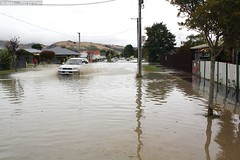
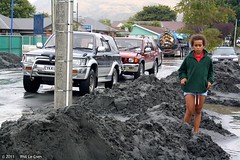

Photograph number UC 10-0492-24
Images, UC QuakeStudies
Students in the Student Volunteer Army cleaning up silt on a residential property after the earthquake.
Photograph number UC 10-0491-31
Images, UC QuakeStudies
Students in the Student Volunteer Army cleaning up silt at a residential property after the earthquake.
Photograph number UC 10-0490-07
Images, UC QuakeStudies
Students in the Student Volunteer Army on their way to clean up silt after the earthquake.
Christchurch council grilled over buildings at quake commission
Audio, Radio New Zealand
The Christchurch City Council has faced tough questioning at the Royal Commission into the Canterbury earthquakes over its role in ensuring buildings are earthquake strengthened.
Minister says recovery process from quake moving quickly
Audio, Radio New Zealand
The Minister for Earthquake Recovery, Gerry Brownlee, says the recovery process from Canterbury's earthquake is moving quickly, despite strong aftershocks yesterday setting back repair work.
Christchurch Press Image: Stacy Squires 2010:09:09 16:33:08
Images, UC QuakeStudies
Photograph captioned by Fairfax, "Christchurch earthquake. Canterbury University. Steven Joyce Tertiary Education Minister's visit to Central Library. Earthquake damage to computers and shelves and ceiling".
Christchurch Press Image: Stacy Squires 2010:09:09 16:33:50
Images, UC QuakeStudies
Photograph captioned by Fairfax, "Christchurch earthquake. Canterbury University. Steven Joyce Tertiary Education Minister's visit to Central Library. Earthquake damage to computers and shelves and ceiling".
Christchurch Press Image: Stacy Squires 2010:09:09 16:33:58
Images, UC QuakeStudies
Photograph captioned by Fairfax, "Christchurch earthquake. Canterbury University. Steven Joyce Tertiary Education Minister's visit to Central Library. Earthquake damage to computers and shelves and ceiling".
Earthquake hazard and risk assessment study Stage 1 Part A: Earthquake sou…
Articles, UC QuakeStudies
This study compiled and tabulated all relevant available information on earthquake sources (active faults) in Canterbury and mapped the fault locations onto 1:50,000 or 1:250,000 overlays on topographic maps (later digitised into the Environment Canterbury active faults database). The study also reviewed information on historic earthquakes, instrumental seismicity and paleoseismic studies and identified information gaps. It recommended an approach for a probabilistic seismic hazard analysis and development of earthquake scenarios. See Object Overview for background and usage information.
King Kapisi
Images, eqnz.chch.2010
Band Together - Concert for Canterbury www.bandtogetherforcanterbury.co.nz 23rd October 2010 Free concrete in Hagley Park following the 4th September 2010 earthquake
Outcomes of the Canterbury Earthquake Sequence for Tourism Businesses
Research papers, University of Canterbury Library
The Christchurch earthquake sequence has been on-going since September 4th 2010. The largest two earthquakes, magnitude (M) 7.1 on September 4th and the M 6.3 on February 22nd 2011 caused immediate and significant damage to the city of Christchurch. As a consequence of the earthquakes, the tourism sector in the Canterbury region has been heavily impacted, with broader impacts being felt throughout the South Island. Resilient Organisations and the University of Canterbury began a series of quantitative investigations into the recovery and response of key business sectors to the earthquakes. The purpose of this study was to build on this work by exploring the outcomes of the earthquakes on the tourism sector, a critical economic driver in the region. Two postal surveys were sent to 719 tourism business managers; the first to businesses in the ‘Impact Zone’ defined as areas that experienced Modified Mercalli intensities greater than 6. The second survey was sent to the remaining businesses throughout the Canterbury region (‘Rest of Canterbury’). Response rates were 46% response for the Impact Zone, and 29% for the Rest of Canterbury. Key findings:
The influence of near-fault motions on liquefaction triggering during the …
Research papers, University of Canterbury Library
The objective of this study is to examine the influence of near-fault motions on liquefaction triggering in Christchurch and neighboring towns during the 2010-2011 Canterbury earthquake sequence (CES). The CES began with the 4 September 2010, Mw7.1 Darfield earthquake and included up to ten events that triggered liquefaction. However, most notably, widespread liquefaction was induced by the Darfield earthquake and the Mw6.2, 22 February 2011 Christchurch earthquake. Of particular relevance to this study is the forward directivity effects that were prevalent in the motions recorded during the Darfield earthquake, and to a much lesser extent, during the Christchurch earthquake. A 2D variant of the Richart-Newmark fatigue theory was used to compute the equivalent number of cycles (neq) for the ground motions, where volumetric strain was used as the damage metric. This study is unique because it considers the contribution and phasing of both the fault-normal and fault-parallel components of motion on neq and the magnitude scaling factor (MSF). It was found that when the fault-normal and fault-parallel motions were treated individually, the former yielded a lower neq than the latter. Additionally, when the combined effects of fault-normal and fault-parallel components were considered, it was found that the MSF were higher than those commonly used. This implies that motions containing near-fault effects are less demanding on the soil than motions that do not. This may be one of several factors that resulted in less severe liquefaction occurring during the Darfield earthquake than the Christchurch earthquake.
Canterbury mental health worries dominate committee debate
Audio, Radio New Zealand
Worries about the mental health impacts of the Canterbury earthquakes dominated a fiery meeting at Parliament today.
Residents frustrated waiting for EQC claims
Audio, Radio New Zealand
People in Canterbury with homes damaged by the February 22nd earthquake have less than six hours left to lodge a claim with the Earthquake Commission.
HMNZS Canterbury caters for Lyttelton Residents, 23 February 2011
Videos, UC QuakeStudies
A video about HMNZS Canterbury providing meals to Lyttelton residents after the 22 February 2011 earthquake. About 700 meals were prepared on the ship for residents who were displaced after the 22 February 2011 earthquake.
CHRISTCHURCH. 7 September 2010
Images, Alexander Turnbull Library
The cartoon shows the letters of the name 'Christchurch' as blocks of stone that have collapsed into a pile of rubble; on top is a single rose. Refers to the Christchurch earthquake of Saturday 4th September 2010. Quantity: 1 digital cartoon(s).
Photo 048
Images, UC QuakeStudies
Damage to the facade of the Church of St Luke the Evangelist after the 4th of September earthquake. Barred off with "KEEP CLEAR" tape and road cones.
Photo 079
Images, UC QuakeStudies
Damage to the Visitors Centre in Kaiapoi, after the September 4th earthquake. The foundations have lifted at the back of the building, giving it a forward lean.
NZ scientists unimpressed Italian study of Canterbury quakes
Audio, Radio New Zealand
An international study looking at the Canterbury earthquakes is attracting loud criticism from New Zealand scientists.
Netta's Story
Articles, UC QuakeStudies
Summary of oral history interview with Netta about her experiences of the Canterbury earthquakes.
Damage on Oxford Terrace
Images, eqnz.chch.2010
Neighbours across the river showing earthquake damage. Hotel Grand Chancellor in the background. File reference: CCL-2011-08-12-CanterburyPublic Library pre-demolition-044 From the collection of Christchurch City Libraries.
Arts Centre
Images, eqnz.chch.2010
Reinforcing the apex of the clocktower gable.
Photograph by Paul Corliss 0118
Images, UC QuakeStudies
A photograph captioned by Paul Corliss, "Creyke Road, Ilam. Post earthquake".
Famous pie recipe under hammer for earthquake
Audio, Radio New Zealand
In June, the Hororata hotel in Canterbury closed after it became clear there was no economic way to repair damage caused by the September earthquake.
Jacinta O'Reilly's Story
Articles, UC QuakeStudies
Summary of oral history interview with Jacinta O'Reilly about her experiences of the Canterbury earthquakes.
Tremor Strike. Simply guess the magnitude of the next four consecutive aft…
Images, Alexander Turnbull Library
A Lotto game called 'Tremor Strike' invites people to 'Simply guess the magnitude of the next four consecutive aftershocks and WIN BIG!' Four differently coloured balls each with a tremor magnitude number bounce across the shaking ground. Refers to the earthquake of 4th September and the continuing aftershocks. Quantity: 1 digital cartoon(s).
Photograph of the Canterbury Provincial Chambers Buildings on Durham Stree…
Images, UC QuakeStudies
A photograph of the earthquake damage to the Canterbury Provincial Chambers Building on Durham Street.
Photograph of the Canterbury Provincial Chambers Buildings on Durham Stree…
Images, UC QuakeStudies
A photograph of the earthquake damage to the Canterbury Provincial Chambers Building on Durham Street.
Photograph of the Canterbury Provincial Chambers Buildings on Durham Stree…
Images, UC QuakeStudies
A photograph of the earthquake damage to the Canterbury Provincial Chambers Building on Durham Street.
Photograph of the Canterbury Provincial Chambers Buildings on Durham Stree…
Images, UC QuakeStudies
A photograph of the earthquake damage to the Canterbury Provincial Chambers Building on Durham Street.