
Search
found 2110 results
Images for CANTERBURY EARTHQUAKE; more images...


The Star 19 October 2011
Articles, UC QuakeStudies
A PDF copy of The Star newspaper, published on Wednesday 19 October 2011.
the jolt opened most kitchen cupboard doors
Images, eqnz.chch.2010
None
Dan Neely WEMO Photograph 34
Images, UC QuakeStudies
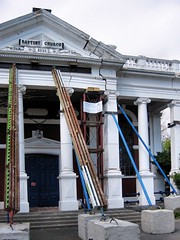
A photograph of the earthquake damage to the former Canterbury Public Library on the corner of Hereford Street and Cambridge Terrace. The bricks in the corner of the building have crumbled and masonry can be seen on the footpath below. Wire fences have been placed around the building as a cordon.
Townsend Telescope: Part Photograph 51
Images, UC QuakeStudies
A photograph of the damage to the teeth of a gear from the worm gear drive of the Townsend Telescope. The gear was damaged during the 22 February 2011 earthquake.
Townsend Telescope: Part Photograph 52
Images, UC QuakeStudies
A photograph of the damage to the teeth of a gear from the worm gear drive of the Townsend Telescope. The gear was damaged during the 22 February 2011 earthquake.
Townsend Telescope: Part Photograph 40
Images, UC QuakeStudies
A photograph of the hour angle setting circle from the Townsend Telescope. The left side of the support arm was bent out of shape during the 22 February 2011 earthquake.
Observatory Tower Photograph 08
Images, UC QuakeStudies
A photograph of cracks around a window of the Observatory tower at the Christchurch Arts Centre. The cracks formed as a result of the 4 September 2010 earthquake.
Observatory Tower Photograph 04
Images, UC QuakeStudies
A photograph of cracks around a window of the Observatory tower at the Christchurch Arts Centre. The cracks formed as a result of the 4 September 2010 earthquake.
Observatory Tower Photograph 02
Images, UC QuakeStudies
A photograph of cracks in the masonry of the Observatory tower at the Christchurch Arts Centre. The cracks formed as a result of the 4 September 2010 earthquake.
Observatory Tower Photograph 06
Images, UC QuakeStudies
A photograph of cracks around a window of the Observatory tower at the Christchurch Arts Centre. The cracks formed as a result of the 4 September 2010 earthquake.
Diary of the Canterbury Cultural Collections Recovery Centre Intern: Mont…
Articles, UC QuakeStudies
A blog post from Moya Sherriff about her sixth month as Intern for the Canterbury Cultural Collections Recovery Centre (CCCRC). In this post Sherriff interviews Jane Teal, the Archivist of the Anglican Diocese of Christchurch, about her experiences rescuing the archive after the earthquakes and moving in to the Recovery Centre. This blog post was downloaded on 18 November 2014.
Experimental testing and modelling to address the performance of RC walls …
Research papers, The University of Auckland Library
The current seismic design practice for reinforced concrete (RC) walls has been drawn into question following the unsatisfactory performance of several RC wall buildings during the Canterbury earthquakes. An overview of current research being undertaken at the University of Auckland into the seismic behaviour of RC walls is presented. The main objectives of this research project are to understand the observed performance of RC walls in Christchurch, quantify the seismic loads on RC walls, and developed improved design procedures for RC walls that will assist in revisions to the New Zealand Concrete Structures Standard. A database summarising the performance of RC wall buildings in the Christchurch CBD was collated to identify damage modes and case-study buildings. A detailed investigation is underway to verify the seismic performance of lightly reinforced concrete walls and initial numerical modeling and small-scale tests are presented in addition to details of planned experimental tests of RC walls. Numerical modelling is being used to understand the potential influence that interactions between walls and other structural elements have on the seismic response of buildings and the loads generated on RC walls. The results from finite element analysis of a severely damaged RC wall in Christchurch highlighted the effect that the floor diaphragms have on the distribution of shear stains in the wall.
UC Civil and Natural Resources Engineering Photograph 021
Images, UC QuakeStudies
A photograph of a section of road lying on the Greendale Fault line which has large cracks caused by the 4 September 2010 earthquake.
UC Civil and Natural Resources Engineering Photograph 087
Images, UC QuakeStudies
A photograph of the Pills for Thrills building on Worcester Street which suffered damage from a fire caused by the 4 September 2010 earthquake.
Townsend Telescope: Part Photograph 37
Images, UC QuakeStudies
A photograph of the slow motion assembly on the lower end of the main tube from the Townsend Telescope. The tube was crushed and bent during the 22 February 2011 earthquake.
Christchurch Earthquake Recovery - An Example of Resilience and Sustainabi…
Research papers, University of Canterbury Library
The term resilience‘’is increasingly being used in a multitude of contexts. Seemingly the latest buzz‘’word, it can mean many things to many people, in many different situations. In a natural hazard context, the terms sustainable planning‘’, and resilience‘planning are now’being used, often interchangeably. This poster provides an overview of resilience and sustainability within a land use planning and natural hazard context, and discusses how they are interrelated in the situation of the earthquake impacted city of Christchurch, New Zealand.
WEMO ERT Set 1 - February 2011 - Photograph 69
Images, UC QuakeStudies
A photograph of an alleyway between Gloucester Street and Cathedral Square. There is a pile of rubble near the end of the alleyway, fallen from the earthquake-damaged Base Backpackers building, behind the former Canterbury Times building on Gloucester Street. Scaffolding has also been constructed up the side of Base Backpackers.
Photograph by Neil Macbeth 506
Images, UC QuakeStudies
Members of the Student Volunteer Army helping themselves to free snacks inside the UCSA's "Big Top" tent. The tent was erected to provide support for students at the University of Canterbury in the aftermath of the 22 February 2011 earthquake. The volunteers have returned from a day of clearing liquefaction from Christchurch properties.
Inferred Seismic Performance and Recovery of the Christchurch Water Supply…
Research papers, University of Canterbury Library
Introduction This poster presents the inferred initial performance and recovery of the water supply network of Christchurch following the 22 February 2011 Mw 6.2 earthquake. Results are presented in a geospatial and temporal fashion. This work strengthens the current understanding of the restoration of such a system after a disaster and quantifies the losses caused by this earthquake in respect with the Christchurch community. Figure 1 presents the topology of the water supply network as well as the spatial distribution of the buildings and their use.
Reviwing Issues with Anchor Projects in Christchurch following the Earthqu…
Research papers, University of Canterbury Library
Introduction In 2011 Christchurch city centre was partially destroyed by an earthquake. Government-led anchor projects were tasked with bringing Christchurch back from rubble. After a period of 7 years out of 16 proposed projects, 10 are already over time for their initial completion dates and the ones completed, are under scrutiny for failing to deliver their expected outcome.
Hybrid Broadband Ground Motion Simulations of Porters Pass Earthquakes
Research papers, University of Canterbury Library
We present ground motion simulations of the Porters Pass (PP) fault in the Canterbury region of New Zealand; a major active source near Christchurch city. The active segment of the PP fault has an inferred length of 82 km and a mostly strike-slip sense of movement. The PP fault slip makes up approximately 10% of the total 37 mm/yr margin-parallel plate motion and also comprises a significant proportion of the total strain budget in regional tectonics. Given that the closest segment of the fault is less than 45 km from Christchurch city, the PP fault is crucial for accurate earthquake hazard assessment for this major population centre. We have employed the hybrid simulation methodology of Graves and Pitarka (2010, 2015), which combines low (f<1 Hz) and high (f>1 Hz) frequencies into a broadband spectrum. We have used validations from three moderate magnitude events (𝑀𝑤4.6 Sept 04, 2010; 𝑀𝑤4.6 Nov 06, 2010; 𝑀𝑤4.9 Apr 29, 2011) to build confidence for the 𝑀𝑤 > 7 PP simulations. Thus far, our simulations include multiple rupture scenarios which test the impacts of hypocentre location and the finite-fault stochastic rupture representation of the source itself. In particular, we have identified the need to use location-specific 1D 𝑉𝑠/𝑉𝑝 models for the high frequency part of the simulations to better match observations.
UC Civil and Natural Resources Engineering Photograph 008
Images, UC QuakeStudies
A photograph of the earthquake damage to the House of Travel building on the corner of Papanui and Leinster Roads, taken from inside a car.
Move to Library Level 5 - Photograph 12
Images, UC QuakeStudies
The University of Canterbury's E-Learning team's temporary office in the James Hight building. The photographer comments, "Yet another change of workplace for our E-Learning group, as the University juggles people and buildings to carry out earthquake repairs. My desk".
Spatial effects of the Canterbury earthquakes on inanga spawning habitat a…
Research papers, University of Canterbury Library
The Canterbury earthquakes resulted in numerous changes to the waterways of Ōtautahi Christchurch. These included bank destabilisation, liquefaction effects, changes in bed levels, and associated effects on flow regimes and inundation levels. This study set out to determine if these effects had altered the location and pattern of sites utilised by īnanga (Galaxias maculatus) for spawning, which are typically restricted to very specific locations in upper estuarine areas. Extensive surveys were carried out in the Heathcote/Ōpāwaho and Avon/Ōtākaro catchments over the four peak months of the 2015 spawning season. New spawning sites were found in both rivers and analysis against pre-earthquake records identified that other significant changes have occurred. Major changes include the finding of many new spawning sites in the Heathcote/Ōpāwaho catchment. Sites now occur up to 1.5km further downstream than the previously reported limit and include the first records of spawning below the Woolston Cut. Spawning sites in the Avon/Ōtākaro catchment also occur in new locations. In the mainstem, sites now occur both upstream and downstream of all previously reported locations. A concentrated area of spawning was identified in Lake Kate Sheppard at a distinctly different location versus pre-quake records, and no spawning was found on the western shores. Spawning was also recorded for the first time in Anzac Creek, a nearby waterway connected to Lake Kate Sheppard via a series of culverts.
New Zealand Defence Force photograph 074
Images, UC QuakeStudies
Damage to Lyttelton following the 22 February 2011 earthquake. Ground Culinary Centre on the corner of London and Canterbury Streets. The wall on the top storey has crumbled into the street, covering the footpath in bricks. Large cracks can be seen above the door, coming out from the corners of the window.
UC Civil and Natural Resources Engineering Photograph 104
Images, UC QuakeStudies
A photograph of a corner of the Civil Suite at the University of Canterbury after the 4 September 2010 earthquake. The photograph was taken on the day when the staff were allowed to return to the building. One of the ceiling panels has fallen onto a desk below, exposing the insulation underneath.
Critical Infrastructure Impacts in Small Towns Following the Kaikoura Eart…
Research papers, University of Canterbury Library
Background and methodology The Mw 7.8, 14th November 2016 earthquake centred (item b, figure 1) in the Hurunui District of the South Island, New Zealand, damaged critical infrastructure across North Canterbury and Marlborough. We investigate the impacts to infrastructure and adaptations to the resulting service disruption in four small rural towns (figure 1): Culverden (a), Waiau (c), Ward (d) and Seddon (e). This is accomplished though literary research, interviews and geospatial analysis. Illustrating our methods, we have displayed here a Hurunui District hazard map (figure 2b) and select infrastructure inventories (figures 2a, 3).
BeckerFraserPhotos May 2013 photograph 151
Images, UC QuakeStudies
Artist Peter Majendie's decorated tree on the corner of Manchester Street and Cambridge Terrace. The tree has been covered with a large frost cloth and hi-vis material for the launch of an earthquake fund by the Canterbury Community Trust.
Photograph by Neil Macbeth 395
Images, UC QuakeStudies
Students from the University of Canterbury observing a two minute silence during their lunch break to remember those who died in the 22 February 2011 earthquake. The students have volunteered to dig up liquefaction as part of the Student Volunteer Army.
Inventory and seismic assessment of earthquake-vulnerable masonry and conc…
Research papers, The University of Auckland Library
Following the 2010–2011 Canterbury earthquakes, a renewed focus has been directed across New Zealand to the hazard posed by the country‘s earthquake-vulnerable buildings, namely unreinforced masonry (URM) and reinforced concrete (RC) buildings with potentially nonductile components that have historically performed poorly in large earthquakes. The research reported herein was pursued with the intention of addressing several recommendations made by the Canterbury Earthquakes Royal Commission of Inquiry which were classified into the following general categories: Identification and provisional vulnerability assessment of URM and RC buildings and building components; Testing, assessment, and retrofitting of URM walls loaded out-of-plane, with a particular focus on highly vulnerable URM cavity walls; Testing and assessment of RC frame components, especially those with presumably non-ductile reinforcement detailing; Portfolio management considering risks, regulations, and potential costs for a portfolio that includes several potentially earthquake-vulnerable buildings; and Ongoing investigations and proposed research needs. While the findings from the reported research have implications for seismic assessments of buildings across New Zealand and elsewhere, an emphasis was placed on Auckland given this research program‘s partnership with the Auckland Council, the Auckland region accounting for about a third each of the country‘s population and economic production, and the number and variety of buildings within the Auckland building stock. An additional evaluation of a historic building stock was carried out for select buildings located in Hawke‘s Bay, and additional experimental testing was carried out for select buildings located in Hawke‘s Bay and Christchurch.