
Search
found 2110 results
Images for CANTERBURY EARTHQUAKE; more images...


New Zealand Defence Force photograph 528
Images, UC QuakeStudies
Kao Wei, Team Leader of the Taiwan USAR team, hugs Mitchell Brown from the New Zealand USAR National Management Team. The Taiwanese team is heading home after helping out with the emergency response to the Canterbury Earthquake.
Rosalee Jenkin Photograph 08
Images, UC QuakeStudies
A photograph of the rebuilt Blackwell's Department Store on the corner of Williams Street and Raven Quay in Kaiapoi. The department store was rebuilt after the previous building was damaged in the 2010 and 2011 Canterbury earthquakes.
The Effects of a Major Disaster on the Musical Life of a City
Articles, UC QuakeStudies
A paper submitted by Andrew Moore in partial fulfilment of the degree of Bachelor of Music with Honours, covering the effects of the Canterbury earthquakes on the musical life of Christchurch. Dissertation supervised by Dr Elaine Dobson, University of Canterbury School of Music. All photographs from The Press are copyright Fairfax Media and are used with permission.
UC Civil and Natural Resources Engineering Photograph 140
Images, UC QuakeStudies
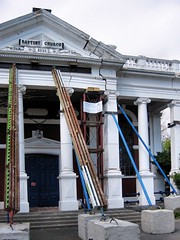
A photograph of workers in a crane-raise platform removing bricks from the earthquake-damaged Christchurch Chinese Methodist Church on Papanui Road.
UC Civil and Natural Resources Engineering Photograph 033
Images, UC QuakeStudies
A photograph of a section of road on the Greendale Fault line with large cracks caused by the 4 September 2010 earthquake.
UC Civil and Natural Resources Engineering Photograph 032
Images, UC QuakeStudies
A photograph of a section of road on the Greendale Fault line with large cracks caused by the 4 September 2010 earthquake.
UC Civil and Natural Resources Engineering Photograph 139
Images, UC QuakeStudies
A photograph of workers in a crane-raise platform removing bricks from the earthquake-damaged Christchurch Chinese Methodist Church on Papanui Road.
UC Civil and Natural Resources Engineering Photograph 035
Images, UC QuakeStudies
A photograph of the Greendale Fault line, now visible across a paddock due to cracks caused by the 4 September 2010 earthquake.
UC Civil and Natural Resources Engineering Photograph 034
Images, UC QuakeStudies
A photograph of the Greendale Fault line, now visible across a paddock due to cracks caused by the 4 September 2010 earthquake.
WEMO ERT Set 1 - March 2011 - Photograph 75
Images, UC QuakeStudies
A photograph of emergency management personnel standing outside the Canterbury Trade Union Centre on Armagh Street. Emergency tape has been draped around the outside of the building and USAR codes have been spray-painted on a column near the entrance. Behind the building are several other earthquake-damaged buildings.
Photograph by Neil Macbeth 264
Images, UC QuakeStudies
Groups of emergency personnel conferring at the base of the collapsed Canterbury Television building on Madras Street in the aftermath of the 22 February 2011 earthquake. Behind them, other emergency personnel can be seen searching the ruins for trapped people. Smoke can be seen billowing from the remains of the building.
Photograph by Neil Macbeth 259
Images, UC QuakeStudies
Members of the New Zealand police shifting a wooden beam from the ruins of the collapsed Canterbury Television Building in the aftermath of the 22 February 2011 earthquake. One of the New Zealand Police members has put on a bicycle helmet as protection. Around them, emergency personnel are searching the rubble for trapped people.
Repaired Reinforced Concrete Walls and Lower-Damage Modifications
Research papers, University of Canterbury Library
As a result of the Canterbury earthquakes, over 60% of the concrete buildings in the Christchurch Central Business District have been demolished. This experience has highlighted the need to provide guidance on the residual capacity and repairability of earthquake-damaged concrete buildings. Experience from 2010 Chile indicates that it is possible to repair severely damaged concrete elements (see photo at right), although limited testing has been performed on such repaired components. The first phase of this project is focused on the performance of two lightly-reinforced concrete walls that are being repaired and re-tested after damage sustained during previous testing.
Measuring the Impact of Insurance on Urban Recovery with Light
Research papers, University of Canterbury Library
We measure the longer-term effect of a major earthquake on the local economy, using night-time light intensity measured from space, and investigate whether insurance claim payments for damaged residential property affected the local recovery process. We focus on the destructive Canterbury Earthquake Sequence (CES) 2010 -2011 as our case study. Uniquely for this event, more than 95% of residential housing units were covered by insurance, but insurance payments were staggered over 5 years, enabling us to identify their local impact. We find that night-time luminosity can capture the process of recovery and describe the recovery’s determinants. We also find that insurance payments contributed significantly to the process of economic recovery after the earthquake, but delayed payments were less affective and cash settlement of claims were more effective than insurance-managed repairs in contributing to local recovery.
BeckerFraserPhotos April 2011 photograph 482
Images, UC QuakeStudies
A sign on a tent set up in the Arts car park at the University of Canterbury after the 22 February 2011 earthquake. The tents were used as temporary lecture rooms while the buildings were being checked for damage. The sign reads, "Clyde 4, ANTH 102 in E338 Drawing Room Mon 11Am, 155 Seat".
Experimental investigation of the seismic residual capacity of earthquake-…
Research papers, University of Canterbury Library
This poster presents preliminary results of ongoing experimental campaigns at the Universities of Auckland and Canterbury, aiming at investigating the seismic residual capacity of damaged reinforced concrete plastic hinges, as well as the effectiveness of epoxy injection techniques for restoring their stiffness, energy dissipation, and deformation capacity characteristics. This work is part of wider research project which started in 2012 at the University of Canterbury entitled “Residual Capacity and Repairing Options for Reinforced Concrete Buildings”, funded by the Natural Hazards Research Platform (NHRP). This research project aims at gaining a better understanding and providing the main end-users and stakeholders (practitioner engineers, owners, local and government authorities, insurers, and regulatory agencies) with comprehensive evidence-based information and practical guidelines to assess the residual capacity of damaged reinforced concrete buildings, as well as to evaluate the feasibility of repairing and thus support their delicate decision-making process of repair vs. demolition or replacement.
Dan Neely WEMO Photograph 14
Images, UC QuakeStudies
A photograph of women sewing felt badges outside the Christchurch City Library in Lyttelton. The felt hearts were a healing outlet during the Canterbury earthquakes. The goal was to create beauty in the midst of chaos, to keep people's hands busy and their minds off the terrifying reality of the earthquakes, as well as to give a gift of love to workers and businesses who helped improve life in Lyttelton.
Dan Neely WEMO Photograph 15
Images, UC QuakeStudies
A photograph of women sewing felt badges outside the Christchurch City Library in Lyttelton. The felt hearts were a healing outlet during the Canterbury earthquakes. The goal was to create beauty in the midst of chaos, to keep people's hands busy and their minds off the terrifying reality of the earthquakes, as well as to give a gift of love to workers and businesses who helped improve life in Lyttelton.
Photograph by Neil Macbeth 330
Images, UC QuakeStudies
Photograph captioned by Neil Macbeth, "Members of the Student Volunteer Army clearing liquefaction in earthquake-ravaged Avonside. The Student Volunteer Army are mostly University of Canterbury students who are helping to clean up the liquefaction from Christchurch properties.
Photograph by Neil Macbeth 332
Images, UC QuakeStudies
Photograph captioned by Neil Macbeth, "Members of the Student Volunteer Army clearing liquefaction in earthquake-ravaged Avonside. The Student Volunteer Army are mostly University of Canterbury students who are helping to clean up the liquefaction from Christchurch properties.
Photograph by Neil Macbeth 328
Images, UC QuakeStudies
Photograph captioned by Neil Macbeth, "Members of the Student Volunteer Army clearing liquefaction in earthquake-ravaged Avonside. The Student Volunteer Army are mostly University of Canterbury students who are helping to clean up the liquefaction from Christchurch properties.
All Right? Poster 2014
Articles, UC QuakeStudies
A poster produced by All Right? titled, Starting a community conversation about wellbeing in post-earthquake Christchurch. The poster outlines the three different phases of All Right, and how it is making a difference to people in Canterbury.
Photograph by Neil Macbeth 334
Images, UC QuakeStudies
Photograph captioned by Neil Macbeth, "Members of the Student Volunteer Army clearing liquefaction in earthquake-ravaged Avonside. The Student Volunteer Army are mostly University of Canterbury students who are helping to clean up the liquefaction from Christchurch properties.
Dan Neely WEMO Photograph 34
Images, UC QuakeStudies
A photograph of the earthquake damage to the former Canterbury Public Library on the corner of Hereford Street and Cambridge Terrace. The bricks in the corner of the building have crumbled and masonry can be seen on the footpath below. Wire fences have been placed around the building as a cordon.
Observatory Tower Photograph 38
Images, UC QuakeStudies
A photograph of the earthquake-damaged Observatory tower at the Christchurch Arts Centre. The photograph was taken using a cellphone camera. The top of the tower collapsed during the 22 February 2011 earthquake. The rubble from the tower has been cleared and a tarpaulin has been placed over the top of the broken tower. Tyres have been placed on the tarpaulin to hold it down. A temporary roof has also been constructed over the tower to keep out the rain. Two vehicles are parked in front.
Doing Gender & Disaster Issue 1: Women's Voices
Articles, UC QuakeStudies
A copy of the first issue of Doing Gender & Disaster, a journal produced by the Gender & Disaster Network. The issue examines the National Council of Women of New Zealand (NCWNZ) project, Women's Voices: Recording women's stories of the Canterbury earthquakes.
Bettina Evans's photograph 100
Images, UC QuakeStudies
Patchwork quilts wrapped around the concrete slabs used to stabilise a broken wall on Winchester Street. They make it look snug despite the snow. Many projects like this have cropped up around Canterbury in an effort to brighten the earthquake environment.
Bettina Evans's photograph 101
Images, UC QuakeStudies
Patchwork quilts wrapped around the concrete slabs used to stabilise a broken wall on Winchester Street. They make it look snug despite the snow. Many projects like this have cropped up around Canterbury in an effort to brighten the earthquake environment.
Townsend Telescope: Part Photograph 51
Images, UC QuakeStudies
A photograph of the damage to the teeth of a gear from the worm gear drive of the Townsend Telescope. The gear was damaged during the 22 February 2011 earthquake.
Townsend Telescope: Part Photograph 52
Images, UC QuakeStudies
A photograph of the damage to the teeth of a gear from the worm gear drive of the Townsend Telescope. The gear was damaged during the 22 February 2011 earthquake.