
Search
found 319 results
Images for Earthquake aftershocks; more images...
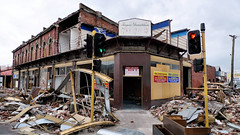
Resilience Tested: A year and a half of 10,000 aftershocks.
Research papers, University of Canterbury Library
On the second day of teaching for 2011, the University of Canterbury (UC) faced the most significant crisis of its 138-year history. After being shaken severely by a magnitude 7.1 earthquake on 4 September 2010, UC felt it was well along the pathway to getting back to ‘normal’. That all changed at 12:51pm on 22 February 2011, when Christchurch city was hit by an even more devastating event. A magnitude 6.3 (Modified Mercalli intensity ten – MM X) earthquake, just 13km south-east of the Christchurch city centre, caused vertical peak ground accelerations amongst the highest ever recorded in an urban environment, in some places more than twice the acceleration due to gravity. The earthquake caused immediate evacuation of the UC campus and resulted in significant damage to many buildings. Thankfully there were no serious injuries or fatalities on campus, but 185 people died in the city and many more suffered serious injuries. At the time of writing, eighteen months after the first earthquake in September, Christchurch is still experiencing regular earthquakes. Seismologists warn that the region may experience heightened seismicity for a decade or more. While writing this report we have talked with many different people from across the University. People’s experiences are different and we have not managed to talk with everyone, but we hope that by drawing together many different perspectives from across the campus that this report will serve two purposes; to retain our institutional memory of what we have learnt over the past eighteen months, and also to share our learnings with other organisations in New Zealand and around the world who, we hope, will benefit from learning about our experience.
Hubbard, James, 1949- : "Severe aftershocks continue.." 28 March 2011
Images, Alexander Turnbull Library
In four frames a man watches the news on TV. He hears that 'Severe aftershocks continue as the demolition crew move into the red zone.. amidst the badly damaged infrastructure..' His wife offers him a cup of tea and assumes the report is about Christchurch but it is not, it is about 'Phil Goff & Labour' Context - Christchurch continues to have aftershocks following the February 22 earthquake and the Labour Party is suffering one bodyblow after another - the last being the Darren Hughes affair. This is disastrous for Labour because the 2011 election is in November. Quantity: 1 digital cartoon(s).
Canterbury Earthquake 7.1
Images, eqnz.chch.2010
Rolleston/Burnham, South Island, NZ It's been a busy few weeks! Was away on geology fieldtrips all the previous two weeks, then on Saturday morning 4th September 2010 at 4.35 am we got woken in Westport to a reasonable but very long earthquake. My husband was back in Christchurch at the time and texted me saying "are you ok?". I replied, "yes!"...
Nisbet, Alistair, 1958- :"Er... can we just stay on the truck... permanent…
Images, Alexander Turnbull Library
A truck carries a house to a new position and the family in the house wonder if they 'can stay on the truck permanently'. Context - Continuing housing problems in Christchurch following the earthquakes of 4 September 2010 and February 22 and June 13 2011. Many aftershocks are still happening and the ground is unstable in many places. Quantity: 1 digital cartoon(s).
Christchurch Press Image: Kirk Hargreaves 2010:09:20 17:22:11
Images, UC QuakeStudies
Photograph captioned by Fairfax, "Hold on to your hats. There's a big 7.1 aftershock coming! Ralph Bungard owner of Three Boys Brewery testing the beer that started being brewed the night of the Christchurch Earthquake".
Christchurch Press Image: Kirk Hargreaves 2010:09:20 17:28:10
Images, UC QuakeStudies
Photograph captioned by Fairfax, "Hold on to your hats. There's a big 7.1 aftershock coming! Ralph Bungard owner of Three Boys Brewery testing the beer that started being brewed the night of the Christchurch Earthquake".
Christchurch Press Image: Kirk Hargreaves 2010:09:20 17:30:57
Images, UC QuakeStudies
Photograph captioned by Fairfax, "Hold on to your hats. There's a big 7.1 aftershock coming! Ralph Bungard owner of Three Boys Brewery testing the beer that started being brewed the night of the Christchurch Earthquake".
"Canterbury?" "No - The ACT Party" 17 September 2010
Images, Alexander Turnbull Library
A man reads a newspaper with a headline 'Aftershocks'. His wife thinks it refers to the Canterbury earthquake of 4th September but it actually refers to the implosion of the ACT Party. Quantity: 1 digital cartoon(s).
Nisbet, Alistair, 1958- :Current ChCh [Christchurch] Tsunami Warning Syste…
Images, Alexander Turnbull Library
The cartoon shows a man, a woman and a dog all yelling with fright. Refers to the series of severe aftershocks that again rocked Christchurch on January 2nd. The largest was a magnitude-5.5 shake shortly before 6am. All were centred at sea off New Brighton. Mayor Bob Parker said that fear that larger quakes could be triggered had been raised by residents, but the tsunami threat was "highly unlikely". Quantity: 1 digital cartoon(s).
Nisbet, Alistair, 1958- :'Course it's safe to rebuild...' 7 January 2012
Images, Alexander Turnbull Library
Shows three new houses sinking into liquefaction after another series of strong aftershocks in early January. A sign reads 'Parklands' and an observer confidently asserts that it is safe to rebuild. Context: the suburb of Parklands in north east Christchurch has been badly damaged by liquifaction. Quantity: 1 digital cartoon(s).
Earthquake response and structural health monitoring of Christchurch Women…
Research papers, University of Canterbury Library
The September 2010 Canterbury and February 2011 Christchurch earthquakes and associated aftershocks have shown that the isolator displacement in Christchurch Women's Hospital (Christchurch City's only base-isolated structure) was significantly less than expected. Occupant accounts of the events have also indicated that the accelerations within the hospital superstructure were larger than would usually be expected within a base-isolated structure and that residual low-level shaking lasts for a longer period of time following the strong-motion of an event than for non-isolated structures.
Christchurch Press Image: Carys Monteath 2010:09:08 05:45:17
Images, UC QuakeStudies
Photograph captioned by Fairfax, "Christchurch Earthquake. Christchurch was rocked by a large aftershock shortly after 8am this morning. The state of emergency has been extended for a further 7 days and more army personnel have been brought into the city".
Evans, Malcolm Paul, 1945- :'Hang on Christchurch we're on our way!' 23 De…
Images, Alexander Turnbull Library
Santa Claus drives his sleigh at great speed towards Christchurch shouting 'Hang on Christchurch we're on our way!' Context: concern about continuing trials and tribulations of Christchurch with continuing earthquakes and aftershocks. Colour and black and white versions available Quantity: 2 digital cartoon(s).
Hubbard, James, 1949- :"Who said we're living ON the edge?!" 14 June 2011
Images, Alexander Turnbull Library
The cartoon shows a desperate man representing 'Christchurch' who is clutching the end of a broken plank that protrudes from a crumbling cliff-face. He says 'Who said we're living ON the edge?!' Context - the man is suggesting that they are not On the edge but OVER it. Refers to the continuing hardships facing many Christchurch residents as earthquakes and aftershocks continue and many face large financial losses because of insurance problems. Quantity: 1 digital cartoon(s).
Christchurch Press 15 June 2011: Section A, Page 7
Articles, UC QuakeStudies
Page 7 of Section A of the Christchurch Press, published on Wednesday 15 June 2011.
Cost-Effective Consideration Of Non-Structural Elements: Lessons From The …
Research papers, University of Canterbury Library
By closely examining the performance of a 22-storey steel framed building in Christchurch subject to various earthquakes over the past seven years, it is shown that a number of lessons can be learnt regarding the cost-effective consideration of non-structural elements. The first point in this work is that non-structural elements significantly affected the costs associated with repairing steel eccentrically braced frame (EBF) links. The decommissioning or rerouting of non-structural elements in the vicinity of damaged links in the case study building attributed to approximately half the total cost of their repair. Such costs could be significantly reduced if the original positioning of non-structural elements took account of the potential need to repair the EBF links. The second point highlighted is the role that pre-cast cladding apparently played on the distribution and type of damage in the building. Loss estimates obtained following the FEMA P-58 framework vary considerably when cladding is or isnt modelled, both because of changes to drift demands up the height of the building and because certain types of subsequent damage are likely to be cheaper to repair than others. Finally, costly repairs to non-structural partition walls were required not only after the moment magnitude 7.1 earthquake in 2010 but also in multiple aftershocks in the years that followed. Repair costs associated with aftershock events exceeded those from the main event, emphasizing the need to consider aftershocks within modern performance-based earthquake engineering and also the opportunity that exists to make more cost-effective repair strategies following damaging earthquakes.
The Housing Slump
Images, UC QuakeStudies
Two images of a house, taken before and after the earthquakes. In the after photograph the chimneys are gone, a column supporting the car port has partly collapsed, windows are broken, and the previously neat lawn and driveway are overgrown. The photographer comments, "This was a house that I was selling up to the September 2010 earthquake in Christchurch. It was on Avonside Drive, which was an area that has been badly hit in every earthquake that has hit the area. In the September quake parts of the house moved in different directions and one of the upstairs doors had to be smashed open to release one of the sons from his bedroom. This occurred in the dark with numerous aftershocks shaking the house. Liquefaction poured up through the floor and flowed down the drive. Everyone got out OK, but soon after the house was red stickered meaning it was dangerous to enter. The house was looted many times even though there was constant police patrols. When the most violent earthquake occurred on 22 February 2012 both the tall heavy chimneys came crashing through into the living areas. Subsequent earthquakes and aftershocks have caused one of the brick fence pillars to fall and the front garage pillar to break up and twist. The family's troubles did not end there. They moved into the home of one of their parents and this mansion of a home was so badly affected by the February earthquake that no one could enter to collect any of their or their parents' belongings. They now own a new home, which they are fond of except when the ground shakes yet again. There has been to date 10,712 earthquakes and aftershocks since 4 September 2010".
Identification of cost-effective retrofit and/or rehabilitation strategies…
Research papers, University of Canterbury Library
Recently developed performance-based earthquake engineering framework, such as one provided by PEER (Deierlein et al. 2003), assist in the quantification in terms of performance such as casualty, monetary losses and downtime. This opens up the opportunity to identify cost-effective retrofit/rehabilitation strategies by comparing upfront costs associated with retrofit with the repair costs that can be expected over time. This loss assessment can be strengthened by learning from recent earthquakes, such as the 2010 Canterbury and 2016 Kaikoura earthquakes. In order to investigate which types of retrofit/rehabilitation strategies may be most cost-effective, a case study building was chosen for this research. The Pacific Tower, a 22-storey EBF apartment located within the Christchurch central business district (CBD), was damaged and repaired during the 2010 Canterbury earthquake series. As such, by taking hazard levels accordingly (i.e. to correspond to the Christchurch CBD), modelling and analysing the structure, and considering the vulnerability and repair costs of its different components, it is possible to predict the expected losses of the aforementioned building. Using this information, cost-effective retrofit/rehabilitation strategy can be determined. This research found that more often than not, it would be beneficial to improve the performance of valuable non-structural components, such as partitions. Although it is true that improving such elements will increase the initial costs, over time, the benefits gained from reduced losses should be expected to overcome the initial costs. Aftershocks do increase the predicted losses of a building even in lower intensities due to the fact that non-structural components can get damaged at such low intensities. By comparing losses computed with and without consideration of aftershocks for a range of historical earthquakes, it was found that the ratio between losses due to main shock with aftershocks to the losses due to the main shock only tended to increase with increasing main shock magnitude. This may be due to the fact that larger magnitude earthquakes tend to generate larger magnitude aftershocks and as those aftershocks happen within a region around the main shock, they are more likely to cause intense shaking and additional damage. In addition to this observation, it was observed that the most significant component of loss of the case study building was the non-structural partition walls.
Christchurch Arts Centre
Images, eqnz.chch.2010
For Best View Press"L" All 23 Arts Centre heritage buildings received significant damage in the earthquake and its subsequent aftershocks, and all have been issued with a red “Unsafe” placard. As a result of the magnitude of this damage, the Arts Centre Trust Board— the body charged with ensuring this iconic precinct is preserved and pr...
Photograph by Neil Macbeth 113
Images, UC QuakeStudies
A photographer outside the Christchurch Art Gallery. Behind him, members of Civil Defence have gathered outside after an aftershock hit during one of their briefings. The Christchurch Art Gallery served as the headquarters for Civil Defence after the 22 February 2011 earthquake.
Checkpoint Top Stories for Friday 10 September 2010
Audio, Radio New Zealand
Christchurch Mayor Bob Parker, New standards for earthquake prone buildings in Christchurch, Some schools reopen, while others face permanent closure, PM says Defence Force's role to check CV, Plans to burn the Koran on hold not cancelled, Chances of magnitude aftershock hitting rapidly decreasing.
Canterbury gets a shock from long and strong earthquake
Audio, Radio New Zealand
Canterbury got a big shock this morning with a long and strong earthquake that sent people running for the nearest door frame. While the region seems to have escaped any major damage, it's left locals thankful it wasn't worse. The quake measured 6.0 on the richter scale and was centred 45 kilometes north of Geraldine. Since then, there have been more than 40 aftershocks. Checkpoint producer Anastasia Hedge has been near the epicentre.
Photograph by Neil Macbeth 112
Images, UC QuakeStudies
Mayor Bob Parker entering the Christchurch Art Gallery after an aftershock hit during one of their briefings. A pile of shattered glass is in the main doorway. The Christchurch Art Gallery served as the headquarters for Civil Defence after the 22 February 2011 earthquake.
Thousands report feeling earthquake in Waikato
Audio, Radio New Zealand
More than 11,000 people reported feeling the earthquake that hit just after 2am on Friday. The magnitude 4.8 quake was centred 5-kilometres south of Te Aroha, at a depth of 6-kilometres. People from Kaitaia, through to the sodden regions of Auckland, Bay of Plenty, Coromandel, and even down in Christchurch, reported feeling it. A series of weaker aftershocks began to strike 40 minutes later, although there are no immediate reports of damage as of yet. It's not the first quake to hit Te Aroha this year - a 5.1 quake rattled the town on January 4. Te Kuiti resident Zane Burdett and Kees Meinderts from Motumaoho, just south of Morrinsville, spoke to Corin Dann.
Resilience framework and guidelines for practice
Research papers, University of Canterbury Library
The Canterbury earthquakes are unique in that the there have been a series of major earthquakes, each with their own subsequent aftershock pattern. These have extended from the first large earthquake in September 2010 to currently, at the time of writing, two years later. The last significant earthquake of over magnitude 5.0 on the Richter scale was in May on 2012, and the total number of aftershocks has exceeded 12,000. The consequences, in addition to the loss of life, significant injury and widespread damage, have been far reaching and long term, with detrimental effects and still uncertain effects for many. This provides unique challenges for individuals, communities, organisations and institutions within Canterbury. This document reviews research-based understandings of the concept of resilience. A conceptual model is developed which identifies a number of the factors that influence individual and household resilience. Guided by the model, a series of recommendations are developed for practices that will support individual and household resilience in Canterbury in the aftermath of the 2010-2011 earthquakes.
Evans, Malcolm Paul, 1945- :"This one's connected to Gerry Brownlee!" 19 J…
Images, Alexander Turnbull Library
A Christchurch seismic monitor churns out reams of paper with wild fluctuations showing earthquakes and aftershocks. Nearby two men examine a second monitor and one of them says 'This one's connected to Gerry Brownlee!' The reams of paper show a perfectly straight line - it appears that nothing is going on in Gerry Brownlee's head. Context - A sense that the Minister for Earthquake Recovery is being less than effective. Colour and black and white versions available Quantity: 2 digital cartoon(s).
Elizabeth Ackermann Photograph 319
Images, UC QuakeStudies
A photograph of a sign in the Canterbury Quakes exhibition at the Canterbury Museum. The sign displays the number of aftershocks in Canterbury since the 4 September 2010 earthquake as of 9.00 am on the morning the photograph was taken. The tally was 9,787.
Nisbet, Alistair, 1958- :New ChCh subdivision?... 17 August 2011
Images, Alexander Turnbull Library
Text reads 'New Chch subdivision?...' The cartoon shows a very snowy scene with several igloos; The subdivision is called 'Igloo Park' and the sign says 'Polar packages available'. Context: Christchurch, after being battered by the February 22 earthquake, the June 13 aftershock and last month's snowstorm have had another week of snow. The cartoon suggests that new subdivisions, necessary because of the earthquakes, could be filled with igloos. Quantity: 1 digital cartoon(s).
Christchurch Press 17 June 2011: Section A, Page 4 (Christchurch Edition)
Articles, UC QuakeStudies
Page 4 of Section A of the Christchurch edition of the Christchurch Press, published on Friday 17 June 2011.
Top Stories for Monday 20 September 2010
Audio, Radio New Zealand
More snow expected in Southland as region starts to mop up, United Future leader questions stability of Act, Seismologists say aftershocks tailing off for Canterbury, Questions raised over earthquake victims insurance, Gunmen attack tourists in Delhi shooting and Farm land drops two-thirds in value in one year.