
Search
found 2110 results
Images for CANTERBURY EARTHQUAKE; more images...


Paul and Sam Corliss's Street Art Photograph (2015:03:28 13:19:44)
Images, UC QuakeStudies
A photograph of street art on a wall along Oxford Street in Lyttelton. The street art depicts buildings that were lost in Lyttelton after the 2010 and 2011 Canterbury earthquakes.
Paul and Sam Corliss's Street Art Photograph (2015:03:28 13:19:30)
Images, UC QuakeStudies
A photograph of street art on a wall along Oxford Street in Lyttelton. The street art depicts buildings that were lost in Lyttelton after the 2010 and 2011 Canterbury earthquakes.
Paul and Sam Corliss's Street Art Photograph (2015:03:28 13:19:41)
Images, UC QuakeStudies
A photograph of street art on a wall along Oxford Street in Lyttelton. The street art depicts buildings that were lost in Lyttelton after the 2010 and 2011 Canterbury earthquakes.
Paul and Sam Corliss's Street Art Photograph (2015:03:28 13:19:15)
Images, UC QuakeStudies
A photograph of street art on a wall along Oxford Street in Lyttelton. The street art depicts buildings that were lost in Lyttelton after the 2010 and 2011 Canterbury earthquakes.
Kim Wright WEMO Photograph 061
Images, UC QuakeStudies
A photograph of an excavator on the side of a road in Canterbury. This stretch of road is near the Greendale fault line which caused the 4 September 2010 earthquake.
Paul and Sam Corliss's Street Art Photograph (2015:03:28 13:19:26)
Images, UC QuakeStudies
A photograph of street art on a wall along Oxford Street in Lyttelton. The street art depicts buildings that were lost in Lyttelton after the 2010 and 2011 Canterbury earthquakes.
All Right? CALD: Smile Couch Image 4
Images, UC QuakeStudies
A photograph from the All Right? Start With a Smile campaign. Start With A Smile was led by Canterbury Employers' Chamber of Commerce and supported by All Right?. The project encouraged Cantabrians to engage with the thousands of migrants who have moved to Canterbury since the earthquakes.
All Right? CALD: Smile Couch Image 2
Images, UC QuakeStudies
A photograph from the All Right? Start with A Smile campaign. Start with A Smile was led by Canterbury Employers' Chamber of Commerce and supported by All Right?. The project encouraged Cantabrians to engage with the thousands of migrants who have moved to Canterbury since the earthquakes.
All Right? CALD: Smile Couch Image 3
Images, UC QuakeStudies
A photograph from the All Right? Start with A Smile campaign. Start with A Smile was led by Canterbury Employers' Chamber of Commerce and supported by All Right?. The project encouraged Cantabrians to engage with the thousands of migrants who have moved to Canterbury since the earthquakes.
All Right? CALD: Smile Couch Image 1
Images, UC QuakeStudies
A photograph from the All Right? Start with A Smile campaign. Start with A Smile was led by Canterbury Employers' Chamber of Commerce and supported by All Right?. The project encouraged Cantabrians to engage with the thousands of migrants who have moved to Canterbury since the earthquakes.
Dan Neely WEMO Photograph 27
Images, UC QuakeStudies
A photograph of members of Civil Defence and other organisations helping with the emergency response to the Canterbury earthquakes. They are standing on the corner of Montreal and Gloucester Streets outside the Christchurch Art Gallery. The Art Gallery served as the headquarters for the Civil Defence after the 22 February 2011 earthquake.
New Zealand Defence Force photograph 288
Images, UC QuakeStudies
Photograph captioned by the New Zealand Defence Force, "The NZ Defence Force helps out after the 22 February 2011 earthquake. HMNZS Canterbury arrives back in Lyttelton Harbour after a very fast return trip to Wellington to resupply".
New Zealand Defence Force photograph 287
Images, UC QuakeStudies
Photograph captioned by the New Zealand Defence Force, "The NZ Defence Force helps out after the 22 February 2011 earthquake. HMNZS Canterbury arrives back in Lyttelton Harbour after a very fast return trip to Wellington to resupply".
New Zealand Defence Force photograph 286
Images, UC QuakeStudies
Photograph captioned by the New Zealand Defence Force, "The NZ Defence Force helps out after the 22 February 2011 earthquake. HMNZS Canterbury arrives back in Lyttelton Harbour after a very fast return trip to Wellington to resupply".
Christchurch Natural Disaster Response and Recovery presentation
Articles, UC QuakeStudies
A pdf copy of a PowerPoint presentation made for the Water Services Association of Australia conference, about SCIRT's approach to asset investigation after the Canterbury earthquakes of 2010 and 2011.
Community in Mind: Hei Puawai Waitaha - a flourishing Waitaha
Articles, UC QuakeStudies
A PDF copy of a publication about rebuilding health and wellbeing in greater Christchurch. The publication was produced by CERA in June 2014.
Jim Baltaxe WEMO Photograph 107
Images, UC QuakeStudies
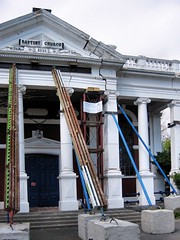
A photograph of the earthquake damage to the Canterbury Provincial Chambers on Durham Street. The top of one of the chambers has crumbled and the masonry has fallen onto the footpath. Scaffolding which was erected after the 4 September 2010 earthquake has also fallen. Wire fences have been placed around the building as a cordon.
Jim Baltaxe WEMO Photograph 108
Images, UC QuakeStudies
A photograph of the earthquake damage to the Canterbury Provincial Chambers on Durham Street. The top of one of the chambers has crumbled and the masonry has fallen onto the footpath. Scaffolding which was erected after the 4 September 2010 earthquake has also fallen. Wire fences have been placed around the building as a cordon.
Elizabeth Ackermann Photograph 170
Images, UC QuakeStudies
A photograph of computers and desks from the Department of Civil and Natural Resources Engineering at the University of Canterbury. These were set up in the Sunday School room of the Avonhead Baptist Church after the 22 February 2011 earthquake.
Elizabeth Ackermann Photograph 171
Images, UC QuakeStudies
A photograph of computers and desks from the Department of Civil and Natural Resources Engineering at the University of Canterbury. These were set up in the Sunday School room of the Avonhead Baptist Church after the 22 February 2011 earthquake.
Environmental Health Officers from the New Zealand Army testing water in C…
Videos, UC QuakeStudies
A video about the New Zealand Army testing the quality of water across Christchurch. After the 4 September 2010 earthquake, the NZ Army developed ties with the Canterbury District Health Board. This relationship continued after the 22 February 2011 earthquake with the NZ Army taking on the role of examining Christchurch's water quality.
The Star 23 July 2011
Articles, UC QuakeStudies
A PDF copy of The Star newspaper, published on Saturday 23 July 2011.
boxes down
Images, eqnz.chch.2010
None
brick fence down
Images, eqnz.chch.2010
None
Townsend Telescope: Part Photograph 59
Images, UC QuakeStudies
A photograph of the governor from the Townsend Telescope. The left weight broke off during the 22 February 2011 earthquake.
Townsend Telescope: Part Photograph 26
Images, UC QuakeStudies
A photograph of the focus assembly from the Townsend Telescope. The assembly was damaged during the 22 February 2011 earthquake.
Townsend Telescope: Part Photograph 66
Images, UC QuakeStudies
A photograph of the focus assembly from the Townsend Telescope. The assembly was damaged during the 22 February 2011 earthquake.
Scrutinising The Prediction of Liquefaction Through New Zealand Case Histo…
Research papers, University of Canterbury Library
Background Liquefaction induced land damage has been identified in more than 13 notable New Zealand earthquakes within the past 150 years, as presented on the timeline below. Following the 2010-2011 Canterbury Earthquake Sequence (CES), the consequences of liquefaction were witnessed first-hand in the city of Christchurch and as a result the demand for understanding this phenomenon was heightened. Government, local councils, insurers and many other stakeholders are now looking to research and understand their exposure to this natural hazard.
Minimising Public Health Risk from Human Waste after a large Wellington Fa…
Research papers, University of Canterbury Library
The greater Wellington region, New Zealand, is highly vulnerable to large earthquakes. While attention has been paid to the consequences of earthquake damage to road, electricity and water supply networks, the consequences of wastewater network damage for public health, environmental health and habitability of homes remain largely unknown for Wellington City. The Canterbury and Kaikōura earthquakes have highlighted the vulnerability of sewerage systems to disruption during a disaster. Management of human waste is one of the critical components of disaster planning to reduce faecal-oral transmission of disease and exposure to disease-bearing vectors. In Canterbury and Kaikōura, emergency sanitation involved a combination of Port-a-loos, chemical toilets and backyard long-drops. While many lessons may be learned from experiences in Canterbury earthquakes, it is important to note that isolation is likely to be a much greater factor for Wellington households, compared to Christchurch, due to the potential for widespread landslides in hill suburbs affecting road access. This in turn implies that human waste may have to be managed onsite, as options such as chemical toilets and Port-a-loos rely completely on road access for delivering chemicals and collecting waste. While some progress has been made on options such as emergency composting toilets, significant knowledge gaps remain on how to safely manage waste onsite. In order to bridge these gaps, laboratory tests will be conducted through the second half of 2019 to assess the pathogen die-off rates in the composting toilet system with variables being the type of carbon bulking material and the addition of a Bokashi composting activator.
WEMO ERT Set 1 - February 2011 - Photograph 70
Images, UC QuakeStudies
A photograph of the earthquake damage to the Base Packpackers building behind the former Canterbury Times building on Gloucester Street. The corner of Base Backpackers has collapsed, exposing a bunkroom inside. Scaffolding has been constructed up the side of the building.