
Search
found 2110 results
Images for CANTERBURY EARTHQUAKE; more images...


CanCERN Newsletter 12, 23 September 2011
Articles, UC QuakeStudies
A copy of the CanCERN online newsletter published on 23 September 2011
CanCERN Newsletter 16, 28 October 2011
Articles, UC QuakeStudies
A copy of the CanCERN online newsletter published on 28 October 2011
CanCERN Newsletter 52, 24 August 2012
Articles, UC QuakeStudies
A copy of the CanCERN online newsletter published on 24 August 2012
CanCERN Newsletter 69, 25 January 2013
Articles, UC QuakeStudies
A copy of the CanCERN online newsletter published on 25 January 2013
CanCERN Newsletter 64, 23 November 2012
Articles, UC QuakeStudies
A copy of the CanCERN online newsletter published on 23 November 2012
CanCERN Newsletter 67, 11 January 2013
Articles, UC QuakeStudies
A copy of the CanCERN online newsletter published on 11 January 2013
CanCERN Newsletter 63, 15 November 2012
Articles, UC QuakeStudies
A copy of the CanCERN online newsletter published on 15 November 2012
CanCERN Newsletter 55, 14 September 2012
Articles, UC QuakeStudies
A copy of the CanCERN online newsletter published on 14 September 2012
CanCERN Newsletter 66, 21 November 2012
Articles, UC QuakeStudies
A copy of the CanCERN online newsletter published on 21 November 2012
CanCERN Newsletter 60, 19 October 2012
Articles, UC QuakeStudies
A copy of the CanCERN online newsletter published on 19 October 2012
CanCERN Newsletter 53, 31 August 2012
Articles, UC QuakeStudies
A copy of the CanCERN online newsletter published on 31 August 2012
CanCERN Newsletter 61, 26 October 2012
Articles, UC QuakeStudies
A copy of the CanCERN online newsletter published on 26 October 2012
CanCERN Newsletter 68, 18 January 2013
Articles, UC QuakeStudies
A copy of the CanCERN online newsletter published on 18 January 2013
CanCERN Newsletter 65, 30 November 2012
Articles, UC QuakeStudies
A copy of the CanCERN online newsletter published on 30 November 2012
Quantification of Infrastructure Downtime in Earthquake Reconstruction
Research papers, University of Canterbury Library
Knowing how to rapidly rebuild disaster-damaged infrastructure, while deciding appropriate recovery strategies and catering for future investment is a matter of core interest to government decision makers, utility providers, and business sectors. The purpose of this research is to explore the effects of decisions and outcomes for physical reconstruction on the overall recovery process of horizontal infrastructure in New Zealand using the Canterbury and Kaikoura earthquakes as cases. A mixed approach including a systematic review, questionnaire survey and semi-structured interviews is used to capture perspectives of those involved in reconstruction process and gain insights into the effect of critical elements on infrastructure downtime. Findings from this research will contribute towards advancements of a systems dynamics model considering critical decision-making variables across phases of the reconstruction process to assess how these variables affect the rebuild process and the corresponding downtime. This project will improve the ability to explore alternative resilience improvement pathways and test the efficacy of alternative means for facilitating a faster and better reconstruction process.
Umut Akguzel Photograph 155
Images, UC QuakeStudies
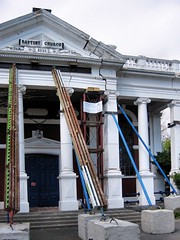
A photograph of the damaged Provincial Council Chambers on Durham Street. The building's roof and walls have collapsed, as has the scaffolding which was erected to repair it after the 4 September 2010 earthquake.
UC Civil and Natural Resources Engineering Photograph 138
Images, UC QuakeStudies
A photograph of a crack in a wall of Room 212 in the Department of Civil and Natural Resources Engineering at the University of Canterbury when staff were let in after the 4 September 2010 earthquake.
Observatory Tower Photograph 29
Images, UC QuakeStudies
A photograph of an earthquake-damaged suitcase in the South Quad of the Christchurch Arts Centre. The suitcase is resting on a pile of scaffolding which had been constructed around the Observatory tower. The scaffolding collapsed along with the tower during the 22 February 2011 earthquake.
Jim Baltaxe WEMO Photograph 106
Images, UC QuakeStudies
A photograph of the earthquake damage to the Canterbury Provincial Chambers on Durham Street. One of the entrance ways has crumbled, and the rubble has fallen in front. An inner door can be seen, now leading to nowhere.
Photograph by Neil Macbeth 363
Images, UC QuakeStudies
Members of the Student Volunteer Army registering new volunteers inside the UCSA's "Big Top" tent. The tent was erected to provide support for students at the University of Canterbury in the aftermath of the 22 February 2011 earthquake.
Photograph by Neil Macbeth 364
Images, UC QuakeStudies
Members of the Student Volunteer Army registering new volunteers inside the UCSA's "Big Top" tent. The tent was erected to provide support for students at the University of Canterbury in the aftermath of the 22 February 2011 earthquake.
Tidal Behavior and Water-Level Changes in Gravel Aquifers in Response to M…
Research papers, Victoria University of Wellington
©2019. American Geophysical Union. All Rights Reserved. Earthquakes have been inferred to induce hydrological changes in aquifers on the basis of either changes to well water-levels or tidal behavior, but the relationship between these changes remains unclear. Here, changes in tidal behavior and water-levels are quantified using a hydrological network monitoring gravel aquifers in Canterbury, New Zealand, in response to nine earthquakes (of magnitudes M w 5.4 to 7.8) that occurred between 2008 and 2015. Of the 161 wells analyzed, only 35 contain water-level fluctuations associated with “Earth + Ocean” (7) or “Ocean” (28) tides. Permeability reduction manifest as changes in tidal behavior and increased water-levels in the near field of the Canterbury earthquake sequence of 2010–2011 support the hypothesis of shear-induced consolidation. However, tidal behavior and water-level changes rarely occurred simultaneously (~2%). Water-level changes that occurred with no change in tidal behavior reequilibrated at a new postseismic level more quickly (on timescales of ~50 min) than when a change in tidal behavior occurred (~240 min to 10 days). Water-level changes were more than likely to occur above a peak dynamic stress of ~50 kPa and were more than likely to not occur below ~10 kPa. The minimum peak dynamic stress required for a tidal behavior change to occur was ~0.2 to 100 kPa.
Recording a story in the POD
Images, eqnz.chch.2010
File reference: CCL-2011-11-22-IMG_0782PODattheShow November2011 From the collection of Christchurch City Libraries.
Recording a story in the POD
Images, eqnz.chch.2010
File reference: CCL-2011-11-22-IMG_0782 PODattheShow November2011 From the collection of Christchurch City Libraries.
A new crack in the footpath in Rydal Park.
Images, eqnz.chch.2010
Cracks in the roads and foot paths were surprisingly hard to find given the strength of the earthquake.
Townsend Telescope: Part Photograph 20
Images, UC QuakeStudies
A photograph of a bolt from the Townsend Telescope. The bolt sheared during the 22 February 2011 earthquake.
BeckerFraserPhotos April 2011 photograph 481
Images, UC QuakeStudies
The inside of a tent set up in the Arts car park at the University of Canterbury after the 22 February 2011 earthquake. The tents were used as temporary lecture rooms while the buildings were being checked for damage.
New Zealand Defence Force photograph 519
Images, UC QuakeStudies
The Taiwanese Ambassador speaking to the Taiwanese Search and Rescue team at Christchurch International Airport. The team is heading home after helping with the emergency response to the Canterbury Earthquake.
Observatory Tower Photograph 31
Images, UC QuakeStudies
A photograph of a crack in between the stairway and a column of the Physics Building at the Canterbury Arts Centre. The crack formed during the 22 February 2011 earthquake.
Paul and Sam Corliss's Street Art Photograph (2015:03:28 13:19:18)
Images, UC QuakeStudies
A photograph of street art on a wall along Oxford Street in Lyttelton. The street art depicts buildings that were lost in Lyttelton after the 2010 and 2011 Canterbury earthquakes.