
Search
found 1756 results
Images for CANTERBURY EARTHQUAKE; more images...


Cup and Show week gives Christchurch reason to smile
Audio, Radio New Zealand
It's Canterbury's annual Cup and Show week. Organisers say the event has extra prominence this year, as the region's been robbed of many major events because of the damage to venues in the September and February earthquakes.
Townsend Telescope: Part Photograph 10
Images, UC QuakeStudies
A photograph of the top cover of the clock from the Townsend Telescope. Parts of the cover were bent out of shape during the 22 February 2011 earthquake.
Townsend Telescope: Part Photograph 32
Images, UC QuakeStudies
A close-up photograph of the lower end of the main tube from the Townsend Telescope. The tube was crushed and bent during the 22 February 2011 earthquake.
Townsend Telescope: Part Photograph 33
Images, UC QuakeStudies
A close-up photograph of the lower end of the main tube from the Townsend Telescope. The tube was crushed and bent during the 22 February 2011 earthquake.
Observatory Tower Photograph 30
Images, UC QuakeStudies
A photograph of rubble from the Observatory tower in the South Quad of the Christchurch Arts Centre. The tower collapsed during the 22 February 2011 earthquake.
The Effects of a Major Disaster on the Musical Life of a City
Articles, UC QuakeStudies
A paper submitted by Andrew Moore in partial fulfilment of the degree of Bachelor of Music with Honours, covering the effects of the Canterbury earthquakes on the musical life of Christchurch. Dissertation supervised by Dr Elaine Dobson, University of Canterbury School of Music. All photographs from The Press are copyright Fairfax Media and are used with permission.
Photograph by Neil Macbeth 367
Images, UC QuakeStudies
Wheelbarrows belonging to the Student Volunteer Army stacked up outside the UCSA's "Big Top". The tent was erected to provide support for students at the University of Canterbury in the aftermath of the 22 February 2011 earthquake.
New Zealand Defence Force photograph 277
Images, UC QuakeStudies
Photograph captioned by the New Zealand Defence Force, "The NZ Defence Force helps out after the 22 February 2011 earthquake. HMNZS Canterbury arrives back in Lyttelton Harbour after a very fast return trip to Wellington to resupply".
New Zealand Defence Force photograph 278
Images, UC QuakeStudies
Photograph captioned by the New Zealand Defence Force, "The NZ Defence Force helps out after the 22 February 2011 earthquake. HMNZS Canterbury arrives back in Lyttelton Harbour after a very fast return trip to Wellington to resupply".
New Zealand Defence Force photograph 279
Images, UC QuakeStudies
Photograph captioned by the New Zealand Defence Force, "The NZ Defence Force helps out after the 22 February 2011 earthquake. HMNZS Canterbury arrives back in Lyttelton Harbour after a very fast return trip to Wellington to resupply".
New Zealand Defence Force photograph 528
Images, UC QuakeStudies
Kao Wei, Team Leader of the Taiwan USAR team, hugs Mitchell Brown from the New Zealand USAR National Management Team. The Taiwanese team is heading home after helping out with the emergency response to the Canterbury Earthquake.
Strike-slip ground-surface rupture (Greendale Fault) associated with the 4…
Research papers, University of Canterbury Library
This paper provides a photographic tour of the ground-surface rupture features of the Greendale Fault, formed during the 4th September 2010 Darfield Earthquake. The fault, previously unknown, produced at least 29.5 km of strike-slip surface deformation of right-lateral (dextral) sense. Deformation, spread over a zone between 30 and 300 m wide, consisted mostly of horizontal flexure with subsidiary discrete shears, the latter only prominent where overall displacement across the zone exceeded about 1.5 m. A remarkable feature of this event was its location in an intensively farmed landscape, where a multitude of straight markers, such as fences, roads and ditches, allowed precise measurements of offsets, and permitted well-defined limits to be placed on the length and widths of the surface rupture deformation.
Photograph by Neil Macbeth 264
Images, UC QuakeStudies
Groups of emergency personnel conferring at the base of the collapsed Canterbury Television building on Madras Street in the aftermath of the 22 February 2011 earthquake. Behind them, other emergency personnel can be seen searching the ruins for trapped people. Smoke can be seen billowing from the remains of the building.
Photograph by Neil Macbeth 259
Images, UC QuakeStudies
Members of the New Zealand police shifting a wooden beam from the ruins of the collapsed Canterbury Television Building in the aftermath of the 22 February 2011 earthquake. One of the New Zealand Police members has put on a bicycle helmet as protection. Around them, emergency personnel are searching the rubble for trapped people.
Parliament pays tribute to victims and rescuers and adjourns
Audio, Radio New Zealand
Parliament has adjourned for two weeks following the declaration of a national emergency after yesterday's devastating Canterbury earthquake. The leadership of the various parties took turns to acknowlege the disaster and pay tribute to it victims and heroes.
Fairfax Video, March 2011 (1)
Videos, UC QuakeStudies
A video about a memorial wall in the Linwood Crematorium Memorial Garden which collapsed during the 22 February 2011 earthquake. The wall housed nearly 100 people's ashes. Staff from the Cremation Society of Canterbury collected the ashes and stored them in bags until the wall could be rebuilt.
WEMO ERT Set 1 - March 2011 - Photograph 75
Images, UC QuakeStudies
A photograph of emergency management personnel standing outside the Canterbury Trade Union Centre on Armagh Street. Emergency tape has been draped around the outside of the building and USAR codes have been spray-painted on a column near the entrance. Behind the building are several other earthquake-damaged buildings.
Nisbet, Alistair, 1958- :'Who needs light rail when you can have right wha…
Images, Alexander Turnbull Library
The title reads 'CBD: High water table, flood/liquefaction risk...' The cartoon shows several Southern Right whales being used to ferry people around Christchurch City. Someone says 'Who needs light rail when you can have right whale!' Context: discussion about building a light rail system as a part of Christchurch post-earthquake development. Context: Several large Southern right whales have found Akaroa Harbour to their liking this week, sticking around rather than heading back south as part of their annual migration back to Antarctica. Quantity: 1 digital cartoon(s).
Smith, Ashley W, 1948-: King of NZ. 4 April 2011
Images, Alexander Turnbull Library
The cartoon shows Prince William during his visit to New Zealand following the Christchurch earthquake on 22 February. He is sitting in a deckchair at the beach wearing a jersey with Canterbury colours and a paper hat with 'King of NZ' printed on it; he holds a sausage on a stick in one hand and a can of beer in the other and appears to be enjoying himself mightily. On either side of him is a fern. Quantity: 1 digital cartoon(s).
Evans, Malcolm Paul, 1945-: "Relax! - the neighbour hasn't a clue we're em…
Images, Alexander Turnbull Library
It is night and a man and his wife are lifting their chemical toilet over the garden fence with the intention of emptying it into the neighbour's longdrop. The man confidently tells his wife to relax as the neighbour hasn't a clue they are planning to do this. The neighbour, meanwhile, sits in the outhouse holding a cricket bat at the ready. Context - toilet problems in Christchurch post earthquake 22 February 2011. Colour and black and white versions available Quantity: 2 digital cartoon(s).
Nisbet, Alistair, 1958-: 150 great reasons to live in Christchurch. 6 Apri…
Images, Alexander Turnbull Library
Text reads '150 great reasons to live in Christchurch'. Someone quotes 'It's only 250 metres to empty your chemical toilet'. An elderly woman trudges through the rain pushing a trolley on which is balanced her chemical toilet. Context - Following the Christchurch earthquake of 22 February 2011 when a great deal of damage was done to the sewage system because of broken pipes thousands of chemical toilets have been distributed but now there seems to be confusion over whether it is safe to use flushing toilets when the sewage system cannot support it or whether residents should still be using chemical toilets. Quantity: 1 digital cartoon(s).
BeckerFraserPhotos April 2011 photograph 482
Images, UC QuakeStudies
A sign on a tent set up in the Arts car park at the University of Canterbury after the 22 February 2011 earthquake. The tents were used as temporary lecture rooms while the buildings were being checked for damage. The sign reads, "Clyde 4, ANTH 102 in E338 Drawing Room Mon 11Am, 155 Seat".
Hubbard, James, 1949- : "The benefit system is there and can sort of get a…
Images, Alexander Turnbull Library
Minister for Social Development Paula Bennett stands on a large carpet that represents the 'dole'; she has swept the detritus of 'job initiatives', 'unemployment' and 'job summit' under the carpet with a broom and says 'The benefit system is there and can sort of get as big as it needs to' Context - the Government has announced its business assistance package to Christchurch is to be watered down and then cease over the next few weeks. John Key and Paula Bennett have said that 'the dole will be there for them'. Clayton Cosgrove Labour's Canterbury Earthquake Recovery spokesperson says Prime Minister John Key and Social Development Minister Paula Bennett are cruelly missing the point in terms of Canterbury people who lose their jobs in the wake of the earthquakes. He says "They want jobs, and they want to know what the Government is going to do about ensuring Christchurch businesses can get up and running again". (Business Scoop 5 April 2011) Quantity: 1 digital cartoon(s).
Dan Neely WEMO Photograph 14
Images, UC QuakeStudies
A photograph of women sewing felt badges outside the Christchurch City Library in Lyttelton. The felt hearts were a healing outlet during the Canterbury earthquakes. The goal was to create beauty in the midst of chaos, to keep people's hands busy and their minds off the terrifying reality of the earthquakes, as well as to give a gift of love to workers and businesses who helped improve life in Lyttelton.
Dan Neely WEMO Photograph 15
Images, UC QuakeStudies
A photograph of women sewing felt badges outside the Christchurch City Library in Lyttelton. The felt hearts were a healing outlet during the Canterbury earthquakes. The goal was to create beauty in the midst of chaos, to keep people's hands busy and their minds off the terrifying reality of the earthquakes, as well as to give a gift of love to workers and businesses who helped improve life in Lyttelton.
Observatory Tower Photograph 38
Images, UC QuakeStudies
A photograph of the earthquake-damaged Observatory tower at the Christchurch Arts Centre. The photograph was taken using a cellphone camera. The top of the tower collapsed during the 22 February 2011 earthquake. The rubble from the tower has been cleared and a tarpaulin has been placed over the top of the broken tower. Tyres have been placed on the tarpaulin to hold it down. A temporary roof has also been constructed over the tower to keep out the rain. Two vehicles are parked in front.
Evans, Malcolm Paul, 1945-:[Courage in the Christchurch earthquake] 28 Feb…
Images, Alexander Turnbull Library
The cartoon shows a row of gold statuettes of Christchurch Mayor Bob Parker smiling and holding a shovel; these are 'The Bob Awards - for supporting roles in Christchurch'. Context - on 22 February 2011 a 6.3 magnitude earthquake struck in Christchurch, which has probably killed more than 200 people (at this point the number is still not known) and caused very severe damage. The courage, generosity and 'can do' attitude of the people has been wonderful and Bob Parker himself is showing himself a tireless and cheerful mayor in extraordinary circumstances. Colour and black and white versions of this cartoon are available Quantity: 2 digital cartoon(s).
Nisbet, Alistair, 1958- :"Maybe NOW they'll let me into the Red Zone!" ...…
Images, Alexander Turnbull Library
Cartoon depicts a person wearing a "Rachel Hunter disguise" saying "Maybe NOW they'll let me into the Red Zone!". A second person responds "It won't happen overnight... but it will happen!". Refers to frustration from Christchurch business owners at not being allowed into the Red Zone following the earthquake on 22 February 2011. Source of information: Heather, Ben. "Anger rising outside red zone". 'The Press', 3 June 2011, https://www.stuff.co.nz/the-press/news/christchurch-earthquake-2011/5094323/Anger-rising-outside-red-zone accessed 25 November 2025. Title taken from item. Quantity: 1 digital cartoon(s). Processing information: Description written by Library staff updated as part of reparative description work November 2025. Details available on request.
On Firmer Ground
Audio, Radio New Zealand
Since the February 22nd earthquake, an influx of displaced Christchurch residents have made North Canterbury their temporary home. Cosmo Kentish-Barnes finds out how some people have coped with this dramatic event and what locals are doing to support them.
Photograph by Neil Macbeth 330
Images, UC QuakeStudies
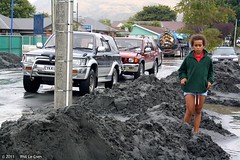
Photograph captioned by Neil Macbeth, "Members of the Student Volunteer Army clearing liquefaction in earthquake-ravaged Avonside. The Student Volunteer Army are mostly University of Canterbury students who are helping to clean up the liquefaction from Christchurch properties.