
Search
found 196 results
Images for Christchurch rebuild; more images...

Union rejects claims of illegal activity
Audio, Radio New Zealand
More on allegations from the Earthquake Commission that some contractors have been filing false invoices for work done on the Christchurch rebuild.
Japanese disaster problem for NZ government deficit
Audio, Radio New Zealand
The Japanese earthquake may have an impact on plans by the government to borrow more to meet the earthquake rebuilding in Christchurch.
Bioclimatic landscape design: improving outdoor comfort in Christchurch to…
Research papers, Lincoln University
The aftermath of three earthquakes has forced Christchurch to re-plan and rebuild. New perspectives of a sustainable city have arisen granting Christchurch the chance of becoming an example to the world. This work is centred on bioclimatic landscape design as a base for greening strategies. It deals with strategic landscape design adapted to a specific climate, from a user’s perspective. The investigation will be applied to Christchurch’s urban centres, assessing cultural adaptability to the local climate and implications for landscape design. Climatic data shows that humidity is not a local problem. However, the wind is the determinant. In Christchurch the solar radiation and the prevailing winds are the most important microclimatic variables, the latter intensifying the loss of surface heat, decreasing the radiant temperature and affecting thermal sensation. The research objective is to explore design parameters at the street-scale and identify ways to maximise thermal comfort in outdoor spaces through design-based strategies. The investigation will apply methods of participant observation, depth interviews, climatic data collection and design experimentation based on thermal comfort models and computer simulation tools. Case study sites chosen for investigation are places with current levels of activity that may be anticipated in the rebuild of the central city. The research will have two main outcomes: improved understanding of local urban culture adaptation to microclimate, and a demonstration of how design can enhance adaption. These outcomes will inform designers and city managers about good design practices and strategies that can be used to ensure a long term liveable city.
Opposition warning over possible Christchurch ministry
Audio, Radio New Zealand
Opposition parties fear a new department to control the rebuilding of Christchurch will be Wellington-centric and not allow the community to have its fair say in decisions. The Labour Party's spokesperson on the Canterbury Earthquake Recovery, Clayton Cosgrove, spoke to our political editor Brent Edwards.
New earthquake authority announced
Audio, Radio New Zealand
"Extraordinary powers for extraordinary times."The Government says that's what it's giving to the new Christchurch earthquake authority it's set up to lead the rebuild.
Photograph by Neil Macbeth 025
Images, UC QuakeStudies
Three Ngai Tahu elders speaking to workers of the Stronger Christchurch Infrastructure Rebuild Team (SCIRT) at the official opening. A camera operator is filming the speech. The ceremony was held in Burwood Park.
Photograph by Neil Macbeth 009
Images, UC QuakeStudies
Ngai Tahu elders performing a powhiri to welcome workers of the Stronger Christchurch Infrastructure Rebuild Team (SCIRT). Mayor Bob Parker is standing to the right. The ceremony was held in Burwood Park.
Parties uncertain about special tax for earthquake
Audio, Radio New Zealand
The country's political parties are uncertain about whether a special tax might be needed to help pay to rebuild Christchurch after this week's devastating earthquake.
All Blacks to play one off test for earthquake
Audio, Radio New Zealand
The All Blacks have announced this morning that they'll play an extra test match this year, to raise money for the rebuild of Christchurch.
Nisbet, Alistair, 1958- :'Okay... er... where do we rebuild?' 17 December …
Images, Alexander Turnbull Library
A helicopter from Christchurch flies over New Zealand looking for somewhere to rebuild but everywhere are notices referring to fires, floods, oily beaches, volcanoes and geysers, quakes, landslides. Nowhere seems to be safe. Quantity: 1 digital cartoon(s).
Checkpoint Top Stories for 25 February 2011
Audio, Radio New Zealand
Earthquake bus survivor, Mike Ardagh - Christchurch Hospital, Reporter Erina O'Donohue live from Christchurch, Where to obtain water, Murray McCully thanks international community, Cowles Stadium welfare centre closed, Man escapes from 12th floor of Forsyth Barr building, Aussie medics set up field hospital, Schools need significant rebuilding and Fourteen supermarkets closed in Christchurch.
Christchurch, NZ - Cashel Mall Restart
Images, eqnz.chch.2010
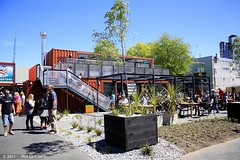
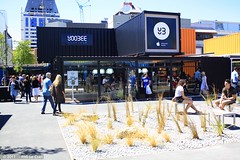
The CBD is slowly being opened up and this is the post - earthquake result of Cashel Mall. A vibrant, fresh look with high end shopping in colourful container shops. A really good step forward for the city.
Christchurch, NZ - Cashel Mall Restart
Images, eqnz.chch.2010
The CBD is slowly being opened up and this is the post - earthquake result of Cashel Mall. A vibrant, fresh look with high end shopping in colourful container shops. A really good step forward for the city.
Christchurch, NZ - Cashel Mall Restart
Images, eqnz.chch.2010
The CBD is slowly being opened up and this is the post - earthquake result of Cashel Mall. A vibrant, fresh look with high end shopping in colourful container shops. A really good step forward for the city.
Christchurch, NZ - Cashel Mall Restart
Images, eqnz.chch.2010
The CBD is slowly being opened up and this is the post - earthquake result of Cashel Mall. A vibrant, fresh look with high end shopping in colourful container shops. A really good step forward for the city.
Christchurch, NZ - Cashel Mall Restart
Images, eqnz.chch.2010
The CBD is slowly being opened up and this is the post - earthquake result of Cashel Mall. A vibrant, fresh look with high end shopping in colourful container shops. A really good step forward for the city.
Christchurch, NZ - Cashel Mall Restart
Images, eqnz.chch.2010
The CBD is slowly being opened up and this is the post - earthquake result of Cashel Mall. A vibrant, fresh look with high end shopping in colourful container shops. A really good step forward for the city.
Photograph by Neil Macbeth 003
Images, UC QuakeStudies
Earthquake Minister, Gerry Brownlee, speaking to Reverend Peter Beck at the Stronger Christchurch Infrastructure Rebuild Team (SCIRT) opening. The ceremony was held in Burwood Park. Workers in florescent vests are standing in the background.
Photograph by Neil Macbeth 020
Images, UC QuakeStudies
Reverend Peter Beck leading a prayer at the Stronger Christchurch Infrastructure Rebuild Team (SCIRT) opening. Mayor Bob Parker is standing to the right of Reverend Peter Beck. The ceremony was held in Burwood Park.
SCIRT Investigations presentation
Articles, UC QuakeStudies
A pdf copy of a PowerPoint presentation prepared for the Christchurch City Council and CPG New Zealand, providing an overview of the investigation work completed.
Body, Guy Keverne, 1967-:'Oh do stop fretting everybody - Christchurch wil…
Images, Alexander Turnbull Library
Several months after the Canterbury earthquakes the Minister for the Redevelopment of Christchurch, Gerry Brownlee, tells people in Christchurch to stop fretting as 'Christchurch will still be a very English looking city'. He refers to several rebuilding options that imitate English cities. Quantity: 1 digital cartoon(s).
Demand for temporary homes expected to be high in Chch
Audio, Radio New Zealand
Demand for temporary accommodation in Christchurch for earthquake evacuees is expected to be intense once the rebuild work kicks into action in coming months - despite a slow start.
Alliance Agreement Objectives
Articles, UC QuakeStudies
An extract from SCIRT's Alliance Agreement, detailing SCIRT's objectives.
Commercial managers' presentation
Articles, UC QuakeStudies
A detailed presentation prepared by SCIRT IST's commercial manager to inform Delivery Team commercial managers about the processes and requirements relating to SCIRT's commercial model.
SCIRT asset assessment request process
Articles, UC QuakeStudies
A diagram which illustrates SCIRT's asset assessment request process.
IRMO to SCIRT Transition Management Plan
Articles, UC QuakeStudies
A plan which describes how the transition from the IRMO programme to the SCIRT programme will take place after the signing of the Alliance Agreement.
Global Archaeology Authority - Lyttelton
Articles, UC QuakeStudies
An authority granted by the New Zealand Historic Places Trust, providing the authority to carry out earthquake repair work that may affect archaeological sites within the Lyttelton area.
Alliance Agreement Schedule 7: Terms of Compensation
Articles, UC QuakeStudies
An extract from SCIRT's Alliance Agreement, detailing the terms of compensation.
Photograph by Neil Macbeth 015
Images, UC QuakeStudies
A powhiri performed by Ngai Tahu elders to welcome workers of the Stronger Christchurch Infrastructure Rebuild Team (SCIRT). Phil Goff is standing in the centre of the group that is being welcomed. The ceremony was held in Burwood Park.
Green Party proposes nationwide earthquake levy
Audio, Radio New Zealand
The Green Party has spelt out how it would impose an earthquake levy on higher earning taxpayers, to fund the rebuild of Christchurch, if it becomes part of the next Government.