
Search
found 2110 results
Images for CANTERBURY EARTHQUAKE; more images...


Diary of the Canterbury Cultural Collections Recovery Centre Intern: Month…
Articles, UC QuakeStudies
A blog post from Moya Sherriff about her eighth month as Intern for the Canterbury Cultural Collections Recovery Centre (CCCRC). In this post Sherriff interviews staff of the Kaiapoi Museum about losing their museum building following the Canterbury earthquakes, and moving their collections into the Canterbury Cultural Collections Recovery Centre. This blog post was downloaded on 18 November 2014.
Footpath cracks next to Rydal Park.
Images, eqnz.chch.2010
Sand volcanoes put the silt all over the road.
sand volcano crater
Images, eqnz.chch.2010
An usual thing to see coming from the ground in Hoon Hay, Christchurch.
BeckerFraserPhotos March 2012 photograph 153
Images, UC QuakeStudies
A worker in a high visibility vest and a hard hat repairing and strengthening the outside of a building at the University of Canterbury. The photograph has been captioned by BeckerFraserPhotos, "The repair work on the buildings at the University of Canterbury looks similar to the scenes in the CBD".
New Zealand Defence Force photograph 656
Images, UC QuakeStudies
A vehicle and caravan being unloaded from the HMNZS Canterbury. The Royal New Zealand Navy delivered machinery and equipment to Christchurch for use in the recovery effort after the Christchurch Earthquake.
Christchurch CBD
Images, eqnz.chch.2010
None
Post-Earthquake Real Estate Decision-Making : Repair or Replace?
Research papers, University of Canterbury Library
Many buildings with relatively low damage from the 2010-2011 Canterbury were deemed uneconomic to repair and were replaced [1,2]. Factors that affected commercial building owners’ decisions to replace rather than repair, included capital availability, uncertainty with regards to regional recovery, local market conditions and ability to generate cash flow, and repair delays due to limited property access (cordon). This poster provides a framework for modeling decision-making in a case where repair is feasible but replacement might offer greater economic value – a situation not currently modeled in engineering risk analysis.
Elizabeth Ackermann Photograph 346
Images, UC QuakeStudies
A photograph of a laminated image tied to the fencing around Cathedral Square. The image depicts the ChristChurch Cathedral as it looked before the Canterbury earthquakes.
BeckerFraserPhotos April 2011 photograph 488
Images, UC QuakeStudies
Tents set up in the Arts car park at the University of Canterbury after the 22 February 2011 earthquake. The tents were used as temporary lecture rooms while the buildings were being checked for damage.
BeckerFraserPhotos April 2011 photograph 479
Images, UC QuakeStudies
Tents set up in the Arts car park at the University of Canterbury after the 22 February 2011 earthquake. The tents were used as temporary lecture rooms while the buildings were being checked for damage.
Rebekah Rogers WEMO Photograph 113
Images, UC QuakeStudies
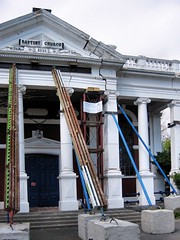
A photograph of the earthquake damage to the Canterbury Provincial Chambers. The top section of the building has crumbled, taking the scaffolding with it. Wire fencing has been placed around the building as a cordon.
BeckerFraserPhotos April 2011 photograph 478
Images, UC QuakeStudies
Tents set up in the Arts car park at the University of Canterbury after the 22 February 2011 earthquake. The tents were used as temporary lecture rooms while the buildings were being checked for damage.
The SCIRT Innovation Project
Articles, UC QuakeStudies
A report created by the University of Canterbury Quake Centre and the University of Auckland, funded by the Building Research Levy. It shows how an innovation process was initiated and managed throughout the rebuilding of the horizontal infrastructure after the Canterbury earthquakes.
Paul collecting stories
Images, eqnz.chch.2010
File reference: CCL-2011-11-22-IMG_0784 PODattheShow November2011 From the collection of Christchurch City Libraries.
UC Civil and Natural Resources Engineering Photograph 002
Images, UC QuakeStudies
A photograph of the earthquake damage to a brick chimney.
New Zealand Defence Force photograph 652
Images, UC QuakeStudies
A truck carrying a generator being unloaded from the HMNZS Canterbury. The Royal New Zealand Navy delivered machinery and equipment to Christchurch for use in the recovery effort after the Christchurch Earthquake.
New Zealand Defence Force photograph 653
Images, UC QuakeStudies
A truck carrying a generator being unloaded from the HMNZS Canterbury. The Royal New Zealand Navy delivered machinery and equipment to Christchurch for use in the recovery effort after the Christchurch Earthquake.
UC Civil and Natural Resources Engineering Photograph 098
Images, UC QuakeStudies
A photograph of the Civil Suite at the University of Canterbury after the 4 September 2010 earthquake. The photograph was taken on the day when the staff were allowed to return to the building.
BeckerFraserPhotos April 2011 photograph 480
Images, UC QuakeStudies
A tent set up in the Arts car park at the University of Canterbury after the 22 February 2011 earthquake. The tents were used as temporary lecture rooms while the buildings were being checked for damage.
PHYSICAL AND FUNCTIONAL PERFORMANCE OF THE TELECOMMUNICATION INFRASTRUCTUR…
Research papers, University of Canterbury Library
The operation of telecommunication networks is critical during business as usual times, and becomes most vital in post-disaster scenarios, when the services are most needed for restoring other critical lifelines, due to inherent interdependencies, and for supporting emergency and relief management tasks. In spite of the recognized critical importance, the assessment of the seismic performance for the telecommunication infrastructure appears to be underrepresented in the literature. The FP6 QuakeCoRE project “Performance of the Telecommunication Network during the Canterbury Earthquake Sequence” will provide a critical contribution to bridge this gap. Thanks to an unprecedented collaboration between national and international researchers and highly experienced asset managers from Chorus, data and evidences on the physical and functional performance of the telecommunication network after the Canterbury Earthquakes 2010-2011 have been collected and collated. The data will be processed and interpreted aiming to reveal fragilities and resilience of the telecommunication networks to seismic events
012
Images, eqnz.chch.2010
Shipping containers against the cliff on the road to Sumner, Christchurch. File reference: CCL-2012-05-12-Around-Sumner-May-2012 DSC_012.JPG From the collection of Christchurch City Libraries.
BeckerFraserPhotos March 2011 photograph 046
Images, UC QuakeStudies
Construction materials outside a house on Canterbury Street in Lyttelton. The house is being demolished after the 22 February 2011 earthquake. Wire fencing and road cones cordon off the area, and a bulldozer and a digger are parked on the road.
BeckerFraserPhotos March 2012 photograph 198
Images, UC QuakeStudies
Photograph captioned by BeckerFraserPhotos, "Jeremy Stewart of Alice in Videoland holding 'When a City Falls', the film recently released about the 2010 and 2011 Canterbury earthquakes".
New Zealand Defence Force photograph 516
Images, UC QuakeStudies
Kao Wei Liang, Team Leader of the Taiwan USAR team, being farewelled at the Christchurch International Airport after helping out with the emergency response to the Canterbury Earthquake.
Closeup of the booth
Images, eqnz.chch.2010
File reference: CCL-2011-11-22-IMG_0783PODattheShow November2011 From the collection of Christchurch City Libraries.
UC Civil and Natural Resources Engineering Photograph 166
Images, UC QuakeStudies
A photograph of an earthquake-damaged bridge over the Kaiapoi River.
UC Civil and Natural Resources Engineering Photograph 164
Images, UC QuakeStudies
A photograph of an earthquake-damaged bridge over the Kaiapoi River.
UC Civil and Natural Resources Engineering Photograph 165
Images, UC QuakeStudies
A photograph of an earthquake-damaged bridge over the Kaiapoi River.
sand volcano
Images, eqnz.chch.2010
Laura, Nicola, and Debra watch a sand volcano build in the Wyn Street gutter.
Cockatiel down!
Images, eqnz.chch.2010
Bruce and his cage were sitting on top of the small wooden table on the right before the earthquake. He was understandably alarmed.