
Search
found 2110 results
Images for CANTERBURY EARTHQUAKE; more images...


The Local Science Response to the 4 September 2010 Canterbury Earthquake
Articles, UC QuakeStudies
PDF slides from a presentation given by Dr. Thomas Wilson from the UC Geology department on 22 November 2010. The presentation was delivered at a GeoNZ conference in Auckland.
Container Love Close-Up
Images, eqnz.chch.2010
Container Love: shipping container decorated with knitted and crocheted squares. Sumner, Christchurch. File reference: CCL-2012-05-12-Around-Sumner-May-2012 DSC_026.JPG From the collection of Christchurch City Libraries.
Temporary eateries, Sumner
Images, eqnz.chch.2010
Temporary eateries in Sumner, Christchurch File reference: CCL-2012-05-12-Around-Sumner-May-2012 DSC_040.JPG From the collection of Christchurch City Libraries.
Container Love Close-Up
Images, eqnz.chch.2010
Container Love: shipping container decorated with knitted and crocheted squares. Sumner, Christchurch. File reference: CCL-2012-05-12-Around-Sumner-May-2012 DSC_031.JPG From the collection of Christchurch City Libraries.
Sumner Library
Images, eqnz.chch.2010
Sumner Library (currently closed), in Sumner, Christchurch File reference: CCL-2012-05-12-Around-Sumner-May-2012 DSC_038.JPG From the collection of Christchurch City Libraries.
Temporary eateries, Sumner
Images, eqnz.chch.2010
Temporary eateries in Sumner, Christchurch File reference: CCL-2012-05-12-Around-Sumner-May-2012 DSC_042.JPG From the collection of Christchurch City Libraries.
Paul on duty at the show
Images, eqnz.chch.2010
File reference: CCL-2011-11-22-378725_10150525003098054_95658493053_10354724_499732666_n PODattheShow November2011 From the collection of Christchurch City Libraries.
Container Love Close-Up
Images, eqnz.chch.2010
Container Love: shipping container decorated with knitted and crocheted squares. Sumner, Christchurch. File reference: CCL-2012-05-12-Around-Sumner-May-2012 DSC_028.JPG From the collection of Christchurch City Libraries.
Container Love Close-Up
Images, eqnz.chch.2010
Container Love: shipping container decorated with knitted and crocheted squares. Sumner, Christchurch. File reference: CCL-2012-05-12-Around-Sumner-May-2012 DSC_032.JPG From the collection of Christchurch City Libraries.
Poseidon Restaurant, Sumner
Images, eqnz.chch.2010
Poseidon Restaurant (currently closed), Sumner, Christchurch File reference: CCL-2012-05-12-Around-Sumner-May-2012 DSC_043.JPG From the collection of Christchurch City Libraries.
Sumner Library
Images, eqnz.chch.2010
Sumner Library (currently closed), in Sumner, Christchurch File reference: CCL-2012-05-12-Around-Sumner-May-2012 DSC_037.JPG From the collection of Christchurch City Libraries.
New Zealand Defence Force photograph 393
Images, UC QuakeStudies
An aerial view of Lyttelton a week after the 22 February 2011 earthquake. The HMZNS Canterbury, HMNZS Otago and HMNZS Pukaki can be seen in the Lyttelton Port.
New Zealand Defence Force photograph 392
Images, UC QuakeStudies
An aerial view of Lyttelton a week after the 22 February 2011 earthquake. The HMZNS Canterbury, HMNZS Otago and HMNZS Pukaki can be seen in the Lyttelton Port.
New Zealand Defence Force photograph 391
Images, UC QuakeStudies
An aerial view of Lyttelton a week after the 22 February 2011 earthquake. The HMZNS Canterbury, HMNZS Otago and HMNZS Pukaki can be seen in the Lyttelton Port.
New Zealand Defence Force photograph 387
Images, UC QuakeStudies
An aerial view of Lyttelton a week after the 22 February 2011 earthquake. The HMZNS Canterbury, HMNZS Otago and HMNZS Pukaki can be seen in the Lyttelton Port.
WEMO ERT Set 3 - February 2011 - Photograph 107
Images, UC QuakeStudies
A photograph of the earthquake damage to the Canterbury Television Building on Gloucester Street. There are large cracks in the columns of the building and many of the windows are broken.
Elizabeth Ackermann Photograph 121
Images, UC QuakeStudies
A photograph of a statue lying on planks of wood outside the Canterbury Museum. The statue fell during the 22 February 2011 earthquake, and the head broke off. A message on the exposed neck reads, "My head is at Christ College".
UC Civil and Natural Resources Engineering Photograph 131
Images, UC QuakeStudies
A photograph of a toppled filing cabinet in an office in the Department of Civil and Natural Resources Engineering at the University of Canterbury, after the 4 September 2010 earthquake.
UC Civil and Natural Resources Engineering Photograph 129
Images, UC QuakeStudies
A photograph of a toppled filing cabinet in an office in the Department of Civil and Natural Resources Engineering at the University of Canterbury, after the 4 September 2010 earthquake.
Sand volcanos cover Rydal Street
Images, eqnz.chch.2010
This has made a huge mess for the residents to clean up. I heard on the news that homes have been damaged by subsidence in areas of earthquake-caused liquefaction like this.
neighbours survey the sand volcanos
Images, eqnz.chch.2010
Lots of people were out and about in the streets checking on everyone after the earthquake. When it was clear that everyone was OK, the sand volcanos became the feature of interest.
Simulation of site amplification effects at Heathcote Valley during the 20…
Research papers, University of Canterbury Library
Heathcote Valley school strong motion station (HVSC) consistently recorded ground motions with higher intensities than nearby stations during the 2010-2011 Canterbury earthquakes. For example, as shown in Figure 1, for the 22 February 2011 Christchurch earthquake, peak ground acceleration at HVSC reached 1.4 g (horizontal) and 2 g (vertical), the largest ever recorded in New Zealand. Strong amplification of ground motions is expected at Heathcote Valley due to: 1) the high impedance contrast at the soil-rock interface, and 2) the interference of incident and surface waves within the valley. However, both conventional empirical ground motion prediction equations (GMPE) and the physics-based large scale ground motions simulations (with empirical site response) are ineffective in predicting such amplification due to their respective inherent limitations.
BeckerFraserPhotos April 2011 photograph 489
Images, UC QuakeStudies
Tents set up in the Arts car park at the University of Canterbury after the 22 February 2011 earthquake. The tents were used as temporary lecture rooms while the buildings were being checked for damage.
BeckerFraserPhotos April 2011 photograph 477
Images, UC QuakeStudies
Tents set up in the Arts car park at the University of Canterbury after the 22 February 2011 earthquake. The tents were used as temporary lecture rooms while the buildings were being checked for damage.
Umut Akguzel Photograph 124
Images, UC QuakeStudies
A photograph of two workers walking down Gloucester Street. To the right, the earthquake-damaged Canterbury Times and Star Building can be seen. A car parked in front has been crushed by falling debris.
Elizabeth Ackermann Photograph 342
Images, UC QuakeStudies
A photograph of a laminated image tied to the fencing around Cathedral Square. The image depicts the Citizen's Memorial as it looked before the Canterbury earthquakes.
GEER Association Aerial Photograph 187
Images, UC QuakeStudies
A photograph of the helicopter used by a team from Geotechnical Extreme Events Reconnaissance (GEER) to take aerial photographs of Canterbury following the 4 September earthquake.
WEMO ERT Set 3 - February 2011 - Photograph 114
Images, UC QuakeStudies
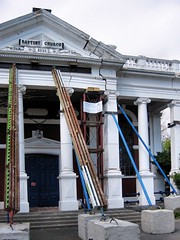
A photograph of the earthquake damage to the Canterbury Provincial Chambers Buildings on Durham Street. Large sections of the masonry have collapsed, spilling onto the road. Wire fencing has been placed around the building as a cordon. Scaffolding erected up the side of the building after the 4 September 2010 earthquake has collapsed. In the distance, a crane is parked on the street.
Performance of Masonry Buildings in the Canterbury Earthquakes and Corresp…
Research papers, The University of Auckland Library
It is well known that buildings constructed using unreinforced masonry (URM) are susceptible to damage from earthquake induced lateral forces that may result in partial or full building collapse. The 2010/2011 Canterbury earthquakes are the most recent New Zealand example of destructive earthquakes, which have drawn people's attention to the inherent seismic weaknesses of URM buildings and anchored masonry veneer systems in New Zealand. A brief review of the data collected following the 2010 Darfield earthquake and more comprehensive documentation of data that was collected following the 2011 Christchurch earthquake is presented, along with the findings from subsequent data interrogation. Large stocks of earthquake prone vintage URM buildings that remain in New Zealand and in other seismically active parts of the world result in the need for minimally invasive and cost effective seismic retrofit techniques. The principal objective of the doctoral research reported herein was to investigate the applicability of near surface mounted (NSM) carbon fibre reinforced polymer (CFRP) strips as a seismic improvement technique. A comprehensive experimental program consisting of 53 pull tests is presented and is used to assess the accuracy of existing FRP-to-masonry bond models, with a modified model being proposed. The strength characteristics of vintage clay brick URM wall panels from two existing URM buildings was established and used as a benchmark when manufacturing replica clay brick test assemblages. The applicability of using NSM CFRP strips as a retrofitting technique for improving the shear strength and the ductility capacity of multi-leaf URM walls constructed using solid clay brick masonry is investigated by varying CFRP reinforcement ratios. Lastly, an experimental program was undertaken to validate the proposed design methodology for improving the strength capacity of URM walls. The program involved testing full-scale walls in a laboratory setting and testing full-scale walls in-situ in existing vintage URM buildings. Experimental test results illustrated that the NSM CFRP technique is an effective method to seismically strengthen URM buildings.
Diary of the Canterbury Cultural Collections Recovery Centre Intern: Month…
Articles, UC QuakeStudies
A blog post from Moya Sherriff about her eighth month as Intern for the Canterbury Cultural Collections Recovery Centre (CCCRC). In this post Sherriff interviews staff of the Kaiapoi Museum about losing their museum building following the Canterbury earthquakes, and moving their collections into the Canterbury Cultural Collections Recovery Centre. This blog post was downloaded on 18 November 2014.