
Search
found 6322 results
Images for CANTERBURY EARTHQUAKE; more images...

Christchurch Central Development Unit.
Other, National Library of New Zealand
Site of CCDU, the Government agency responsible for rebuilding Christchurch after the earthquakes and resulting demolition. Includes vision for the city, profile of the director, reasons to invest in Christchurch central, work programme for the unit, and video file.
$27million spent on earthquake strengthening bridges
Audio, Radio New Zealand
The transport agency says its earthquake strengthening of bridges has repaid itself in Canterbury after September's quake.
Earthquake Commission looks at increasing size of fraud team
Audio, Radio New Zealand
The Earthquake Commission is looking at increasing the size of the team investigating fraudalent claims in Canterbury.
SPCA Canterbury Photograph 21
Images, UC QuakeStudies
A photograph of members of SPCA Canterbury conducting a meeting in the Rescue Coordination Centre after the 22 February 2011 earthquake.
Road crack - Christchurch earthquake
Images, eqnz.chch.2010
20100904_3308_1D3-24 Road crack - Christchurch earthquake Outside our house after the 7.1 Richter Canterbury earthquake on September 4 2010 #369
Christchurch Earthquake 22/02/11
Images, eqnz.chch.2010
None
Christchurch Earthquake 22/02/11
Images, eqnz.chch.2010
None
Christchurch Earthquake 22/02/11
Images, eqnz.chch.2010
None
Christchurch Earthquake 22/02/11
Images, eqnz.chch.2010
None
Christchurch Earthquake 22/02/11
Images, eqnz.chch.2010
Armagh Street Bridge.
Christchurch Earthquake 22/02/11
Images, eqnz.chch.2010
Cathedral Square.
Christchurch Earthquake 22/02/11
Images, eqnz.chch.2010
Manchester Street
Christchurch Earthquake 22/02/11
Images, eqnz.chch.2010
New Regent Street
Christchurch Earthquake 22/02/11
Images, eqnz.chch.2010
Victoria Square.
Christchurch Earthquake 22/02/11
Images, eqnz.chch.2010
None
Christchurch Earthquake 22/02/11
Images, eqnz.chch.2010
None
Emma Butler's Story
Articles, UC QuakeStudies
Summary of oral history interview with Emma Butler about her experiences of the Canterbury earthquakes.
SPCA Canterbury Photograph 25
Images, UC QuakeStudies
A photograph of members of Massey University's Veterinary Emergency Response Team (VERT) working in the central city red zone after the 22 February 2011 earthquake. VERT travelled to Christchurch after the 22 February 2011 earthquake in order to assist with caring for animals. Each member is wearing a hard hat, face masks, and a head lamp.
Nisbet, Alistair, 1958- :Slow progress after Christchurch earthquakes. 19 …
Images, Alexander Turnbull Library
Two men chat over the fence about the state of their houses after the 4th September earthquake in Christchurch. One of them is complaining about the slow pace of reconstruction of houses after the magnitude 7.1 earthquake on 4 September 2010; the second man thinks they are doing their best. Context - Frustration over the slow rate of processing insurance applications and building inspections after the magnitude 7.1 earthquake on 4 September 2010 which although it resulted in a lot of damage, no-one died. In the cartoon the man's red sticker (meaning the house is uninhabitable) has faded to green after being put on the house after the September earthquake. Three days after this cartoon was published the much more disastrous earthquake of the 22nd February struck and many people died. Quantity: 1 digital cartoon(s).
Canterbury from the air... AFTERSHOCKS. 6 September 2010
Images, Alexander Turnbull Library
The word 'AFTERSHOCKS' appears printed across the Canterbury landscape. Text reads 'Canterbury from the air...' Refers to the earthquake of 4th September and the frequent aftershocks that continued for at least two weeks. Quantity: 1 digital cartoon(s).
Digital Photograph: Corner of London and Canterbury Streets, Lyttelton
Images, Canterbury Museum
One landscape colour digital photograph taken on 19 November 2011 showing the corner of London and Canterbury Streets. Visible in the photograph (left to right) are the Lyttelton Library, Freemans Dining Room, Ray White Real Estate and Min Sargison Real Estate on London Street. The photograph is looking to the southeast. The site of the Timebal...
Digital Photograph: Lyttelton Bakery, corner Norwich Quay and Canterbury S…
Images, Canterbury Museum
One landscape colour digital photograph taken on 19 November 2011 showing the temporary premises of Lyttelton Bakery in a relocatable building on Norwich Quay. The building is located on the site of the Royal Hotel. Also visible in the photograph are (left to right up Canterbury Street) Lyttelton Service Station, Samo, Lyttelton Telephone Exchan...
Families attend Chch earthquake memorial unveiling
Audio, Radio New Zealand
The Canterbury Earthquake National Memorial was unveiled to the public at a memorial attended by more than 3000 people.
Photo 015
Images, UC QuakeStudies
Large cracks on a street in Avonside barred off with police tape after the September 4th earthquake.
Photo 016
Images, UC QuakeStudies
Large cracks on a street in Avonside barred off with police tape after the September 4th earthquake.
Photo 004
Images, UC QuakeStudies
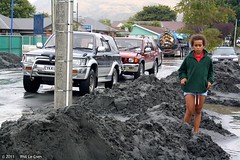
Liquefaction dug out of properties and piled on the streets in Avonside after the September 4th earthquake.
Photo 025
Images, UC QuakeStudies
Cones marking a crack in the centre of a street in Avonside after the September 4th earthquake.
Photo 052
Images, UC QuakeStudies
Cracks in the parking lot in front of a store in Kaiapoi, after the September 4th earthquake.
Photo 063
Images, UC QuakeStudies
Liquefaction and damage to tiles in front of a store in Kaiapo, after the September 4th earthquake.
The Spatial and Temporal Patterns of Anxiety and Chest Pain Resulting From…
Research papers, University of Canterbury Library
The aim of this thesis was to examine the spatial and the temporal patterns of anxiety and chest pain resulting from the Canterbury, New Zealand earthquaeks. Three research objectives were identified: examine any spatial or termporal clusters of anxiety and chest pain; examine the associations between anxiety, chest pain and damage to neighbourhood; and determine any statistically significant difference in counts of anxiety and chest pain after each earthquake or aftershock which resulted in severe damage. Measures of the extent of liquefaction the location of CERA red-zones were used as proxy measures for earthquake damage. Cases of those who presented to Christchurch Public Hospital Emergency Department with either anxiety or chest pain between May 2010 and April 2012 were aggregated to census area unit (CAU) level for analysis. This thesis has taken a unique approach to examining the spatial and spatio-temporal variations of anxiety and chest pain after an earthquake and offers unique results. This is the first study of its kind to use a GIS approach when examining Canterbury specific earthquake damage and health variables at a CAU level after the earthquakes. Through the use of spatio-termporal scan modelling, negative and linear regression modelling and temporal linear modelling with dummy variables this research was able to conclude there are significant spatial and temporal variations in anxiety and chest pain resulting from the earthquakes. The spatio-termporal scan modelling identified a hot cluster of both anxiety and chest pain within Christchurch at the same time the earthquakes occurred. The negative binomial model found liquefaction to be a stronger predictor of anxiety than the Canterbury Earthquake Recovery Authority's (CERA) land zones. The linear regression model foun chest pain to be positively associated with all measures of earthquake damage with the exception of being in the red-zone. The temporal modelling identified a significant increase in anxiety cases one month after a major earthquake, and chest pain cases spiked two weeks after an earthquake and gradually decreased over the following five weeks. This research was limited by lack of control period data, limited measures of earthquake damage, ethical restrictions, and the need for population tracking data. The findings of this research will be useful in the planning and allocation of mental wellbeing resources should another similar event like the Canterbury Earthquakes occur in New Zealand.