

Search
found 2009 results
Images for Earthquake Services; more images...

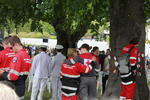
Photograph by Neil Macbeth 717
Images, UC QuakeStudies
Reverend Peter Beck speaking at the Christchurch Earthquake Memorial Service. A sign language interpreter is standing to the right. The service was held in Hagley Park on 18 March 2011.
Mt Pleasant news.
Other, National Library of New Zealand
Blog providing information for residents of the Christchurch suburb of Mt Pleasant following the earthquakes. Includes news, information on basic services, and contacts for help and advice.
Canterbury Earthquake - David Neal
Audio, Radio New Zealand
David Neal is the national programmes manager for the Red Cross. The Christchurch Red Cross response team is out with the fire service, searching buildings for people who might be trapped.
Fire Service busy in Christchurch
Audio, Radio New Zealand
The Fire Service still has a big job to do in Christchurch following the February 22nd earthquake, but their role is slowly changing.
CoCA : Centre of Contemporary Art.
Other, National Library of New Zealand
Christchurch gallery’s collections, exhibitions and services. Includes featured articles from CoCa Magazine. Includes coverage
Christchurch mental health services struggle with demand
Audio, Radio New Zealand
The number of emergency psychiatric assessments in Christchurch has more than doubled since the earthquakes struck.
Christchurch Cathedral.
Other, National Library of New Zealand
Information on events, weekly services, music, history and architecture, news and newsletters and current and archived sermons. Includes both pre-earthquake information, and current life of the cathedral.
Canterbury Health System Earthquake Memories, Story 18: A sonographer's st…
Articles, UC QuakeStudies
An earthquake memories story from Rex de Ryke, Charge Sonographer, Radiology Service, titled, "A sonographer's story".
Canterbury Health System Earthquake Memories, Story 07: Staff absolutely f…
Articles, UC QuakeStudies
An earthquake memories story from Chris Drennan, Respiratory Services Physician, Christchurch Hospital, titled, "Staff absolutely focussed".
Pull-Out Behavior of Adhesive Connections in Unreinforced Masonry Walls
Research papers, The University of Auckland Library
The connections between walls of unreinforced masonry (URM) buildings and flexible timber diaphragms are critical building components that must perform adequately before desirable earthquake response of URM buildings may be achieved. Field observations made during the initial reconnaissance and the subsequent damage surveys of clay brick URM buildings following the 2010/2011 Canterbury, New Zealand, earthquakes revealed numerous cases where anchor connections joining masonry walls or parapets with roof or floor diaphragms appeared to have failed prematurely. These observations were more frequent for adhesive anchor connections than for through-bolt connections (i.e., anchorages having plates on the exterior facade of the masonry walls). Subsequently, an in-field test program was undertaken in an attempt to evaluate the performance of adhesive anchor connections between unreinforced clay brick URM walls and roof or floor diaphragm. The study consisted of a total of almost 400 anchor tests conducted in eleven existing URM buildings located in Christchurch, Whanganui and Auckland. Specific objectives of the study included the identification of failure modes of adhesive anchors in existing URM walls and the influence of the following variables on anchor load-displacement response: adhesive type, strength of the masonry materials (brick and mortar), anchor embedment depth, anchor rod diameter, overburden level, anchor rod type, quality of installation, and the use of metal mesh sleeves. In addition, the comparative performance of bent anchors (installed at an angle of minimum 22.5° to the perpendicular projection from the wall surface) and anchors positioned horizontally was investigated. Observations on the performance of wall-to-diaphragm connections in the 2010/2011 Canterbury earthquakes, a summary of the performed experimental program and test results, and a proposed pull-out capacity relationship for adhesive anchors installed into multi-leaf clay brick masonry are presented herein AM - Accepted Manuscript
Full waveform seismic tomography for geological velocity model in Canterbu…
Research papers, University of Canterbury Library
Memorial service marks 10th anniversary
Audio, Radio New Zealand
A civic memorial service was held at 12.30pm on the north bank of Oi Manawa, Canterbury National Earthquake Memorial.
Systematic ground motion observations in the Canterbury earthquakes
Research papers, University of Canterbury Library
Christchurch Press Image: Stacy Squires, 2011:02:22 17:39:35
Images, UC QuakeStudies
Photograph captioned by Fairfax, "Earthquake damage in central Christchurch after a 6.3 earthquake. Emergency services set up in Latimer Square".
Christchurch Press Image: Stacy Squires, 2011:02:22 17:38:16
Images, UC QuakeStudies
Photograph captioned by Fairfax, "Earthquake damage in central Christchurch after a 6.3 earthquake. Emergency services set up in Latimer Square".
New Zealand Defence Force photograph 677
Images, UC QuakeStudies
Members of the Christchurch earthquake emergency services personnel dining in the Moveable Feasts marquee in Latimer Square. After the 22 February 2011 earthquake, emergency service agencies set up their headquarters in Latimer Square.
New Zealand Defence Force photograph 679
Images, UC QuakeStudies
Members of the Christchurch earthquake emergency services personnel dining in the Moveable Feasts marquee in Latimer Square. After the 22 February 2011 earthquake, emergency service agencies set up their headquarters in Latimer Square.
New Zealand Defence Force photograph 678
Images, UC QuakeStudies
Members of the Christchurch earthquake emergency services personnel dining in the Moveable Feasts marquee in Latimer Square. After the 22 February 2011 earthquake, emergency service agencies set up their headquarters in Latimer Square.
New Zealand Defence Force photograph 676
Images, UC QuakeStudies
Members of the Christchurch earthquake emergency services personnel dining in the Moveable Feasts marquee in Latimer Square. After the 22 February 2011 earthquake, emergency service agencies set up their headquarters in Latimer Square.
Photograph by Neil Macbeth 698
Images, UC QuakeStudies
Mayor Bob Parker speaking at the Christchurch Earthquake Memorial Service, with Reverend Peter Beck to his left. The service was held in Hagley Park on 18 March 2011.
Photograph by Neil Macbeth 699
Images, UC QuakeStudies
Mayor Bob Parker speaking at the Christchurch Earthquake Memorial Service. Reverend Peter Beck is standing to the left. The service was held in Hagley Park on 18 March 2011.
Photograph by Neil Macbeth 695
Images, UC QuakeStudies
Crowds at the Christchurch Earthquake Memorial Service. More than 40,000 people attended the memorial service in Hagley Park on 18 March 2011. A banner reading, 'Rise up Christchurch' is flying above the crowd.
Photograph by Neil Macbeth 719
Images, UC QuakeStudies
Mayor Bob Parker speaking at the Christchurch Earthquake Memorial Service. A sign language interpreter is standing to the right. The service was held in Hagley Park on 18 March 2011.
Photograph by Neil Macbeth 670
Images, UC QuakeStudies
Mayor Bob Parker speaking at the Christchurch Earthquake Memorial Service. A sign language interpreter stands to the right. The service was held in Hagley Park on 18 March 2011.
Photograph by Neil Macbeth 720
Images, UC QuakeStudies
Mayor Bob Parker speaking at the Christchurch Earthquake Memorial Service. A sign language interpreter is standing to the right. The service was held in Hagley Park on 18 March 2011.
Photograph by Neil Macbeth 669
Images, UC QuakeStudies
Mayor Bob Parker speaking at the Christchurch Earthquake Memorial Service. A sign language interpreter stands to the right. The service was held in Hagley Park on 18 March 2011.
New Fire Service review into Christchurch earthquake response
Audio, Radio New Zealand
The Fire Service may have announced another investigation into its response to last year's deadly February earthquake in Christchurch, but there are already claims it won't go far enough although some feel it will indicate the need for a Royal Commission of Inquiry.
Earthquake Impacts, Organizational Resilience and Recovery of the Accommod…
Research papers, University of Canterbury Library
The purpose of this study is to analyse the felt earthquake impacts, resilience and recovery of organizations in Canterbury by comparing three business sectors (accommodation/food services, Education/Training and Manufacturing). A survey of the three sectors in 2013 of Canterbury organizations impacted by the earthquakes revealed significant differences between the three sectors on felt earthquake impacts and resilience. On recovery and mitigation factors, the accommodation/food services sector is not significantly different from the other two sectors. Overall, the survey results presented here indicate that the Accommodation/Food Services sector was the least impacted by the earthquakes in comparison to the Education/Training and Manufacturing sectors. Implications for post-disaster management and recovery of the accommodation sector are suggested.
Insuring earthquakes: How would the Californian and Japanese insurance pro…
Research papers, Victoria University of Wellington
Earthquakes are insured only with public sector involvement in high-income countries where the risk of earthquakes is perceived to be high. The proto-typical examples of this public sector involvement are the public earthquake insurance schemes in California, Japan, and New Zealand (NZ). Each of these insurance programs is structured differently, and the purpose of this paper is to examine these differences using a concrete case-study, the sequence of earthquakes that occurred in the Christchurch, New Zealand, in 2011. This event turned out to have been the most heavily insured earthquake event in history. We examine what would have been the outcome of the earthquakes had the system of insurance in NZ been different. In particular, we focus on the public earthquake insurance programs in California (the California Earthquake Authority - CEA), and in Japan (Japanese Earthquake Reinsurance - JER). Overall, the aggregate cost to the public insurer in NZ was $NZ 11.1 billion in its response to the earthquakes. If a similar-sized disaster event had occurred in Japan and California, homeowners would have received $NZ 2.5 billion and $NZ 1.4 billion from the JER and CEA, respectively. We further describe the spatial and distributive patterns of these different scenarios.
Canterbury Health System Earthquake Memories, Story 14: Masses of people
Articles, UC QuakeStudies
An earthquake memories story from Karen Carson, Team Leader Telephone Service, Christchurch Hospital, titled, "Masses of people".