

Search
found 100457 results
Images for NEW-ZEALAND; more images...
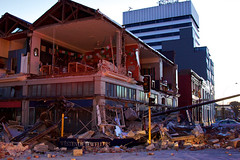


20100906-120228.jpg
Images, eqnz.chch.2010
None
20100906-120310.jpg
Images, eqnz.chch.2010
None
Going in!
Images, eqnz.chch.2010
Working at getting things out of the Victoria Square before it is demolished. www.stuff.co.nz/the-press/news/christchurch-earthquake-20... What I found on my walk around the city January 15, 2014 Ch...
Christchurch Window
Images, eqnz.chch.2010
None
Melancholy, memories and six nostalgias: Postquake Christchurch and the pr…
Research papers, Lincoln University
The city of Christchurch, New Zealand, was until very recently a “Junior England”—a small city that still bore the strong imprint of nineteenth-century British colonization, alongside a growing interest in the underlying biophysical setting and the indigenous pre-European landscape. All of this has changed as the city has been subjected to a devastating series of earthquakes, beginning in September 2010, and still continuing, with over 12,000 aftershocks recorded. One of these aftershocks, on February 22, 2011, was very close to the city center and very shallow with disastrous consequences, including a death toll of 185. Many buildings collapsed, and many more need to be demolished for safety purposes, meaning that over 80 percent of the central city will have gone. Tied up with this is the city’s precious heritage—its buildings and parks, rivers, and trees. The threats to heritage throw debates over economics and emotion into sharp relief. A number of nostalgic positions emerge from the dust and rubble, and in one form is a reverse-amnesia—an insistence of the past in the present. Individuals can respond to nostalgia in very different ways, at one extreme become mired in it and unable to move on, and at the other, dismissive of nostalgia as a luxury in the face of more pressing crises. The range of positions on nostalgia represent the complexity of heritage debates, attachment, and identity—and the ways in which disasters amplify the ongoing discourse on approaches to conservation and the value of historic landscapes.
Doyle, Martin, 1956-: Could the wrecking ball be used on structures OUTSID…
Images, Alexander Turnbull Library
Text reads 'Could the wrecking ball be used on structures outside Christchurch?' The cartoon shows Minister for the Reconstruction of Christchurch Gerry Brownlee as the wrecking ball on a crane; he says 'let the fun begin'. To one side is a large house crowded with people which represents 'the welfare state' and is surrounded by a barrier on which are printed the words 'Fiscal emergency'. Context - Gerry Brownlee is seen by many as rather too quick to demolish heritage buildings in his rush to rebuild Christchurch. The wrecking ball idea also suggests that the National government is likely to wreck the welfare state in its efforts to sort out economic problems. Quantity: 1 digital cartoon(s).
Brockie, Robert Ellison, 1932- :"But off the record to look for a quiet sp…
Images, Alexander Turnbull Library
Text reads 'Dalai Lama visits Christchurch ostensibly to sympathise with quake-hit residents'. The cartoon shows the Dalai Lama bestowing blessings on a large crowd. In an insert he is seen sitting cross-legged on top of Mount Cook saying 'But off the record I came to look for a quiet spot to retire to!' Context - The Dalai Lama visited the quake-hit city for two days in early June. He also sent a letter of condolence to Prime Minister John Key after the February 22 earthquake. Quantity: 1 digital cartoon(s).
Brockie, Robert Ellison, 1932-:'Where was that Kiwi moonman when we wanted…
Images, Alexander Turnbull Library
The cartoon shows members of the 'Japan Seismic Institute studying an earthquake graph; one of them says 'Where was that Kiwi moonman when we wanted him?' Depicted also is thew 'moonman' Ken Ring as a wizard studying an astrological chart. Behind them all Japan is depicted as a devastated wasteland. Context - the Japanese earthquake and tsunami of 4th March 2011 and the present threat of a nuclear catastrophe. Also the so-called Moon Man, astrologer Ken Ring, who predicted that Christchurch would be hit by a huge earthquake today (20 March 2011). His claims have terrified Cantabrians and led to people fleeing Christchurch. Quantity: 1 digital cartoon(s).
A framework for rapid post-earthquake assessment of bridges and restoratio…
Research papers, The University of Auckland Library
Quick and reliable assessment of the condition of bridges in a transportation network after an earthquake can greatly assist immediate post-disaster response and long-term recovery. However, experience shows that available resources, such as qualified inspectors and engineers, will typically be stretched for such tasks. Structural health monitoring (SHM) systems can therefore make a real difference in this context. SHM, however, needs to be deployed in a strategic manner and integrated into the overall disaster response plans and actions to maximize its benefits. This study presents, in its first part, a framework of how this can be achieved. Since it will not be feasible, or indeed necessary, to use SHM on every bridge, it is necessary to prioritize bridges within individual networks for SHM deployment. A methodology for such prioritization based on structural and geotechnical seismic risks affecting bridges and their importance within a network is proposed in the second part. An example using the methodology application to selected bridges in the medium-sized transportation network of Wellington, New Zealand is provided. The third part of the paper is concerned with using monitoring data for quick assessment of bridge condition and damage after an earthquake. Depending on the bridge risk profile, it is envisaged that data will be obtained from either local or national seismic monitoring arrays or SHM systems installed on bridges. A method using artificial neural networks is proposed for using data from a seismic array to infer key ground motion parameters at an arbitrary bridges site. The methodology is applied to seismic data collected in Christchurch, New Zealand. Finally, how such ground motion parameters can be used in bridge damage and condition assessment is outlined. AM - Accepted manuscript
Tremain, Garrick 1941-: "I'm bereft of ideas for the economy..." 31 March …
Images, Alexander Turnbull Library
In six small cameos Prime Minister John Key ponders over things economic and ends up dancing; he says 'I'm bereft of ideas for the economy gambling the lives of our troops in the Afghanistan mess I'm presiding over the biggest budget deficit in our history borrowing $300m a week to cushion our slide into oblivion Using lots of World Cup piffle to distract from the real issues Yet I'm still rating miles higher than Goff so how hopeless is he??? A little man in the last frame comments 'Spoiled for choice eh?' Context - New Zealand's rather dire economic situation made so much worse by the Christchurch earthquakes of 4 September 2010 and 22 February 2011, the consistently high poll rating of John Key and the series of disasters suffered by the Labour Party in the run up to the 2011 election in November. Quantity: 1 digital cartoon(s).
Empowered Christchurch Social Media Campaigns: Seismic Risk
Images, UC QuakeStudies
A poster created by Empowered Christchurch to advertise their submission to the CERA Draft Transition Recovery Plan on social media.The poster reads, "Submission, CERA Draft Transition Recovery Plan. Seismic Risk. One thing we can learn from the past is that seismic risk in Canterbury has been underestimated before the earthquakes struck. This is confirmed in a report for EQC in 1991 (paper 2005). It is also the conclusion of the Royal Commission in the CTV report. A number of recommendations have been made but not followed. For example, neither the AS/NZS 1170.5 standard nor the New Zealand Geotechnical Society guidelines have been updated. Yet another recovery instrument is the Earthquake Prone Building Act, which is still to be passed by Parliament. As the emergency response part of the recovery is now behind us, we need to ensure sustainability for what lies ahead. We need a city that is driven by the people that live in it, and enabled by a bureaucracy that accepts and mitigates risks, rather than transferring them to the most vulnerable residents."
Winter, Mark, 1958-:[Christchurch Cathedral after the earthquake] 1 March …
Images, Alexander Turnbull Library
The cartoon shows Christchurch Cathedral shattered and with its steeple gone after the earthquake on 22 February 2011. The words 'The oSCARs' (wordplay on 'Oscars' and 'scars') are in the top left corner and the text 'The worst picture' are in the centre. A second version shows an 'Oscar' statuette with a crown on its head. Context - The Christchurch earthquake 22 February 2011 and the 2011 Oscars - annual film awards. Two versions of this cartoon are available Quantity: 1 digital cartoon(s).
The Star 17 August 2011
Articles, UC QuakeStudies
A PDF copy of The Star newspaper, published on Wednesday 17 August 2011.
Christchurch Earthquake 22/02/11
Images, eqnz.chch.2010
Manchester Street looking north-ish, towards the intersection with Armagh Street.
20100908-154916.jpg
Images, eqnz.chch.2010
None
20100908-165328.jpg
Images, eqnz.chch.2010
None
20100906-150820.jpg
Images, eqnz.chch.2010
None
20100906-150906.jpg
Images, eqnz.chch.2010
None
20100908-165757.jpg
Images, eqnz.chch.2010
None
20100906-151302.jpg
Images, eqnz.chch.2010
None
20100908-153513.jpg
Images, eqnz.chch.2010
None
20100908-154847.jpg
Images, eqnz.chch.2010
None
20100908-154632.jpg
Images, eqnz.chch.2010
None
20100908-163439.jpg
Images, eqnz.chch.2010
None
20100908-164449.jpg
Images, eqnz.chch.2010
None
20100908-172539.jpg
Images, eqnz.chch.2010
None
20100906-150728.jpg
Images, eqnz.chch.2010
None
20100906-153858.jpg
Images, eqnz.chch.2010
None
20100906-121051.jpg
Images, eqnz.chch.2010
None
20100906-121116.jpg
Images, eqnz.chch.2010
None