

Search
found 100457 results
Images for NEW-ZEALAND; more images...
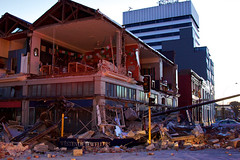


Natalie Kerschner WEMO Photograph 048
Images, UC QuakeStudies
A photograph of a fire fighter standing in front of 33 Worcester Street, now a pile of rubble after the 4 September 2010 earthquake.
Natalie Kerschner WEMO Photograph 045
Images, UC QuakeStudies
A photograph of fire fighters in front of 33 Worcester Street, now a pile of rubble after the 4 September 2010 earthquake. Fire damage can be seen on the house next door.
Natalie Kerschner WEMO Photograph 047
Images, UC QuakeStudies
A photograph of a fire fighter standing in front of 33 Worcester Street, now a pile of rubble after the 4 September 2010 earthquake. Fire damage can be seen on the house next door.
WEMO ERT Set 3 - February 2011 - Photograph 089
Images, UC QuakeStudies
A photograph looking north along Latimer Square towards Gloucester Street. A fire truck is parked on the left side of the road.
Natalie Kerschner WEMO Photograph 046
Images, UC QuakeStudies
A photograph of a fire fighter standing in front of 33 Worcester Street, now a pile of rubble after the 4 September 2010 earthquake. Fire damage can be seen on the house next door.
Canterbury Rugby Jersey: Andy Ellis
Images, Canterbury Museum
One red and black polyester Canterbury rugby jersey with sponsor logos for AMI Insurance, Tui beer, KooGa, ITM and Scenic Hotels on the front, rear and sleeves; signed on the front by halfback Andy Ellis and on the rear by the entire Canterbury team. The jersey was worn by Ellis in the free morale boosting ITM Cup match between Canterbury and We...
T-shirt: Band Together Concert for Canterbury
Images, Canterbury Museum
One white cotton t-shirt with red printed guitar logo on front and ‘Band / Together / Concert / for / Canterbury // 23rd October / Hagley Park’ in black and red writing, guitar logo and names of performers on the reverse. This concert was a free morale booster following the 4 September 2010 earthquake. The 4 September 2010 earthquake unsettled ...
BRICKS4SALE
Images, eqnz.chch.2010
None
Alternative Radio : exhibiting radio and music heritage after the Christch…
Research papers, University of Canterbury Library
This article examines the representation of Christchurch, New Zealand, student radio station RDU in the exhibition Alternative Radio at the Canterbury Museum in 2016. With the intention of ‘making visible what is invisible’ about radio broadcasting, the exhibition articulated RDU as a point of interconnection between the technical elements of broadcasting, the social and musical culture of station staff and volunteers, and the broader local and national music scenes. This paper is grounded in observations of the exhibitions and associated public programmes, and interviews with the key participants in the exhibition including the museum's exhibition designer and staff from RDU, who acted as independent practitioners in collaboration with the museum. Alternative Radio also addressed the aftermath of the major earthquake of 22 February 2011, when RDU moved into a customised horse truck after losing its broadcast studio. The exhibition came about because of the cultural resonance of the post-quake story, but also emphasised the long history of the station before that event, and located this small student radio station in the broader heritage discourse of the Canterbury museum, activating the historical, cultural, and personal memories of the station's participants and audiences.
Christchurch: Creating a World-Class Cycling Network in a Transition City
Research papers, University of Canterbury Library
The New Zealand city of Christchurch suffered a series of devastating earthquakes in 2010-11 that changed the urban landscape forever. A new rebuilt city is now underway, largely based on the expressed wishes of the populace to see Christchurch return to being a more people-oriented, cycle-friendly city that it was known for in decades past. Currently 7% of commuters cycle to work, supported by a 200km network of mostly conventional on-road painted cycle lanes and off-road shared paths. The new "Major Cycleways" plan aims to develop approximately 100km of high-quality cycling routes throughout the city in 5-7 years. The target audience is an unaccompanied 10-year-old cycling, which requires more separated cycleways and low-volume/speed "neighbourhood greenways" to meet this standard. This presentation summarises the steps undertaken to date to start delivering this network. Various pieces of research have helped to identify the types of infrastructure preferred by those currently not regularly cycling, as well as helping to assess the merits of different route choices. Conceptual cycleway guidelines have now been translated into detailed design principles for the different types of infrastructure being planned. While much of this work is based on successful designs from overseas, including professional advice from Dutch practitioners, an interesting challenge has been to adapt these designs as required to suit local road environments and road user expectations. The first parts of the new network are being rolled out now, with the hope that this will produce an attractive and resilient network for the future population that leads to cycling being a major part of the local way of life.
Regional Differences in the Psychological Recovery of Christchurch Residen…
Research papers, University of Canterbury Library
We examined changes in psychological distress experienced by residents of Christchurch following two catastrophic earthquakes in late 2010 and early 2011, using data from the New Zealand Attitudes and Values Study (NZAVS), a national probability panel study of New Zealand adults. Analyses focused on the 267 participants (172 women, 95 men) who were living in central Christchurch in 2009 (i.e., before the Christchurch earthquakes), and who also provided complete responses to our yearly panel questionnaire conducted in late 2010 (largely between the two major earthquakes), late 2011, and late 2012. Levels of psychological distress were similar across the different regions of central Christchurch immediately following the September 2010 earthquake, and remained comparable across regions in 2011. By late 2012, however, average levels of psychological distress in the regions had diverged as a function of the amount of property damage experienced within each given region. Specifically, participants in the least damaged region (i.e., the Fendalton-Waimairi and Riccarton-Wigram wards) experienced greater drops in psychological distress than did those in the moderately damaged region (i.e., across the Spreydon-Heathcote and Hagley- Ferrymead wards). However, the level of psychological distress reported by participants in the most damaged region (i.e., across Shirley-Papanui and Burwood-Pegasus) were not significantly different to those in the least damaged region of central Christchurch. These findings suggest that different patterns of psychological recovery emerged across the different regions of Christchurch, with the moderately damaged region faring the worst, but only after the initial shock of the destruction had passed.
Economic payback of improved detailing for concrete buildings with precast…
Research papers, University of Canterbury Library
A seismic financial risk analysis of typical New Zealand reinforced concrete buildings constructed with topped precast concrete hollow-core units is performed on the basis of experimental research undertaken at the University of Canterbury over the last five years. An extensive study that examines seismic demands on a variety of multi-storey RC buildings is described and supplemented by the experimental results to determine the inter-storey drift capacities of the buildings. Results of a full-scale precast concrete super-assemblage constructed and tested in the laboratory in two stages are used. The first stage investigates existing construction and demonstrates major shortcomings in construction practice that would lead to very poor seismic performance. The second stage examines the performance of the details provided by Amendment No. 3 to the New Zealand Concrete Design Code NZS 3101:1995. This paper uses a probabilistic financial risk assessment framework to estimate the expected annual loss (EAL) from previously developed fragility curves of RC buildings with precast hollow core floors connected to the frames according to the pre-2004 standard and the two connection details recommended in the 2004 amendment. Risks posed by different levels of damage and by earthquakes of different frequencies are examined. The structural performance and financial implications of the three different connection details are compared. The study shows that the improved connection details recommended in the 2004 amendment give a significant economic payback in terms of drastically reduced financial risk, which is also representative of smaller maintenance cost and cheaper insurance premiums.
Seismic performance and financial risk of masonry houses
Research papers, University of Canterbury Library
Seismic behaviour of typical unreinforced masonry (URM) brick houses, that were common in early last century in New Zealand and still common in many developing countries, is experimentally investigated at University of Canterbury, New Zealand in this research. A one halfscale model URM house is constructed and tested under earthquake ground motions on a shaking table. The model structure with aspect ratio of 1.5:1 in plan was initially tested in the longitudinal direction for several earthquakes with peak ground acceleration (PGA) up to 0.5g. Toppling of end gables (above the eaves line) and minor to moderate cracking around window and door piers was observed in this phase. The structure was then rotated 90º and tested in the transverse (short) direction for ground motions with PGA up to 0.8g. Partial out-of-plane failure of the face loaded walls in the second storey and global rocking of the model was observed in this phase. A finite element analysis and a mechanism analysis are conducted to assess the dynamic properties and lateral strength of the model house. Seismic fragility function of URM houses is developed based on the experimental results. Damping at different phases of the response is estimated using an amplitude dependent equivalent viscous damping model. Financial risk of similar URM houses is then estimated in term of expected annual loss (EAL) following a probabilistic financial risk assessment framework. Risks posed by different levels of damage and by earthquakes of different frequencies are then examined.
Earthquake risk over time windows: Do people bias risk to the end of an in…
Research papers, Victoria University of Wellington
Located on the edge of two tectonic plates, New Zealand has numerous fault lines and seismic risk across the whole country. The way this risk is communicated affects whether people prepare effectively or at all. Research has shown that perceptions of risk are affected by slight changes in wording, and that probabilities commonly reported by experts and media are often interpreted subjectively based on context. In the context of volcanoes, research has found that given a certain probability of a volcano in a specific time window, people perceive risk as higher in later time intervals within that window. The present study examines this pattern with regard to earthquakes and aftershocks in the New Zealand context. Participants in both Wellington (N = 102) and Christchurch (N = 98) were presented an expert statement of earthquake risk within a given time window in Wellington and aftershock risk in Christchurch, and asked to rate their perception of risk in specific intervals across the time window. For a Wellington earthquake, participants perceived risk as incrementally higher toward the end of the 50 year time window whereas for a Christchurch aftershock, risk perception increased slightly for the first three intervals of the 12 month time window. Likelihood of preparing was constant over the time windows, with Wellington citizens rating themselves more likely than Christchurch citizens to prepare for either an earthquake or aftershock, irrespective of current level of preparedness. These findings suggest that people view earthquakes as more likely later toward the end of a given time window and that they view aftershocks very differently to scientific predictions.
People in Disasters Conference - Putting People at the Heart of the Rebuild
Videos, UC QuakeStudies
A video of a presentation by Ian Campbell, Executive General Manager of the Stronger Christchurch Rebuild Team (SCIRT), during the third plenary of the 2016 People in Disasters Conference. The presentation is titled, "Putting People at the Heart of the Rebuild".The abstract for this presentation reads: On the face of it, the Stronger Christchurch Infrastructure Rebuild Team (SCIRT) is an organisation created to engineer and carry out approximately $2B of repairs to physical infrastructure over a 5-year period. Our workforce consists primarily of engineers and constructors who came from far and wide after the earthquakes to 'help fix Christchurch'. But it was not the technical challenges that drew them all here. It was the desire and ambition expressed in the SCIRT 'what we are here for' statement: 'to create resilient infrastructure that gives people security and confidence in the future of Christchurch'. For the team at SCIRT, people are at the heart of our rebuild programme. This is recognised in the intentional approach SCIRT takes to all aspects of its work. The presentation will touch upon how SCIRT communicated with communities affected by our work and how we planned and coordinated the programme to minimise the impacts, while maximising the value for both the affected communities and the taxpayers of New Zealand and rate payers of Christchurch funding it. The presentation will outline SCIRT's very intentional approach to supporting, developing, connecting, and enabling our people to perform, individually, and collectively, in the service of providing the best outcome for the people of Christchurch and New Zealand.
Transfers from primary to tertiary units – frequency, timing, reasons, out…
Research papers, The University of Auckland Library
The Evaluating Maternity Units (EMU) study is a mixed method project involving a prospective cohort study, surveys (two postnatal questionnaires) and focus groups. It is an Australasian project funded by the Australian Health and Medical Research Council. Its primary aim was to compare the birth outcomes of two groups of well women – one group who planned to give birth at a primary maternity unit, and a second group who planned to give birth at a tertiary hospital. The secondary aim was to learn about women’s views and experiences regarding their birthplace decision-making, transfer, maternity care and experiences, and any other issues they raised. The New Zealand arm of the study was carried out in Christchurch, and was seriously affected by the earthquakes, halting recruitment at 702 participants. Comprehensive details were collected from both midwives and women regarding antenatal and early labour changes of birthplace plans and perinatal transfers from the primary units to the tertiary hospital. Women were asked about how they felt about plan changes and transfers in the first survey, and they were discussed in some focus groups. The transfer findings are still being analysed and will be presented. This study is set within the local maternity context, is recent, relevant and robust. It provides midwives with contemporary information about transfers from New Zealand primary maternity units and women’s views and experiences. It may help inform the conversations midwives have with each other, and with women and their families/whānau, regarding the choices of birthplace for well childbearing women.
Christchurch: The Transitional City Pt IV, pages 88-89: Christchurch Trans…
Articles, UC QuakeStudies
A PDF copy of pages 88-89 of the book Christchurch: The Transitional City Pt IV. The pages document the transitional project 'Christchurch Transitional Cathedral'. Photos with permission: The Anglican Church
Scott, Thomas, 1947- :[Building code and the Christchurch earthquake] 2 Ma…
Images, Alexander Turnbull Library
A rescue worker carries the dead body of a woman out of the crumbled remains of a building. Nearby is a copy of the 'Building Code'. Context - there are questions being asked about whether some of the buildings that collapsed too readily in the Christchurch earthquake of 22 February 2011 had been subject to stringent enough building code regulations. The Department of Building and Housing said the vertical shaking in the central business district was both extreme and unusual and early indications suggest it was much more violent than designed for in the building code standards which are based on the kind of shaking expected to happen every 500 years. Quantity: 1 digital cartoon(s).
Winter, Mark, 1958-:22.2.11 [Christchurch earthquake] 23 February 2011
Images, Alexander Turnbull Library
The cartoon shows the Christchurch Anglican Cathedral tower in ruins and without its steeple. Above the drawing is the date '22.2.11'. A second version shows a huge magnitude 6.3 earthquake tremor on a seismic graph on top of which is the date '22.2.11'. Context - On 22 February 2011 at 12:51 pm (NZDT), Christchurch experienced a major magnitude 6.3 earthquake, which resulted in severe damage and many casualties. A National State of Emergency has been declared. The cathedral tower has collapsed and there has been devastating damage to the remaining structure. The Cathedral is one of around six sites of extreme concern around the city where many are believed to still be trapped. This earthquake followed on from an original magnitude 7.1 earthquake on 4 September 2010 which did far less damage and in which no-one died. Two versions of this cartoon are available Quantity: 2 digital cartoon(s).
All Right? Campaigns and Projects: It's All Right Red Cross Postcards
Articles, UC QuakeStudies
A PDF copy of eight postcards from phase 1 of the All Right? campaign. The front of each postcard is an image beginning with the phrase, "It's All Right...". On the reverse is a short discussion of the specific emotion that the card seeks to normalise, and a space for writing ideas about what the reader can do to improve their wellbeing in relation to that emotion.
Borehole Sediment Samples: Canterbury Museum
Images, Canterbury Museum
Eight white corflute boxes of sediment samples from the borehole drilled adjacent to the Canterbury Museum Rolleston Avenue facade following the 22 February 2011 earthquake. Project number 52160, Bore hole BH02 These sediment samples are from machine drilled borings taken from the land near the Rolleston Avenue facade of Canterbury Museum. The ...
North Canterbury News 29 March 2011
Articles, UC QuakeStudies
A PDF copy of the North Canterbury News community newspaper, published on Tuesday 29 March 2011.
St. Albans Library
Images, eqnz.chch.2010
The community centre in my old neighbourhood. Now it's an empty lot.
St. Albans Library
Images, eqnz.chch.2010
The community centre in my old neighbourhood. Now it's an empty lot.
Find the Car in this Photo.
Images, eqnz.chch.2010
This apartment building was across the street from our old flat. Now it's an empty lot.
James DONALDSON Gaoler of Addington and wife Mary Ann, matron of Addington…
Images, eqnz.chch.2010
Fallen headstone due to September 4th earthquake: Mary Ann DONALDSON Died 20 April 1908 aged 68 years Occupation: domestic of Division Street Born: England [information from cemetery online database and listed as in same plot as below] In loving remembrance of James DONALDSON who departd this life June 10th 1904 aged 77 years "Thou shalt come t...
brick fence down on Samuel Street
Images, eqnz.chch.2010
None
Characteristics of vertical ground motions in the Canterbury earthquakes
Research papers, University of Canterbury Library
This paper presents a critical evaluation of vertical ground motions observed in the Canterbury earthquake sequence. The abundance of strong near-source ground-motion recordings provides an opportunity to comprehensively review the estimation of vertical ground motions via the New Zealand Standard for earthquake loading, NZS1170.5:2004, and empirical ground motion prediction equations (GMPEs). An in-depth review of current GMPEs is carried out to determine the existing trends and characteristics present in the empirical models. Results illustrate that vertical ground motion amplitudes estimated based on NZS1170.5:2004 are significantly unconservative at short periods and near-source distances. While conventional GMPEs provide an improved prediction, in many instances they too underpredict vertical ground motion accelerations at short periods and near-source distances.
Conceptualising Adaptive Resilience using Grounded Theory
Research papers, University of Canterbury Library
We present the initial findings from a study of adaptive resilience of lifelines organisations providing essential infrastructure services, in Christchurch, New Zealand following the earthquakes of 2010-2011. Qualitative empirical data was collected from 200 individuals in 11 organisations. Analysis using a grounded theory method identified four major factors that aid organisational response, recovery and renewal following major disruptive events. Our data suggest that quality of top and middle-level leadership, quality of external linkages, level of internal collaboration, ability to learn from experience, and staff well-being and engagement influence adaptive resilience. Our data also suggest that adaptive resilience is a process or capacity, not an outcome and that it is contextual. Post-disaster capacity/resources and post-disaster environment influence the nature of adaptive resilience.
Simulation of site amplification effects at Heathcote Valley during the 20…
Research papers, University of Canterbury Library
Heathcote Valley school strong motion station (HVSC) consistently recorded ground motions with higher intensities than nearby stations during the 2010-2011 Canterbury earthquakes. For example, as shown in Figure 1, for the 22 February 2011 Christchurch earthquake, peak ground acceleration at HVSC reached 1.4 g (horizontal) and 2 g (vertical), the largest ever recorded in New Zealand. Strong amplification of ground motions is expected at Heathcote Valley due to: 1) the high impedance contrast at the soil-rock interface, and 2) the interference of incident and surface waves within the valley. However, both conventional empirical ground motion prediction equations (GMPE) and the physics-based large scale ground motions simulations (with empirical site response) are ineffective in predicting such amplification due to their respective inherent limitations.