

Search
found 100457 results
Images for NEW-ZEALAND; more images...
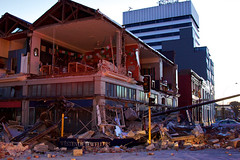


Evans, Malcolm Paul, 1945-:[Christchurch earthquake] 23 February 2011
Images, Alexander Turnbull Library
Someone holds a mobile phone and sends a text 'CH CH WE R ALL IN THS 2 GTHR' (Christchurch we are all in this together). Context - On 22 February 2011 at 12:51 pm (NZDT), Christchurch experienced a major magnitude 6.3 earthquake, which resulted in severe damage and many casualties. A National State of Emergency has been declared. This followed on from an original magnitude 7.1 earthquake on 4 September 2010 which did far less damage and in which no-one died. Both colour and black and white versions of this cartoon are available Quantity: 2 digital cartoon(s).
Evans, Malcolm Paul, 1945- :"The shake which lasted 75 minutes and caused …
Images, Alexander Turnbull Library
A television announcer sits at his desk reading the news. He says 'The shake which lasted 75 minutes and caused widespread damage in living rooms all over the country measured 5.18 on the rugby scale and was centred on Port Elizabeth in South Africa'. Context: The All Blacks lost to the Springboks 5-18 in a tri-nations test match in South Africa only a few days before the World Cup kick-off. Fans have been warned not to panic. Colour and black and white versions available Quantity: 2 digital cartoon(s).
Darroch, Bob, 1940- :"I know how they feel in Christchurch... I have a job…
Images, Alexander Turnbull Library
Shows a man exhausted after a weekend of watching the All Blacks playing Ireland on TV. His wife understands the frustration of Christchurch residents waiting too long for repairs to properties. Context: Refers to frustrating delays in getting earthquake-related repairs done in Christchurch, this in large part due to slowness of insurance claims and permissions. Quantity: 1 digital cartoon(s).
Scott, Thomas, 1947- :'Question; would you rather live in Wellington...'. …
Images, Alexander Turnbull Library
Three men chat in a pub. One of them reads a newspaper article about the Mayor of Christchurch, Bob Parker, who commented that he was scared of earthquakes when in Wellington. All three drinkers would rather be in Wellington than trapped beside Bob Parker at a dinner table. Context: Christchurch's Mayor has told the Emergency Management Conference he's scared to be in Wellington. He gave graphic descriptions of the Christchurch earthquakes, getting people to bang on the tables for 45 seconds so they could see what it felt like. Quantity: 1 digital cartoon(s).
About All Right? Presentations - Dr Rob's Tips
Articles, UC QuakeStudies
A PDF copy of a presentation by Dr Rob Gordon (NZ Red Cross) and All Right?. The presentation provides six tips from Gordon for attaining wellbeing after a disaster, together with images from phase 2 of the All Right? campaign.
A new crack in the footpath in Rydal Park.
Images, eqnz.chch.2010
Cracks in the roads and foot paths were surprisingly hard to find given the strength of the earthquake.
brick fence down
Images, eqnz.chch.2010
None
Sunrise Over Manchester Destruction
Images, eqnz.chch.2010
Taken as the severity of the situation began to sink in to most of the people wandering around. Police, Fire and other emergency personal showed a fantastic response to how they dealt with the situation they had.
People in Disasters Conference - Understanding Immediate Human Behaviour t…
Videos, UC QuakeStudies
A video of a presentation by Professor David Johnston during the fourth plenary of the 2016 People in Disasters Conference. Johnston is a Senior Scientist at GNS Science and Director of the Joint Centre for Disaster Research in the School of Psychology at Massey University. The presentation is titled, "Understanding Immediate Human Behaviour to the 2010-2011 Canterbury Earthquake Sequence, Implications for injury prevention and risk communication".The abstract for the presentation reads as follows: The 2010 and 2011 Canterbury earthquake sequences have given us a unique opportunity to better understand human behaviour during and immediately after an earthquake. On 4 September 2010, a magnitude 7.1 earthquake occurred near Darfield in the Canterbury region of New Zealand. There were no deaths, but several thousand people sustained injuries and sought medical assistance. Less than 6 months later, a magnitude 6.2 earthquake occurred under Christchurch City at 12:51 p.m. on 22 February 2011. A total of 182 people were killed in the first 24 hours and over 7,000 people injured overall. To reduce earthquake casualties in future events, it is important to understand how people behaved during and immediately after the shaking, and how their behaviour exposed them to risk of death or injury. Most previous studies have relied on an analysis of medical records and/or reflective interviews and questionnaire studies. In Canterbury we were able to combine a range of methods to explore earthquake shaking behaviours and the causes of injuries. In New Zealand, the Accident Compensation Corporation (a national health payment scheme run by the government) allowed researchers to access injury data from over 9,500 people from the Darfield (4 September 2010) and Christchurch (22 February 2011 ) earthquakes. The total injury burden was analysed for demography, context of injury, causes of injury, and injury type. From the injury data inferences into human behaviour were derived. We were able to classify the injury context as direct (immediate shaking of the primary earthquake or aftershocks causing unavoidable injuries), and secondary (cause of injury after shaking ceased). A second study examined people's immediate responses to earthquakes in Christchurch New Zealand and compared responses to the 2011 earthquake in Hitachi, Japan. A further study has developed a systematic process and coding scheme to analyse earthquake video footage of human behaviour during strong earthquake shaking. From these studies a number of recommendations for injury prevention and risk communication can be made. In general, improved building codes, strengthening buildings, and securing fittings will reduce future earthquake deaths and injuries. However, the high rate of injuries incurred from undertaking an inappropriate action (e.g. moving around) during or immediately after an earthquake suggests that further education is needed to promote appropriate actions during and after earthquakes. In New Zealand - as in US and worldwide - public education efforts such as the 'Shakeout' exercise are trying to address the behavioural aspects of injury prevention.
Eastside story : the perceived impact of the Canterbury earthquakes on tea…
Research papers, University of Canterbury Library
It is reported that natural disasters such as earthquakes impact significantly upon survivors’ psychological wellbeing. Little is known however about the impact of disasters upon the professional performance of survivor employees such as teachers. Using a survey research design with an emphasis upon a qualitative data collection, 39 teachers from 6 schools in the eastern suburbs of Christchurch, New Zealand rated the impact of the 2010 and 2011 earthquakes upon their professional performance and 13 volunteered to participate in a follow up focus group interviews. The data collected was interpreted via three theoretical/policy frameworks: the New Zealand Teacher Council mandatory requirements for teachers, the basic psychological needs theory and the inclusive transactional model of stress. Contrary to expectations, relationships with learners, colleagues, learner's whanau (family) and the wider community were on the whole perceived to be positively impacted by the earthquakes, while participation in professional development was regarded in more negative terms. The results indicated that teachers were able to continue (despite some stress reactions) because the basic psychological needs of being a teacher were not disrupted and indeed in some cases were enhanced. A model of teacher performance following a natural disaster is presented. Recommendations and implications (including future research undertakings) arising from the study are indicated. It was noted that given the importance of the school in supporting community recovery following a disaster, support for them and consideration of the role of teachers and the preparation for this should be given some priority.
Financial and non-financial information transfer and communication within …
Research papers, University of Canterbury Library
This participant-observation study explores the process of gathering and evaluating both financial and non-financial information and communication and transfer of that information within a medium-size Electrical Company in Christchurch, New Zealand. The previous literature has established the importance and the main characteristics of small and medium enterprises (SMEs), mainly studying manufacturing companies. However, there has been little research done in New Zealand on the overall communication process and the financial and non-financial information usage in a small-medium enterprise. Face-to-face interviews were carried out with all the office employees and two partners, along with a ten month participant-observation in the Electrical Company in order to understand how financial and non-financial information is communicated and processed in an SME. Also, research in an SME that has overcome the 2008 economic depression and several major earthquakes allows a deep understanding of lessons learned and what is valued by the Electrical Company. The research has found characteristics of this SME similar to those that have been mentioned in previous literature. However, the partners of the Electrical Company understand the importance of financial management and use financial information extensively to ensure the business expenses are under control. Moreover, the partners use more than just financial information to manage the company. They gather non-financial information through talking to their accountant, their customers and people in the same industry and they keenly follow the news on the rebuilding of Christchurch.
Seismic performance of single-storey light timber-framed buildings braced …
Research papers, University of Canterbury Library
Light timber framed (LTF) structures provide a cost-effective and structurally efficient solution for low-rise residential buildings. This paper studies seismic performance of single-storey LTF buildings sheathed by gypsum-plasterboards (GPBs) that are a typical lining product in New Zealand houses. Compared with wood-based structural panels, GPBs tend to be more susceptible to damage when they are used in bracing walls to resist earthquake loads. This study aims to provide insights on how the bracing wall irregularity allowed by the current New Zealand standard NZS 3604 and the in-plane rigidity of ceiling diaphragms affect the overall seismic performance of these GPB-braced LTF buildings. Nonlinear time-history analyses were conducted on a series of single-storey baseline buildings with different levels of bracing wall irregularities and ceiling diaphragm rigidity. The results showed significant torsional effect caused by the eccentric bracing wall layout with semi-rigid/rigid ceiling diaphragms. On average, bracing wall drift demand caused by the extreme bracing wall irregularities was three times of that in the regular bracing wall layout under the rigid diaphragm assumption. This finding agreed well with the house survey after the 2011 Canterbury Earthquake in which significantly more damage was observed in the houses with irregular bracing wall layouts and relatively rigid diaphragms. Therefore, it is recommended to limit the level of bracing wall eccentricity and ensure the sufficiently rigid diaphragms to avoid excessive damage in these LTF buildings in future events.
Inventory and seismic assessment of earthquake-vulnerable masonry and conc…
Research papers, The University of Auckland Library
Following the 2010–2011 Canterbury earthquakes, a renewed focus has been directed across New Zealand to the hazard posed by the country‘s earthquake-vulnerable buildings, namely unreinforced masonry (URM) and reinforced concrete (RC) buildings with potentially nonductile components that have historically performed poorly in large earthquakes. The research reported herein was pursued with the intention of addressing several recommendations made by the Canterbury Earthquakes Royal Commission of Inquiry which were classified into the following general categories: Identification and provisional vulnerability assessment of URM and RC buildings and building components; Testing, assessment, and retrofitting of URM walls loaded out-of-plane, with a particular focus on highly vulnerable URM cavity walls; Testing and assessment of RC frame components, especially those with presumably non-ductile reinforcement detailing; Portfolio management considering risks, regulations, and potential costs for a portfolio that includes several potentially earthquake-vulnerable buildings; and Ongoing investigations and proposed research needs. While the findings from the reported research have implications for seismic assessments of buildings across New Zealand and elsewhere, an emphasis was placed on Auckland given this research program‘s partnership with the Auckland Council, the Auckland region accounting for about a third each of the country‘s population and economic production, and the number and variety of buildings within the Auckland building stock. An additional evaluation of a historic building stock was carried out for select buildings located in Hawke‘s Bay, and additional experimental testing was carried out for select buildings located in Hawke‘s Bay and Christchurch.
Performance of earthquake strengthened URM buildings in the 2010/2011 Chri…
Research papers, The University of Auckland Library
Following the 22 February 2011 Christchurch earthquake a comprehensive damage survey of the unreinforced masonry (URM) building stock of Christchurch city, New Zealand was undertaken. Because of the large number of aftershocks associated with both the 2011 Christchurch earthquake and the earlier 4 September 2010 Darfield earthquake, and the close proximity of their epicentres to Christchurch city, this earthquake sequence presented a unique opportunity to assess the performance of URM buildings and the various strengthening methods used in New Zealand to increase the performance of these buildings in earthquakes. Because of the extent of data that was collected, a decision was made to initially focus exclusively on the earthquake performance of URM buildings located in the central business district (CBD) of Christchurch city. The main objectives of the data collection exercise were to document building characteristics and any seismic strengthening methods encountered, and correlate these attributes with observed earthquake damage. In total 370 URM buildings in the CBD were surveyed. Of the surveyed buildings, 62% of all URM buildings had received some form of earthquake strengthening and there was clear evidence that installed earthquake strengthening techniques in general had led to reduced damage levels. The procedure used to collect and process information associated with earthquake damage, general analysis and interpretation of the available survey data for the 370 URM buildings, the performance of earthquake strengthening techniques, and the influence of earthquake strengthening levels on observed damage are reported within. http://15ibmac.com/home/
Seismics in the City 2016 - Panel (Part 7)
Videos, UC QuakeStudies
A video of a presentation by Antony Gough, New Zealand property developer, during a panel at the 2016 Seismics in the City Conference. The panel has three themes:A City on the Move: Collaboration and Regeneration: "'Christchurch is now moving rapidly from the recovery phase into a regeneration stage with Central and Local Government working with the wider community, including the business community to ensure we get optimal outcomes for greater Christchurch' (CECC)."Looking Back: Remembering and Learning: "What are the milestones? What are the millstones? What have we learnt? What have we applied?"Looking Forward: Visioning and Building: "What do we aspire to? What are the roadblocks? What is the way forward?"
Hubbard, James, 1949- :[Rugby World Cup for Christchurch?] 15 March 2011
Images, Alexander Turnbull Library
Prime Minister John Key sits on a huge crushing ball that represents the 'IRB' (International Rugby Board) and says 'Don't listen to rumour. It's not a fait accompli yet!' The ball swings towards crumbling land which represents 'Christchurch World Cup Rights'. Context - The Government has repeatedly said its preference is to keep cup games in Christchurch and Mr Key said yesterday that it would send a "powerful message" about Christchurch, although the Government had to be realistic. "The IRB are the ultimate arbiter ... they hold their own insurance policies and they'll have their own discussions with their insurers. There's only so far New Zealand can take this." (Stuff 12 March 2011) Quantity: 1 digital cartoon(s).
A Giant Sized Game of Monopoly
Images, UC QuakeStudies
A digitally manipulated image of the Gap Filler Monopoly board square on Manchester Street. The photographer comments, "On the site of a demolished earthquake damaged building in Christchurch, New Zealand is a Monopoly game square for giants. The Gap Filler Project makes the bare land where once a building once stood into something both interesting and unique and this time they created a massive Monopoly board square. In the game of Monopoly you move your player with a dog, shoe or maybe the hat, but as the most common thing in the City are diggers they have the placed one on the square. There are also two houses on Manchester Street, which is priced at $240".
Proposed Highfield subdivision development
Research papers, Lincoln University
The recent earthquakes in Canterbury have left thousands of Christchurch residents’ homeless or facing the possibility of homelessness. The New Zealand Government, so far, have announced that 5,100 homes in Christchurch will have to be abandoned as a result of earthquake damaged land (Christchurch City Council, 2011). They have been zoned red on the Canterbury Earthquake Recovery Authority (CERA) map and there are another 10,000 that have been zoned orange, awaiting a decision (Christchurch City Council, 2011). This situation has placed pressures on land developers and local authorities to speed up the process associated with the development of proposed subdivisions in Christchurch to accommodate residents in this situation (Tarrant, 2011).
Post-disaster indigenous mental health support: Tangata whaiora networks a…
Research papers, Lincoln University
This paper identifies and analyses the networks of support for tangata whaiora (mental health clients) utilising a kaupapa Mäori health service following the Ötautahi/Christchurch earthquakes in Aotearoa New Zealand from 2010 to 2012. Semi- structured interviews were undertaken with 39 participants, comprising clients (Mäori and Päkehä), staff, managers and board members of a kaupapa Mäori provider in the city. Selected quotes are presented alongside a social network analysis of the support accessed by all participants. Results show the signifi cant isolation of both Mäori and Päkehä mental health clients post- disaster and the complexity of individuals and collectives dealing with temporally and spatially overlapping hazards and disasters at personal, whänau and community level.
Flexi-Ed: Enhancing education through flexible form
Research papers, Victoria University of Wellington
As cities evolve, change and grow, the need and desire for adaptable architecture becomes evident across the nation. Architecture needs to undertake techniques that are flexible in order to adapt and align with the development of future generations in New Zealand. The Education industry is a primary example of a sector which requires flexibility within both classroom architectural form and interior configuration. This is a resultant of the recently updated Ministry of Education requirements; which state that every new classroom built or renovated nationwide, must implement the MoE classroom design standards for Innovative Learning Environments. ILE teaching spaces are configured as an open plan interior, supporting flexibility in classroom arrangement and teaching techniques. ILE classrooms are capable of evolving and adapting as educational practices evolve and change, allowing schools to remain modern and future focused. As part of this movement to ILE, the Ministry of Education has also recently made an attempt to improve the quality of temporary classrooms. This has been done by looking into the initiation of a programme that utilizes relocatable classroom buildings. Relocatable classrooms have been selected for multiple reasons, primarily flexibility. Flexibility is key for a school environment as it allows the school to actively respond to fluctuating school rolls. It is anticipated that the programme will provide a faster delivery process with a standardised design that allows the classrooms to be relocated from one school to another with relative ease. Following the devastating February 2011 earthquake the Greater Christchurch Region, the Education sector is in the midst of the Canterbury Schools Rebuild Programme. As a repercussion of this natural disaster, the majority of Christchurch schools have redevelopment or rebuild projects in progress, with preliminary design phases already in action for a small group of select schools regarded as high priority. The primary funding for these projects are sourced from insurance money, implementing tight budget restrictions, affecting the architectural design, quality and speed of the construction and repair works. The available funding limits the affordable classroom options to basic teaching spaces that have been stripped back to simple architectural forms, dictating not only the re-design, but also how our future generations will learn. Thus causing the development of the new student-led learning ILE concept to become controlled by existing construction techniques and the Rebuild Programmes budget restrictions. This thesis focuses on the future proofing of New Zealand schools by providing an affordable and time efficient alternative option to the current static, traditional construction, an option that has the ability to cater to the unpredictable fluctuating school rolls across the nation. This has been done by developing a prefabricated system for standalone classroom blocks. These blocks have the ability to be relocated between different school sites, dynamically catering to the unpredictable school roll numbers experienced across New Zealand. This site flexibility is reflected with the interior flexibility in the classrooms, enhancing the internal teaching space composition and challenges the existing design standards set by the Ministry of Education for Innovative Learning Environments. This system is called “Flexi-Ed”. Flexibility has been a key driver for this thesis, as the prefabricated structure is have to be flexible in three ways; first in the sense of being easy to assemble and disassemble. Second by offering flexible interior learning environments and thirdly the joints of the structure are designed with the ability to be flexible in order to cope with seismic activity. These three principles will provide schools with long term flexibility, minimal on-site interruption and heighten the standard of ILE across the nation. I strive to provide schools with long term flexibility and minimal site interruption, whilst heightening the standard of Innovative Learning Environments across New Zealand.
Evans, Malcolm Paul, 1945-:[Christchurch earthquakes and Pike River Mine] …
Images, Alexander Turnbull Library
The cartoon shows the hands of two people joined in mutual despair and kindness. One represents 'Christchurch' and the other the 'Pike River Mine'. Context - the 7.1 earthquake on 4 September 2010 in Christchurch in which there was a lot of damage but no deaths, the Pike River Mine disaster which occurred on the West Coast on 19 November 2010 and caused the deaths of 29 coal miners and now on 22 February 2011 a 6.3 magnitude earthquake in Christchurch which has probably killed more than 200 people (at this point the number is still not known) and caused much more severe damage. The reason the apparently lesser magnitude quake caused more destruction is because it was very shallow, was in the middle of the day and struck very close to the centre of the city. Colour and black and white versions of this cartoon are available Quantity: 2 digital cartoon(s).
Evans, Malcolm Paul, 1945-: [Christchurch milk.] 10 April 2011
Images, Alexander Turnbull Library
In three small frames above the main frame, milk tankers are shown bumping wildly over Christchurch roads made uneven by the earthquakes of September 4 2010 and February 22 2011; and in the large frame below a man is painting out the word 'milk' on a tanker and replacing it with the word 'butter'. Context - the bad roads caused by the erathquakes in Canterbury have turned the milk into butter. Colour and black and white versions available Title from file name Quantity: 2 digital cartoon(s).
Evans, Malcolm Paul, 1945-: Christchurch Council website invites ideas for…
Images, Alexander Turnbull Library
Christchurch City has to be rebuilt after the earthquakes of 4 September 2010 and 22 February 2011. People are being invited to contribute ideas about how to rebuild on a city council website. A group of people look at ideas on computers; a boy comments that 'this one looks just like the old city' and his father comments 'but built fifty miles up the road!' A woman looks at what appears to be pre European Maori pa site and says 'Hone Harawira wants something pre-European!' Another woman looks at a map of the middle of the South Island and says 'Rodney Hide doesn't care as long as Christchurch combines with Timaru and Westport!' Context - Former ACT leader Rodney Hide in his role as Minister for Local Government likes 'supercities' and Hone Harawira has left the Maori Party, fed up with the compromises he believes they have to make to suit their coalition agreement with the National government. He seems to prefer a city that will reflect simpler pre-European times. Colour and black and white versions available Quantity: 2 digital cartoon(s).
Evans, Malcolm Paul, 1945-:[Christchurch earthquake and entrepreneurship] …
Images, Alexander Turnbull Library
A small boy is being a real entrepreneur after the Christchurch earthquake of 22 February 2011 and has set up a road-side stall from which you can buy a bag of 'real leakyfakshun'. Behind him is a pile of liquefaction and a spade with which he can fill bags. Context - the Christchurch earthquake of 22 February has caused vastly more liquefaction than the original 4th September earthquake. The vibrations from the quake cause liquefaction which is where the soil loses strength and stiffness, and behaves more like a liquid than a solid - rather like wet sand. Colour and black and white versions available Quantity: 2 digital cartoon(s).
Evans, Malcolm Paul, 1945- :'Christchurch is worried how it will house the…
Images, Alexander Turnbull Library
Two men discuss in a pub the problem that Christchurch has about how to house all the workers arriving to rebuild the city. One of them suggests the solution found for the workers on the Manapouri Dam which was housing them on cruise liners. Context: One solution has been provided by the Defence Force who are leasing 42 derelict NZDF houses next to Burnham Military Camp. Colour and black and white versions available Quantity: 2 digital cartoon(s).
Evans, Malcolm Paul, 1945- :'So, you weren't hit by the quake, but you thi…
Images, Alexander Turnbull Library
Shows an earthquake assessor at the door of a family home. The whole family is wearing snorkles and goggles. Context: Possibly refers to claims being made by owners of leaky homes as well as earthquake victims. Colour and black and white versions available Quantity: 2 digital cartoon(s).
Evans, Malcolm Paul, 1945- :[Shoulder-tapped Chinese Architect]. 8 April 2…
Images, Alexander Turnbull Library
Shows John Key phoning Canterbury Earthquake Recovery Minister Gerry Brownlee during his recent visit to China. Key tells Gerry he has found an architect friend in China who can design the new Christchurch Cathedral. Wider context refers to the debate over the 3 plans recently released for the Cathedral, but also refers to media debate concerning Key's involvement in instances of preferential appointments - in particular, his claim to have forgotten a phone call to his friend Ian Fletcher in which Key suggested Fletcher should apply to become director of the Government Communications Security Bureau. See Stuff, 3 April 2013. Colour and black and white versions available Quantity: 2 digital cartoon(s).
Evans, Malcolm Paul, 1945- :"They've had enough of freezing cold days and …
Images, Alexander Turnbull Library
The top frame shows the barbed wire and watch tower of a prison. There is a comment about someone wanting the warmth of a prison cell. The second frame shows prison staff chatting at cross purposes about a petition from Christchurch with homes wrecked by earthquake pleading to be allowed to live in prison and the sentence imposed on the Bridgecorp directors who have been accused of defrauding investors. Colour and black and white versions available Quantity: 2 digital cartoon(s).
Evans, Malcolm Paul, 1945- :"That's it - I'm out!" ... 23 June 2011
Images, Alexander Turnbull Library
In the top frame a man reads a newspaper report that says 'Govt to buy up red stickered homes' and shouts 'That's it - I'm out!' His mate comments that he thought it was his neighbour's house that was munted and that his house was ok. In the lower frame the first man says 'That's right... and I don't want to live next door to a politician?!' Context - A report released 23 June 2011 has divided quake-hit Canterbury into four zones with those in the worst affected residential red zone offered cash to move out. The man in the cartoon thinks that the government is buying up the houses so that politicians can live in them. Colour and black and white versions available Quantity: 2 digital cartoon(s).
Evans, Malcolm Paul, 1945- :"Four point one! Three point six! Five point t…
Images, Alexander Turnbull Library
In the top frames two children shout 'four point one', 'three point six', and 'five point two' and in the frame below it is seen that they are responding to bumps in the road as their mother drives through Christchurch streets. Context - The children have become expert at guessing the seismic intensity of earthquakes in Christchurch and are now applying them to bumps in the road. Colour and black and white versions available Quantity: 2 digital cartoon(s).