

Search
found 100457 results
Images for NEW-ZEALAND; more images...
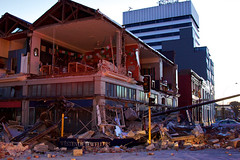


Chimney: Replica
Images, Canterbury Museum
Replica chimney comprising a chimney pot atop a lightweight brick chimney. The chimney is contextualised by a portion of slate roof, guttering and bricked house exterior below.
Power Cable Section
Images, Canterbury Museum
One section of power cable with cut ends, covered in rubber and black electrical tape; two smaller cables branching off the main section; damaged and twisted in the 22 February 2011 earthquake. One of the most noticeable effects of the earthquakes in Canterbury was the loss of basic infrastructure such as power, water and sewerage. The earthqu...
Model: Liquefaction Volcano
Images, Canterbury Museum
Plastic and wood model of three liquefaction volcanoes. The working model pumps water over the grey surface which is decorated with a basket of laundry, a bucket of pegs and a football. The model is surrounded by artificial green grass and rests atop a black wooden base.
Power Cable Section
Images, Canterbury Museum
One section of new power cable with black rubber casing and one end cut; manufacturer's mark reads 'General Cable NZ X-90 Electrical Cable 600/1000V'. Example of new power cables that needed to be laid following the 22 February earthquake. High voltage power cables in Christchurch are located underground, meaning that the areas which experience...
Brooch: Host A Brooch #14
Images, Canterbury Museum
One steel, brick and concrete brooch created from debris collected after the 22 February 2011 earthquake; steel from a gas heater has been woven to create three enclosures for the piece of brick and two pieces of concrete; a stainless steel pin has been woven on the reverse for attachment. Worn by numerous people as part of the Host A Brooch pro...
Heart for Christchurch: Blue Bird
Images, Canterbury Museum
One cream cotton 'Heart for Christchurch' decorated with a bird in blue stitching; a blue loop with a bead is at the top centre so the item can be displayed. Inscription on reverse reads 'With / love / from / Denice Ostman / Finland / 2011' Made for the people of Christchurch following the 22 February earthquake. Denice Ostman from Finland sent...
Heart for Christchurch: Green Tiki
Images, Canterbury Museum
One red swirled fabric 'Heart for Christchurch' decorated with a tiki stitched in green on the front; green and red tartan fabric on reverse; red ribbon loop so the item can be displayed; an attached piece of green paper reads 'From Linda who lives in Scotland but who has a daughter, son-in-law & 3 small grandsons who live in Timaru'. Made for t...
Uniform: Japanese Disaster Relief Team
Images, Canterbury Museum
One orange and blue official uniform worn by members of the Japanese Disaster Relief Team that provided assistance after 22 February 2011 earthquake; 'Rescuer' badge on left chest with Japanese text underneath; Japanese flag badges on right of chest and right sleeve as part of 'Japanese / Disaster Relief Team / JDR' shield shaped badge. Blue and...
Heart for Christchurch: Seven Embellishments
Images, Canterbury Museum
One cream and brown fabric 'Heart for Christchurch' decorated with lace and seven embellishments with a velvet cord loop at the top centre so the item can be displayed. Maker's name - Evie Harris / Napier - on reverse. Made for the people of Christchurch following the 22 February earthquake. This ‘Heart for Christchurch’ was made by Evie Harris...
Heart for Christchurch: Purple with Pink Rose
Images, Canterbury Museum
One felted purple 'Heart for Christchurch' decorated with a pink rose with green leaves and an orange loop at the top centre so the item can be displayed. Faint stitched inscription 'we are / with you' on reverse. Made for the people of Christchurch following the 22 February earthquake. Jill Gunn contributed this ‘Heart for Christchurch’ as a g...
Drone: Parrot AR
Images, Canterbury Museum
An aero-modelling quadricopter device used by Opus International Consultants to assess the structural integrity of the interior of the Cathedral of the Blessed Sacrament, Christchurch. The drone is comprised of a central hull with high definition video recording capability surrounded by four circles of grey foam, each containing a smaller black ...
Heart for Christchurch: Hope
Images, Canterbury Museum
One cream, white and red fabric 'Heart for Christchurch' with white polka dots on red background on reverse; the front is decorated with the word 'Hope' and a bird in red stitching along with two red ribbon bows and a 'made with love' metal embellishment at the centre bottom; a red ribbon loop with a wooden button at the top centre is attached s...
Heart for Christchurch: Knitted, with Note
Images, Canterbury Museum
One red knitted woollen 'Heart for Christchurch' with a piece of yellow paper attached at top right reading 'Handcrafted especially for you by Sue Hornick, Moulden, NT, Australia'. Made for the people of Christchurch following the 22 February earthquake. Sue Moulden from Australia’s Northern Territories sent this red knitted heart as a gift to ...
Model: Transitional Cathedral
Images, Canterbury Museum
A model of the ChristChurch Transitional Cathedral made predominantly out of laser cut and engraved coloured acrylic as well as timber dowels to represent the cardboard tubes.
Soft Sculpture Kakapo: Little Ra
Images, Canterbury Museum
One green and yellow soft sculpture kakapo with wire feet, stuffed body and black plastic eyes. Has an attached card naming the bird Little Ra and explaining it is part of the 'Journey - The Kakapo of Christchurch' project by artist Sayraphim Lothian.
Model: Temple for Christchurch
Images, Canterbury Museum
One model of the Temple for Christchurch with a rectangular base of Jarrah and solid silver conical shapes and wave like walls representing the movement of the 22 February 2011 earthquake. Based on the Temple for Christchurch sculpture that was designed by Hippathy Valentine.
Christchurch Earthquake 22/02/11
Images, eqnz.chch.2010
Christchurch Cathedral, Cathedral Square.
Christchurch Earthquake 22/02/11
Images, eqnz.chch.2010
Christchurch Cathedral, Cathedral Square.
Christchurch Square Clock Tower damaged by Equake
Images, eqnz.chch.2010
The clock face on the left is showing the correct time. The clock face on the right stopped at the moment of the big earthquake in CHCH on Sept 4th at 4.25am. It stayed like that for a week until fixed. Interestingly that face has not shown the correct time since.
Opportunity from disaster: Evidence of the Christchurch earthquake’s effec…
Research papers, Victoria University of Wellington
We estimate the causal effects of a large unanticipated natural disaster on high schoolers’ university enrolment decisions and subsequent medium-term labour market outcomes. Using national administrative data after a destructive earthquake in New Zealand, we estimate that the disaster raises tertiary education enrolment of recent high school graduates by 6.1 percentage points. The effects are most pronounced for males, students who are academically weak relative to their peers, and students from schools directly damaged by the disaster. As relatively low ability males are overrepresented in sectors of the labour market helped by the earthquake, greater demand for university may stem from permanent changes in deeper behavioural parameters such as risk aversion or time preference, rather than as a coping response to poor economic opportunities.
RadioQuake: Getting back 'on air' after the Christchurch earthquakes
Research papers, University of Canterbury Library
Local independent radio stations in Christchurch, New Zealand, had their operations severely disrupted by major earthquakes in September 2010 and February 2011. This article examines the experiences of three radio stations that were shut out of their central city premises by the cordon drawn around the city after the 22 February quake. One of the stations continued broadcasting automatically, while the others were unable to fully get back on air for several weeks afterwards. All of the stations had to manage access to workspaces, the emotional needs of staff and volunteers, the technical ability to broadcast, and the need to adapt content appropriately when back on air. For the locally based radio managers decisions had to be made about the future of the stations in a time of significant emotional, physical, and geological upheaval. The article explores how these radio stations were disrupted by the earthquake, and how they returned to air through new combinations and interconnections of people, workspace, technology, content and transmission.
Recycling of end-of-life tyres in seismic isolation foundation systems
Research papers, University of Canterbury Library
Over 6.3 million waste tyres are produced annually in New Zealand (Tyrewise, 2021), leading to socioeconomic and environmental concerns. The 2010-11 Canterbury Earthquake Sequence inflicted extensive damage to ~6,000 residential buildings, highlighting the need to improve the seismic resilience of the residential housing sector. A cost-effective and sustainable eco-rubber geotechnical seismic isolation (ERGSI) foundation system for new low-rise buildings was developed by the authors. The ERGSI system integrates a horizontal geotechnical seismic isolation (GSI) layer i.e., a deformable seismic energy dissipative filter made of granulated tyre rubber (GTR) and gravel (G) – and a flexible rubberised concrete raft footing. Geotechnical experimental and numerical investigations demonstrated the effectiveness of the ERGSI system in reducing the seismic demand at the foundation level (i.e., reduced peak ground acceleration) (Hernandez et al., 2019; Tasalloti et al., 2021). However, it is essential to ensure that the ERGSI system has minimal leaching attributes and does not result in long-term negative impacts on the environment.
Methods for Incorporating Soil Nonlinearity in Ground Motion Simulation
Research papers, University of Canterbury Library
This poster discusses several possible approaches by which the nonlinear response of surficial soils can be explicitly modelled in physics-based ground motion simulations, focusing on the relative advantages and limitations of the various methodologies. These methods include fully-coupled 3D simulation models that directly allow soil nonlinearity in surficial soils, the domain reduction method for decomposing the physical domain into multiple subdomains for separate simulation, conventional site response analysis uncoupled from the simulations, and finally, the use of simple empirically based site amplification factors We provide the methodology for an ongoing study to explicitly incorporate soil nonlinearity into hybrid broadband simulations of the 2010-2011 Canterbury, New Zealand earthquakes.
Modelling Nonlinear Site Effects in Physics-Based Ground Motion Simulation
Research papers, University of Canterbury Library
Background This study examines the performance of site response analysis via nonlinear total-stress 1D wave-propagation for modelling site effects in physics-based ground motion simulations of the 2010-2011 Canterbury, New Zealand earthquake sequence. This approach allows for explicit modeling of 3D ground motion phenomena at the regional scale, as well as detailed nonlinear site effects at the local scale. The approach is compared to a more commonly used empirical VS30 (30 m time-averaged shear wave velocity)-based method for computing site amplification as proposed by Graves and Pitarka (2010, 2015), and to empirical ground motion prediction via a ground motion model (GMM).
Nisbet, Alastair, 1958- :"Where are ya Bob? dont' tell me...flat out again…
Images, Alexander Turnbull Library
An exceedingly large 'Gerry' Brownlee, the Minister for Earthquake Recovery, rises from a chair, holding a briefcase labeled 'CERA' and calling for 'Bob' Parker, the mayor of Christchurch. The thin Parker was flattened against Brownlee's enormous rear, when Brownlee sat on the chair. Brownlee and Parker had a strained relationship, with the government taking an increasing amount of control in local decision making. After ongoing assurances by Parker that Christchurch City Council would meet all of International Accreditation New Zealand's requirements on issuing building consents, Brownlee announced in June 2013 without Parker's prior knowledge that the authority had withdrawn its accreditation. Quantity: 1 digital cartoon(s).
Nisbet, Alistair, 1958-:Satellite to plunge to earth..."People should see …
Images, Alexander Turnbull Library
The title reads 'Satellite to plunge to earth "People should see quite a show." A 'NASA' satellite heads towards New Zealand; someone inside says 'Beep! Beep! Christchurch CBD here we come! Woo-hoo!' Context: A great deal of the CBD (Central Business District) in Christchurch is being demolished, considered to dangerous or too expensive to restore. A defunct 6.5 ton NASA satellite falls to earth this week... 26 pieces, with a combined mass of 500kg will survive the fiery re-entry and hurtle towards us. NASA doesn't have much idea of where it will land so it may demolish some of Christchurch. Quantity: 1 digital cartoon(s).
Relationship between observed liquefaction at Kaiapoi following the 2010 D…
Research papers, The University of Auckland Library
The Darfield earthquake caused widespread damage in the Canterbury region of New Zealand, with the majority of damage resulting from liquefaction and lateral spreading. One of the worst hit locations was the small town of Kaiapoi north of Christchurch, an area that has experienced liquefaction during past events and has been identified as highly susceptible to liquefaction. The low lying town sits on the banks of the Kaiapoi River, once a branch of the Waimakariri, a large braided river transporting gravelly sediment. The Waimakariri has been extensively modified both by natural and human processes, consequently many areas in and around the town were once former river channels.
"We have land for sale and foreigners are welcome!" 19 October 2010
Images, Alexander Turnbull Library
A man and woman clutch each other in terror as their house rocks in an aftershake; the man grabs his phone and offers his land for sale adding that 'foreigners are welcome'. Refers to the Canterbury earthquake of 4th September 2010 which continues to experience aftershakes, some of them quite significant. Refers also to the debate about whether New Zealand should be selling land, particularly farms, to foreigners; one side of the debate considers the sale of land to foreigners to make economic sense while others feel that our heritage is being lost. Both colour and black and white versions of this cartoon are available Quantity: 2 digital cartoon(s).
"Hey Phil... It's a 'Dear John' letter..." 8 September 2010
Images, Alexander Turnbull Library
The Queen tells Prince Philip that she has received a 'Dear John' letter from PM John Key and that it 'seems the earth has moved for him back in NZ'. Text above reads 'Keynote'. In a second version the queen says that John Key 'preferred to stay at home 'cos the earth moved'. A third version refers to the decision of the PM to remain in New Zealand because of the Christchurch earthquake instead of going on a trip to Europe with his wife during which they were to have stayed at the invitation of the Queen at Balmoral Castle in Scotland. Quantity: 3 digital cartoon(s).
Indigenous Peoples and urban disaster: Māori responses to the 2010-12 Chri…
Research papers, Lincoln University
Indigenous Peoples retain traditional coping strategies for disasters despite the marginalisation of many Indigenous communities. This article describes the response of Māori to the Christchurch earthquakes of 2010 and 2012 through analyses of available statistical data and reports, and interviews done three months and one year after the most damaging event. A significant difference between Māori and ‘mainstream’ New Zealand was the greater mobility enacted by Māori throughout this period, with organisations having roles beyond their traditional catchments throughout the disaster, including important support for non-Māori. Informed engagement with Indigenous communities, acknowledging their internal diversity and culturally nuanced support networks, would enable more efficient disaster responses in many countries.