

Search
found 100457 results
Images for NEW-ZEALAND; more images...


Transcript of Chris's earthquake story
Articles, UC QuakeStudies
A pdf transcript of Chris's second earthquake story, captured by the UC QuakeBox Take 2 project. Interviewer: Joshua Black. Transcriber: Caleb Middendorf.
Maori experiences and expressions of leadership through the Christchurch O…
Research papers, Lincoln University
The 2010 and 2011 earthquakes of Canterbury have had a serious and ongoing effect on Maori in the city (Lambert, Mark-Shadbolt, Ataria, & Black, 2012). Many people had to rely on themselves, their neighbours and their whanau for an extended period in 2011, and some are still required to organise and coordinate various activities such as schooling, health care, work and community activities such as church, sports and recreation in a city beset by ongoing disruption and distress. Throughout the phases of response and recovery, issues of leadership have been implicitly and explicitly woven through both formal and informal investigations and debates. This paper presents the results of a small sample of initial interviews of Maori undertaken in the response and early recovery period of the disaster and discusses some of the implications for Maori urban communities.
'"Thank goodness for our little radio": Researching post-quake radio audie…
Research papers, University of Canterbury Library
This article discusses the use of radio after major earthquakes in Christchurch, New Zealand, in 2010 and 2011. It draws on archival sources to retrospectively research post-quake audiences in the terms people used during and soon after the earthquakes through personal narratives and Twitter. Retrospective narratives of earthquake experiences affirm the value of radio for communicating the scale of disaster and comforting listeners during dislocation from safe home spaces. In the narratives radio is often compared with television, which signifies electricity supply and associated comfort but also visually confirms the city’s destruction. Twitter provides insights into radio use from within the disaster period, but its more global reach facilitates reflection on online and international radio from outside the disaster-affected area. This research demonstrates the value of archival audience research, and finds that the combination of online radio and Twitter enables a new form of participatory disaster spectatorship from afar.
Data and Decision Making in the Transport System Following the Kaikoura Ea…
Research papers, University of Canterbury Library
The 14 November 2016 Kaikōura earthquake had major impacts on New Zealand's transport system. Road, rail and port infrastructure was damaged, creating substantial disruption for transport operators, residents, tourists, and business owners in the Canterbury, Marlborough and Wellington regions, with knock-on consequences elsewhere. During both the response and recovery phases, a large amount of information and data relating to the transport system was generated, managed, analysed, and exchanged within and between organisations to assist decision making. To improve information and data exchanges and related decision making in the transport sector during future events and guide new resilience strategies, we present key findings from a recent post-earthquake assessment. The research involved 35 different stakeholder groups and was conducted for the Ministry of Transport. We consider what transport information was available, its usefulness, where it was sourced from, mechanisms for data transfer between organisations, and suggested approaches for continued monitoring.
Radio Quake: Broadcasting in Post-Quake Christchurch
Research papers, University of Canterbury Library
The Civil Defense understanding of the role of radio in disaster tends to focus on its value in providing essential information during and after the event. However this role is compromised when a station’s premises are destroyed, or rendered inaccessible by official cordons. The Radio Quake study examines how radio stations in Christchurch managed to resume broadcasting in the aftermath of the earthquake of February 22, 2011. In New Zealand’s heavily networked and commercialised radio environment there is a significant disparity between networked and independent stations’ broadcast commitments and resourcing. All Christchurch radio broadcasters were forced to improvise new locations, complex technical workarounds, and responsive styles of broadcasting after the February 22 earthquake, but the need to restore, or maintain, a full on air presence after the earthquake, rested entirely on often financially tenuous, locally owned and staffed independent radio: student, Iwi, community access, and local commercial stations. This paper will explore the resourcefulness and resilience of broadcasters riding out the aftershocks in hotels, motels, bedrooms, and a horse truck, using digital technologies in new ways to reimagine the practice of radio in Christchurch.
From film to Web 2.0: transmedia as a distribution model for political doc…
Research papers, The University of Auckland Library
This research is a creative exploration of transmedia’s ability to offer up a model of distribution and audience engagement for political documentary. Transmedia, as is well known, is a fluid concept. It is not restricted to the activities of the entertainment industry and its principles also reverberate in the practice of political and activist documentary projects. This practice-led research draws on data derived from the production and circulation of Obrero, an independent transmedia documentary. The project explores the conditions and context of the Filipino rebuild workers who migrated to Christchurch, New Zealand after the earthquake in 2011. Obrero began as a film festival documentary that co-exists with two other new media iterations, each reaching its respective target audience: a web documentary, and a Facebook-native documentary. This study argues that relocating the documentary across new media spaces not only expands the narrative but also extends the fieldwork and investigation, forms like-minded publics, and affords the creation of an organised hub of information for researchers, academics and the general public. Treating documentary as research can represent a novel pathway to knowledge generation and the present case study, overall, provides an innovative model for future scholarship.
Are memorials just for remembering? A study of natural disaster memorials …
Research papers, Lincoln University
When a tragedy occurs of local or national scale throughout the world a memorial is often built to remember the victims, and to keep the tragedy fresh in the minds of generations with the conviction that this must not be repeated. Memorials to commemorate natural disasters very to the objective of a human induced tragedy in that future catastrophic events that affect the lives and livelihood of many citizens are sure to reoccur in countries that are geographically pre-disposed to the ravages of nature. This thesis examines memorial sites as case studies in New Zealand and Japan to explore the differences in how these two countries memorialise earthquakes, and tsunamis in the case of Japan, and whether there are lessons that each could learn from each other. In so doing, it draws largely on scholarly literature written about memorials commemorating war as little is written on memorials that respond to natural disasters. Visited case sites in both countries are analysed through multiple qualitative research methods with a broad view of what constitutes a memorial when the landscape is changed by the devastation of a natural disaster. How communities prepare for future events through changes in planning legislation, large scale infrastructure, tourism and preparedness for personal safety are issues addressed from the perspective of landscape architecture through spatial commemorative places. The intentions and meanings of memorials may differ but in the case of a memorial of natural disaster there is a clear message that is common to all. To reduce the severity of the number of deaths and level of destruction, education and preparedness for future events is a key aim of memorials and museums.
Using high-strength self-compacting concrete in reinforced concrete beam-c…
Research papers, University of Canterbury Library
The capability of self-compacting concrete (SCC) in flowing through and filling in even the most congested areas makes it ideal for being used in congested reinforced concrete (RC) structural members such as beam-column joints (BCJ). However, members of tall multi-storey structures impose high capacity requirements where implementing normal-strength self-compacting concrete is not preferable. In the present study, a commercially reproducible high-strength self-compacting concrete (HSSCC), a conventionally vibrated high-strength concrete (CVHSC) and a normal strength conventionally vibrated concrete (CVC) were designed using locally available materials in Christchurch, New Zealand. Following the guidelines of the New Zealand concrete standards NZS3101, seven beam-column joints (BCJ) were designed. Factors such as the concrete type, grade of reinforcement, amount of joint shear stirrups, axial load, and direction of casting were considered variables. All BCJs were tested under a displacement-controlled quasi-static reversed cyclic regime. The cracking pattern at different load levels and the mode of failure were also recorded. In addition, the load, displacement, drift, ductility, joint shear deformations, and elongation of the plastic hinge zone were also measured during the experiment. It was found that not only none of the seismically important features were compromised by using HSSCC, but also the quality of material and ease of construction boosted the performance of the BCJs.
Finite element analyses of hollow-core units subjected to shear and torsion
Research papers, University of Canterbury Library
A building boom in the 1980s allowed pre-stressed hollow-core floor construction to be widely adopted in New Zealand, even though the behaviour of these prefabricated elements within buildings was still uncertain. Inspections following the Canterbury and Kaikōura earthquakes has provided evidence of web-splitting, transverse cracking and longitudinal splitting on hollow-core units, confirming the susceptibility of these floors to undesirable failure modes. Hollow-core slabs are mainly designed to resist bending and shear. However, there are many applications in which they are also subjected to torsion. In New Zealand, hollow-core units contain no transverse reinforcement in the soffit concrete below the cells and no web reinforcement. Consequently, their dependable performance in torsion is limited to actions that they can resist before torsional cracking occurs. In previous work by the present authors, a three-dimensional FE modelling approach to study the shear flexural behaviour of precast pre-stressed hollow core units was developed and validated by full-scale experiments. This paper shows how the FE analyses have been extended to investigate the response of HC units subjected to torsional actions. Constitutive models, based on nonlinear fracture mechanics, have been used to numerically predict the torsional capacity of HC units and have been compared with experimental results. The results indicate that the numerical approach is promising and should be developed further as part of future research.
The Recovery of Canterbury’s Organisations:A comparative analysis of the 4…
Research papers, University of Canterbury Library
The 4 September, 22 February, and 13 June earthquakes experienced in Canterbury, New Zealand would have been significant events individually. Together they present a complex and unprecedented challenge for Canterbury and New Zealand. The repetitive and protracted nature of these events has caused widespread building and infrastructure damage, strained organisations’ financial and human resources and challenged insurer and investor confidence. The impact of the earthquakes was even more damaging coming in the wake of the worst worldwide recession since the great depression of the 1930s. However, where there is disruption there is also opportunity. Businesses and other organisations will drive the physical, economic and social recovery of Canterbury, which will be a dynamic and long-term undertaking. Ongoing monitoring of the impacts, challenges and developments during the recovery is critical to maintaining momentum and making effective mid-course adjustments. This report provides a synthesis of research carried out by the Resilient Organisations (ResOrgs) Research Programme1 at the University of Canterbury and Recover Canterbury in collaboration with Opus Central Laboratories (part of Opus International Consultants). The report includes discussions on the general state of the economy as well as data from three surveys (two conducted by ResOrgs and one by Recover Canterbury) on business impacts of the earthquakes, population movements and related economic recovery issues. This research and report offers two primary benefits:
In-situ lateral load test performance of Christchurch houses
Research papers, The University of Auckland Library
There is very little research on total house strength that includes contributions of non-structural elements. This testing programme provides inclusive stiffness and response data for five houses of varying ages. These light timber framed houses in Christchurch, New Zealand had minor earthquake damage from the 2011 earthquakes and were lateral load tested on site to determine their strength and/or stiffness, and to identify damage thresholds. Dynamic characteristics including natural periods, which ranged from 0.14 to 0.29s were also investigated. Two houses were quasi-statically loaded up to approximately 130kN above the foundation in one direction. Another unidirectional test was undertaken on a slab-on-grade two-storey house, which was also snapback tested. Two other houses were tested using cyclic quasi-static loading, and between cycles snapback tests were undertaken to identify the natural period of each house, including foundation and damage effects. A more detailed dynamic analysis on one of the houses provided important information on seismic safety levels of post-quake houses with respect to different hazard levels in the Christchurch area. While compared to New Zealand Building Standards all tested houses had an excess of strength, damage is a significant consideration in earthquake resilience and was observed in all of the houses. http://www.aees.org.au/downloads/conference-papers/2015-2/
Doors and Chords: Explorations from Music to Architecture
Research papers, Victoria University of Wellington
Architecture and music have a long intertwining history.These respective creative forces many times have collaborated into monumental place, harboured rich occasion, been catalyst for cultural movement and defined generations. Together they transcend their respective identities. From dinky local church to monstrous national stadia, together they are an intense concentration, a powerfully addictive dosage where architecture is the place, music is the faith, and people are the reason. Music is a programme that architecture often celebrates in poetic and grand fashion; a superficial excuse to symbolise their creative parallels. But their relationship is much richer and holds more value than just the opportunity to attempt architectural metaphor.While music will always overshadow the architecture in the sense of a singular event, architecture is like the soundman behind the mixing desk. It’s not the star front and centre grabbing your attention, but is responsible for framing the star. It is the foundational backdrop, a critical pillar. Great architecture can help make great music. In this sense music is a communication of architecture, it is the ultimate creative function. Christchurch, New Zealand, is a city whose story changed in an instant. The seismic events of 2010 and 2011 have become the overriding subject of its historical narrative, as it will be for years to come. Disaster redefines place (the town of Napier, struck by an earthquake in 1931, exemplifies this). There is no quantifiable justification for an exploration of architecture and music within the context of Christchurch. The Town Hall, one of New Zealand’s most architecturally significant buildings, is under repair. The Christ Church Cathedral will more than likely be rebuilt to some degree of its former self. But these are echoes of the city that Christchurch was.They are saved because they are artefact. Evidence of history.This thesis makes the argument for the new, the better than before, and for the making of opportunity from disaster, by proposing a ‘new’ town hall, conceived from the sound of old.
Anglican Advocacy: Proudly Pokie Free - promotional material
Articles, UC QuakeStudies
A copy of a PDF file containing logos and posters for the Proudly Pokie Free campaign.
Anglican Advocacy: Proudly Pokie Free - letter for venues
Articles, UC QuakeStudies
A PDF copy of a template letter to hospitality venue. The letter is written on behalf of Anglican Advocacy (previously Anglican Social Justice Unit) and the Problem Gambling Foundation and encourages the recipient to declare their venue 'Proudly Pokie Free'. Personal contact details have been redacted.
Evans, Malcolm Paul, 1945-:[Planning a new Christchurch post earthquake] 4…
Images, Alexander Turnbull Library
A man sits at his desk with an enormous sheet of blank paper headed 'New Christchurch' before him; peering over his shoulder is a huge figure who appears to be a man from an earlier era of the history of Christchurch. Context - Christchurch earthquake of 22 February 2011 and the start of debate about how city should be rebuilt. The historic man suggests a strong pull to preserve historic Christchurch. Colour and black and white versions available Quantity: 2 digital cartoon(s).
Nisbet, Alastair, 1958- :[Orana Park lodge]. 25 May 2013
Images, Alexander Turnbull Library
Orana Wildlife Park 'lodge' sleeps passengers from Christchurch airport with no accommodation and who would otherwise sleep at the terminal. The Park staff think that 'they get free accommodation and we have a new paying exhibit!' They have also put up a notice: 'Cheapskates - Do not feed'. Is this a solution to airport 'night kippers'? The shortage of accommodation in Christchurch due to earthquake damage led many air travellers to sleep overnight at the air terminal. Quantity: 1 digital cartoon(s).
Webb, Murray, 1947- :[Mayor Bob Parker] 10 March 2011
Images, Alexander Turnbull Library
Caricature of Mayor Bob Parker dissolving into quakes; below the image is the name 'Christchurch' in very quavery letters. A second version shows Bob Parker without the shakes and without the name 'Christchurch'. Context - Opinion seems to be that Mayor Bob Parker has shown excellent leadership during the earthquakes and aftershocks in Christchurch. The earthquakes were on 4 September and 22 February. Two versions of this cartoon are available Quantity: 2 digital cartoon(s).
Evans, Malcolm Paul, 1945- :"That's not one of those expensive Adidas jers…
Images, Alexander Turnbull Library
A female bartender chats with a customer as she pours his beer. She asks him about his jersey, saying 'That's not one of those expensive Adidas jerseys is it?' and he replies 'No - it's a Christchurch "After the quake" jersey!' The jersey has on the front three rectangular shapes that are tipping over. Context: Adidas has been at the centre of a jersey-pricing storm since it was revealed the replica tops could be bought much cheaper overseas. The jersey had been listed for sale at $US79.99 ($NZ92.68) on the US website worldrugbyshop.com and could also be found cheaper on British websites. It was retailing for $220 in New Zealand, but retailers have dropped the price as the debate has raged. Adidas has refused to drop the wholesale price. Colour and black and white versions available Quantity: 2 digital cartoon(s).
Hubbard, James, 1949- :Earthquake survivors. 23 February 2011
Images, Alexander Turnbull Library
Text reads 'Earthquake survivors' and amongst the rubble of a collapsed building is a man representing 'courage' who is trapped by a concrete slab and a woman with severed legs who is reaching out to help him and who represents 'compassion'. Context - The very severe Christchurch earthquake of 22 February 2011 in which probably more than 200 people died and an enormous amount of structural damage has been done. Quantity: 1 digital cartoon(s).
Tremain, Garrick, 1941- :[Heroes in the Christchurch earthquake] 25 Februa…
Images, Alexander Turnbull Library
Several volunteers work amongst the ruins of a building. A woman nearby weeps and the man comforting her comments 'and to think we believed sports stars were our national heroes'. Context - on 22 February 2011 a 6.3 magnitude earthquake struck in Christchurch which has probably killed more than 200 people (at this point the number is still not known) and caused very severe damage. There has been enormous praise for the efforts of many ordinary people who have shown courage in the catastrophe. Quantity: 1 digital cartoon(s).
Evans, Malcolm Paul, 1945-:[Rebuilding Christchurch after the 2011 earthqu…
Images, Alexander Turnbull Library
In the top two frames a man discovers a pile of stinking bones and scratches his head in puzzlement; he is pleased when a second man rushes towards him with another bone which, in the lower frame, he proceeds to try to fit together with a bone from the original stack. The second man then realizes that the dinosaur from which he took the bone is starting to shudder and quake. Context - This is a metaphor about the rebuilding the city of Christchurch after the earthquake of 22 February 2011. Debates are beginning about the preserving or knocking down of historic buildings as well as the rebuilding or repairing of houses. Colour and black and white versions available Quantity: 2 digital cartoon(s).
Nisbet, Alistair, 1958- :Emergency! Marmite stocks endangered! 24 March 20…
Images, Alexander Turnbull Library
Refers to the Christchurch manufacturer of Sanitarium marmite that has been forced to close down because of earthquake damage. There is a national shortage which is causing much grief. Quantity: 1 digital cartoon(s).
WEMO ERT Set 1 - March 2011 - Photograph 134
Images, UC QuakeStudies
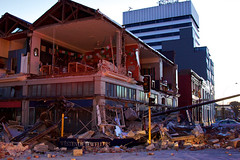
A photograph of the earthquake damage to a building on Hereford Street. A column on the right side of the building has snapped and the side wall has pulled away from the building. USAR codes have been spray-painted on one of the windows on the bottom storey. In the foreground there is a police car.
WEMO ERT Set 3 - February 2011 - Photograph 011
Images, UC QuakeStudies
A photograph of fire engines and other emergency vehicles parked on Worcester Street near Latimer Square.
Nisbet, Alastair, 1958- :'Canterbury special! It's gotta be better than ti…
Images, Alexander Turnbull Library
Shows a helicopter spray painting Christchurch with the Canterbury colours of black and red. Someone in the helicopter yells that 'it's gotta be better than tint of TC3'. Context: Probably refers to the apology by Earthquake Recovery Minister Gerry Brownlee for offending Christchurch's TC3 residents after saying he was 'sick and tired' of their moaning. TC3 means 'technical category 3'. Land classified TC3 is the mostly badly quake-damaged considered economically repairable. Quantity: 1 digital cartoon(s).
Evans, Malcolm Paul, 1945- :"This one's connected to Gerry Brownlee!" 19 J…
Images, Alexander Turnbull Library
A Christchurch seismic monitor churns out reams of paper with wild fluctuations showing earthquakes and aftershocks. Nearby two men examine a second monitor and one of them says 'This one's connected to Gerry Brownlee!' The reams of paper show a perfectly straight line - it appears that nothing is going on in Gerry Brownlee's head. Context - A sense that the Minister for Earthquake Recovery is being less than effective. Colour and black and white versions available Quantity: 2 digital cartoon(s).
Bicycle: Johnson's Grocery
Images, Canterbury Museum
One black Phillips brand bicycle with a large basket on the front, and a sign reading ‘Johnson's’ hanging from the frame. The front wheel is smaller than the back wheel.
Book: The Big Quake, Canterbury September 4, 2010
Images, Canterbury Museum
Multicolour softcover book titled "The Big Quake, Canterbury September 4, 2010" by The Press; colour illustrations and maps; accompanying DVD. The extent of the damage caused by the 4 September 2010 earthquake is recorded in this book by Christchurch’s daily newspaper The Press. The overall message portrayed is one of community spirit and a com...
Time Capsule: Copper
Images, Canterbury Museum
One cylindrical copper time capsule with soldered ends containing rolled copies of the Christchurch Times and The Press from 25 March 1931, along with a document detailing the placement of the time capsule by the then North Canterbury Hospital Board; one end of the capsule has been removed to allow access. The North Canterbury Hospital Board pl...
Sign: Cokers Hotel
Images, Canterbury Museum
One metal backed plastic sign, circa 1970s, for Cokers Hotel, Manchester Street, Christchurch detailing hotel services and featuring a map of the central city. The Cokers Hotel was located in central Christchurch at 52 Manchester Street. First licensed by John Etherdan (Jack) Coker in 1867, in 1890 the lease was taken over by Captain Popham, wh...