
Search
found 2110 results
Images for CANTERBURY EARTHQUAKE; more images...


GEER Association Aerial Photograph 063
Images, UC QuakeStudies
An aerial photograph of rural Canterbury following the 4 September earthquake, taken from a helicopter.
GEER Association Aerial Photograph 012
Images, UC QuakeStudies
An aerial photograph of rural Canterbury following the 4 September earthquake, taken from a helicopter.
GEER Association Aerial Photograph 038
Images, UC QuakeStudies
An aerial photograph of rural Canterbury following the 4 September earthquake, taken from a helicopter.
GEER Association Aerial Photograph 087
Images, UC QuakeStudies
An aerial photograph of rural Canterbury following the 4 September earthquake, taken from a helicopter.
GEER Association Aerial Photograph 041
Images, UC QuakeStudies
An aerial photograph of rural Canterbury following the 4 September earthquake, taken from a helicopter.
GEER Association Aerial Photograph 024
Images, UC QuakeStudies
An aerial photograph of rural Canterbury following the 4 September earthquake, taken from a helicopter.
Jayne Rattray's Story
Articles, UC QuakeStudies
Summary of oral history interview with Jayne Rattray about her experiences of the Canterbury earthquakes.
Mel Hillier's Story
Articles, UC QuakeStudies
Summary of oral history interview with Mel Hillier about her experiences of the Canterbury earthquakes.
Thérèse Angelo's Story
Articles, UC QuakeStudies
Summary of oral history interview with Thérèse Angelo about her experiences of the Canterbury earthquakes.
Belaynesh Tegegen's Story
Articles, UC QuakeStudies
Summary of oral history interview with Belaynesh Tegegen about her experiences of the Canterbury earthquakes.
Mary Hamilton's Story
Articles, UC QuakeStudies
Summary of oral history interview with Mary Hamilton about her experiences of the Canterbury earthquakes.
Estelle Laugesen's Story
Articles, UC QuakeStudies
Summary of oral history interview with Estelle Laugesen about her experiences of the Canterbury earthquakes.
Diana Madgin's Story
Articles, UC QuakeStudies
Summary of oral history interview with Diana Madgin about her experiences of the Canterbury earthquakes.
Emma Content's Story
Articles, UC QuakeStudies
Summary of oral history interview with Emma Content about her experiences of the Canterbury earthquakes.
Susan Barnes's Story
Articles, UC QuakeStudies
Summary of oral history interview with Susan Barnes about her experiences of the Canterbury earthquakes.
Helen King's Story
Articles, UC QuakeStudies
Summary of oral history interview with Helen King about her experiences of the Canterbury earthquakes.
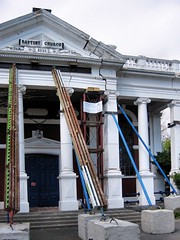
BeckerFraserPhotos September 2011 photograph 125
Images, UC QuakeStudies
Photograph captioned by BeckerFraserPhotos, "Canterbury Museum re-opened to the public on the 1st anniversary of the September earthquake, 4 September, 2011".
Umut Akguzel Photograph 029
Images, UC QuakeStudies
A photograph of cracks to the wall of the earthquake-damaged Wheki Building at the University of Canterbury.
Implications of the Canterbury earthquake sequence for Adelaide, South Aus…
Research papers, The University of Auckland Library
The city of Christchurch has experienced over 10,000 aftershocks since the 4th of September 2010 earthquake of which approximately 50 have been greater than magnitude 5. The damage caused to URM buildings in Christchurch over this sequence of earthquakes has been well documented. Due to the similarity in age and construction of URM buildings in Adelaide, South Australia and Christchurch (they are sister cities, of similar age and heritage), an investigation was conducted to learn lessons for Adelaide based on the Christchurch experience. To this end, the number of URM buildings in the central business districts of both cities, the extent of seismic strengthening that exists in both cities, and the relative earthquake hazards for both cities were considered. This paper will report on these findings and recommend strategies that the city of Adelaide could consider to significantly reduce the seismic risk posed by URM buildings in future earthquake.
Photo 014
Images, UC QuakeStudies
Workers survey a street in Avonside where there are large cracks, piles of liquefaction dug up from people's houses, fenced off portions of the street and an army vehicle parked, after the September 4th earthquake.
Photo 042
Images, UC QuakeStudies
The Hardie and Thomson building on Sherbourne Street is on a lean, barred off with police tape and road cones, after the 4th September earthquake. The city centre is visible in the distance.
Photo 043
Images, UC QuakeStudies
The Hardie and Thomson building on Sherbourne Street is on a lean, barred off with police tape and road cones, after the 4th September earthquake. The city centre is visible in the distance.
Performance of Unreinforced Masonry (URM) Buildings and Earthquake Perform…
Videos, UC QuakeStudies
A video recording of a lecture presented by Professor Rajesh Dhakal and Professor Andy Buchanan as part of the 2011 University of Canterbury Earthquake Lecture Series.
Shirley Community Centre, Shirley
Images, eqnz.chch.2010
Shirley Community Centre, Shirley Road, Christchurch. File reference: CCL-2012-05-10-Around-Shirley-May-2012 DSC_02866.JPG From the collection of Christchurch City Libraries.
Shirley Community Centre, Shirley
Images, eqnz.chch.2010
Shirley Community Centre, Shirley Road, Christchurch. File reference: CCL-2012-05-10-Around-Shirley-May-2012 DSC_02862.JPG From the collection of Christchurch City Libraries.
Shirley Community Centre, Shirley
Images, eqnz.chch.2010
Shirley Community Centre, Shirley Road, Christchurch. File reference: CCL-2012-05-10-Around-Shirley-May-2012 DSC_02869.JPG From the collection of Christchurch City Libraries.
Shirley Community Centre, Shirley
Images, eqnz.chch.2010
Shirley Community Centre, Shirley Road, Christchurch. File reference: CCL-2012-05-10-Around-Shirley-May-2012 DSC_02863.JPG From the collection of Christchurch City Libraries.
Shirley Community Centre, Shirley
Images, eqnz.chch.2010
Shirley Community Centre, Shirley Road, Christchurch. File reference: CCL-2012-05-10-Around-Shirley-May-2012 DSC_02867.JPG From the collection of Christchurch City Libraries.
New Zealand Defence Force photograph 066
Images, UC QuakeStudies
The Navy's multi-purpose vessel HMNZS Canterbury in Lyttelton Harbour. 700 meals were prepared in the HMNZS Canterbury for Lyttelton after the 22 February 2011 earthquake.
Canterbury Earthquake Anniversary Series: Thérèse Angelo, Air Force Museum
Articles, UC QuakeStudies
A blog post written by Thérèse Angelo, Director of the Air Force Museum of New Zealand. This is the third guest post in the NZ Museums blog series marking the first anniversary of the Christchurch earthquake. This blog post was downloaded on 4 February 2015.