
Search
found 196 results
Images for new Zealand; more images...
Rail returns between Picton and Christchurch
Audio, Radio New Zealand
The track will open this week after being closed for nearly a year after the line suffered extensive damage in last November's earthquake.
Something For the Weekend - Quake City Re-opens
Audio, Radio New Zealand
Canterbury Museum is inviting visitors to view Quake City for free during the special exhibition's reopening this weekend, 16 & 17 September. The newly-relocated exhibition that tells stories from the Canterbury earthquakes, reopened on 14 September.
First freight chugs into Chch from Picton since Kaikoura quake
Audio, Radio New Zealand
The first freight train since the devastating Kaikoura earthquake has chugged into Christchurch, after an historic 348 kilometre journey from Picton.
Canterbury land can't be farmed due to earthquake
Audio, Radio New Zealand
Tourism, native planting, and bee keeping are all possibilities a community lead working group is waiting on government funding to explore.
Christchurch rebuild offers training for Pasifika peoples
Audio, Radio New Zealand
Six years after Christchurch's destructive 6.3 magnitude earthquake the rebuild programme is now being used to provide training for workers from the Pacific. Twenty-four workers from Fiji, Tonga and Samoa are helping rebuild the city while learning new skills and earning money they can send home.
"Once you move, it's a different story" : the meaning of home for 1.5 gene…
Research papers, University of Canterbury Library
While some scholarship on refugee youth has focussed on leaving a place that is typically considered ‘home,’ there has been little attention to what ‘home’ means to them and how this is negotiated in the country of (re)settlement. This is particularly the case for girls and women. New Zealand research on refugee settlement has largely focussed on the economic integration of refugees. Although this research is essential, it runs the risk of overlooking the socio-cultural aspects of the resettlement experiences and renders partial our understanding of how particular generations and ethnic groups develop a sense of belonging to their adopted homeland. In order to address these research gaps, this thesis explores the experiences of 12 Afghan women, aged 19-29 years, of refugee background who relocated to Christchurch, New Zealand, during their childhood and early teenage years. This study employed semi-structured, one-to-one, in-depth interviews and photo-elicitation to encourage talk about participants’ experiences of leaving Afghanistan, often living in countries of protracted displacement (Iran and/or Pakistan) and making- and being-at-home in New Zealand. In this thesis, I explore the ways in which they frame Afghanistan, and the ways in which their experiences in Iran and Pakistan disrupt the dichotomisation of belonging in terms of ‘here’ (ancestral land) and ‘there’ (country of residence). Furthermore, I use affect theorising to analyse the participants’ expressions of resettlement and home in New Zealand. Feeling at home is as much about negotiating cultural and gendered identities in Western secular societies as it is about belonging to a particular community. Through their experiences of ‘living in two worlds’, the participants are able to strategically challenge cultural expectations without undermining their reputations as Muslims and as Afghan women. The participants discussed their emotional responses to double-displacement: one as a result of war and the other as a result of 2011 Canterbury earthquakes. Therefore, I suggest that for young Afghan women, Afghanistan was among several markers of home in a long embodied journey of (re)settlement.
Transport infrastructure performance and management in the South Island of…
Research papers, University of Canterbury Library
At 00:02 on 14th November 2016, a Mw 7.8 earthquake occurred in and offshore of the northeast of the South Island of New Zealand. Fault rupture, ground shaking, liquefaction, and co-seismic landslides caused severe damage to distributed infrastructure, and particularly transportation networks; large segments of the country’s main highway, State Highway 1 (SH1), and the Main North Line (MNL) railway line, were damaged between Picton and Christchurch. The damage caused direct local impacts, including isolation of communities, and wider regional impacts, including disruption of supply chains. Adaptive measures have ensured immediate continued regional transport of goods and people. Air and sea transport increased quickly, both for emergency response and to ensure routine transport of goods. Road diversions have also allowed critical connections to remain operable. This effective response to regional transport challenges allowed Civil Defence Emergency Management to quickly prioritise access to isolated settlements, all of which had road access 23 days after the earthquake. However, 100 days after the earthquake, critical segments of SH1 and the MNL remain closed and their ongoing repairs are a serious national strategic, as well as local, concern. This paper presents the impacts on South Island transport infrastructure, and subsequent management through the emergency response and early recovery phases, during the first 100 days following the initial earthquake, and highlights lessons for transportation system resilience.
Transport infrastructure performance and management in the South Island of…
Research papers, University of Canterbury Library
At 00:02 on 14th November 2016, a Mw 7.8 earthquake occurred in and offshore of the northeast of the South Island of New Zealand. Fault rupture, ground shaking, liquefaction, and co-seismic landslides caused severe damage to distributed infrastructure, and particularly transportation networks; large segments of the country’s main highway, State Highway 1 (SH1), and the Main North Line (MNL) railway line, were damaged between Picton and Christchurch. The damage caused direct local impacts, including isolation of communities, and wider regional impacts, including disruption of supply chains. Adaptive measures have ensured immediate continued regional transport of goods and people. Air and sea transport increased quickly, both for emergency response and to ensure routine transport of goods. Road diversions have also allowed critical connections to remain operable. This effective response to regional transport challenges allowed Civil Defence Emergency Management to quickly prioritise access to isolated settlements, all of which had road access 23 days after the earthquake. However, 100 days after the earthquake, critical segments of SH1 and the MNL remain closed and their ongoing repairs are a serious national strategic, as well as local, concern. This paper presents the impacts on South Island transport infrastructure, and subsequent management through the emergency response and early recovery phases, during the first 100 days following the initial earthquake, and highlights lessons for transportation system resilience.
Anna Leask - Behind bars
Audio, Radio New Zealand
Anna Leask has worked for the New Zealand Herald since 2008 and is currently a senior reporter, covering crime and justice for the daily newspaper as well as for the Weekend Herald and Herald on Sunday. Notably she's reported on the re-investigation of Arthur Allan Thomas, 43 years after the double murders for which he served nine years in prison before being pardoned, and the Christchurch 'House of Horrors' murderer Jason Somerville, who killed his wife and buried her under his East Christchurch house a year after doing the same to his neighbour Tisha Lowery. Leask covered the Pike River Mine disaster in 2010, the 2011 Canterbury earthquakes, Fiji's Cyclone Winston in early 2016 and travelled to Gallipoli in 2015 to cover the centenary of the Anzac landings. She won a Canon Media Award for crime and justice reporting in 2014. Her first book, Behind Bars: Real-life stories from inside New Zealand prisons has just been released.
Digital Photograph: Brass Band at the Canterbury Earthquake Memorial Servi…
Images, Canterbury Museum
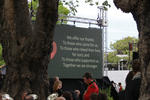
One landscape colour digital photograph taken 22 February 2017 showing brass band members at the Canterbury Earthquake Memorial Service. Behind the band is a digital screen showing words of thanks from survivors.
Digital Photograph: Guests Arriving at the Canterbury Earthquake Memorial …
Images, Canterbury Museum
One landscape colour digital photograph taken 22 February 2017 showing guests being seated prior to the Canterbury Earthquake Memorial Service.
Digital Photograph: First Responders at the Canterbury Earthquake Memorial…
Images, Canterbury Museum
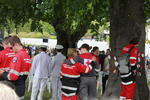
One landscape colour digital photograph taken 22 February 2017 showing first responders at the Canterbury Earthquake Memorial Service.
Digital Photograph: Brass Band at the Canterbury Earthquake Memorial Servi…
Images, Canterbury Museum
One landscape colour digital photograph taken 22 February 2017 showing brass band members at the Canterbury Earthquake Memorial Service. Behind the band is a digital screen showing an image of flowers floating in the Avon River.
Digital Photograph: Members of the Media at the Canterbury Earthquake Memo…
Images, Canterbury Museum
One landscape colour digital photograph taken 22 February 2017 showing cameramen and journalists at the Canterbury Earthquake Memorial Service.
Digital Photograph: Media Viewing Area at the Canterbury Earthquake Memori…
Images, Canterbury Museum
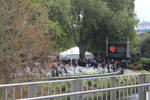
One landscape colour digital photograph taken 22 February 2017 showing the appointed media viewing area at the Canterbury Earthquake Memorial Service.
Digital Photograph: First Responders and Public Viewing Areas at the Cante…
Images, Canterbury Museum
One landscape colour digital photograph taken 22 February 2017 showing the appointed first responders and public viewing areas at the Canterbury Earthquake Memorial Service.
Digital Photograph: First Responders Laying Wreaths at the Canterbury Eart…
Images, Canterbury Museum
One landscape colour digital photograph taken 22 February 2017 showing first responders laying wreaths at the Canterbury Earthquake Memorial Service.
Digital Photograph: Commemoration Board at the Canterbury Earthquake Memor…
Images, Canterbury Museum
One landscape colour digital photograph taken 22 February 2017 showing a gentleman reading messages on a commemoration board at the Canterbury Earthquake Memorial Service.
Digital Photograph: Flowers Floating in the Avon River
Images, Canterbury Museum
One landscape colour digital photograph taken 22 February 2017 showing flowers floating in the Avon River as part of the Canterbury Earthquake Memorial Service.
Digital Photograph: Sunflower Atop a Road Works Cone
Images, Canterbury Museum
One landscape colour digital photograph taken 22 February 2017 showing a sunflower sitting atop a road works cone as part of the Canterbury Earthquake Memorial Service.
Digital Photograph: Earthquake Memorial Trellis
Images, Canterbury Museum
One landscape colour digital photograph taken 22 February 2017 showing an earthquake memorial trellis at the site of the former Canterbury Television building.
Digital Photograph: Commemorative Note to Andrew Bishop
Images, Canterbury Museum
One landscape colour digital photograph taken 22 February 2017 showing a commemorative note to, and photograph of, Andrew Bishop attached to an earthquake memorial trellis at the site of the former Canterbury Television building.
Digital Photograph: Flowers on an Earthquake Memorial Trellis
Images, Canterbury Museum
One landscape colour digital photograph taken 22 February 2017 showing a bouquet of flowers and a note attached to an earthquake memorial trellis at the site of the former Canterbury Television building.
Digital Photograph: Earthquake Memorial Trellis
Images, Canterbury Museum
One landscape colour digital photograph taken 22 February 2017 showing an earthquake memorial trellis at the site of the former Canterbury Television building.
Digital Photograph: Karen Bishop at an Earthquake Memorial Trellis
Images, Canterbury Museum
One landscape colour digital photograph taken 22 February 2017 showing Karen Bishop attaching a windmill to an earthquake memorial trellis in memory of her son Andrew Bishop at the site of the former Canterbury Television building.
Digital Photograph: Windmill Attached to an Earthquake Memorial Trellis
Images, Canterbury Museum
One landscape colour digital photograph taken 22 February 2017 showing a windmill attached to an earthquake memorial trellis by Karen Bishop in memory of her son Andrew Bishop at the site of the former Canterbury Television building.
Digital Photograph: Flowers at the Site of the Former Canterbury Televisio…
Images, Canterbury Museum
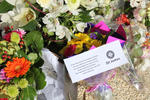
One landscape colour digital photograph taken 22 February 2017 showing a bouquet of flowers left at the site of the former Canterbury Television building by the Toyama Language School in memory of earthquake victims.
Digital Photograph: Flowers at the Site of the Former Canterbury Televisio…
Images, Canterbury Museum
One landscape colour digital photograph taken 22 February 2017 showing bouquets of flowers and gifts left at the site of the former Canterbury Television building in memory of earthquake victims.
The Central finally arrives at Christchurch's Arts Centre
Audio, Radio New Zealand
It's been a long, long wait but Christchurch's Arts Centre finally has a contemporary art gallery space again - and it's just opened. It's the latest 'reveal' in the Arts Centre post-earthquake rebuild. The new gallery's called The Central and is housed in the original Canterbury College Library. Four Christchurch families and gallerist Jonathan Smart have made it happen and artists including local sculptor Neil Dawson, photographer Peter Peryer, glitter specialist Reuben Patterson and painter Dick Frizzell are in the mix for the opening group show. There are some new names there too. Lynn Freeman speaks to The Central's Jonathan Smart and Ngai Tahu artist Lonnie Hutchinson who has work in the opening show.
The Great Outdoors - Peter Langlands
Audio, Radio New Zealand
Conservationist, forager, angler and former fisheries observer Peter Langlands talks about the many threats to our lakes and waterways. Lynn Freeman asked the Cantabrian how the earthquakes affected Christchurch birds, as there was talk that they left the city.