
Search
found 132 results
Images for christchurch OR past OR heritage OR historic; more images...
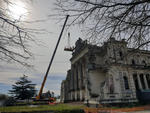
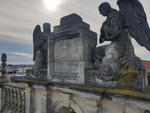
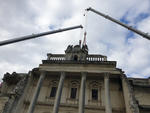
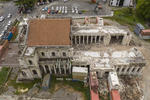
Digital Photograph: Cathedral of the Blessed Sacrament during demolition b…
Images, Canterbury Museum
One digital photograph showing the Cathedral of the Blessed Sacrament during demolition. A yellow digger arm and nibbler claw can be seen along with stone falling from an exterior wall. Taken by photographer Helen McLeod in December 2020.
Transcript of Laura's earthquake story
Articles, UC QuakeStudies
An edited copy of the pdf transcript of Laura's second earthquake story, captured by the UC QuakeBox Take 2 project. At the participant's request, parts of this transcript have been redacted. Interviewer: Jennifer Middendorf. Transcriber: Laura Moir.
Outrage in Canterbury over Brownlee's promotion
Audio, Radio New Zealand
The appointment of Christchurch MP Gerry Brownlee as National's deputy leader has been met with a chorus of outrage from some Cantabrians - who say he is responsible for lengthy delays in settling insurance claims from the Canterbury earthquakes.
Earthquake anniversary marks 10 years of disruption
Audio, Radio New Zealand
It's 10 years since the first big Christchurch earthquake - and if you'd just started school then you're now ending your decade of education amidst a global pandemic. We meet two teens for whom disruption is normal.
Christ Church Cathedral's day of restoration
Audio, Radio New Zealand
A momentous day in Christchurch as a huge steel frame was installed as part of the stabilisation work for Christ Church Cathedral. Karyn speaks with project director Keith Paterson about the plans to return the famed rose window extensively damage in the 2011 earthquake.
Strategies for earthquake strengthening vintage clay-brick unreinforced ma…
Research papers, The University of Auckland Library
This thesis describes the strategies for earthquake strengthening vintage clay bricks unreinforced masonry (URM) buildings. URM buildings are well known to be vulnerable to damage from earthquake-induced lateral forces that may result in partial or full building collapse. The 2010/2011 Canterbury earthquakes are the most recent destructive natural disaster that resulted in the deaths of 185 people. The earthquake events had drawn people’s attention when URM failure and collapse caused about 39 of the fatality. Despite the poor performance of URM buildings during the 2010/2011 Canterbury earthquakes, a number of successful case study buildings were identified and their details research in-depth. In order to discover the successful seismic retrofitting techniques, two case studies of retrofitted historical buildings located in Christchurch, New Zealand i.e. Orion’s URM substations and an iconic Heritage Hotel (aka Old Government Building) was conducted by investigating and evaluating the earthquake performance of the seismic retrofitting technique applied on the buildings prior to the 2010/2011 Canterbury earthquakes and their performance after the earthquakes sequence. The second part of the research reported in this thesis was directed with the primary aim of developing a cost-effective seismic retrofitting technique with minimal interference to the vintage clay-bricks URM buildings. Two retrofitting techniques, (i) near-surface mounted steel wire rope (NSM-SWR) with further investigation on URM wallettes to get deeper understanding the URM in-plane behaviour, and (ii) FRP anchor are reported in this research thesis
Southern Response in court contesting class action
Audio, Radio New Zealand
Southern Response is back in court today - this time having a final go at arguing that a class action against it should not be an 'opt-out'. Christchurch residents Brendan and Colleen Ross say the state insurer deliberately withheld the true cost of repairing their home which was damaged in the Canterbury earthquakes. They are now among 3000 people represented in a class action led by Christchurch lawyer Grant Cameron. In September last year the Court of Appeal decided the class action could proceed on an 'opt-out' basis - which means it would cover more people and potentially cost the state-owned insurer more money if it loses. Southern Response is challenging that decision in the Supreme Court, a two day hearing wrapped up on Tuesday. Checkpoint reporter Logan Church was there.
Transcript of Tania's earthquake story
Articles, UC QuakeStudies
A pdf transcript of Tania's second earthquake story, captured by the UC QuakeBox Take 2 project. Interviewer: Laura Moir. Transcriber: Lucy Denham.
Impacts of site specific information on post-earthquake cordons: A compara…
Research papers, University of Canterbury Library
Post-earthquake cordons have been used after seismic events around the world. However, there is limited understanding of cordons and how contextual information of place such as geography, socio-cultural characteristics, economy, institutional and governance structure etc. affect decisions, operational procedures as well as spatial and temporal attributes of cordon establishment. This research aims to fill that gap through a qualitative comparative case study of two cities: Christchurch, New Zealand (Mw 6.2 earthquake, February 2011) and L’Aquila, Italy (Mw 6.3 earthquake, 2009). Both cities suffered comprehensive damage to its city centre and had cordons established for extended period. Data collection was done through purposive and snowball sampling methods whereby 23 key informants were interviewed in total. The interviewee varied in their roles and responsibilities i.e. council members, emergency managers, politicians, business/insurance representatives etc. We found that cordons were established to ensure safety of people and to maintain security of place in both the sites. In both cities, the extended cordon was met with resistance and protests. The extent and duration of establishment of cordon was affected by recovery approach taken in the two cities i.e. in Christchurch demolition was widely done to support recovery allowing for faster removal of cordons where as in L’Aquila, due to its historical importance, the approach to recovery was based on saving all the buildings which extended the duration of cordon. Thus, cordons are affected by site specific needs. It should be removed as soon as practicable which could be made easier with preplanning of cordons.
Transcript of Julie's earthquake story
Articles, UC QuakeStudies
A pdf transcript of Julie's second earthquake story, captured by the UC QuakeBox Take 2 project. Interviewer: Samuel Hope. Transcriber: Natalie Looyer.
Transcript of Diane Hyde's earthquake story
Articles, UC QuakeStudies
A pdf transcript of Diane Hyde's second earthquake story, captured by the UC QuakeBox Take 2 project. Interviewer: Paul Millar. Transcriber: Natalie Looyer.
Transcript of Ann's earthquake story
Articles, UC QuakeStudies
A pdf transcript of Ann's second earthquake story, captured by the UC QuakeBox Take 2 project. Interviewer: Samuel Hope. Transcriber: Josie Hepburn.
Assessing the link between sea level rise and mental well-being : a case s…
Research papers, University of Canterbury Library
With sea level rise (SLR) fast becoming one of the most pressing matters for governments worldwide, there has been mass amounts of research done on the impacts of SLR. However, these studies have largely focussed on the ways that SLR will impact both the natural and built environment, along with how the risk to low-lying coastal communities can be mitigated, while the inevitable impacts that this will have on mental well-being has been understudied. This research has attempted to determine the ways in which SLR can impact the mental well-being of those living in a low-lying coastal community, along with how these impacts could be mitigated while remaining adaptable to future environmental change. This was done through conducting an in-depth literature review to understand current SLR projections, the key components of mental well-being and how SLR can influence changes to mental well-being. This literature review then shaped a questionnaire which was distributed to residents of the New Brighton coastline. This questionnaire asked respondents how they interact with the local environment, how much they know about SLR and its associated hazards, whether SLR causes any level of stress or worry along with how respondents feel that these impacts could be mitigated. This research found that SLR impacts the mental well-being of those living in low-lying coastal communities through various methods: firstly, the respondents perceived risk to SLR and its associated hazards, which was found to be influenced by the suburbs that respondents live in, their knowledge of SLR, their main sources of information and the prior experience of the Canterbury Earthquake Sequence (CES). Secondly, the financial aspects of SLR were also found to be drivers of stress or worry, with depreciating property values and rising insurance premiums being frequently noted by respondents. It was found that the majority of respondents agreed that being involved in and informed of the protection process, having more readable and accurate information, and an increased engagement with community events and greenspaces would help to reduce the stress or worry caused by SLR, while remaining adaptable to future environmental change.
Poster used to advertise the Young women's experiences of COVID-19 researc…
Articles, UC QuakeStudies
Poster inviting potential participants to contact researchers engaged in the Young Women's Experiences of COVID-19 research project.
Information sheet for participants
Articles, UC QuakeStudies
Young women's experiences of the COVID-19 pandemic - Information sheet.
Interview questions
Articles, UC QuakeStudies
Interview questions.
Olivia's Interview Transcript_RDUP06
Articles, UC QuakeStudies
A PDF transcript of an interview with Olivia (pseudonym) about her experiences during the COVID-19 pandemic.
Annie's Interview Transcript_LT13
Articles, UC QuakeStudies
A PDF transcript of an interview with Annie (pseudonym) about her experiences during the COVID-19 pandemic.
Raewyn's Interview Transcript_RDUP11
Articles, UC QuakeStudies
A PDF transcript of an interview with Raewyn (pseudonym) about her experiences during the COVID-19 pandemic.
Sara's Interview transcript_RDUP05
Articles, UC QuakeStudies
A PDF transcript of an interview with Sara (pseudonym) about her experiences during the COVID-19 pandemic.
Nina's Interview Transcript_RDUP07
Articles, UC QuakeStudies
A PDF transcript of and interview with Nina (pseudonym) about her experiences during the COVID-19 pandemic.
El's Interview Transcript_LT14
Articles, UC QuakeStudies
A PDF transcript of an interview with El about her experiences during the COVID-19 pandemic.
Kelsey's Interview Transcript_LT02
Articles, UC QuakeStudies
A PDF transcript of an interview with Kelsey (pseudonym) about her experiences during the COVID-19 pandemic.
Cheryl's Interview Transcript_LT08
Articles, UC QuakeStudies
A PDF transcript of an interview with Cheryl (pseudonym) about her experiences during the COVID-19 pandemic.
Clare's Interview Transcript_LT01
Articles, UC QuakeStudies
A PDF transcript of an interview with Clare (pseudonym) about her experiences during the COVID-19 pandemic.
Daisy's Interview Transcript_LT10
Articles, UC QuakeStudies
A PDF transcript of an interview with Daisy (pseudonym) about her experiences during the COVID-19 pandemic.
Consent Form 2- Publication and Storage
Articles, UC QuakeStudies
Consent Form 2: Publication and Storage
Asayal's Interview Transcript_LT09
Articles, UC QuakeStudies
A PDF transcript of an interview with Asayal about her experiences during the COVID-19 pandemic.
Consent Form 1 - Interview
Articles, UC QuakeStudies
Consent Form 1 - Interview
Biographical information form
Articles, UC QuakeStudies
Biographical information form.