

Search
found 918 results
Images for CANTERBURY; more images...
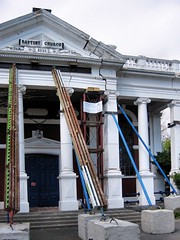
Observatory Tower Photograph 02
Images, UC QuakeStudies
A photograph of cracks in the masonry of the Observatory tower at the Christchurch Arts Centre. The cracks formed as a result of the 4 September 2010 earthquake.
Observatory Tower Photograph 07
Images, UC QuakeStudies
A photograph of the Observatory tower at the Christchurch Arts Centre. There are cracks in the masonry of the tower near where the two storeys join. The cracks formed as a result of the 4 September 2010 earthquake. Wire fencing has been placed at the entrance to the courtyard in front as a cordon.
Observatory Tower Photograph 36
Images, UC QuakeStudies
A photograph of the platform for the Townsend Telescope amongst the rubble of the Observatory tower at the Christchurch Arts Centre. The tower collapsed during the 22 February 2011 earthquake, severely damaging the telescope.
Observatory Tower Photograph 06
Images, UC QuakeStudies
A photograph of cracks around a window of the Observatory tower at the Christchurch Arts Centre. The cracks formed as a result of the 4 September 2010 earthquake.
Townsend Telescope Pre-Earthquake Photographs 02
Images, UC QuakeStudies
A photograph of the Townsend Telescope in the Observatory at the Christchurch Arts Centre. In the bottom right-hand corner of the photograph is a pulley for the telescope's clock drive. This is one of the pieces that went missing when the Observatory tower collapsed in the 22 February 2011 earthquake. This image was used by Graeme Kershaw, Technician at the University of Canterbury Department of Physics and Astronomy, to identify the telescope's parts after the 22 February 2011 earthquake.
Townsend Telescope Pre-Earthquake Photographs 09
Images, UC QuakeStudies
A photograph of the middle section of the Townsend Telescope. The telescope is in the Observatory at the Christchurch Arts Centre. A plate on the side reads, "T Cook & Sons, 1864, York & London". This image was used by Graeme Kershaw, Technician at the University of Canterbury Department of Physics and Astronomy, to identify the telescope's parts after the 22 February 2011 earthquake.
Observatory Tower Photograph 35
Images, UC QuakeStudies
A photograph of the rubble from the Observatory tower in the South Quad of the Christchurch Arts Centre. The tower collapsed during the 22 February 2011 earthquake. A digger was used to clear the rubble away from the building. Scaffolding constructed around the tower has also collapsed and is amongst the rubble.
Observatory Tower Photograph 34
Images, UC QuakeStudies
A photograph of the bottom storey of the Observatory tower at the Christchurch Arts Centre. Rubble from the top two storeys of the tower has spilled into the courtyard in front of the tower. A digger was used to clear the rubble away from the building.
Observatory Tower Photograph 14
Images, UC QuakeStudies
A close-up photograph of parts of the Townsend Telescope recovered from the rubble of the Observatory tower. The telescope was housed in the tower at the Christchurch Arts Centre. It was severely damaged when the tower collapsed during the 22 February 2011 earthquake.
Townsend Telescope Pre-Earthquake Photographs 01
Images, UC QuakeStudies
A photograph of Wayne Smith and Ken Vickery inside the Observatory at the Christchurch Arts Centre, taken in the 1970s. Smith and Vickery are pictured next to the Townsend Telescope, which they have just refurbished. No repair work was necessary during this process.
Observatory Tower Photograph 12
Images, UC QuakeStudies
A photograph of parts of the Townsend Telescope recovered from the rubble of the Observatory tower. The telescope was housed in the tower at the Christchurch Arts Centre. It was severely damaged when the tower collapsed during the 22 February 2011 earthquake.
Observatory Tower Photograph 24
Images, UC QuakeStudies
A photograph of the earthquake damage to the Observatory tower at the Christchurch Arts Centre. The top two storeys of the tower collapsed during the 22 February 2011 earthquake and the rubble spilled into the courtyard in front. A digger was used to clear the rubble away from the building. A tarpaulin has been draped over the top of the tower.
Townsend Telescope Pre-Earthquake Photographs 08
Images, UC QuakeStudies
A photograph of the middle section of the Townsend Telescope. The telescope is in the Observatory at the Christchurch Arts Centre. A plate on the side reads, "T Cook & Sons, 1864, York & London". This image was used by Graeme Kershaw, Technician at the University of Canterbury Department of Physics and Astronomy, to identify the telescope's parts after the 22 February 2011 earthquake.
Observatory Tower Photograph 37
Images, UC QuakeStudies
A photograph of the earthquake-damaged Observatory tower at the Christchurch Arts Centre. The photograph was taken using a cellphone camera. The top of the tower collapsed during the 22 February 2011 earthquake. The rubble from the tower has been cleared and a tarpaulin has been placed over the top of the broken tower. Tyres have been placed on the tarpaulin to hold it down. A temporary roof has also been constructed over the tower to keep out the rain.
Townsend Telescope Pre-Earthquake Photographs 10
Images, UC QuakeStudies
A photograph of the Townsend Telescope. The telescope is in the Observatory at the Christchurch Arts Centre. A plate on the side reads, "T Cook & Sons, 1864, York & London". This image was used by Graeme Kershaw, Technician at the University of Canterbury Department of Physics and Astronomy, to identify the telescope's parts after the 22 February 2011 earthquake.
Observatory Tower Photograph 32
Images, UC QuakeStudies
A photograph of the earthquake damage to the Observatory tower at the Christchurch Arts Centre. The top two storeys of the tower collapsed during the 22 February 2011 earthquake and the rubble spilled into the courtyard in front. A digger was used to clear the rubble away from the building. A tarpaulin has been draped over the top of the broken tower and the roof behind.
Observatory Tower Photograph 03
Images, UC QuakeStudies
A photograph of the Observatory tower at the Christchurch Arts Centre. There are cracks in the masonry of the tower near where the two storeys join. The cracks formed as a result of the 4 September 2010 earthquake.
Observatory Tower Photograph 05
Images, UC QuakeStudies
A photograph of a window of the Observatory tower at the Christchurch Arts Centre.
Observatory Tower Photograph 18
Images, UC QuakeStudies
A photograph of the earthquake damage to the second story of the Observatory tower at the Christchurch Arts Centre. The front of the storey has collapsed, exposing the inside. A tarpaulin has been draped over the top and the roof of the building behind.
People in Disasters Conference - Organisational Resilience is more than ju…
Videos, UC QuakeStudies
A video of a presentation by Associate Professor John Vargo during the fifth plenary of the 2016 People in Disasters Conference. Vargo is a senior researcher and co-leader of the Resilient Organisations Research Programme at the University of Canterbury. The presentation is titled, "Organisational Resilience is more than just Business Continuity".The abstract for this presentation reads as follows: Business Continuity Management is well-established process in many larger organisations and a key element in their emergency planning. Research carried out by resilient organisations follow the 2010 and 2011 Canterbury Earthquakes show that most small organisations did not have a business continuity plan (BCP), yet many of these organisations did survive the massive disruptions following the earthquakes. They were resilient to these catastrophic events, but in the absence of a BCP. This research also found that many of the organisations with BCP's, struggled to use them effectively when facing real events that did not align with the BCP. Although the BCPs did a good job of preparing organisations to deal with technology and operational disruptions, there was virtually no coverage for the continuity of people. Issues surrounding staff welfare and engagement were amongst the most crucial issues faced by Canterbury organisations, yet impacts of societal and personal disruption did not feature in BCPs. Resilience is a systematic way of looking at how an organization can survive a crisis and thrive in an uncertain world. Business continuity is an important aspect for surviving the crisis, but it is only part of the bigger picture addressed by organisational resilience. This presentation will show how organizational experiences in the Canterbury earthquakes support the need to move to a 'Business Continuity' for the '21st Century', one that incorporates more aspects of resilience, especially the 'people' areas of leadership, culture, staff welfare, and engagement.
ELM Offices Level 7 Library - Photograph 04
Images, UC QuakeStudies
The University of Canterbury's E-Learning team's temporary office in the James Hight building. The photographer comments, "First looks at our new temporary (maybe) office space. Our group will stay here until April or May 2011, then will move to another floor in the Central Library. Reception. This is where students used to come to enquire about support services".
ELM Offices Level 7 Library - Photograph 15
Images, UC QuakeStudies
A view of the UBS building at the University of Canterbury, seen from level 7 of the James Hight building. The photographer comments, "First looks at our new temporary (maybe) office space. Our group will stay here until April or May 2011, then will move to another floor in the Central Library. The University Book Shop building".
ELM Offices Level 7 Library - Photograph 13
Images, UC QuakeStudies
A member of the University of Canterbury's E-Learning team in their temporary office in the James Hight building. The photographer comments, "First looks at our new temporary (maybe) office space. Our group will stay here until April or May 2011, then will move to another floor in the Central Library. South view over trees to the hills".
ELM Offices Level 7 Library - Photograph 10
Images, UC QuakeStudies
Members of the University of Canterbury's E-Learning team Jess Hollis and Alan Hoskin in their temporary office in the James Hight building. The photographer comments, "First looks at our new temporary (maybe) office space. Our group will stay here until April or May 2011, then will move to another floor in the Central Library. Room 709 - Jess & Alan".
Energy - Communication Resilience
Research papers, University of Canterbury Library
This is a joint Resilience Framework undertaken by the Electrical, Computer and Software Engineering Department of the University of Auckland in association with West Power and Orion networks and partially funded by the New Zealand National Science Challenge and QuakeCoRE. The Energy- Communication research group nearly accomplished two different researches focusing on both asset resilience and system resilience. Asset resilience research which covers underground cables system in Christchurch region is entitled “2010-2011 Canterbury Earthquake Sequence Impact on 11KV Underground Cables” and system resilience research which covers electricity distribution and communication system in West Coast region is entitled “NZ Electricity Distribution Network Resilience Assessment and Restoration Models following Major Natural Disturbance“. As the fourth milestone of the aforementioned research project, the latest outcome of both projects has been socialised with the stakeholders during the Cigre NZ 2019 Forum.
SeisFinder : A Web Application for Extraction of Data from Computationally…
Research papers, University of Canterbury Library
Overview of SeisFinder SeisFinder is an open-source web service developed by QuakeCoRE and the University of Canterbury, focused on enabling the extraction of output data from computationally intensive earthquake resilience calculations. Currently, SeisFinder allows users to select historical or future events and retrieve ground motion simulation outputs for requested geographical locations. This data can be used as input for other resilience calculations, such as dynamic response history analysis. SeisFinder was developed using Django, a high-level python web framework, and uses a postgreSQL database. Because our large-scale computationally-intensive numerical ground motion simulations produce big data, the actual data is stored in file systems, while the metadata is stored in the database. The basic SeisFinder architecture is shown in Figure 1.
Measuring the Impact of Insurance on Urban Recovery with Light
Research papers, University of Canterbury Library
We measure the longer-term effect of a major earthquake on the local economy, using night-time light intensity measured from space, and investigate whether insurance claim payments for damaged residential property affected the local recovery process. We focus on the destructive Canterbury Earthquake Sequence (CES) 2010 -2011 as our case study. Uniquely for this event, more than 95% of residential housing units were covered by insurance, but insurance payments were staggered over 5 years, enabling us to identify their local impact. We find that night-time luminosity can capture the process of recovery and describe the recovery’s determinants. We also find that insurance payments contributed significantly to the process of economic recovery after the earthquake, but delayed payments were less affective and cash settlement of claims were more effective than insurance-managed repairs in contributing to local recovery.
ELM Offices Level 7 Library - Photograph 07
Images, UC QuakeStudies
The University of Canterbury's E-Learning team's temporary office in the James Hight building. The photographer comments, "First looks at our new temporary (maybe) office space. Our group will stay here until April or May 2011, then will move to another floor in the Central Library. House bar. This reception desk is not used now. A small kitchen is at the right".
UC Restarts - Photograph 12
Images, UC QuakeStudies
Students sit outside the InTentCity 6.3 Cafe, which was set up in a tent in the Law car park while University of Canterbury buildings were closed for structural testing. The photographer comments, "The University restarts its teaching, and the techies in e-learning move out of NZi3. The cafe has an outside seating area under the trees".
ELM Offices Level 7 Library - Photograph 11
Images, UC QuakeStudies
Alan Hoskin, a member of the University of Canterbury's E-Learning team, in their temporary office in the James Hight building. The photographer comments, "First looks at our new temporary (maybe) office space. Our group will stay here until April or May 2011, then will move to another floor in the Central Library. Bean bag. Alan wanted the beanbag but Jess said no".