

Search
found 847 results
Images for Earthquake, 22 February 2011 Christchurch, New Zealand; more images...
Nisbet, Alistair, 1958-:[The value of old technology in natural disasters]…
Images, Alexander Turnbull Library
The cartoon shows a room full of dying electronic gadgets like television, sound systems, a digital phone, a computer etc. and a wood burning stove, a candle, an analogue phone and a barbecue that are old technology and so very useful after the Christchurch earthquake of 22 February 2011. The barbecue says 'How can we retire? These youngsters can't cut it!' Published in The Press Quantity: 1 digital cartoon(s).
Evans, Malcolm Paul, 1945-"Just between you and me, I'm hoping to have him…
Images, Alexander Turnbull Library
In the living room of a house half-ruined by the Christchurch earthquake a decrepit and useless-looking man in a grubby white singlet doses in his armchair with a glass of beer in his hand; his wife whispers to a friend 'Just between you and me, I'm hoping to have him red-stickered!' Context - The two Christchurch earthquakes of 4 September 2010 and 22 February 2011 and the technique of using different coloured stickers to designate the degree of damage to buildings - 'red' indicates that it needs to be demolished. Colour and black and white versions available Quantity: 2 digital cartoon(s).
Brockie, Robert Ellison, 1932-:[The New Zealand ship of state] 4 March 2011
Images, Alexander Turnbull Library
A ship named 'NZ Ship of State' lies high and dry on rocks; the great jagged holes in her represent 'the recession', 'Pike River', 'Chch 1' and 'Chch 2'. A man standing nearby asks 'How will we refloat her?' and a second man answers '...by cutting Working for Families & interest-free student loans' Someone outside the frame says 'Where's the No. 8 wire?' Context - The New Zealand economy was stagnating before the impact of the Christchurch earthquakes of 4 September 2010 and 22 February 2011 and the Pike River Mine disaster before that. The government was already considering cutting Working for Families & interest-free student loans before the earthquakes struck and it seems that now they are trying to push through these policy changes using the earthquakes as an excuse. Quantity: 1 digital cartoon(s).
Nisbet, Alistair, 1958- :"Dang! I'm busting again!" 16 June 2011
Images, Alexander Turnbull Library
A man, half shown, sits on a loo and says 'Dang! I'm busting again! as he reaches for the toilet paper which has a different 'quake claim' printed on each section. Context - Magnitude 6.0 and 5.5 earthquakes rocked Christchurch again at 1pm and 2.20pm on 13th June 2011. These quakes follow the first earthquake on September 4th 2010 and the second on February 22nd 2011. (www.stuff.co.nz, 13 June 2011) Each time there is a significant quake more damage is done and so people have to make further insurance claims. Quantity: 1 digital cartoon(s).
Winter, Mark 1958-:Red & black - Kia kaha Christchurch. 5 March 2011
Images, Alexander Turnbull Library
The cartoon has stripes above the words 'RED & BLACK kia kaha Christchurch'. Context - red and black are the Canterbury colours - the cartoon is a tribute to the people of Christchurch after the disastrous earthquake of 22 February 2011. 'Kia kaha' means 'forever strong'. Quantity: 1 digital cartoon(s).
Nisbet, Alistair, 1958-:[Handling the Christchurch earthquakes] 14 March 2…
Images, Alexander Turnbull Library
In a Christchurch street still covered in liquefaction man weeps over his four-wheel drive car, which has a number plate showing the word 'macho'. Two women who are working at clearing the road of silt watch and one of them observes that 'he's not handling the quake well at all... Keeps getting silt smears on the 4 x 4!' Context - The Christchurch earthquake of 22 February 2011. Liquefaction is a particular problem. There is a point being made here about the 'macho' man who sobs over his car and the two staunch women who get on with the cleaning-up effort. Quantity: 1 digital cartoon(s).
Winter, Mark, 1958-: Rugby World Cup. 17 March 2011
Images, Alexander Turnbull Library
The text 'Rugby World Cup' runs across the top of the cartoon. Below is a poster depicting the shape of a rugby ball with a double koru design and the year '2011'. It is accompanied by the words 'Rugby New Zealand (well not quite all New Zealand)' Someone off screen kicks a rugby ball that represents 'Christrch' across the frame. Context - Christchurch has been told that they will not be able to host any Rugby World Cup games because of the damage to the city after the earthquakes 4 September 2010 and 22 February 2011. Quantity: 1 digital cartoon(s).
Johnny Moore : playing favourites
Audio, Radio New Zealand
Johnny Moore is the owner of the Goodbye Blue Monday bar in Christchurch, which has been closed since the 22 February earthquake. He talks to Kim about the turbulent times since then and his career in the hospitality industry.
Nisbet, Alistair, 1958- :"Is it my turn yet?" 7 June 2011
Images, Alexander Turnbull Library
Two huge wrestlers, one representing 'Port Hills fault' and the other 'Greendale fault' struggle together over a broken Christchurch. Another wrestler, representing 'Other faults' appears in the distance yelling 'Is it my turn yet?' Context - Christchurch has now had three major earthquakes and thousands of aftershocks. It now appears likely that the Christchurch quakes resulted from activity on a fault extending directly eastward from the Alpine fault that remained unknown until last year, says Roger Musson, a seismologist at the British Geological Survey in Edinburgh. The new fault first came to light last September (4th) when a stronger but less calamitous quake shook Darfield, 40 kilometres west of Christchurch. Musson says the latest quake (Feb 22, 2011) probably resulted from an eastward continuation of activity on the same fault. "It has probably not moved for tens of thousands of years, so lots of strain built up," says Musson. The third major quake happened on 13th June 2011. (New Scientist - February 22, 2011) Quantity: 1 digital cartoon(s).
Christchurch, NZ - Cashel Mall Restart
Images, eqnz.chch.2010
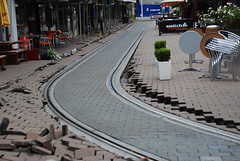
The CBD is slowly being opened up and this is the post - earthquake result of Cashel Mall. A vibrant, fresh look with high end shopping in colourful container shops. A really good step forward for the city.
Christchurch, NZ - Cashel Mall Restart
Images, eqnz.chch.2010
The CBD is slowly being opened up and this is the post - earthquake result of Cashel Mall. A vibrant, fresh look with high end shopping in colourful container shops. A really good step forward for the city.
Christchurch, NZ - Cashel Mall Restart
Images, eqnz.chch.2010
The CBD is slowly being opened up and this is the post - earthquake result of Cashel Mall. A vibrant, fresh look with high end shopping in colourful container shops. A really good step forward for the city.
Christchurch, NZ - Cashel Mall Restart
Images, eqnz.chch.2010
The CBD is slowly being opened up and this is the post - earthquake result of Cashel Mall. A vibrant, fresh look with high end shopping in colourful container shops. A really good step forward for the city.
Christchurch, NZ - Cashel Mall Restart
Images, eqnz.chch.2010
The CBD is slowly being opened up and this is the post - earthquake result of Cashel Mall. A vibrant, fresh look with high end shopping in colourful container shops. A really good step forward for the city.
Christchurch, NZ - Cashel Mall Restart
Images, eqnz.chch.2010
The CBD is slowly being opened up and this is the post - earthquake result of Cashel Mall. A vibrant, fresh look with high end shopping in colourful container shops. A really good step forward for the city.
Evans, Malcolm Paul, 1945-:[Rebuilding Christchurch after the 2011 earthqu…
Images, Alexander Turnbull Library
In the top two frames a man discovers a pile of stinking bones and scratches his head in puzzlement; he is pleased when a second man rushes towards him with another bone which, in the lower frame, he proceeds to try to fit together with a bone from the original stack. The second man then realizes that the dinosaur from which he took the bone is starting to shudder and quake. Context - This is a metaphor about the rebuilding the city of Christchurch after the earthquake of 22 February 2011. Debates are beginning about the preserving or knocking down of historic buildings as well as the rebuilding or repairing of houses. Colour and black and white versions available Quantity: 2 digital cartoon(s).
Nisbet, Alistair, 1958-: "Got anything for cholera, Delhi belly and dysent…
Images, Alexander Turnbull Library
A woman walks along a ruined road passing a broken sewer leaking raw sewage; rats abound and a voice from a nearby medical centre asks 'Got anything for cholera, Delhi belly and dysentery?' A sign offering 'Flu shots now' stands outside the centre. Context - Christchurch post earthquake of 22 February 2011. Quantity: 1 digital cartoon(s).
On Firmer Ground
Audio, Radio New Zealand
Since the February 22nd earthquake, an influx of displaced Christchurch residents have made North Canterbury their temporary home. Cosmo Kentish-Barnes finds out how some people have coped with this dramatic event and what locals are doing to support them.
Earthquake News “Geotechnical Damage due to the 2011 Christchurch, New Zea…
Research papers, University of Canterbury Library
On 22 February 2011,a magnitude Mw 6.3 earthquake occurred with an epicenter located near Lyttelton at about 10km from Christchurch in Canterbury region on the South Island of New Zealand (Figure 1). Since this earthquake occurred in the midst of the aftershock activity which had continued since the 4 September 2010 Darfield Earthquake occurrence, it was considered to be an aftershock of the initial earthquake. Because of the short distance to the city and the shallower depth of the epicenter, this earthquake caused more significant damage to pipelines, traffic facilities, residential houses/properties and multi-story buildings in the central business district than the September 2010 Darfield Earthquake in spite of its smaller earthquake magnitude. Unfortunately, this earthquake resulted in significant number of casualties due to the collapse of multi-story buildings and unreinforced masonry structures in the city center of Christchurch. As of 4 April, 172 casualties were reported and the final death toll is expected to be 181. While it is extremely regrettable that Christchurch suffered a terrible number of victims, civil and geotechnical engineers have this hard-to-find opportunity to learn the response of real ground from two gigantic earthquakes which occurred in less than six months from each other. From geotechnical engineering point of view, it is interesting to discuss the widespread liquefaction in natural sediments, repeated liquefaction within short period and further damage to earth structures which have been damaged in the previous earthquake. Following the earthquake, an intensive geotechnical reconnaissance was conducted to capture evidence and perishable data from this event. The team included the following members: Misko Cubrinovski (University of Canterbury, NZ, Team Leader), Susumu Yasuda (Tokyo Denki University, Japan, JGS Team Leader), Rolando Orense (University of Auckland, NZ), Kohji Tokimatsu (Tokyo Institute of Technology, Japan), Ryosuke Uzuoka (Tokushima University, Japan), Takashi Kiyota (University of Tokyo, Japan), Yasuyo Hosono (Toyohashi University of Technology, Japan) and Suguru Yamada (University of Tokyo, Japan).
Winter, Mark, 1958-: The Garden City. 19 March 2011
Images, Alexander Turnbull Library
The cartoon depicts a little plant with two tiny leaves; text reads 'THE GARDEN CITY'. A second version includes the words 'Begins to grow again'. Context - The earliest stages of the rebuilding of Christchurch after the earthquakes of 4 September 2010 and 22 February 2011. Quantity: 2 digital cartoon(s).
Geotechnical Aspects of the 22 February 2011 Christchurch earthquake
Research papers, University of Canterbury Library
The 22 February 2011, Mw6.2-6.3 Christchurch earthquake is the most costly earthquake to affect New Zealand, causing 181 fatalities and severely damaging thousands of residential and commercial buildings, and most of the city lifelines and infrastructure. This manuscript presents an overview of observed geotechnical aspects of this earthquake as well as some of the completed and on-going research investigations. A unique aspect, which is particularly emphasized, is the severity and spatial extent of liquefaction occurring in native soils. Overall, both the spatial extent and severity of liquefaction in the city was greater than in the preceding 4th September 2010 Darfield earthquake, including numerous areas that liquefied in both events. Liquefaction and lateral spreading, variable over both large and short spatial scales, affected commercial structures in the Central Business District (CBD) in a variety of ways including: total and differential settlements and tilting; punching settlements of structures with shallow foundations; differential movements of components of complex structures; and interaction of adjacent structures via common foundation soils. Liquefaction was most severe in residential areas located to the east of the CBD as a result of stronger ground shaking due to the proximity to the causative fault, a high water table approximately 1m from the surface, and soils with composition and states of high susceptibility and potential for liquefaction. Total and differential settlements, and lateral movements, due to liquefaction and lateral spreading is estimated to have severely compromised 15,000 residential structures, the majority of which otherwise sustained only minor to moderate damage directly due to inertial loading from ground shaking. Liquefaction also had a profound effect on lifelines and other infrastructure, particularly bridge structures, and underground services. Minor damage was also observed at flood stop banks to the north of the city, which were more severely impacted in the 4th September 2010 Darfield earthquake. Due to the large high-frequency ground motion in the Port hills numerous rock falls and landslides also occurred, resulting in several fatalities and rendering some residential areas uninhabitable.
PGC building survivor from February Christchurch quake
Audio, Radio New Zealand
The woman who fought the odds to regain her mobility after being trapped and crushed in her collapsed work place, the PGC building, when Christchurch was devastated by the earthquake of February 22. She is now helping other quake victims, especially the children of injured parents some of who have had long periods of separation.
WEMO ERT Set 1 - March 2011 - Photograph 58
Images, UC QuakeStudies
A photograph of members of the Wellington Emergency Management Office Emergency Response Team in the hanger of a Royal New Zealand Air Force Hercules. The ERT members are travelling to Christchurch to help out in the emergency response to the 22 February 2011 earthquake. Blankets, tent poles, and other supplies have been stacked in the centre of the hanger.
The Princess Cinema in New Brighton
Images, UC QuakeStudies
The brick facade has fallen from the former Princess Cinema in New Brighton, exposing the rooms inside, and crushing a car parked below. The photographer comments, "The front of the old Princess Cinema in New Brighton after the earthquake in Christchurch, New Zealand on 22 February. Under the pile of bricks is a luckily unoccupied blue car. The word CLEAR on the broken facade is to show that there is no one in the car. This building has now been knocked down as it was so dangerous".
Preliminary Observations of the Impacts the 22 February Christchurch Earth…
Research papers, University of Canterbury Library
On 22 February 2011, Canterbury and its largest city Christchurch experienced its second major earthquake within six months. The region is facing major economic and organisational challenges in the aftermath of these events. Approximately 25% of all buildings in the Christchurch CBD have been “red tagged” or deemed unsafe to enter. The New Zealand Treasury estimates that the combined cost of the February earthquake and the September earthquake is approximately NZ$15 billion[2]. This paper examines the national and regional economic climate prior to the event, discusses the immediate economic implications of this event, and the challenges and opportunities faced by organisations affected by this event. In order to facilitate recovery of the Christchurch area, organisations must adjust to a new norm; finding ways not only to continue functioning, but to grow in the months and years following these earthquakes. Some organisations relocated within days to areas that have been less affected by the earthquakes. Others are taking advantage of government subsidised aid packages to help retain their employees until they can make long-term decisions about the future of their organisation. This paper is framed as a “report from the field” in order to provide insight into the early recovery scenario as it applies to organisations affected by the February 2011 earthquake. It is intended both to inform and facilitate discussion about how organisations can and should pursue recovery in Canterbury, and how organisations can become more resilient in the face of the next crisis.
Smith, Ashley W, 1948-:[Moon man non-event lunch] 15 March 2011
Images, Alexander Turnbull Library
Text at the top of the cartoon reads 'News - A "Moon man non-event lunch" will be held above Christchurch to defy quake predictions for that day'. In tea rooms on hills above Christchurch a group of people enjoy lunch as they defy precaution against a predicted earthquake. They order a 'pot o' tea', 'pie & chips', 'sandwich & coke' and a 'shake & roll'; above in a black and thunderous cloud God thinks he heard someone request a shake & a roll'. Context - After the two big earthquakes in Christchurch on 4 September 2010 and 22 February 2011, the so-called Moon Man Ken Ring is backing away from his prediction that Christchurch will be whacked by a huge earthquake today (20 March 2011). His claims have terrified Cantabrians and led to people fleeing Christchurch. M.P. Nick Smith and the Skeptics Society are planning a lunch in one of Christchurch's highest, oldest, stone buildings - on the day that "moon man" Ken Ring says the city will be hit by another devastating earthquake ; the lunch will be held at noon on March 20 at the Sign of the Kiwi, on the top of the Port Hills - which Smith said was the closest building to the epicentre of the February 22 quake. Quantity: 1 digital cartoon(s).
Lifelines Performance and Management following the 22 February 2011 Christ…
Research papers, University of Canterbury Library
A magnitude 6.3 earthquake struck the city of Christchurch at 12:51pm on Tuesday 22 February 2011. The earthquake caused 182 fatalities, a large number of injuries, and resulted in widespread damage to the built environment, including significant disruption to the lifelines. The event created the largest lifeline disruption in a New Zealand city in 80 years, with much of the damage resulting from extensive and severe liquefaction in the Christchurch urban area. The Christchurch earthquake occurred when the Canterbury region and its lifelines systems were at the early stage of recovering from the 4 September 2010 Darfield (Canterbury) magnitude 7.1 earthquake. This paper describes the impact of the Christchurch earthquake on lifelines by briefly summarising the physical damage to the networks, the system performance and the operational response during the emergency management and the recovery phase. Special focus is given to the performance and management of the gas, electric and road networks and to the liquefaction ejecta clean-up operations that contributed to the rapid reinstatement of the functionality of many of the lifelines. The water and wastewater system performances are also summarized. Elements of resilience that contributed to good network performance or to efficient emergency and recovery management are highlighted in the paper.
Nisbet, Alistair, 1958-:[New Year] 1 January 2011
Images, Alexander Turnbull Library
The arms of a woman who represents New Zealand reach out to a baby to whom she has just given birth. The baby represents '2011' and is a particularly hideous specimen. The doctor who holds the baby says 'He's cute now but wait 'til he gets older!' Outside the window is seen a cracked and damaged landscape and a storm rages; the headstone of a grave reads 'RIP 2010'. Context - Christchurch or maybe the South Island have had a bad year because of the Pike River Mine disaster and the earthquake of 4 September 2010. There is perhaps prescience in this cartoon because on 22 February 2011 a much worse earthquake hit Christchurch. Published in The Press Quantity: 1 digital cartoon(s).
Evans, Malcolm Paul, 1945-: [Christchurch milk.] 10 April 2011
Images, Alexander Turnbull Library
In three small frames above the main frame, milk tankers are shown bumping wildly over Christchurch roads made uneven by the earthquakes of September 4 2010 and February 22 2011; and in the large frame below a man is painting out the word 'milk' on a tanker and replacing it with the word 'butter'. Context - the bad roads caused by the erathquakes in Canterbury have turned the milk into butter. Colour and black and white versions available Title from file name Quantity: 2 digital cartoon(s).
Winter, Mark, 1958-: Rock Star Rocky. 12 March 2011
Images, Alexander Turnbull Library
Text reads 'ROCK STAR' and below is an image of a large rock named 'Rocky'. Context - When a 25-tonne boulder crashed through the garage roof of Phil Johnson's home and left it in ruins during the Christchurch earthquake of 22 February he sold it at an online auction for NZ$60,500 (#27,652). Mr Johnson dubbed it "Rocky". The money will be used to help quake victims. Quantity: 2 digital cartoon(s).