

Search
found 918 results
Images for CANTERBURY; more images...
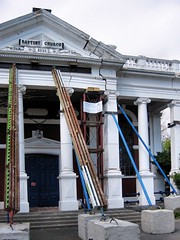
UC Restarts - Photograph 24
Images, UC QuakeStudies
Members of the University of Canterbury's Printery team in the Printery's reception area. The photographer comments, "The University restarts its teaching, and the techies in e-learning move out of NZi3. We are sharing an office at the printery building. Looking from our office through to Printery reception".
Methods for Incorporating Soil Nonlinearity in Ground Motion Simulation
Research papers, University of Canterbury Library
This poster discusses several possible approaches by which the nonlinear response of surficial soils can be explicitly modelled in physics-based ground motion simulations, focusing on the relative advantages and limitations of the various methodologies. These methods include fully-coupled 3D simulation models that directly allow soil nonlinearity in surficial soils, the domain reduction method for decomposing the physical domain into multiple subdomains for separate simulation, conventional site response analysis uncoupled from the simulations, and finally, the use of simple empirically based site amplification factors We provide the methodology for an ongoing study to explicitly incorporate soil nonlinearity into hybrid broadband simulations of the 2010-2011 Canterbury, New Zealand earthquakes.
Predicting Liquefaction in Near-Real-Time (NRT) : An Assessment of Geospat…
Research papers, University of Canterbury Library
Semi-empirical models based on in-situ geotechnical tests have become the standard of practice for predicting soil liquefaction. Since the inception of the “simplified” cyclic-stress model in 1971, variants based on various in-situ tests have been developed, including the Cone Penetration Test (CPT). More recently, prediction models based soley on remotely-sensed data were developed. Similar to systems that provide automated content on earthquake impacts, these “geospatial” models aim to predict liquefaction for rapid response and loss estimation using readily-available data. This data includes (i) common ground-motion intensity measures (e.g., PGA), which can either be provided in near-real-time following an earthquake, or predicted for a future event; and (ii) geospatial parameters derived from digital elevation models, which are used to infer characteristics of the subsurface relevent to liquefaction. However, the predictive capabilities of geospatial and geotechnical models have not been directly compared, which could elucidate techniques for improving the geospatial models, and which would provide a baseline for measuring improvements. Accordingly, this study assesses the realtive efficacy of liquefaction models based on geospatial vs. CPT data using 9,908 case-studies from the 2010-2016 Canterbury earthquakes. While the top-performing models are CPT-based, the geospatial models perform relatively well given their simplicity and low cost. Although further research is needed (e.g., to improve upon the performance of current models), the findings of this study suggest that geospatial models have the potential to provide valuable first-order predictions of liquefaction occurence and consequence. Towards this end, performance assessments of geospatial vs. geotechnical models are ongoing for more than 20 additional global earthquakes.
Performance of Underground Electricity Cables During the 2010-2011 Canterb…
Research papers, University of Canterbury Library
Asset management in power systems is exercised to improve network reliability to provide confidence and security for customers and asset owners. While there are well-established reliability metrics that are used to measure and manage business-as-usual disruptions, an increasing appreciation of the consequences of low-probability high-impact events means that resilience is increasingly being factored into asset management in order to provide robustness and redundancy to components and wider networks. This is particularly important for electricity systems, given that a range of other infrastructure lifelines depend upon their operation. The 2010-2011 Canterbury Earthquake Sequence provides valuable insights into electricity system criticality and resilience in the face of severe earthquake impacts. While above-ground assets are relatively easy to monitor and repair, underground assets such as cables emplaced across wide areas in the distribution network are difficult to monitor, identify faults on, and repair. This study has characterised in detail the impacts to buried electricity cables in Christchurch resulting from seismically-induced ground deformation caused primarily by liquefaction and lateral spread. Primary modes of failure include cable bending, stretching, insulation damage, joint braking and, being pulled off other equipment such as substation connections. Performance and repair data have been compiled into a detailed geospatial database, which in combination with spatial models of peak ground acceleration, peak ground velocity and ground deformation, will be used to establish rigorous relationships between seismicity and performance. These metrics will be used to inform asset owners of network performance in future earthquakes, further assess component criticality, and provide resilience metrics.
People in Disasters Conference - A Systematic Review of Compassion Fatigue…
Videos, UC QuakeStudies
A video of a presentation by Jai Chung during the Staff and Patients Stream of the 2016 People in Disasters Conference. The presentation is titled, "A Systematic Review of Compassion Fatigue of Nurses During and After the Canterbury Earthquakes".The abstract for the presentation reads as follows: Limited research is currently available about compassion fatigue of health professionals during and after disasters in New Zealand. The purpose of this systematic literature review was to provide a comprehensive outline of existing research. National and international literature was compared and contrasted to determine the importance of recognising compassion fatigue during and after disasters. Health professionals responding to disasters have played an important role in saving lives. Especially, during and after the Canterbury earthquakes, many health professionals cared for the traumatized public of the region. When responding to and caring for many distressed people, health professionals - particularly nurses - may strongly empathise with people's pain, fear, and distress. Consequently, they can be affected both emotionally and physically. Nurses may experience intensive and extreme distress and trauma directly and indirectly. Physical exhaustion can arise quickly. Emotional exhaustion such as hopelessness and helplessness may lead to nurses losing the ability to nurture and care for people during disasters. This can lead to compassion fatigue. It is important to understand how health professionals, especially nurses, experience compassion fatigue in order to help them respond to disasters appropriately. International literature explains the importance of recognising compassion fatigue in nursing, and explores different coping mechanisms that assist nurses overcome or prevent this health problem. In contrast, New Zealand literature is limited to experiences of nurses' attitudes in responding to natural disasters. In light of this, this literature review will help to raise awareness about the importance of recognising and addressing symptoms of compassion fatigue in a profession such as nursing. Gaps within the research will also be identified along with recommendations for future research in this area, especially from a New Zealand perspective. Please note that due to a recording error the sound cuts out at 9 minutes.
Townsend Telescope Pre-Earthquake Photographs 06
Images, UC QuakeStudies
A photograph of the clock drive of the Townsend Telescope. The telescope is in the Observatory at the Christchurch Arts Centre. This image was used by Graeme Kershaw, Technician at the University of Canterbury Department of Physics and Astronomy, to identify the telescope's parts after the 22 February 2011 earthquake.
Townsend Telescope Pre-Earthquake Photographs 07
Images, UC QuakeStudies
A photograph of the middle section of the Townsend Telescope. The telescope is in the Observatory at the Christchurch Arts Centre. This image was used by Graeme Kershaw, Technician at the University of Canterbury Department of Physics and Astronomy, to identify the telescope's parts after the 22 February 2011 earthquake.
UC Restarts - Photograph 30
Images, UC QuakeStudies
A sign at ground level on a coal bunker in the University of Canterbury's Facilities Management yard reads "Squawk. Quack quack squawk. Quack quack quack quack quack. Danger. Health and safety risk. No ducklings past this point." The photographer comments, "Sign on the coal bunker at the boiler house, FM".
ELM Offices Level 7 Library - Photograph 12
Images, UC QuakeStudies
The University of Canterbury's E-Learning team's temporary office in the James Hight building. The photographer comments, "First looks at our new temporary (maybe) office space. Our group will stay here until April or May 2011, then will move to another floor in the Central Library. This bench will disappear".
UC Restarts - Photograph 11
Images, UC QuakeStudies
Students sit outside the InTentCity 6.3 Cafe, which was set up in a tent in the Law car park while University of Canterbury buildings were closed for structural testing. The photographer comments, "The University restarts its teaching, and the techies in e-learning move out of NZi3".
ELM Offices Level 7 Library - Photograph 33
Images, UC QuakeStudies
University of Canterbury staff members are escorted by Civil Defence members in order to retrieve essential items from their offices. The photographer comments, "E-learning team after clearing their offices. Brendon Stillwell (ICTS tech helping with PCs), Antoine Monti, Susan Tull, Herbert Thomas, Paul Nicholls, Gregor Ronald, Lei Zhang, Jess Hollis".
ELM Offices Level 7 Library - Photograph 32
Images, UC QuakeStudies
University of Canterbury staff members are escorted by Civil Defence members in order to retrieve essential items from their offices. The photographer comments, "E-learning team after clearing their offices. Brendon Stillwell (ICTS tech helping with PCs), Antoine Monti, Susan Tull, Herbert Thomas, Paul Nicholls, Gregor Ronald, Lei Zhang, Jess Hollis".
Townsend Telescope: Part Photograph 29
Images, UC QuakeStudies
A photograph of the lower end of the main tube of the Townsend Telescope. The tube was crushed and bent during the 22 February 2011 earthquake.
Townsend Telescope: Part Photograph 56
Images, UC QuakeStudies
A photograph of some of the parts of the Townsend Telescope. Many of the parts were damaged during the 22 February 2011 earthquake.
Townsend Telescope: Part Photograph 61
Images, UC QuakeStudies
A photograph of two clock gears from the Townsend Telescope.
Townsend Telescope: Part Photograph 17
Images, UC QuakeStudies
A photograph of the scale viewer eyepiece from the Townsend Telescope.
Townsend Telescope: Part Photograph 51
Images, UC QuakeStudies
A photograph of the damage to the teeth of a gear from the worm gear drive of the Townsend Telescope. The gear was damaged during the 22 February 2011 earthquake.
Townsend Telescope: Part Photograph 55
Images, UC QuakeStudies
A photograph of the declinator readout ring from the Townsend Telescope. The ring was chipped and scratched during the 22 February 2011 earthquake.
Townsend Telescope: Part Photograph 22
Images, UC QuakeStudies
A photograph of the knurled knob from the Townsend Telescope. The teeth of the knob were damaged during the 22 February 2011 earthquake.
Townsend Telescope: Part Photograph 23
Images, UC QuakeStudies
A photograph of a friction collar from the Townsend Telescope.
Townsend Telescope: Part Photograph 11
Images, UC QuakeStudies
A photograph of the earthquake-damaged output shaft from the top-plate of the Townsend Telescope's clock drive. The output shaft was bent out of shape during the 22 February 2011 earthquake.
Townsend Telescope: Part Photograph 10
Images, UC QuakeStudies
A photograph of the top cover of the clock from the Townsend Telescope. Parts of the cover were bent out of shape during the 22 February 2011 earthquake.
Townsend Telescope: Part Photograph 12
Images, UC QuakeStudies
A photograph of a collar from the Townsend Telescope. Part of the collar was bent out of shape during the 22 February 2011 earthquake.
Townsend Telescope: Part Photograph 13
Images, UC QuakeStudies
A photograph of a slow motion rod from the Townsend Telescope. The rod was bent out of shape during the 22 February 2011 earthquake.
Townsend Telescope: Part Photograph 15
Images, UC QuakeStudies
A photograph of a slow motion knob and shaft from the Townsend Telescope. The knob broke off the shaft during the 22 February 2011 earthquake.
Townsend Telescope: Part Photograph 14
Images, UC QuakeStudies
A photograph of a slow motion gear from the Townsend Telescope.
Townsend Telescope: Part Photograph 18
Images, UC QuakeStudies
A photograph of an eyepiece clamp from the Townsend Telescope.
Townsend Telescope: Part Photograph 19
Images, UC QuakeStudies
A photograph of a governor friction plate from the Townsend Telescope.
Townsend Telescope: Part Photograph 08
Images, UC QuakeStudies
A photograph of a slow motion rod from the Townsend Telescope.
Townsend Telescope: Part Photograph 09
Images, UC QuakeStudies
A photograph of a slow motion rod from the Townsend Telescope.