

Search
found 7152 results
Images for CANTERBURY; more images...
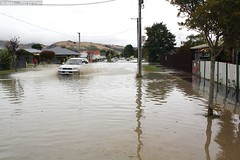
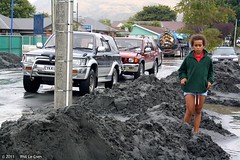

Crumbled
Images, eqnz.chch.2010
"Open Theatre" - The Odeon Built in 1883 and known as the Tuam Street Hall or Theatre and was New Zealand's oldest masonry, purpose built theatre. In 1930, it became the St. James Theatre, It became The Odeon Movie Theatre in 1960. Demolition started in September 2012 after the Christchurch earthquakes of 2010/2011 but seems to have stopped!?
Christchurch Cathedral - Stay of Execution
Images, eqnz.chch.2010
Christ Church Cathedral has been granted a stay of execution after a High-Court ruling today to stop the planned demolition of the earthquake-damaged Christchurch central landmark.
Hawkey, Allan Charles, 1941- : Earthquake bill $8.5 billion. 13 April 2011
Images, Alexander Turnbull Library
Shows a postman who has just put an 'Earthquake bill' for '$8.5 billion' into the government's letterbox. Context - The New Zealand government will spend about 8.5 billion NZ dollars (6.6 billion U.S. dollars) over the next few years rebuilding Christchurch. New Zealand Finance Minister Bill English said on Tuesday that the Treasury has estimated the direct cost of the two earthquakes is about 5.5 billion NZ dollars), which will be fully provided for in the Budget in May. He said about 3 billion NZ dollars of that relates to thegovernment's share of local government infrastructure, roads, insurance excesses on schools and housing, land remediation from the September quake, demolition, Accidents Compensation Corporation scheme and the business support package. (Xinhuanet 12 April 2011) Quantity: 1 digital cartoon(s).
Winter, Mark, 1958-: Good Will/Wills/William. 18 March 2011
Images, Alexander Turnbull Library
The cartoon shows a caricature of Prince William accompanied by the words 'Good Wills'. A second version has the words 'GOOD WILLiam' and the third has the words 'Good Will'. Context - Prince William visited New Zealand, and Christchurch in particular, after the earthquakes of 4 September 2010 and 22 February 2011 in Christchurch. Quantity: 3 digital cartoon(s).
Nisbet, Alastair, 1958- :[Rates base]. 1 May 2013
Images, Alexander Turnbull Library
A small house is shown on an enormous foundation block labelled 'Rate$'. The cartoonist's comment is 'Like for like for the house...Total dislike for the foundation!' In Christchurch there were prospects of large rises in householders' rate to help finance the Christchurch Rebuild project. In view of the damage to housing, rate increases may be badly disproportionate. Quantity: 1 digital cartoon(s).
Nisbet, Alistair, 1958- :Uses for Christchurch rubble?... 19 July 2011
Images, Alexander Turnbull Library
Text reads 'Uses for Christchurch rubble?...' The cartoon shows a bridge made partially of earthquake rubble leading from Lyttelton Harbour to Diamond Harbour on Banks Peninsula. Someone in a van says 'At long last... A bridge to Diamond Harbour!' And someone else says 'And somewhere to fish!' Context - Rubble from the earthquake may be used for the construction of watersides and bridges. This cartoon is a fanciful use for Christchurch earthquake rubble. Currently a ferry connects Diamond Harbour to Lyttelton, on the harbour's northern shore. In combination with buses from Lyttelton to downtown Christchurch, this allows residents of Diamond Bay to commute to the city. Quantity: 1 digital cartoon(s).
"Here's me helping Christchurch people hurt by the quake. ... In fact I've…
Images, Alexander Turnbull Library
In a series of five out of six caricatures Christchurch Mayor Bob Parker shows photographs of himself helping people hurt by the 4th September earthquake and helping Christchurch after the earthquake. In the sixth caricature he disingenuously smirks and says that he has been so busy helping Christchurch that he forgot about the Mayoral election; he then affects a philosophical stance about his chances. Refers to the advantage that the earthquake of 4th September has given the incumbent mayor Bob Parker in the local body elections of 9th October. Black and white and colour versions of this cartoon are available Quantity: 2 digital cartoon(s).
Bromhead, Peter, 1933-:[Time capsules unearthed after the Christchurch ear…
Images, Alexander Turnbull Library
Text above the image reads 'Time capsules unearthed in Christchurch' A man reads a newspaper which says 'Petrol is so cheap you can actually afford to run one of these new-fangled motor cars...' Context - when a bronze statue of Christchurch founder John Robert Godley, which stood in Cathedral Square, toppled during the Christchurch earthquake of 22 February 2011, a crane driver clearing rubble discovered two time capsules. One is a small glass capsule with a hand-written letter on gold parchment inside, while the other is a large metal-like object, yet to be opened. A Nelson newspaper 'The Colonist' in an article published in 1918, about the time capsule in Christchurch said, "This statute of John Robert Godley executed by Thomas Woolner was erected in the west side of the Cathedral Square by the Provincial Government of Canterbury, and unveiled by the late Sir Charles Christopher Bowen on August 6 1867, it was moved to this site in March 1918." The man in the cartoon reads a bout the cost of petrol being incredibly cheap and thinks it refers to today's prices. Quantity: 1 digital cartoon(s).
Nisbet, Alastair, 1958- :'Archway Homes - Land & cathedral packages for al…
Images, Alexander Turnbull Library
Shows Bishop Victoria Matthews reading a brochure offering cheap deals for cathedrals and their various accoutrements. Context: refers to the debate about the fate of the Christchurch Cathedral. Bishop Victoria Matthews is in favour of demolishing the cathedral to a certain safe level. The lobby for saving the cathedral, wrecked by the earthquakes of 2010 and 2011, is very strong. Quantity: 1 digital cartoon(s).
Nisbet, Alastair, 1958- :Rates quake. 28 June 2012
Images, Alexander Turnbull Library
Shows an earthquake in Christchurch. A large notice reads 'Bob's wishlist to justify Chch rates hike'. 'Bob' is Bob Parker the Mayor of Christchurch. Context: Refers to an Order in Council to give Christchurch City Council more flexibility in setting rates. Cr Yani Johanson sought to grant 100 per cent rates relief for residents who had been unable to occupy their homes during the 2011-12 financial year because of the city's earthquakes - a proposal which staff said would cost $4.9 million - this proposal was voted down. Quantity: 1 digital cartoon(s).
Evans, Malcolm Paul, 1945-:[Courage in the Christchurch earthquake] 28 Feb…
Images, Alexander Turnbull Library
The cartoon shows a row of gold statuettes of Christchurch Mayor Bob Parker smiling and holding a shovel; these are 'The Bob Awards - for supporting roles in Christchurch'. Context - on 22 February 2011 a 6.3 magnitude earthquake struck in Christchurch, which has probably killed more than 200 people (at this point the number is still not known) and caused very severe damage. The courage, generosity and 'can do' attitude of the people has been wonderful and Bob Parker himself is showing himself a tireless and cheerful mayor in extraordinary circumstances. Colour and black and white versions of this cartoon are available Quantity: 2 digital cartoon(s).
Tremain, Garrick 1941-: "I'm bereft of ideas for the economy..." 31 March …
Images, Alexander Turnbull Library
In six small cameos Prime Minister John Key ponders over things economic and ends up dancing; he says 'I'm bereft of ideas for the economy gambling the lives of our troops in the Afghanistan mess I'm presiding over the biggest budget deficit in our history borrowing $300m a week to cushion our slide into oblivion Using lots of World Cup piffle to distract from the real issues Yet I'm still rating miles higher than Goff so how hopeless is he??? A little man in the last frame comments 'Spoiled for choice eh?' Context - New Zealand's rather dire economic situation made so much worse by the Christchurch earthquakes of 4 September 2010 and 22 February 2011, the consistently high poll rating of John Key and the series of disasters suffered by the Labour Party in the run up to the 2011 election in November. Quantity: 1 digital cartoon(s).
Winter, Mark, 1958-: [Downsizemic activity - interest rates fall] 11 March…
Images, Alexander Turnbull Library
Text top left reads 'Downsizemic activity' and a seismic graph zigzags wildly but gradually tails off into the words 'Interest rates' which take a serious downwards trend. Context - The Christchurch earthquakes of 4 September 2010 and 22 February 2011 which have had an impact on an already stagnating economy. The Reserve Bank has made a relatively large 50-point cut in its benchmark interest rate, the Official Cash Rate (from 3% to 2.5 per cent). Critics say that inflation is already running unacceptably high and there is a threat of much higher inflation in a year or two when the rebuilding of Christchurch begins to put pressure on limited resources. The Reserve Bank acknowledged these factors, but it has chosen instead to focus on the immediate impact of the earthquake on the economy and particularly on all-important business and consumer sentiment. (Press editorial 12 March 2011) Quantity: 1 digital cartoon(s).
Winter, Mark, 1958-:[Christchurch Cathedral after the earthquake] 1 March …
Images, Alexander Turnbull Library
The cartoon shows Christchurch Cathedral shattered and with its steeple gone after the earthquake on 22 February 2011. The words 'The oSCARs' (wordplay on 'Oscars' and 'scars') are in the top left corner and the text 'The worst picture' are in the centre. A second version shows an 'Oscar' statuette with a crown on its head. Context - The Christchurch earthquake 22 February 2011 and the 2011 Oscars - annual film awards. Two versions of this cartoon are available Quantity: 1 digital cartoon(s).
Madonna in Quake Damaged Basilica
Images, eqnz.chch.2010
This statue of the Virgin Mary stood in the south tower of The Cathedral of the Blessed Sacrament and had been facing inside from when she was placed there and through the September 2010 earthquake. That changed on February 22 2010 at 12.51pm when Christchurch was rocked by a 6.3 magnitude earthquake. During the violent shaking motion Mary was t...
State of the tourism sector 2012
Research papers, Lincoln University
The Tourism Industry Association New Zealand’s (TIA) annual State of the Tourism Sector 2012 has been prepared in partnership with Lincoln University. The objective of this is to understand better how the tourism sector sees its future and what challenges and opportunities lie ahead in both the short and longer term. State of the Tourism Sector 2012 provides a current view of the tourism sector for those within the industry and for external stakeholders who have an interest in tourism in New Zealand.
A community-led, science-informed conversation around the future use of th…
Research papers, Lincoln University
Lincoln University was commissioned by the Avon-Otakaro Network (AvON) to estimate the value of the benefits of a ‘recreation reserve’ or ‘river park’ in the Avon River Residential Red Zone (ARRRZ). This research has demonstrated significant public desire and support for the development of a recreation reserve in the Avon River Residential Red Zone. Support is strongest for a unique natural environment with native fauna and flora, healthy wetlands and rivers, and recreational opportunities that align with this vision, such as walking, cycling and water-based sporting and leisure activities. The research also showed support for a reserve that promotes and enables community interaction and wellbeing, and is evident in respondents’ desires for community gardens, regular festivals and markets, and the physical linking of the CBD with eastern suburbs through a green corridor. There is less support for children’s playgrounds, sports fields or open grassed areas, all of which could be considered as more typical of an urban park development. Benefits (willing to pay) to Christchurch residents (excluding tourists) of a recreation reserve could be as high as $35 million each year. Savings to public health costs could be as high as $50.3 million each year. The incorporation or restoration of various ecosystems services, including water quality improvements, flood mitigation and storm water management could yield a further $8.8 million ($19, 600) per hectare/year at 450 ha). Combined annual benefits of a recreational reserve in the ARRRZ are approximately $94.1 million per annum but this figure does not include potentially significant benefits from, for example, tourism, property equity gains in areas adjacent to the reserve, or the effects of economic rejuvenation in the East. Although we were not able to provide costing estimates for park attributes, this study does make available the value of benefits, which can be used as a guide to the scope of expenditure on development of each park attribute.
Investigating the role of clay layers in containing liquefied soils
Research papers, University of Canterbury Library
During the 2010 - 2011 Canterbury earthquake sequence, extensive liquefaction was observed in many areas of Christchurch city and its surroundings, causing widespread damage to buildings and infrastructure. While existing simplified methods were found to work well in some areas of the city, there were also large areas where these methods did not perform satisfactorily. In some of these cases, researchers have proposed that layers of fine grained material within the soil profile may be responsible for preventing the manifestation of liquefaction. This paper presents preliminary findings on the mechanisms at play when pressure differentials exist across a clay layer. It is found that if the clay layer is unable to distort, then pore fluid is unable to break-through the layer even with relatively high pressures, resulting in dissipation of excess pore pressures by seepage. If the layers are however able to distort, then it is possible for the pore fluid to break through the clay layer, potentially resulting in adverse effects in terms of the severity of liquefaction.
ROBUST friction building shaking table testing overview
Research papers, University of Canterbury Library
Shaking table testing of a full-scale three storey resilient and reparable complete composite steel framed building system is being conducted. The building incorporates a number of interchangeable seismic resisting systems of New Zealand and Chinese origin. The building has a steel frame and cold formed steel-concrete composite deck. Energy is dissipated by means of friction connections. These connections are arranged in a number of structural configurations. Typical building nonskeletal elements (NSEs) are also included. Testing is performed on the Jiading Campus shaking table at Tongji University, Shanghai, China. This RObust BUilding SysTem (ROBUST) project is a collaborative China-New Zealand project sponsored by the International Joint Research Laboratory of Earthquake Engineering (ILEE), Tongji University, and a number of agencies and universities within New Zealand including BRANZ, Comflor, Earthquake Commission, HERA, QuakeCoRE, QuakeCentre, University of Auckland, and the University of Canterbury. This paper provides a general overview of the project describing a number of issues encountered in the planning of this programme including issues related to international collaboration, the test plan, and technical issues.
Safe as Houses? The Limits of Seismic Building Regulation in Aotearoa New …
Research papers, University of Canterbury Library
In 2016, the Building (Earthquake-prone Buildings) Amendment Act 2016 was introduced to address the issue of seismic vulnerability amongst existing buildings in Aotearoa New Zealand. This Act introduced a mandatory scheme to remediate buildings deemed particularly vulnerable to seismic hazard, as recommended by the 2012 Royal Commission into the Canterbury earthquake sequence of 2010–2011. This Earthquake-prone Building (EPB) framework is unusual internationally for the mandatory obligations that it introduces. This article explores and critiques the operation of the scheme in practice through an examination of its implementation provisions and the experiences of more recent seismic events (confirmed by engineering research). This analysis leads to the conclusion that the operation of the current scheme and particularly the application of the concept of EPB vulnerability excludes large numbers of (primarily urban) buildings which pose a significant risk in the event of a significant (but expected) seismic event. As a result, the EPB scheme fails to achieve its goals and instead may create a false impression that it does so
Nisbet, Alastair, 1958- :"Where are ya Bob? dont' tell me...flat out again…
Images, Alexander Turnbull Library
An exceedingly large 'Gerry' Brownlee, the Minister for Earthquake Recovery, rises from a chair, holding a briefcase labeled 'CERA' and calling for 'Bob' Parker, the mayor of Christchurch. The thin Parker was flattened against Brownlee's enormous rear, when Brownlee sat on the chair. Brownlee and Parker had a strained relationship, with the government taking an increasing amount of control in local decision making. After ongoing assurances by Parker that Christchurch City Council would meet all of International Accreditation New Zealand's requirements on issuing building consents, Brownlee announced in June 2013 without Parker's prior knowledge that the authority had withdrawn its accreditation. Quantity: 1 digital cartoon(s).
Nisbet, Alastair, 1958- :'Looks like drought on the landscape!' 9 March 20…
Images, Alexander Turnbull Library
The New Zealand public contemplate a dead drought stricken landscape. As well as lack of water, there is a lack of moderate pay scales for CEOs, satisfaction with EQC, quality TV, generous insurance companies, brilliant Solid Energy management, the integrity of John Banks (and by implication that of other MPs), quality education ministers, worthwhile overseas trips by the Prime Minister, 'clever' NZ First MPs and a boost for the West Coast among others. Considered from a Canterbury perspective, the drought of early 2013 becomes a symbol for many of the recent political and social ailments afflicting the land. Quantity: 1 digital cartoon(s).
An inventory of unreinforced masonry churches in New Zealand
Research papers, The University of Auckland Library
Churches are an important part of New Zealand's historical and architectural heritage. Various earthquakes around the world have highlighted the significant seismic vulnerability of religious buildings, with the extensive damage that occurred to stone and clay-brick unreinforced masonry churches after the 2010-2011 Canterbury earthquakes emphasising the necessity to better understand this structural type. Consequently, a country-wide inventory of unreinforced masonry churches is here identified. After a bibliographic and archival investigation, and a 10 000 km field trip, it is estimated that currently 297 unreinforced masonry churches are present throughout New Zealand, excluding 12 churches demolished in Christchurch because of heavy damage sustained during the Canterbury earthquake sequence. The compiled database includes general information about the buildings, their architectural features and structural characteristics, and any architectural and structural transformations that have occurred in the past. Statistics about the occurrence of each feature are provided and preliminary interpretations of their role on seismic vulnerability are discussed. The list of identified churches is reported in annexes, supporting their identification and providing their address.
Southland Times Image: Robyn Edie 2010:12:07 18:50:37
Images, UC QuakeStudies
Photograph captioned by Fairfax, "Invercargill Fire Station fire fighters who recently went to help in Christchurch for the Canterbury Earthquake cleanup. The National Boss presented the fire fighters with a Certificate of Commendation on Tuesday night. Invercargill firefighters Cameron McLachlan, Pete Scarlet, Dennis Hika, Chris Hamilton, Aaron Ramsay, National Commander Mike Hall, John Gilder, Ron Fetolofai (absent Murray Milne-Maresca) presented a certificate of commendation for their service during the Christchurch earthquake by national commander Mike Hall yesterday".
Fairfax Video, December 2012 (7)
Videos, UC QuakeStudies
A video of an interview with John Walley, Chief Executive of the New Zealand Manufacturers and Exporters Association, about the experiences of businesses in the aftermath of the 2010 and 2011 Canterbury earthquakes. Walley talks about the stress on manufacturers to continue as usual after the earthquakes. He also talks about the importance of businesses' communication lines, and looking after customers and staff. This video is part of a series about businesses in Christchurch after the earthquakes.
Improving regulatory frameworks for earthquake risk mitigation
Research papers, The University of Auckland Library
New Zealand's devastating Canterbury earthquakes provided an opportunity to examine the efficacy of existing regulations and policies relevant to seismic strengthening of vulnerable buildings. The mixed-methods approach adopted, comprising both qualitative and quantitative approaches, revealed that some of the provisions in these regulations pose as constraints to appropriate strengthening of earthquake-prone buildings. Those provisions include the current seismic design philosophy, lack of mandatory disclosure of seismic risks and ineffective timeframes for strengthening vulnerable buildings. Recommendations arising from these research findings and implications for pre-disaster mitigation for future earthquake and Canterbury's post-disaster reconstruction suggest: (1) a reappraisal of the requirements for earthquake engineering design and construction, (2) a review and realignment of all regulatory frameworks relevant to earthquake risk mitigation, and (3) the need to develop a national programme necessary to achieve consistent mitigation efforts across the country. These recommendations are important in order to present a robust framework where New Zealand communities such as Christchurch can gradually recover after a major earthquake disaster, while planning for pre-disaster mitigation against future earthquakes. AM - Accepted Manuscript
Nisbet, Alastair, 1958- :'Can ya just pull the plug and let me die peacefu…
Images, Alexander Turnbull Library
Shows a sick and damaged Christchurch Anglican Cathedral in a hospital bed with two attendants. The Cathedral asks 'Can ya just pull the plug and let me die peacefully?'. Context refers to recent comments by Bishop Victoria Matthews that the Christchurch Cathedral is 'being left to die with no dignity' because of ongoing legal battles about its future. There has been ongoing debate and controversy over whether the Cathedral should be demolished, reconstructed or restored following damage suffered in the February 2011 Earthquake. Quantity: 1 digital cartoon(s).
Hubbard, James, 1949- :"The aftershock.. The shake-up. The waiting and anx…
Images, Alexander Turnbull Library
The cartoon shows the leader of the new Mana Party, Hone Harawira, in four frames that illustrate 'The aftershock', 'the shake-up', 'the waiting & anxiety!...' and in the last frame 'the liquefaction...' as he sinks up to his chest in 'Poll Street'. Context - In fact Hone Harawira won the Te Tai Tokerau by-election with a majority of 1,117 votes, followed fairly closely by Kelvin Davis (Labour). The Labour and Mana candidates seemed to be neck and neck just before the election on 26 June 2011. The cartoon uses earthquake imagery to illustrate the emotional roller-coaster for Hone Harawira. Quantity: 1 digital cartoon(s).
Evans, Malcolm Paul, 1945- :Christchurch re-build red tape. 24 May 2011
Images, Alexander Turnbull Library
The cartoon shows an enormous ball of red tape and all around frustrated workers carry away their ladders and tools. Context - Three months after a quake that scored a direct hit under Christchurch, many residents are struggling with mountains of paperwork required to get their homes repaired and rebuilt. Reference numbers, codes and Pin numbers permeate our daily living now as we deal with the aftermath of two major earthquakes in six months. People feel they are lucky that they have the EQC pot to draw on, but there are a lot of complexities, anomalies and frustrations. (BBC News 21 May 2011) Colour and black and white versions available Quantity: 2 digital cartoon(s).
Body, Guy Keverne, 1967-:The Week - US Republican Party, Dubrovnick and Ki…
Images, Alexander Turnbull Library
Four cameos on events of the week. The struggle for the US Republican Party to find a suitable presidential candidate. A Croatian tourism official has been sacked over comments about "drunk and crazy" New Zealand and Australian tourists. 'Mother Nature' is an 'unfit mother' in Christchurch because of the earthquakes. Quantity: 1 digital cartoon(s).