

Search
found 100457 results
Images for NEW-ZEALAND; more images...
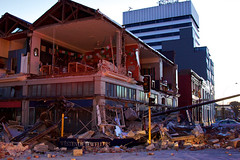


New Zealand Defence Force photograph 180
Images, UC QuakeStudies
Aerial image of a residential area of Christchurch taken by the Royal New Zealand Air Force for the Earthquake Commission.
New Zealand Defence Force photograph 626
Images, UC QuakeStudies
Hazel Hampton, a resident from one of Christchurch's eastern suburbs, filling out paperwork for a member of the New Zealand Army. Hazel Hampton is receiving a chemical toilet. Her suburb has been without water and power for over ten days.
New Zealand Defence Force photograph 324
Images, UC QuakeStudies
An aerial view of Christchurch a week after the 22 February 2011 earthquake.
New Zealand Defence Force photograph 734
Images, UC QuakeStudies
Members of the New Zealand Air Force unloading a generator from a NZ C130 Hercules at the Christchurch Air Movements Terminal. This was the first generators to arrive from Australia to support Operation Christchurch Quake.
New Zealand Defence Force photograph 061
Images, UC QuakeStudies
NZ Army Chefs creating hot-box meals to be delivered to emergency service workers helping with the Christchurch earthquake operation.
New Zealand Defence Force photograph 224
Images, UC QuakeStudies
Photograph captioned by the New Zealand Defence Force, "Chief of Defence Force, Major General Rhys Jones on an operational tour of earthquake affected areas of Christchurch".
New Zealand Defence Force photograph 609
Images, UC QuakeStudies
South Island Operations Manager, Jeoff Barr, loading chemical toilets into a unimog in Christchurch. The chemical toilets were delivered to residents in Christchurch who had been without water for ten days.
New Zealand Defence Force photograph 230
Images, UC QuakeStudies
Photograph captioned by the New Zealand Defence Force, "Chief of Defence Force, Major General Rhys Jones on an operational tour of earthquake affected areas of Christchurch".
New Zealand Defence Force photograph 547
Images, UC QuakeStudies
Chief of the New Zealand Defence Force, Rhys Jones, and the Minister of Defence, Wayne Mapp, visiting the HMNZS Otago in Lyttelton.
New Zealand Defence Force photograph 176
Images, UC QuakeStudies
A member of No. 3 Squadron in the Iroquois helicopter making tours of Christchurch after the 22 February 2011 earthquake.
New Zealand Defence Force photograph 515
Images, UC QuakeStudies
The Taiwanese Search and Rescue team being farewelled at the Christchurch International Airport after helping out with the emergency response to the Canterbury Earthquake.
Forecasting future earthquakes in New Zealand
Audio, Radio New Zealand
Mention the words "earthquake" in the same brief as "remediation" and it's enough to strike fear in the hearts of all New Zealanders, particularly those in Christchurch and other earthquake prone areas of the country. Now we find the chances of the ground shaking more violently in a quake is much higher than previously thought for large parts of the country. In some places it has doubled or even trebled. What are the ramifications of this new found knowledge? Joining the show to discuss is Michelle Grant, President of the Structural Engineering Society New Zealand, and Matt Gerstenberger, Principal Scientist and Seismologist at GNS Science
New Zealand Defence Force photograph 438
Images, UC QuakeStudies
A police officer distributes supplies to members of the emergency services in Latimer Square.
New Zealand Defence Force photograph 384
Images, UC QuakeStudies
A Squadron 3 Iroquois helicopter refuelling at Hagley park after an aerial tour of Christchurch and Lyttelton.
Aotearoa New Zealand field education practice
Research papers, University of Canterbury Library
This chapter will draw on recent literature and practice experience to discuss the nature of field education in Aotearoa New Zealand. Social work education in this country is provided by academic institutions that are approved by the Social Workers Registration Board. The field education curriculum is therefore shaped by both the regulatory body and the tertiary institutions. Significant numbers of students undertake field education annually which places pressure on industry and raises concerns as to the quality of student experience. Although the importance of field education is undisputed it remains poised in a liminal space between the tertiary education and social service sectors where it is not sufficiently resourced by either. This affects the provision of practice placements as well as the establishment of long-term cross-sector partnerships. Significant events such as the 2010 and 2011 Christchurch earthquakes and recent terrorist attacks have exposed students to different field education experiences signalling the need for programmes to be responsive. Examples of creative learning opportunities in diverse environments, including in indigenous contexts, will be described. Drawing upon recent research, we comment on student and field educator experiences of supervision in the field. Recommendations to further develop social work field education in Aotearoa New Zealand relate to resourcing, infrastructure and quality, support for field educators, and assessment.
New Zealand Defence Force photograph 460
Images, UC QuakeStudies
Two diggers at the site of the CTV Building. In the background, the elevator shaft can still be seen.
New Zealand Defence Force photograph 024
Images, UC QuakeStudies
A solider guarding a cordon on Barbadoes Street near Moorhouse Avenue after the 22 February 2011 earthquake.
New Zealand Defence Force photograph 152
Images, UC QuakeStudies
Defence Force personnel walking down Norwich Quay during an operational tour of Lyttelton taken by Commander Joint Forces New Zealand, Air Vice Marshal Peter Stockwell and Chief of Army Tim Keating to view the aftermath of the Christchurch Earthquake.
New Zealand Defence Force photograph 624
Images, UC QuakeStudies
Members of the New Zealand Army delivering chemical toilets to residents in an eastern suburb. The suburb has been without water and power for over ten days.
New Zealand Defence Force photograph 010
Images, UC QuakeStudies
Members of No. 40 Squadron, a transport squadron in the Royal New Zealand Air Force, preparing the Hercules to move people out of Christchurch after the 22 February 2011 earthquake.
New Zealand Defence Force photograph 646
Images, UC QuakeStudies
A digger being unloaded from the HMNZS Canterbury. The Royal New Zealand Navy delivered machinery and equipment to Christchurch for use in the recovery effort after the Christchurch Earthquake.
New Zealand Defence Force photograph 141
Images, UC QuakeStudies
Defence Force personnel during an operational tour of Lyttelton taken by Commander Joint Forces New Zealand, Air Vice Marshal Peter Stockwell and Chief of Army Tim Keating to view the aftermath of the Christchurch Earthquake.
New Zealand Defence Force photograph 124
Images, UC QuakeStudies
A member of the Royal New Zealand Air Force directing an ambulance at the Christchurch airport. In the background is a Boeing 757, used to evacuate rest home residents from Christchurch after the 22 February 2011 earthquake.
New Zealand Defence Force photograph 374
Images, UC QuakeStudies
An aerial view of Lyttelton a week after the 22 February 2011 earthquake.
New Zealand Defence Force photograph 358
Images, UC QuakeStudies
An aerial view of Redcliffs a week after the 22 February 2011 earthquake.
New Zealand Defence Force photograph 271
Images, UC QuakeStudies
Photograph captioned by the New Zealand Defence Force, "The NZ Defence Force helps out after the 22 February 2011 earthquake. Army and Air Force Medics as well as Hercules crew and Air Security transfer elderly patients from NZDF ambulances to the Air Force's C-130 Hercules for transport to other parts of NZ. LAC Brendon Stads (left) and WO1 Tim Crow help transfer an elderly patient onto the Hercules".
New Zealand Defence Force photograph 587
Images, UC QuakeStudies
Aerial image of Cathedral Square taken by the Royal New Zealand Air Force for the Earthquake Commission.
New Zealand Defence Force photograph 071
Images, UC QuakeStudies
Rubble from a collapsed building on Norwich Quay in Lyttelton. The front wall of a building has collapsed onto the street, crushing a car. To the left, the Lyttelton hotel can be seen with a damaged facade.
New Zealand Defence Force photograph 630
Images, UC QuakeStudies
Ian Saunders, a resident from one of Christchurch's eastern suburbs, collecting a chemical toilet from the Army. Ian's suburb has been without water and power for over ten days.
New Zealand Defence Force photograph 698
Images, UC QuakeStudies
Damage to the Fuze Restaurant and Cafe on the corner of Oxford Street and Norwich Quay. The facade around the top of the building has crumbled into the street below. Wire fencing has been used to create a cordon around the building.