

Search
found 7152 results
Images for CANTERBURY; more images...
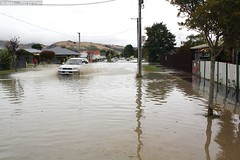
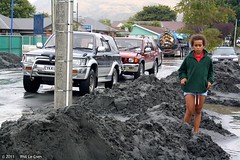

Dallington 11
Articles, UC QuakeStudies
A photograph captioned, "I miss living here, right by the river. I'd been there for quite a long time, 12 years or so. I realize now I took it for granted a bit. I used to get a bit bored with having a big old house that was cold, difficult to clean, and perhaps hard to keep warm. But now, when I go back there, I miss living in a big house by the river with an open fire and a big lounge and everything. I had the park there on the other side of the river. And there was a little bridge down there where you could walk over to it. There was actually a circuit you could do, up to the New Brighton Bridge and back. Yeah, it was beautiful".
Dallington 20
Articles, UC QuakeStudies
A photograph captioned, "I was reading in the paper this morning about one of the people who was orange and then went red yesterday. They said they were really glad they'd gone red rather than green-blue. Green-blue is the one they're going to have problems with".
Dallington 9
Articles, UC QuakeStudies
A photograph captioned, "After the September earthquake, it was more a simple case of something gets broken and it gets repaired. Then came February, and June as well, and suddenly it's just not so straightforward anymore".
Dallington 14
Articles, UC QuakeStudies
A photograph captioned, "Lovely big weeds, they're pretty aren't they. Amongst all this".
Dallington 16
Articles, UC QuakeStudies
A photograph captioned, "It feels like it has been a really on-going process. We weren't in the head space for it really, because when you retire, you think you're in your retirement home and you're there to stay. You don't expect to have to move on. To do all this".
Dallington 18
Articles, UC QuakeStudies
A photograph captioned, "We went to Nigel's place for breakfast and stayed for three months".
Dallington 5
Articles, UC QuakeStudies
A photograph captioned, "In the 1930s the traffic in Gayhurst Road was so light that I can remember playing hockey and cricket with apple boxes for wickets. If a car or cart came along there was plenty of time to shift the boxes to let them past".
Dallington 7
Articles, UC QuakeStudies
A photograph captioned, "My daughter grew up in this house. She's 10 now. She is going to miss it - and Dallington. It's where she's grown up, what she knows. She'll miss it alright. Me too".
Dallington 1
Articles, UC QuakeStudies
A photograph showing the damaged streetscape of Dallington, following the series of earthquakes in Christchurch.
Dallington 6
Articles, UC QuakeStudies
A photograph captioned, "Nobody’s trained for this, you go to your lawyer and they can’t give you an answer because they've never faced this before, so yeah, even they are scratching around trying to find out".
Dallington 22
Articles, UC QuakeStudies
A photograph captioned, "The government's not stupid, they'll put three houses on each of these sections".
Dallington 13
Articles, UC QuakeStudies
Its 12 years of accumulated stuff and I was thinking I was just going to get rid of everything. I had the feeling I didn't want to hang onto anything. We tried to get rid of a lot of stuff in a garage sale. Some of it went, some of it didn't. It's a long process".
Dallington 19
Articles, UC QuakeStudies
A photograph captioned, "We get the young fellas to come in and do the upkeep on the government houses that have been sold. They cut down all the long grass and just tidy up all the fire risk sections. This one's easier cos the house is gone. If you keep it tidy it looks tidy from the road. There's people living here, and there's nothing worse than looking over your house and seeing grass this high".
Dallington 16
Articles, UC QuakeStudies
A photograph showing St Paul's School's damage in Dallington, following the series of earthquakes in Christchurch.
Dallington 4
Articles, UC QuakeStudies
A photograph showing a 'red zoned' home in Dallington, following the series of earthquakes in Christchurch.
Dallington 10
Articles, UC QuakeStudies
A photograph showing Jean Sprott in her 'red zoned' home, soon to be demolished following the series of earthquakes in Christchurch.
Dallington 1
Articles, UC QuakeStudies
A photograph captioned, "So they gradually go".
Dallington 17
Articles, UC QuakeStudies
A photograph showing earthquake damage in a Dallington resident's home, following the series of earthquakes in Christchurch.
Dallington 14
Articles, UC QuakeStudies
A photograph showing a window in a 'red zoned' home in Dallington, Christchurch following the February 2011 earthquake.
Dallington 17
Articles, UC QuakeStudies
A photograph captioned, "I guess the only good thing that came out of the earthquake is that we know the residents better. It definitely bought people together, and the support was incredible. If you didn't know your neighbours before, you definitely knew them after the quake. We made friends out of this".
Dallington 21
Articles, UC QuakeStudies
A photograph captioned, "See, Dallington still is beautiful".
Building resilience in transient rural communities – a post-earthquake reg…
Research papers, Lincoln University
The Kaikoura earthquake in November 2016 highlighted the vulnerability of New Zealand’s rural communities to locally-specific hazard events, which generate regional and national scale impacts. Kaikoura was isolated with significant damage to both the east coast road (SH1) and rail corridor, and the Inland Road (Route 70). Sea bed uplift along the coast was significant – affecting marine resources and ocean access for marine operators engaged in tourism and harvesting, and recreational users. While communities closest to the earthquake epicentre (e.g., Kaikoura, Waiau, Rotherham and Cheviot) suffered the most immediate earthquake damage, the damage to the transport network, and the establishment of an alternative transport route between Christchurch and Picton, has significantly impacted on more distant communities (e.g., Murchison, St Arnaud and Blenheim). There was also considerable damage to vineyard infrastructure across the Marlborough region and damage to buildings and infrastructure in rural settlements in Southern Marlborough (e.g., Ward and Seddon).
Building resilience in transient rural communities – a post-earthquake reg…
Research papers, Lincoln University
This report forms part of a research project examining rural community resilience to natural hazard events, with a particular focus on transient population groups. A preliminary desktop and scoping exercise was undertaken to examine nine communities affected by the Kaikoura earthquake and to identify the variety of transient population groups that are commonly (and increasingly) found in rural New Zealand (see Wilson & Simmons, 2017). From this, four case study communities – Blenheim, Kaikoura, Waiau and St Arnaud – were selected to represent a range of settlement types. These communities varied in respect of social, economic and geographic features, including the presence of particular transient population groups, and earthquake impact. While the 2016 Kaikoura earthquake provided a natural hazard event on which to focus the research, the research interest was in long-term (and broad) community resilience, rather than short-term (and specific) response and recovery actions which occurred post-earthquake.
Airbnb, no events blamed for business drop - Chch motels
Audio, Radio New Zealand
It's being called the worst winter for moteliers since the Canterbury earthquakes and the blame's being put squarely on Airbnb and a lack of events in Christchurch. Motels are reporting up to a third less business than last year - and that means some could have to close.
New Brighton businesses blast city leaders' 'lack of unity'
Audio, Radio New Zealand
Businesses in the Christchurch suburb of New Brighton are demanding urgent action to pull the area out of an economic slump. The seaside town has struggled since the Canterbury Earthquakes, with thousands of people - and customers - leaving the area due to land damage under their homes.
Christchurch Press Image: Robyn Edie 2010:09:10 14:41:30
Images, UC QuakeStudies
Photograph captioned by Fairfax, "Gorge Road School held a 'Red & Black' themed dress day and a gold coin donation (which they made into a coin trail) to raise funds for earthquake-stricken Canterbury. Pictured are the school pupils (fifty in total) in front of their school".
Rangiora Express
Audio, Radio New Zealand
One of the great community initiative's in Canterbury is the Rangiora Earthquake Express - where urgent help is still needed. These Rangiora volunteers have been up and running for sometime now, with daily runs into the Christchurch suburbs most desperately in need of water and other essential supplies.
Opposition warning over possible Christchurch ministry
Audio, Radio New Zealand
Opposition parties fear a new department to control the rebuilding of Christchurch will be Wellington-centric and not allow the community to have its fair say in decisions. The Labour Party's spokesperson on the Canterbury Earthquake Recovery, Clayton Cosgrove, spoke to our political editor Brent Edwards.
Chances of magnitude aftershock hitting rapidly decreasing
Audio, Radio New Zealand
Two earthquake scientists say the chance of a magnitude six aftershock hitting the Canterbury region is decreasing day by day and is now unlikely. A Victoria University professor in geophysics and a GNS seismologist have put into perspective the weekend's devastating earthquake at a lecture in Wellington.
Big Year Interview - Bruce Lamb
Audio, Radio New Zealand
Senior Constable Bruce Lamb is the Christchurch police dog handler who narrowly survived being shot in the course of duty on 13 July 2010, his police dog, Gage, was killed. Then Bruce's house was red stickered following the Canterbury earthquake in September, condemned and to be demolished.