

Search
found 7152 results
Images for CANTERBURY; more images...
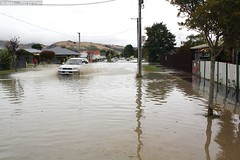
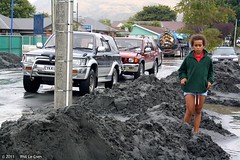

Christchurch Press Image: John Kirk-Anderson 2010:10:21 11:23:50
Images, UC QuakeStudies
Photograph captioned by Fairfax, "Newly married couple Jill Tyquin-Smith and Arthur Smith of Rangiora, who decided to get married after the Canterbury earthquake so they could live together. They organised the wedding in two weeks and are now living happily ever after".
Christchurch Press Image: John Kirk-Anderson 2010:10:21 11:16:19
Images, UC QuakeStudies
Photograph captioned by Fairfax, "Newly married couple Jill Tyquin-Smith and Arthur Smith of Rangiora, who decided to get married after the Canterbury earthquake so they could live together. They organised the wedding in two weeks and are now living happily ever after".
Engaging Quake Claimants and Community Networks - Address by Brian Parker
Videos, UC QuakeStudies
A video of an address by Brian Parker, Project Manager of Canterbury Communities' Earthquake Recovery Network (CanCERN) and Managing Director of Sharp Teaching, at the 2015 Seismics and the City forum. This talk is about learning from complex claims and local knowledge.
Fairfax Media Auckland Bureau Image: John Selkirk 2010:10:04 20:20:28
Images, UC QuakeStudies
Photograph captioned by Fairfax, "The Canterbury Earthquake Business Benefit Dinner hosted by the Prime Minister, was held tonight at Sky City in Auckland. Shown at the dinner is Auckland Supercity mayoral candidate Len Brown (left) with Bill Highet the retail GM at Meridian".
Retailers Association speak about compensation package
Audio, Radio New Zealand
The Government is to provide income support to some workers who've lost earnings because of the earthquake in Canterbury. The support package will be offered to businesses with fewer than 20 employees, which are unable to operate or pay their staff.
Half of earthquake appeal money given out
Audio, Radio New Zealand
Over half of the $21 million donated to the Red Cross in the wake of September's Canterbury earthquake has been paid out. More than ten thousand grant applications have been received to date, including about six thousand since the beginning of November.
Our Changing World - Base Isolation
Audio, Radio New Zealand
Base isolation has generally been considered an expensive system used mainly in commercial buildings to make them more earthquake resilient. Katy Gosset meets the University of Canterbury engineers who've developed a safe, low cost model that could work in our homes.
Checkpoint Top Stories for Tuesday 28 September 2010
Audio, Radio New Zealand
Child Youth and Family admits mistakes, 1223 workers to join Auckland unemployed, Man pleads guilty to Raymond Piper's death, Phoenix squares bill for unpaid ACC levies, Parker accused of avoiding debates for political reasons, Scholars call on Govt to rethink Canterbury earthquake law.
Rebuild vs Repair - Christchurch insurers
Audio, Radio New Zealand
New assessment guidelines are reclassifying houses which were previously written off as being repairable, leaving owners up to $180,000 worse off. Kathryn talks to Leanne Curtis, spokesperson for the Canterbury Community Earthquake Recovery Network, and Renee Walker, spokesperson for IAG New Zealand.
Forgotten Victims - Elaine Lacey
Audio, Radio New Zealand
Five years on from the Canterbury Earthquakes there is concern over a group of so-called forgotten victims - adolescent boys. Anti violence group Aviva say they have seen a rise in violent behaviour from this group. Elaine Lacey from Aviva joins me
Christchurch Mail Image: John Bisset 2010:09:10 14:22:22
Images, UC QuakeStudies
Photograph captioned by Fairfax, "Members of the Red Cross civil defence response team and South Canterbury Police have been in Christchurch helping with the earthquake clean up. Having a look at a damaged bridge on River Road near Tai Tapu is Anna Sole".
Photograph by Jocelyn Kinghorn 499
Images, UC QuakeStudies
A view down Armagh Street where a cordon checkpoint has been set up and guarded by the Army. On the road side are rubbish bins and road cones to divert the traffic. Part of the Canterbury Provincial Council Buildings can be seen.
Economics of Infrastructure Resilience EoRI project
Videos, UC QuakeStudies
A video of a presentation by Michelle Daly of GNS Science on the "Economics of Infrastructure Resilience EoRI project". The presentation was delivered at the learning forum on Interdependencies of Lifeline Systems as part of the University of Canterbury's Lifeline Week.
Photograph by Jocelyn Kinghorn 2305
Images, UC QuakeStudies
Portaloos on the Pine Mound, part of Festival of Flowers. Each portaloo was decorated with various floral features. This one has been decorated in Canterbury colours, red and black. Detail of butterflies inside near the figurine dressed as a rugby player's foot.
Christchurch Press Image: John Kirk-Anderson 2010:10:21 11:23:44
Images, UC QuakeStudies
Photograph captioned by Fairfax, "Newly married couple Jill Tyquin-Smith and Arthur Smith of Rangiora, who decided to get married after the Canterbury earthquake so they could live together. They organised the wedding in two weeks and are now living happily ever after".
Christchurch Press Image: Dean Kozanic 2010:09:04 16:53:15
Images, UC QuakeStudies
Photograph captioned by Fairfax, "Prime Minister John Key visited Christchurch after its 7.1 magnitude earthquake at 0435 Saturday morning. Civil Defence have set up base at Christchurch Art Gallery. Pictured with Mayor Bob Parker and Canterbury Earthquake Recovery Minister Gerry Brownlee".
Christchurch Press Image: Dean Kozanic 2010:09:04 16:54:02
Images, UC QuakeStudies
Photograph captioned by Fairfax, "Prime Minister John Key visited Christchurch after its 7.1 magnitude earthquake at 0435 Saturday morning. Civil Defence have set up base at Christchurch Art Gallery. Pictured with Mayor Bob Parker and Canterbury Earthquake Recovery Minister Gerry Brownlee".
Christchurch Press Image: Dean Kozanic 2010:09:04 16:53:00
Images, UC QuakeStudies
Photograph captioned by Fairfax, "Prime Minister John Key visited Christchurch after its 7.1 magnitude earthquake at 0435 Saturday morning. Civil Defence have set up base at Christchurch Art Gallery. Pictured with Mayor Bob Parker and Canterbury Earthquake Recovery Minister Gerry Brownlee".
Christchurch Press Image: Dean Kozanic 2010:09:04 16:53:09
Images, UC QuakeStudies
Photograph captioned by Fairfax, "Prime Minister John Key visited Christchurch after its 7.1 magnitude earthquake at 0435 Saturday morning. Civil Defence have set up base at Christchurch Art Gallery. Pictured with Mayor Bob Parker and Canterbury Earthquake Recovery Minister Gerry Brownlee".
Uncovering Victoria Square
Articles, Christchurch uncovered
In 1848, when the City of Christchurch was nothing but a design concept of the Canterbury Association back in London the idea of a ‘little slice of England’ (but half the world away) was born (Rice 2014, 9). Exactly how … Continue reading →
20131231_8484_EOS M-22 Quake City exhibit
Images, eqnz.chch.2010
20131231_8484_EOS M-22 Quake City exhibit Another city walk around, this time with my brother-in-law from Auckland. Also went to the Quake City exhibition in the city organised by the Canterbury Museum. First fine day for a while. #4502
20131231_8503_EOS M-22 From Cashel Street
Images, eqnz.chch.2010
20131231_8503_EOS M-22 From Cashel Street Another city walk around, this time with my brother-in-law from Auckland. Also went to the Quake City exhibition in the city organised by the Canterbury Museum. First fine day for a while. #4504
Deans Homestead October 2008
Images, eqnz.chch.2010
20081011_1524_1D3-45 Deans Homestead October 2008 The historic Deans Homestead 23 months ago. Now destroyed in the Canterbury earthquake of September 4th 2010. This photo was taken on the PSNZ 2008 Southern Regional Photographic Convention bus trip. #384
The Demise of the URM Building Stock in Christchurch during the 2010–2011 …
Research papers, The University of Auckland Library
The progressive damage and subsequent demolition of unreinforced masonry (URM) buildings arising from the Canterbury earthquake sequence is reported. A dataset was compiled of all URM buildings located within the Christchurch CBD, including information on location, building characteristics, and damage levels after each major earthquake in this sequence. A general description of the overall damage and the hazard to both building occupants and to nearby pedestrians due to debris falling from URM buildings is presented with several case study buildings used to describe the accumulation of damage over the earthquake sequence. The benefit of seismic improvement techniques that had been installed to URM buildings is shown by the reduced damage ratios reported for increased levels of retrofit. Demolition statistics for URM buildings in the Christchurch CBD are also reported and discussed. VoR - Version of Record
Experimental test program and modelling to address the performance of RC w…
Research papers, The University of Auckland Library
The current seismic design practice for reinforced concrete (RC) walls has been drawn into question following the Canterbury earthquakes. An overview of current research being undertaken at the University of Auckland into the seismic behaviour of RC walls is presented. The main objectives of this research project are to understand the observed performance of several walls in Christchurch, quantify the seismic loads on RC walls, and developed improved design procedures for RC walls that will assist in revisions to NZS 3101. A database summarising of the performance of RC wall buildings in the Christchurch CBD was collated to identify damage modes and case-study buildings. A detailed investigation is underway to verify the seismic performance of lightly reinforced concrete walls and an experimental setup has been developed to subject RC wall specimen to loading that is representative of a multi-storey building. Numerical modelling is being used to understand the observed performance of several case-study RC walls buildings in Christchurch. Of particular interest is the influence that interactions between walls and other structural elements have on the seismic response of buildings and the loads generated on RC walls.
A synthesis of historical environmental changes to Brooklands Lagoon/Te Ri…
Research papers, Lincoln University
Brooklands Lagoon / Te Riu o Te Aika Kawa (‘Brooklands’) is an important wetland and estuarine ecosystem in Canterbury. It is a site of cultural significance to Ngāi Tūāhuriri, and is also valued by the wider community. Home to an array of life, it is connected to the Pūharakekenui/Styx and Waimakariri rivers, and is part of a wetland landscape complex that includes the Avon-Heathcote / Ihutai estuary to the south and the Ashley / Rakahuri estuary to the north. Notionally situated within the territorial boundary of Christchurch City Council and jurisdictionally encompassed by the regional council Environment Canterbury, it has been legally determined to be part of the coastal marine area. The complicated administrative arrangements for the lagoon mirror the biophysical and human challenges to this surprisingly young ecosystem since its formation in 1940. Here we present a synthesis of the historical events and environmental influences that have shaped Brooklands Lagoon. Before existing as an intertidal ecosystem, the Waimakariri river mouth was situated in what is now the southern end of the lagoon. A summary timeline of key events is set out in the table below. These included the diversion of the Waimakariri River mouth via the construction of Wrights Cut in the 1930s, which influenced the way that the lower reaches of the river interacted with the land and sea. A large flood in 1940 shifted the river mouth ~2 to 3 kilometres north, that created the landscape that we see today. However, this has not remained stable, as the earthquake sequence in 2010 and 2011 subsided the bed of the estuary. The changes are ongoing, as sea level rise and coastal inundation will place ongoing pressure on the aquatic ecosystem and surrounding land. How to provide accommodation space for Brooklands as an estuary will be a key planning and community challenge, as Environment Canterbury begins the engagement for the review of its Regional Coastal Plan. There is also a requirement to safeguard its ecological health under the 2020 National Policy Statement on Freshwater Management. This will necessitate an integrated mountains to sea (ki uta ki tai) management approach as the lagoon is affected by wider catchment activities. We hope that this report will contribute to, and inform these processes by providing a comprehensive historical synthesis, and by identifying considerations for the future collaborative management of Brooklands Lagoon, and protection of its values. In essence, we suggest that Te Riu o Te Aika Kawa deserves some sustained aroha.
Gaining ‘authority to operate’: Student‐led emergent volunteers and establ…
Research papers, Lincoln University
There is growing expectation that local volunteers will play a more integrated role in disaster response, yet emergent groups are often ‘outsiders’ to crisis management, prompting questions of the conditions and processes by which these groups can forge relationships with established response agencies, and the tensions which can arise those interactions. This article analyses how student-led volunteers, as an emergent group, nevertheless gained “authority to operate” in the aftermath of the 2010-2011 earthquakes in Canterbury, New Zealand. Our study demonstrates how established response agencies and emergent groups can form hugely impactful and mutually supportive relationships. However, our analysis also points to two interrelated tensions that can arise, regarding the terms by which emergent groups are recognised, and the ‘distance’ considered necessary between emergent groups and established response agencies. The discussion considers implications for inclusiveness, risk and responsibility if emergent volunteers are to be further integrated into disaster response.
Samo Lyttelton cafe Photograph 5
Images, UC QuakeStudies
A photograph of the interior of the Samo Lyttelton cafe. Shelves hold childrens' books and toys, a tray of condiments, and other items.
Nisbet, Alistair, 1958- :WHUMP! WHUMP! WHUMP! 15 June 2011
Images, Alexander Turnbull Library
A huge fist representing 'quakes', that is wearing a boxing glove, thumps a man who represents 'CHCH' (Christchurch) 'WHUMP! WHUMP! WHUMP!' The man is knocked out. Context - Magnitude 6.0 and 5.5 earthquakes rocked Christchurch again at 1pm and 2.20pm on 13th June 2011. These quakes follow the first earthquake on September 4th 2010 and the second on February 22nd 2011. (www.stuff.co.nz, 13 June 2011) Quantity: 1 digital cartoon(s).
Fault rupture patterns during the Mw7.8 2016 Kaikoura Earthquake in the re…
Research papers, University of Canterbury Library
Surface rupture and slip from the Mw 7.8 2016 Kaikōura Earthquake have been mapped in the region between the Leader and Charwell rivers using field mapping and LiDAR data. The eastern Humps, north Leader and Conway-Charwell faults ruptured the ground surface in the study area. The E-NE striking ‘The Humps’ Fault runs along the base of the Mt Stewart range front, appears to dip steeply NW and intersects the NNW-NNE Leader Fault which itself terminates northwards at the NE striking Conway-Charwell Fault. The eastern Humps Fault is up to the NW and accommodates oblique slip with reverse and right lateral displacement. Net slip on ‘The Humps’ Fault is ≤4 m and produced ≤4 m uplift of the Mt Stewart range during the earthquake. The Leader Fault strikes NNW-NNE with dips ranging from ~10° west to 80° east and accommodated ≤4 m net slip comprising left-lateral and up-to-the-west vertical displacement. Like the Humps west of the study area, surface-rupture of the Leader Fault occurred on multiple strands. The complexity of rupture on the Leader Fault is in part due to the occurrence of bedding-parallel slip within the Cretaceous-Cenozoic sequence. Although the Mt Stewart range front is bounded by ‘The Humps’ Fault, in the study area neither this fault nor the Leader Fault were known to have been active before the earthquake. Fieldwork and trenching investigations are ongoing to characterise the geometry, kinematics and paleoseismic history of the mapped active faults.