
Search
found 173 results
Images for Earthquake Christchurch; more images...
Christchurch Earthquake Recovery - An Example of Resilience and Sustainabi…
Research papers, University of Canterbury Library
The term resilience‘’is increasingly being used in a multitude of contexts. Seemingly the latest buzz‘’word, it can mean many things to many people, in many different situations. In a natural hazard context, the terms sustainable planning‘’, and resilience‘planning are now’being used, often interchangeably. This poster provides an overview of resilience and sustainability within a land use planning and natural hazard context, and discusses how they are interrelated in the situation of the earthquake impacted city of Christchurch, New Zealand.
Christchurch homes sit empty
Audio, Radio New Zealand
Post-earthquake most people would say it was difficult to find housing in Christchurch. But reports suggest that the market has flattened. And terraced housing and apartments are sitting empty. Christchurch Council finance committee chairman, Councillor Raf Manji, discusses future developments like The East Frame.
Bob Burnett: better homes for better health
Audio, Radio New Zealand
Christchurch architect Bob Burnett founded the Superhome movement after his children got sick "bouncing around substandard rentals" after the Christchurch earthquake.
Christchurch cycleways disastrous for St Albans business
Audio, Radio New Zealand
The Christchurch City Council is investing $156 million in 13 cycleways across the city, in a post-earthquake overhaul of the city's transport network.
Earthquake survivor says Wgtn must cordon around unsafe sites
Audio, Radio New Zealand
A woman crushed to within milimetres of her life in the Christchurch earthquake says it is murderously cavalier for Wellington's council not to cordon off weak or prone buildings.
Piles, bones and marbles: what was under the Godleys’ house?
Articles, Christchurch uncovered
Way back in the winter of 2012, at the height of the post-earthquake demolition, I was pretty excited to learn we were going to get the chance to investigate the site of John and Charlotte Godley’s house in Lyttelton. John … Continue reading →
After the earthquakes, Lyttelton Redux
Audio, Radio New Zealand
Lyttelton was hit harder than most by the Christchurch earthquakes - particularly the Lyttelton Museum. But now it's back - triumphantly, we may say! - with a little help from its friends, past and present. Key historical figures in Lyttelton's history are brought back to life in a new exhibition by Julia Holden - Lyttelton Redux - which has just opened at Canterbury Museum.
Christchurch sitting on mental health 'time bomb'
Audio, Radio New Zealand
Dr Sue Bagshaw, the head of a youth health clinic Christchurch, fears the high rates of Post Traumatic Stress Disorder among children will skyrocket due to the earthquake.
Wheelchair users still struggling with access in Christchurch
Audio, Radio New Zealand
Wheelchair users say Christchurch is frustrating and difficult to navigate around since the earthquakes, especially roads and footpaths, which is leaving people feeling isolated.
Digital Photograph: Flowers Floating in the Avon River
Images, Canterbury Museum
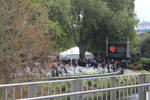
One landscape colour digital photograph taken 22 February 2017 showing flowers floating in the Avon River as part of the Canterbury Earthquake Memorial Service.
Life soon to return to Christchurch's Cathedral square
Audio, Radio New Zealand
Cathederal Square has remained largely untouched by developers since the 2011 earthquake. That is about to change, with work beginning on a series of hotels.
Digital Photograph: Sunflower Atop a Road Works Cone
Images, Canterbury Museum
One landscape colour digital photograph taken 22 February 2017 showing a sunflower sitting atop a road works cone as part of the Canterbury Earthquake Memorial Service.
Surge in young Cantabrians seeking mental health help
Audio, Radio New Zealand
The increase began after Christchurch's 2011 earthquakes, but the District Health Board is expecting to face even more challenges following effects of the Port Hills fires and last year's earthquake in Kaikoura.
Real asset in innovative damage assessment
Articles, UC QuakeStudies
A document which outlines SCIRT's post-earthquake asset assessment process.
Old Christchurch stadium seats sold off
Audio, Radio New Zealand
Work has finally begun dismantling Lancaster Park in Christchurch, six years after it was damaged beyond repair in the February earthquake. It comes at the same time the city's leaders debate what a new stadium could look like and who will pay.
Digital Photograph: Commemorative Note to Andrew Bishop
Images, Canterbury Museum
One landscape colour digital photograph taken 22 February 2017 showing a commemorative note to, and photograph of, Andrew Bishop attached to an earthquake memorial trellis at the site of the former Canterbury Television building.
New Zealand's best cats battle for glory
Audio, Radio New Zealand
The National Cat Show is on in Christchurch on Sunday, the first time cat lovers from across the country have met in Christchurch since the earthquakes.
Christchurch redzone homeowners win seven year battle
Audio, Radio New Zealand
The quake outcasts, who were uninsured at the time, will receive 80 percent of the pre-earthquake value of their homes. Three of them tell John Campbell how they've been living in limbo.
Digital Photograph: Flowers at the Site of the Former Canterbury Televisio…
Images, Canterbury Museum
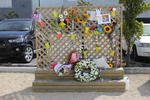
One landscape colour digital photograph taken 22 February 2017 showing bouquets of flowers and gifts left at the site of the former Canterbury Television building in memory of earthquake victims.
Kids and post-quake anxiety
Audio, Radio New Zealand
Kim Button of the Neighbourhood Trust talks about the emotional scars Christchurch child are bearing after the earthquakes.
Cruise ships coming back to Christchurch in 2019
Audio, Radio New Zealand
The Lyttelton Port Company, owned by Christchurch City Council, will spend $56 million on a new berth for cruise ships, which haven't visited the garden city since the 2011 earthquake.
Digital Photograph: Flowers at the Site of the Former Canterbury Televisio…
Images, Canterbury Museum
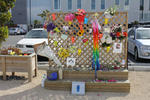
One landscape colour digital photograph taken 22 February 2017 showing a bouquet of flowers left at the site of the former Canterbury Television building by the Toyama Language School in memory of earthquake victims.
Insuring earthquakes: How would the Californian and Japanese insurance pro…
Research papers, Victoria University of Wellington
Earthquakes are insured only with public sector involvement in high-income countries where the risk of earthquakes is perceived to be high. The proto-typical examples of this public sector involvement are the public earthquake insurance schemes in California, Japan, and New Zealand (NZ). Each of these insurance programs is structured differently, and the purpose of this paper is to examine these differences using a concrete case-study, the sequence of earthquakes that occurred in the Christchurch, New Zealand, in 2011. This event turned out to have been the most heavily insured earthquake event in history. We examine what would have been the outcome of the earthquakes had the system of insurance in NZ been different. In particular, we focus on the public earthquake insurance programs in California (the California Earthquake Authority - CEA), and in Japan (Japanese Earthquake Reinsurance - JER). Overall, the aggregate cost to the public insurer in NZ was $NZ 11.1 billion in its response to the earthquakes. If a similar-sized disaster event had occurred in Japan and California, homeowners would have received $NZ 2.5 billion and $NZ 1.4 billion from the JER and CEA, respectively. We further describe the spatial and distributive patterns of these different scenarios.
Digital Photograph: Flowers at the Site of the Former Canterbury Televisio…
Images, Canterbury Museum
One landscape colour digital photograph taken 22 February 2017 showing a bouquet of flowers left at the site of the former Canterbury Television building by St John New Zealand in memory of earthquake victims and in appreciation of first responders.
Alternative Radio : exhibiting radio and music heritage after the Christch…
Research papers, University of Canterbury Library
This article examines the representation of Christchurch, New Zealand, student radio station RDU in the exhibition Alternative Radio at the Canterbury Museum in 2016. With the intention of ‘making visible what is invisible’ about radio broadcasting, the exhibition articulated RDU as a point of interconnection between the technical elements of broadcasting, the social and musical culture of station staff and volunteers, and the broader local and national music scenes. This paper is grounded in observations of the exhibitions and associated public programmes, and interviews with the key participants in the exhibition including the museum's exhibition designer and staff from RDU, who acted as independent practitioners in collaboration with the museum. Alternative Radio also addressed the aftermath of the major earthquake of 22 February 2011, when RDU moved into a customised horse truck after losing its broadcast studio. The exhibition came about because of the cultural resonance of the post-quake story, but also emphasised the long history of the station before that event, and located this small student radio station in the broader heritage discourse of the Canterbury museum, activating the historical, cultural, and personal memories of the station's participants and audiences.
Duncan Webb ahead of Nicky Wagner in Chch central
Audio, Radio New Zealand
Christchurch lawyer Duncan Webb made the shift into politics because of the people left behind after the Christchurch earthquakes. Now he's ahead of National's Nicky Wagner in the latest results.
Re-start container mall wanted in Kaikōura
Audio, Radio New Zealand
Kaikōura's struggling business community wants a container mall similar to Christchurch's re-start mall set up after the Canterbury earthquakes.
Sign of the Kiwi re-opens in Christchurch - locals delight
Audio, Radio New Zealand
Built in June 1917, the popular 'Sign of the Kiwi' heritage building in Christchurch's Port Hills has re-opened today after being closed for six years due to earthquake damage.
CTV families hold protest in Christchurch
Audio, Radio New Zealand
Some of the families of the 115 people who dies in the CTV building during the 2011 Canterbury earthquake protested in Latimer Square yesterday over the police decision not to prosecute the designers of the CTV building. They say they do want to see a prosecution go ahead, and they are seeking legal advice about what their options are.
First freight chugs into Chch from Picton since Kaikoura quake
Audio, Radio New Zealand
The first freight train since the devastating Kaikoura earthquake has chugged into Christchurch, after an historic 348 kilometre journey from Picton.