
Search
found 5912 results
Images for :Christchurch; more images...


Signs of Things To Come Photograph 2
Images, UC QuakeStudies
A photograph of signs on the corner of Colombo and Hereford Streets that are part of Signs of Things to Come. This was a wayfinding project by Generation Zero and Diadem, for FESTA 2014. The signage gives directions to key central city and FESTA locations, and compares the current and future potential of transport in Christchurch.
Signs of Things To Come Photograph 3
Images, UC QuakeStudies
A photograph of signs on the corner of Colombo and Hereford Streets that are part of Signs of Things to Come. This was a wayfinding project by Generation Zero and Diadem, for FESTA 2014. The signage gives directions to key central city and FESTA locations, and compares the current and future potential of transport in Christchurch.
BeckerFraserPhotos April 2011 photograph 018
Images, UC QuakeStudies
A community briefing sign for Burwood Park, between Cresswell Avenue and New Brighton Road. These signs were put up in Christchurch for each community briefing. The first series (6 March to 12 March) were held in 12 locations, second series (21 March to 26 March) in 10 locations and the third series (16 April to 18 April) in 8 locations.
WEMO ERT Set 3 - February 2011 - Photograph 014
Images, UC QuakeStudies
A photograph of members of the Wellington Emergency Management Office Emergency Response Team walking through Latimer Square. In the background there are members from other emergency management teams including the China USAR team, the Tauranga Response Team, and the Red Cross.
Rebekah Rogers WEMO Photograph 105
Images, UC QuakeStudies
A photograph of a portable shower unit set up in Hagley Park for the emergency management personnel who travelled to Christchurch after the 22 February 2011 earthquake. A clothes line has been set up by tying ropes to the shower unit and a digger. To the right, a number of portaloos can also be seen.
WEMO ERT Set 1 - February 2011 - Photograph 39
Images, UC QuakeStudies
A photograph of members of the Wellington Emergency Management Office Emergency Response Team and the New Zealand Police inspecting the Cherish Bridal and Formal Wear store on Montreal Street. Inside the store one of the ERT members is attempting to break through a wall.
Rebekah Rogers WEMO Photograph 077
Images, UC QuakeStudies
A photograph of a residential property in the Christchurch central city with USAR codes spray-painted on the driveway and "No go" spray-painted on the front window and door. A red sticker in the window indicates that the building is unsafe to enter. Cordon tape has been draped around the side, cordoning off a pile of bricks.
WEMO ERT Set 1 - February 2011 - Photograph 37
Images, UC QuakeStudies
A photograph of members of the Wellington Emergency Management Office Emergency Response Team and the New Zealand Police inspecting the Cherish Bridal and Formal Wear store on Montreal Street. Inside the store one of the ERT members is attempting to break through a wall.
Kim Wright WEMO Photograph 041
Images, UC QuakeStudies
A photograph of a map of Christchurch in a temporary Civil Defence headquarters set up at the Mainland Foundation Ballpark after the 4 September 2010 earthquake. Red, green and blue markings on the map indicate where flooding, sand and closures are located. Post-it notes and a key with a tag reading, "Manchester" are attached to the map.
Jim Baltaxe WEMO Photograph 064
Images, UC QuakeStudies
A photograph of an office on the side of a Christchurch road. "Danger keep out" has been spray-painted on the front wall. The road in front has been dug up in places and piles of gravel have been placed on the footpath. Road cones and cordon tape have been used to cordon off a large hole in the road.
WEMO ERT Set 1 - February 2011 - Photograph 26
Images, UC QuakeStudies
A photograph of the earthquake damage to the Provincial Hotel on the corner of Barbadoes and Cashel Streets. The second storey walls have crumbled, and the bricks have fallen onto the ground below. Scaffolding erected in front of the building is now on a lean. Wire fencing has been placed around the building as a cordon.
WEMO ERT Set 3 - February 2011 - Photograph 016
Images, UC QuakeStudies
A photograph of members of the Wellington Emergency Management Office Emergency Response Team in Latimer Square. There are members of other emergency management teams in the background including the Tauranga Response Team, the Taupo Response Team, and the New South Wales USAR team.
WEMO ERT Set 2 - February 2011 - Photograph 07
Images, UC QuakeStudies
A photograph of the earthquake-damaged Cathedral of the Blessed Sacrament on Barbadoes Street. Rubble from the collapsed tower is lying on the ground in front. A car has been crushed under this rubble. Wire fencing, shipping containers, and road cones have been placed around the building as a cordon.
Rebekah Rogers WEMO Photograph 033
Images, UC QuakeStudies
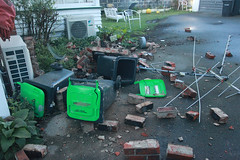
A photograph of an earthquake-damaged building in Christchurch. The wall on the side of the house has crumbled, and the bricks have fallen onto the fence and damaged it. Wooden planks have been used to brace the wall towards the back of the property. A red sticker on the front window indicates that the house is unsafe to enter.
WEMO ERT Set 3 - February 2011 - Photograph 051
Images, UC QuakeStudies
A photograph of the earthquake-damaged Cathedral of the Blessed Sacrament on Barbadoes Street. Rubble from the collapsed tower is lying on the ground in front. A car has been crushed under this rubble. Wire fencing, shipping containers, and road cones have been placed around the building as a cordon.
WEMO ERT Set 1 - February 2011 - Photograph 24
Images, UC QuakeStudies
A photograph of the earthquake damage to the Cathedral of the Blessed Sacrament on Barbadoes Street. The tower on the right has crumbled, and the masonry has fallen to the pavement below. A car has been crushed by the fallen rubble. Windows in the tower behind are broken.
WEMO ERT Set 3 - February 2011 - Photograph 052
Images, UC QuakeStudies
A photograph of the earthquake-damaged Cathedral of the Blessed Sacrament on Barbadoes Street. Rubble from the collapsed tower is lying on the ground in front. A car has been crushed under this rubble. Wire fencing, shipping containers, and road cones have been placed around the building as a cordon.
Signs of Things To Come Photograph 1
Images, UC QuakeStudies
A photograph of two large signs at Re:START Mall that are part of Signs of Things to Come. This was a wayfinding project by Generation Zero and Diadem, for FESTA 2014. The signage gives directions to key central city and FESTA locations, and compares the current and future potential of transport in Christchurch.
The Effects of a Major Disaster on the Musical Life of a City
Articles, UC QuakeStudies
A paper submitted by Andrew Moore in partial fulfilment of the degree of Bachelor of Music with Honours, covering the effects of the Canterbury earthquakes on the musical life of Christchurch. Dissertation supervised by Dr Elaine Dobson, University of Canterbury School of Music. All photographs from The Press are copyright Fairfax Media and are used with permission.
View From the Studio Photograph 5
Images, UC QuakeStudies
A photograph of a detail of Mike Hewson's installation 'View from the Studio' in Re:Start Mall. An outline of the cathedral's tower is sketched on plywood, accompanied by the words, "Mike Hewson 2012. 'View From Studio'. (We should try keep some part of the cathedral rather than just demo-ing it)".
Jim Baltaxe WEMO Photograph 063
Images, UC QuakeStudies
A photograph of road works on a residential street in Christchurch. Two workers in high-visibility vests can be seen, one setting up road cones. A digger is sitting on a pile of dug up gravel and earth. Cordon fences have been placed around the site. In the distance, a dump truck can be seen.
Sand volcanos cover Rydal Street
Images, eqnz.chch.2010
This has made a huge mess for the residents to clean up. I heard on the news that homes have been damaged by subsidence in areas of earthquake-caused liquefaction like this.
neighbours survey the sand volcanos
Images, eqnz.chch.2010
Lots of people were out and about in the streets checking on everyone after the earthquake. When it was clear that everyone was OK, the sand volcanos became the feature of interest.
Exploring the Acceptability, Feasibility, and Effectiveness of a Digital P…
Research papers, The University of Auckland Library
Background: Up to 6 years after the 2011 Christchurch earthquakes, approximately one-third of parents in the Christchurch region reported difficulties managing the continuously high levels of distress their children were experiencing. In response, an app named Kākano was co-designed with parents to help them better support their children’s mental health. Objective: The objective of this study was to evaluate the acceptability, feasibility, and effectiveness of Kākano, a mobile parenting app to increase parental confidence in supporting children struggling with their mental health. Methods: A cluster-randomized delayed access controlled trial was carried out in the Christchurch region between July 2019 and January 2020. Parents were recruited through schools and block randomized to receive immediate or delayed access to Kākano. Participants were given access to the Kākano app for 4 weeks and encouraged to use it weekly. Web-based pre- and postintervention measurements were undertaken. Results: A total of 231 participants enrolled in the Kākano trial, with 205 (88.7%) participants completing baseline measures and being randomized (101 in the intervention group and 104 in the delayed access control group). Of these, 41 (20%) provided full outcome data, of which 19 (18.2%) were for delayed access and 21 (20.8%) were for the immediate Kākano intervention. Among those retained in the trial, there was a significant difference in the mean change between groups favoring Kākano in the brief parenting assessment (F1,39=7, P=.012) but not in the Short Warwick-Edinburgh Mental Well-being Scale (F1,39=2.9, P=.099), parenting self-efficacy (F1,39=0.1, P=.805), family cohesion (F1,39=0.4, P=.538), or parenting sense of confidence (F1,40=0.6, P=.457). Waitlisted participants who completed the app after the waitlist period showed similar trends for the outcome measures with significant changes in the brief assessment of parenting and the Short Warwick-Edinburgh Mental Well-being Scale. No relationship between the level of app usage and outcome was found. Although the app was designed with parents, the low rate of completion of the trial was disappointing. Conclusions: Kākano is an app co-designed with parents to help manage their children’s mental health. There was a high rate of attrition, as is often seen in digital health interventions. However, for those who did complete the intervention, there was some indication of improved parental well-being and self-assessed parenting. Preliminary indications from this trial show that Kākano has promising acceptability, feasibility, and effectiveness, but further investigation is warranted. Trial Registration: Australia New Zealand Clinical Trials Registry ACTRN12619001040156; https://www.anzctr.org.au/Trial/Registration/TrialReview.aspx?id=377824&isReview=true
WEMO ERT Set 1 - March 2011 - Photograph 58
Images, UC QuakeStudies
A photograph of members of the Wellington Emergency Management Office Emergency Response Team in the hanger of a Royal New Zealand Air Force Hercules. The ERT members are travelling to Christchurch to help out in the emergency response to the 22 February 2011 earthquake. Blankets, tent poles, and other supplies have been stacked in the centre of the hanger.
Rebekah Rogers WEMO Photograph 061
Images, UC QuakeStudies
A photograph of a large trench at the entrance to a street in Christchurch. There is water and liquefaction in the trench. Road cones have been placed around it as a warning. In the background, two personnel from the New Zealand Army are guarding the entrance to the street. They are wearing their army uniforms and high-visibility vests.
BeckerFraserPhotos December 2011 photograph 0293
Images, UC QuakeStudies
An aerial photograph of the Christchurch central city near Cashel and High Streets. The photograph has been captioned by BeckerFraserPhotos, "The dense collection of buildings surrounding the Hotel Grand Chancellor with the two cranes being used for the demolition. What little of the street is visible running horizontally across the photograph is Hereford Street".
BeckerFraserPhotos December 2011 photograph 0289
Images, UC QuakeStudies
An aerial photograph of the Christchurch central city. The photograph has been captioned by BeckerFraserPhotos, "High Street runs across this photograph in the top third from the old Majestic Theatre at the intersection of Manchester and Lichfield Streets to the intersection of Madras and St Asaph Street which is just beyond the edge of the photo".
A taxonomically detailed and large-scale view of the factors affecting the…
Research papers, Lincoln University
A city’s planted trees, the great majority of which are in private gardens, play a fundamental role in shaping a city’s wild ecology, ecosystem functioning, and ecosystem services. However, studying tree diversity across a city’s many thousands of separate private gardens is logistically challenging. After the disastrous 2010–2011 earthquakes in Christchurch, New Zealand, over 7,000 homes were abandoned and a botanical survey of these gardens was contracted by the Government’s Canterbury Earthquake Recovery Authority (CERA) prior to buildings being demolished. This unprecedented access to private gardens across the 443.9 hectares ‘Residential Red Zone’ area of eastern Christchurch is a unique opportunity to explore the composition of trees in private gardens across a large area of a New Zealand city. We analysed these survey data to describe the effects of housing age, socio-economics, human population density, and general soil quality, on tree abundance, species richness, and the proportion of indigenous and exotic species. We found that while most of the tree species were exotic, about half of the individual trees were local native species. There is an increasing realisation of the native tree species values among Christchurch citizens and gardens in more recent areas of housing had a higher proportion of smaller/younger native trees. However, the same sites had proportionately more exotic trees, by species and individuals, amongst their larger planted trees than older areas of housing. The majority of the species, and individuals, of the larger (≥10 cm DBH) trees planted in gardens still tend to be exotic species. In newer suburbs, gardens in wealthy areas had more native trees than gardens from poorer areas, while in older suburbs, poorer areas had more native big trees than wealthy areas. In combination, these describe, in detail unparalleled for at least in New Zealand, how the tree infrastructure of the city varies in space and time. This lays the groundwork for better understanding of how wildlife distribution and abundance, wild plant regeneration, and ecosystem services, are affected by the city’s trees.
FESTA Promotional Video
Videos, UC QuakeStudies
A video made by Julian Vares about FESTA - the Festival of Transitional Architecture. The video includes explanations from FESTA director Jessica Halliday and key collaborators about what FESTA is about, and the important role it plays in the rebuild and recovery of Christchurch. It also includes a compilation of footage from the first three FESTA events of 2012, 2013 and 2014. This footage was shot by Rick Harvie (Belmont Productions), Peter Young (Fisheye Films), Ed Lust and John Chrisstoffels.