
Search
found 5912 results
Images for :Christchurch; more images...


WEMO ERT Set 1 - February 2011 - Photograph 40
Images, UC QuakeStudies
A photograph of members of the Wellington Emergency Management Office Emergency Response Team inspecting the Southern Finance Ltd building on Montreal Street.
BeckerFraserPhotos October 2011 photograph 383
Images, UC QuakeStudies
The ground floor of the Central Library on Gloucester Street. Books have fallen off the shelves and are in piles in the aisles.
Paul and Sam Corliss's Street Art Photograph (2013:05:04 13:20:07)
Images, UC QuakeStudies
A photograph of an advertising image in the window of Sugar Hair and Beauty, on the ground floor of the Inland Revenue Building.
Photograph by Jennifer Middendorf 294
Images, UC QuakeStudies
A string quartet from Christchurch Girls High School plays on the riverbank before the River of Flowers event held in Riccarton Bush, commemorating the second anniversary of the 22 February earthquake. In the foreground people wait for the event to start.
Helen Devereux Photograph 080
Images, UC QuakeStudies
For the first time in November 2011, Christchurch residents finally had the opportunity to see the earthquake-damaged city centre on the Red Zone bus tours organised by CERA. Damage to the Odeon Theatre can be seen out the window.
Helen Devereux Photograph 081
Images, UC QuakeStudies
For the first time in November 2011, Christchurch residents finally had the opportunity to see the earthquake-damaged city centre on the Red Zone bus tours organised by CERA. Damage to the Odeon Theatre can be seen out the window.
Helen Devereux Photograph 070
Images, UC QuakeStudies
For the first time in November 2011, Christchurch residents finally had the opportunity to see the earthquake-damaged city centre on the Red Zone bus tours organised by CERA. Damage to buildings on Cashel Street can be seen out the window.
Helen Devereux Photograph 096
Images, UC QuakeStudies
For the first time in November 2011, Christchurch residents finally had the opportunity to see the earthquake-damaged city centre on the Red Zone bus tours organised by CERA. The Regent Theatre dome which has been removed from the building.
Helen Devereux Photograph 090
Images, UC QuakeStudies
For the first time in November 2011, Christchurch residents finally had the opportunity to see the earthquake-damaged city centre on the Red Zone bus tours organised by CERA. Looking into Cathedral Square, the Regent Theatre dome can be partially seen.
Helen Devereux Photograph 111
Images, UC QuakeStudies
The Wizard of Christchurch, who has launched a campaign to save the Christ Church Cathedral from demolition. Taken on a day when a walkway was opened up between Re:Start Mall and Cathedral Square to allow temporary public access.
WEMO ERT Set 3 - February 2011 - Photograph 089
Images, UC QuakeStudies
A photograph looking north along Latimer Square towards Gloucester Street. A fire truck is parked on the left side of the road.
WEMO ERT Set 3 - February 2011 - Photograph 236
Images, UC QuakeStudies
A photograph of a large crack in the pavement of New Regent Street, near the tram tracks. Many of the pavement tiles have fallen into the crack.
WEMO ERT Set 3 - February 2011 - Photograph 054
Images, UC QuakeStudies
A photograph of a United Kingdom International Search and Rescue Service tent in Latimer Square.
Homage to the Lost Spaces Photograph 8
Images, UC QuakeStudies
A photograph of Mike Hewson's installation 'Homage to the Lost Spaces' on the earthquake-damaged Cranmer Courts building.
Helen Devereux Photograph 112
Images, UC QuakeStudies
The Wizard of Christchurch, who has launched a campaign to save the Christ Church Cathedral from demolition. Taken on a day when a walkway was opened up between Re:Start Mall and Cathedral Square to allow temporary public access.
BeckerFraserPhotos June 2012 photograph 030
Images, UC QuakeStudies
Photograph captioned by BeckerFraserPhotos, "The lights are on at the new Press building, the first office workers to return to the central city red zone".
BeckerFraserPhotos April 2011 photograph 103
Images, UC QuakeStudies
Photograph captioned by BeckerFraserPhotos, "A sign on the protective fence around the Arts Centre, Hereford Street. The sign reads, 'Danger, unsafe site, do not enter'".
WEMO ERT Set 3 - February 2011 - Photograph 013
Images, UC QuakeStudies
A photograph of a group of tents in Latimer Square. The tents were set up as temporary accommodation for emergency management personnel after the 22 February 2011 earthquake.
BeckerFraserPhotos October 2010 photograph 028
Images, UC QuakeStudies
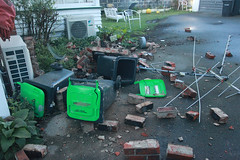
The collapsed brick wall along the side of a house in Christchurch. A tarpaulin has been placed over a hole to prevent weather damage to the inside of the building. Ironically, it is being held down by bricks.
Central City Tour, 4 April 2011 - Photograph 16
Images, UC QuakeStudies
A spray-painted message on a wall of Englefield Lodge reads "We will try to save this house." Wooden bracing supports the wall. The photographer comments, "A bike ride around the CBD. Englefield, Christchurch's oldest house in Fitzgerald Ave".
Photograph by Paul Corliss 3311
Images, UC QuakeStudies
A photograph of a protest sign reading, "Pillage People" and showing the faces of key figures in the Christchurch rebuild superimposed on the bodies of the Village People. The photograph is captioned by Paul Corliss, "Woodham Road, Linwood".
BeckerFraserPhotos October 2011 photograph 611
Images, UC QuakeStudies
Photograph captioned by BeckerFraserPhotos, "Detail of Christ's College".
sand volcano in our front lawn
Images, eqnz.chch.2010
None
sand volcano
Images, eqnz.chch.2010
This one was really flowing out of the ground.
Assessing the seismic resilience of an underground lifeline: Case study of…
Research papers, University of Canterbury Library
essential systems upon which the well-being and functioning of societies depend. They deliver a service or a good to the population using a network, a combination of spatially-distributed links and nodes. As they are interconnected, network elements’ functionality is also interdependent. In case of a failure of one component, many others could be momentarily brought out-of-service. Further problems arise for buried infrastructure when it comes to buried infrastructure in earthquake and liquefaction-prone areas for the following reasons: • Technically more demanding inspections than those required for surface horizontal infrastructure • Infrastructure subject to both permanent ground displacement and transient ground deformation • Increase in network maintenance costs (i.e. deterioration due to ageing material and seismic hazard) These challenges suggest careful studies on network resilience will yield significant benefits. For these reasons, the potable water network of Christchurch city (Figure 1) has been selected for its well-characterized topology and its extensive repair dataset.
Urban comfort in a future compact city: Analysis of open-space qualities i…
Research papers, Lincoln University
The increase in urban population has required cities to rethink their strategies for minimising greenhouse gas impacts and adapting to climate change. While urban design and planning policy have been guided by principles such as walkability (to reduce the dependence on cars) and green infrastructure (to enhance the quality of open spaces to support conservation and human values), there have been conflicting views on what spatial strategies will best prepare cities for a challenging future. Researchers supporting compact cities based upon public Transit Oriented Development have claimed that walkability, higher density and mixed-uses make cities more sustainable (Owen, 2009) and that, while green spaces in cities are necessary, they are dull in comparison with shopfronts and street vendors (Speck, 2012, p 250). Other researchers claim that green infrastructure is fundamental to improving urban sustainability and attracting public space users with improved urban comfort, consequently encouraging walkability (Pitman and Ely, 2013). Landscape architects tend to assume that ‘the greener the better’; however, the efficiency of urban greenery in relation to urban comfort and urbanity depends on its density, distribution and the services provided. Green infrastructure can take many forms (from urban forests to street trees) and provide varied services (amended microclimate, aesthetics, ecology and so forth). In this paper, we evaluate the relevance of current policy in Christchurch regarding both best practice in green infrastructure and urban comfort (Tavares, 2015). We focus on the Christchurch Blueprint for rebuilding the central city, and critically examine the post-earthquake paths the city is following regarding its green and grey infrastructures and the resulting urban environment. We discuss the performance and appropriateness of the current Blueprint in post-earthquake Christchurch, particularly as it relates to the challenges that climate change is creating for cities worldwide.
The Christchurch Urban Design Panel: Its role and influence on residential…
Research papers, Lincoln University
During the 21st century, New Zealand has experienced increasing public concern over the quality of the design and appearance of new developments, and their effects on the urban environment. In response to this, a number of local authorities developed a range of tools to address this issue, including urban design panels to review proposals and provide independent advice. Following the 2010 and 2011 Canterbury earthquake sequence, the commitment to achieve high quality urban design within Christchurch was given further importance, with the city facing the unprecedented challenge of rebuilding a ‘vibrant and successful city’. The rebuild and regeneration reinforced the need for independent design review, putting more focus and emphasis on the role and use of the urban design panel; first through collaboratively assisting applicants in achieving a better design outcome for their development by providing an independent set of eyes on their design; and secondly in assisting Council officers in forming their recommendations on resource consent decisions. However, there is a perception that urban design and the role of the urban design panel is not fully understood, with some stakeholders arguing that Council’s urban design requirements are adding cost and complexity to their developments. The purpose of this research was to develop a better understanding on the role of the Christchurch urban design panel post-earthquake in the central city; its direct and indirect influence on the built environment; and the deficiencies in the broader planning framework and institutional settings that it might be addressing. Ultimately, the perceived role of the Panel is understood, and there is agreement that urban design is having a positive influence on the built environment, albeit viewed differently amongst the varying groups involved. What has become clear throughout this research is that the perceived tension between the development community and urban design well and truly exists, with the urban design panel contributing towards this. This tension is exacerbated further through the cost of urban design to developers, and the drive for financial return from their investments. The panel, albeit promoting a positive experience, is simply a ‘tick box’ exercise for some, and as the research suggests, groups or professional are determining themselves what constitutes good urban design, based on their attitude, the context in which they sit and the financial constraints to incorporate good design elements. It is perhaps a bleak time for urban design, and more about building homes.
Jim Baltaxe WEMO Photograph 098
Images, UC QuakeStudies
A photograph of the earthquake damage to a hotel in the Christchurch central city. Cordon tape has been placed across the entrance to the hotel and USAR codes have been spray-painted on the footpath outside.
Jim Baltaxe WEMO Photograph 037
Images, UC QuakeStudies
A photograph of a member of the New Zealand Army on the roof of an earthquake-damaged property in Christchurch. A tarpaulin has been placed over a hole in the roof caused by the collapsed chimney.
Aftermath of earthquake - shops
Images, eqnz.chch.2010
Aftermath of September 4th Earthquake in Canterbury. Shops on Colombo Street in Christchurch. The initial 7.1 quake has been followed by around 1590 aftershocks recorded to date - causing further damage to already weakened structures.