
Search
found 6322 results
Images for Canterbury earthquakes; more images...

Brief Crisis Intervention after a Disaster : Client and Counsellor Experie…
Research papers, University of Canterbury Library
This thesis set out to explore the experiences of clients and counsellors in immediate crisis intervention shortly after a major earthquake. It explored the experiences and perceptions of change during counselling for both clients and counsellor, all of which were exposed to the disaster. This study supported the idea of counsellors needing to adapt to the context of post-disaster counselling and addressing client’s immediate needs. Having both been through the same disaster meant counsellors were often going through similar experiences and emotions as their clients during this time. This led counsellors to develop a greater sense of connection and understanding of their client, as well as showing more emotional responsivity and self-disclosure. This was experienced as different to their normal therapy engagement. The implications of these counsellor responses were seen to be helpful, but at times had the potential to be hindering for counselling. Clients valued their counsellor’s techniques and personal qualities but often failed to identify what contribution they, themselves, made to change processes. The differing nature of counselling in post-disaster areas, as gauged by this study may help inform expectations and experiences regarding provision of post-disaster acute interventions.
Dan Neely WEMO Photograph 34
Images, UC QuakeStudies
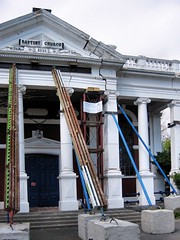
A photograph of the earthquake damage to the former Canterbury Public Library on the corner of Hereford Street and Cambridge Terrace. The bricks in the corner of the building have crumbled and masonry can be seen on the footpath below. Wire fences have been placed around the building as a cordon.
High-resolution surficial soil velocity models in the Canterbury, New Zeal…
Research papers, University of Canterbury Library
This presentation summarizes the development of high-resolution surficial soil velocity models in the Canterbury, New Zealand basin. Shallow (<30m) shear wave velocities were primarily computed based on a combination of a large database of over 15,000 cone penetration test (CPT) logs in and around Christchurch, and a recently-developed Christchurch-specific empirical correlation between soil shear wave velocity and CPT. Large active-source testing at 22 locations and ambient-wavefield surface wave and H/V testing at over 80 locations were utilized in combination with 1700 water well logs to constrain the inter-bedded stratigraphy and velocity of Quaternary sediments up to depths of several hundred meters. Finally, seismic reflection profiles and the ambient-wavefield surface wave data provide constraint on velocities from several hundred meters to several kilometres. At all depths, the high resolution data illustrates the complexity of the soil conditions in the region, and the developed 3D models are presently being used in broadband ground motion simulations to further interpret the observed strong ground motions in the 2010-2011 Canterbury earthquake sequence.
The coseismicity and morphology of the Acheron rock avalanche deposit in t…
Research papers, University of Canterbury Library
The Acheron rock avalanche is located in the Red Hill valley almost 80 km west of Christchurch and is one of 42 greywacke-derived rock avalanches identified in the central Southern Alps. It overlies the Holocene active Porters Pass Fault; a component of the Porters Pass-Amberley Fault Zone which extends from the Rakaia River to beyond the Waimakariri River. The Porters Pass Fault is a dextral strike-slip fault system viewed as a series of discontinuous fault scarps. The location of the fault trace beneath the deposit suggests it may represent a possible source of seismic shaking resulting in the formation of the Acheron rock avalanche. The rock mass composition of the rock avalanche source scar is Torlesse Supergroup greywacke consisting of massive sandstone and thinly bedded mudstone sequences dipping steeply north into the centre of the source basin. A stability analysis identified potential instability along shallow north dipping planar defects, and steep south dipping toppling failure planes. The interaction of the defects with bedding is considered to have formed conditions for potential instability most likely triggered by a seismic event. The dTositional area of the rock avalanche covers 7.2 x 10⁵ m2 with an estimated volume of 9 x 10 m3 The mobilised rock mass volume was calculated at 7.5 x 10⁶ m3• Run out of the debris from the top of the source scar to the distal limit reached 3500m, descending over a vertical fall of almost 700m with an estimated Fahrboschung of 0.2. The run out of the rock avalanche displayed moderate to high mobility, travelling at an estimated maximum velocity of 140-160 km/hour. The rapid emplacement of the deposit is confirmed by highly fragmented internal composition and burial of forest vegetation New radiocarbon ages from buried wood retrieved from the base of Acheron rock avalanche deposit represents an emplacement age closely post-dating (Wk 12094) 1152 ± 51 years B.P. This differs significantly from a previous radiocarbon age of (NZ547) 500 ± 69 years B.P. and modal lichenometry and weathering-rind thickness ages of approximately 460 ± 10 yrs and 490 ± 50 years B.P. The new age shows no resemblance to an earthquake event around 700- 500 years B.P. on the Porters Pass-Amberley Fault Zone. The DAN run out simulation using a friction model rheology successfully replicated the long run out and velocity of the Acheron rock avalanche using a frictron angle of 27° and high earth pressure coefficients of 5.5, 5.2, and 5.9. The elevated earth pressure coefficients represent dispersive pressures derived from dynamic fragmentation of the debris within the mobile rock avalanche, supporting the hypothesis of Davies and McSaveney (2002). The DAN model has potential applications for areas prone to large-scale instability in the elevated slopes and steep waterways of the Southern Alps. A paleoseismic investigation of a newly identified scarp of the Porters Pass Fault partially buried by the rock avalanche was conducted to identify any evidence of a coseismic relationship to the Acheron rock avalanche. This identified three-four fault traces striking at 078°, and a sag pond displaying a sequence of overbank deposits containing two buried soils representing an earthquake event horizon. A 40cm vertical offset of the ponded sediment and lower buried soil horizqn was recorded, which was dated to (Wk 13112 charcoal in palosol) 653 ± 54 years B.P. and (Wk 13034 palosol) 661 ± 34 years B.P. The evidence indicates a fault rupture occurred along the Porters Pass Fault, west of Porters Pass most likely extending to the Red Lakes terraces, post-dating 700 years B.P., resulting in 40cm of vertical displacement and an unknown component of dextral strike slip movement. This event post dates the event one (1000 ± 100 years B.P) at Porters Pass previously considered to represent the most recent rupture along the fault line. This points to a probable source for resetting of the modal weathering-rind thicknesses and lichen size populations in the Red Hill valley and possibly the Red Lakes terraces. These results suggest careful consideration must be given to the geomorphic and paleoseismic history of a specific site when applying surface dating techniques and furthermore the origin of dates used in literature and their useful range should be verified. An event at 700-500 years B.P did not trigger the Acheron rock avalanche as previously assumed supporting Howard's conclusions. The lack of similar aged rupture evidence in either of the Porters Pass and Coleridge trenches supports Howard's hypothesis of segmentation of the Porters Pass Fault; where rupture occurs along one fault segment but not along another. The new rock avalanche age closely post-dating 1200-1100 years B.P. resembles the poorly constrained event one rupture age of 1700-800 years B.P for the Porters Pass Fault and the tighter constrained Round Top event of 1010 ± 50 years B.P. on the Alpine Fault. Eight other rock avalanche deposits spread across the central Southern Alps also resemble the new ages however are unable to be assigned specific earthquake events due to the large associated error bars of± 270 years. This clustering of ages does represent compelling lines of evidence for large magnitude earthquake events occurring over the central Southern Alps. The presence of a rock avalanche deposit does not signify an earthquake based on the historical evidence in the Southern Alps however clustering of ages does suggest that large Mw >7 earthquakes occurred across the Southern Alps between 1200-900 years BP.
Hubbard, James, 1949- :"You do great work, on behalf of mankind, I express…
Images, Alexander Turnbull Library
Two workmen in hard hats stand amongst the rubble of Christchurch looking askance as the Dalai Lama beams and says 'You do great work, on behalf of mankind, I express great platitude...' One of the workmen holds a newspaper with a heading that reads 'Dalai Lama's quake message: think positive'. Context - The Dalai Lama visited the quake-hit city for two days in early June. He also sent a letter of condolence to Prime Minister John Key after the February 22 earthquake. Quantity: 1 digital cartoon(s).
Resilience Tested: A year and a half of 10,000 aftershocks.
Research papers, University of Canterbury Library
On the second day of teaching for 2011, the University of Canterbury (UC) faced the most significant crisis of its 138-year history. After being shaken severely by a magnitude 7.1 earthquake on 4 September 2010, UC felt it was well along the pathway to getting back to ‘normal’. That all changed at 12:51pm on 22 February 2011, when Christchurch city was hit by an even more devastating event. A magnitude 6.3 (Modified Mercalli intensity ten – MM X) earthquake, just 13km south-east of the Christchurch city centre, caused vertical peak ground accelerations amongst the highest ever recorded in an urban environment, in some places more than twice the acceleration due to gravity. The earthquake caused immediate evacuation of the UC campus and resulted in significant damage to many buildings. Thankfully there were no serious injuries or fatalities on campus, but 185 people died in the city and many more suffered serious injuries. At the time of writing, eighteen months after the first earthquake in September, Christchurch is still experiencing regular earthquakes. Seismologists warn that the region may experience heightened seismicity for a decade or more. While writing this report we have talked with many different people from across the University. People’s experiences are different and we have not managed to talk with everyone, but we hope that by drawing together many different perspectives from across the campus that this report will serve two purposes; to retain our institutional memory of what we have learnt over the past eighteen months, and also to share our learnings with other organisations in New Zealand and around the world who, we hope, will benefit from learning about our experience.
Doing Gender & Disaster Issue 1: Women's Voices
Articles, UC QuakeStudies
A copy of the first issue of Doing Gender & Disaster, a journal produced by the Gender & Disaster Network. The issue examines the National Council of Women of New Zealand (NCWNZ) project, Women's Voices: Recording women's stories of the Canterbury earthquakes.
Fiona Farrell: Writing the Quakes
Audio, Radio New Zealand
Fiona Farrell has been awarded the $100,000 Creative New Zealand Michael King Writer's Fellowship to research and write twin books, one fiction and one non-fiction, inspired by her experiences of the Canterbury earthquakes and the rebuilding of the city.
On Firmer Ground
Audio, Radio New Zealand
Since the February 22nd earthquake, an influx of displaced Christchurch residents have made North Canterbury their temporary home. Cosmo Kentish-Barnes finds out how some people have coped with this dramatic event and what locals are doing to support them.
Top Stories for Monday 04 October 2010
Audio, Radio New Zealand
Today: a month on from the Canterbury earthquake, we take a comprehensive look at the recovery process from the Garden City; we get a glimpse at the Commonwealth Games and; trauma affects police involved in the recovery of Carmen Thomas' body.
Bettina Evans's photograph 100
Images, UC QuakeStudies
Patchwork quilts wrapped around the concrete slabs used to stabilise a broken wall on Winchester Street. They make it look snug despite the snow. Many projects like this have cropped up around Canterbury in an effort to brighten the earthquake environment.
Bettina Evans's photograph 101
Images, UC QuakeStudies
Patchwork quilts wrapped around the concrete slabs used to stabilise a broken wall on Winchester Street. They make it look snug despite the snow. Many projects like this have cropped up around Canterbury in an effort to brighten the earthquake environment.
Nisbet, Alistair, 1958- :'This town ain't big enough for the both of us!' …
Images, Alexander Turnbull Library
Two cowboys representing the CCC (Christchurch City Council) and 'protesters' are about to have a gun battle in a deserted street. Context: Relates to anger and a protest of 4000 people at what they see as poor performance by the City Council in dealing with earthquake issues. Quantity: 1 digital cartoon(s).
Descriptions of coping with commonly occurring events by highly self-regul…
Research papers, University of Canterbury Library
Children are often overlooked in the aftermath of a natural disaster, and children’s use of coping strategies plays an important part in their post-disaster adaptation (Vernberg, La Greca, Silverman, & Prinstein, 1996). The aim of this qualitative study was to explore the coping strategies of children with adequate self-regulation skills and minimal behaviour problems, living in Christchurch following the major 2010 and 2011 earthquakes. This aim was achieved through the use of semi-structured interviews with five seven-year-old children, their parents, and their teachers. These interviews were analysed using Directed Content Analysis and results showed that children most often reported using active and adaptive coping strategies, followed by avoidant strategies. Results in the current literature regarding children’s coping suggest that children exposed to natural disasters are able to utilise strategies that involve some personal control over their environment and emotions, through the use of active and adaptive coping strategies. Findings from this study contribute to the current understanding of children’s use of coping strategies when faced with commonly occurring childhood upsets. Further research is required regarding the outcomes associated with the use of effective coping strategies following traumatic events.
Effect of precast-prestressed flooring systems on the seismic performance …
Research papers, University of Canterbury Library
A one story, two bays, approximately half scaled, perimeter moment frame containing precastprestressed floor units was built and tested at the University of Canterbury to investigate the effect of precastprestressed floor units on the seismic performance of reinforced concrete moment resisting frame. This paper gives an overview of the experimental set up and summarizes the results obtained from the test. The results show that elongation in the beam plastic hinges is partially restrained by the prestressed floor, which increases the strength of the beams much more than that being specified in the codes around the world.
Seismics in the City 2016 - Panel (Part 4)
Videos, UC QuakeStudies
A video of Hon. Nicky Wagner, Associate Minister for Canterbury Earthquake Recovery, Hon. Lianne Dalziel, Mayor of Christchurch, and Peter Townsend, CEO of the Canterbury Employers' Chamber of Commerce, responding to questions from the floor during a panel at the 2016 Seismics in the City Conference. The panel has three themes:A City on the Move: Collaboration and Regeneration: "'Christchurch is now moving rapidly from the recovery phase into a regeneration stage with Central and Local Government working with the wider community, including the business community to ensure we get optimal outcomes for greater Christchurch' (CECC)."Looking Back: Remembering and Learning: "What are the milestones? What are the millstones? What have we learnt? What have we applied?"Looking Forward: Visioning and Building: "What do we aspire to? What are the roadblocks? What is the way forward?"
Observatory Tower Photograph 08
Images, UC QuakeStudies
A photograph of cracks around a window of the Observatory tower at the Christchurch Arts Centre. The cracks formed as a result of the 4 September 2010 earthquake.
Observatory Tower Photograph 04
Images, UC QuakeStudies
A photograph of cracks around a window of the Observatory tower at the Christchurch Arts Centre. The cracks formed as a result of the 4 September 2010 earthquake.
Observatory Tower Photograph 02
Images, UC QuakeStudies
A photograph of cracks in the masonry of the Observatory tower at the Christchurch Arts Centre. The cracks formed as a result of the 4 September 2010 earthquake.
Observatory Tower Photograph 06
Images, UC QuakeStudies
A photograph of cracks around a window of the Observatory tower at the Christchurch Arts Centre. The cracks formed as a result of the 4 September 2010 earthquake.
Evans, Malcolm Paul, 1945-: RWC ticket. 17 March 2011
Images, Alexander Turnbull Library
The cartoon shows a terribly disappointed rugby fan standing in the centre of a devastated Christchurch holding up a 'RWC ticket' and bleating 'BUT...' Context - The decision that there will be no Rugby World Cup games in Christchurch because of the damage caused by the earthquakes of 4 September 2010 and 22 February 2011. Colour and black and white versions of this cartoon are available Quantity: 2 digital cartoon(s).
Photograph by Neil Macbeth 330
Images, UC QuakeStudies
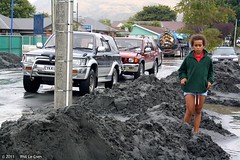
Photograph captioned by Neil Macbeth, "Members of the Student Volunteer Army clearing liquefaction in earthquake-ravaged Avonside. The Student Volunteer Army are mostly University of Canterbury students who are helping to clean up the liquefaction from Christchurch properties.
Photograph by Neil Macbeth 332
Images, UC QuakeStudies
Photograph captioned by Neil Macbeth, "Members of the Student Volunteer Army clearing liquefaction in earthquake-ravaged Avonside. The Student Volunteer Army are mostly University of Canterbury students who are helping to clean up the liquefaction from Christchurch properties.
Christchurch Press Image: Dean Kozanic 2010:09:30 (01)
Images, UC QuakeStudies
Photograph captioned by Fairfax, "Canterbury dairy farmer Heath Smith (left), and assistant farm manager Tom Clark, both noticed an increased noise followed by absolute silence from the animals around the farm just before the large 4 September earthquake".
Photograph by Neil Macbeth 328
Images, UC QuakeStudies
Photograph captioned by Neil Macbeth, "Members of the Student Volunteer Army clearing liquefaction in earthquake-ravaged Avonside. The Student Volunteer Army are mostly University of Canterbury students who are helping to clean up the liquefaction from Christchurch properties.
Christchurch Press Image: Dean Kozanic 2010:09:30 (02)
Images, UC QuakeStudies
Photograph captioned by Fairfax, "Canterbury dairy farmer Heath Smith (right), and assistant farm manager Tom Clark, both noticed an increased noise followed by absolute silence from the animals around the farm just before the large 4 September earthquake".
Fairfax Video, March 2014 (2)
Videos, UC QuakeStudies
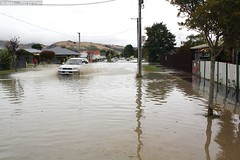
A video of an interview with Kim Evans, manager of the Shirley Bakery, about the flooding of her store. Evans describes the flood damage as being worse than the damage caused by the 2010 and 2011 Canterbury earthquakes.
All Right? Poster 2014
Articles, UC QuakeStudies
A poster produced by All Right? titled, Starting a community conversation about wellbeing in post-earthquake Christchurch. The poster outlines the three different phases of All Right, and how it is making a difference to people in Canterbury.
Fairfax Media Auckland Bureau Image: John Selkirk 2010:10:04 20:41:12
Images, UC QuakeStudies
Photograph captioned by Fairfax, "The Canterbury Earthquake Business Benefit Dinner hosted by the Prime Minister, was held tonight at Sky City in Auckland. Shown at the dinner is Telecom CEO Paul Reynolds (left) with Fonterra CEO Andrew Ferrier".
Fairfax Media Auckland Bureau Image: John Selkirk 2010:10:04 21:23:21
Images, UC QuakeStudies
Photograph captioned by Fairfax, "The Canterbury Earthquake Business Benefit Dinner hosted by the Prime Minister, was held tonight at Sky City in Auckland. Shown at the dinner is Richie McCaw who was one of the bid spotters".