
Search
found 5912 results
Images for :Christchurch; more images...


Shermine Kwok Photograph 62
Images, UC QuakeStudies
A photograph of the 'Arcades Project' on the corner of Kilmore and Durham Streets. The public sculpture was a collaboration between FESTA, Andrew Just, Ryan Reynolds and Life in Vacant Spaces.
Assessment of Empirical Lateral Spreading Displacement Models using Data f…
Research papers, University of Canterbury Library
Liquefaction-induced lateral spreading during the 2011 Christchurch earthquake in New Zealand was severe and extensive, and data regarding the displacements associated with the lateral spreading provides an excellent opportunity to better understand the factors that influence these movements. Horizontal displacements measured from optical satellite imagery and subsurface data from the New Zealand Geotechnical Database (NZGD) were used to investigate four distinct lateral spread areas along the Avon River in Christchurch. These areas experienced displacements between 0.5 and 2 m, with the inland extent of displacement ranging from 100 m to over 600 m. Existing empirical and semi-empirical displacement models tend to under estimate displacements at some sites and over estimate at others. The integrated datasets indicate that the areas with more severe and spatially extensive displacements are associated with thicker and more laterally continuous deposits of liquefiable soil. In some areas, the inland extent of displacements is constrained by geologic boundaries and geomorphic features, as expressed by distinct topographic breaks. In other areas the extent of displacement is influenced by the continuity of liquefiable strata or by the presence of layers that may act as vertical seepage barriers. These observations demonstrate the need to integrate geologic/geomorphic analyses with geotechnical analyses when assessing the potential for lateral spreading movements.
3D Ground Motion Simulations for the Christchurch Area Including the Surfa…
Research papers, University of Canterbury Library
We present initial results from a set of three-dimensional (3D) deterministic earthquake ground motion simulations for the northern Canterbury plains, Christchurch and the Banks Peninsula region, which explicitly incorporate the effects of the surface topography. The simu-lations are done using Hercules, an octree-based finite-element parallel software for solving 3D seismic wave propagation problems in heterogeneous media under kinematic faulting. We describe the efforts undertaken to couple Hercules with the South Island Velocity Model (SIVM), which included changes to the SIVM code in order to allow for single repetitive que-ries and thus achieve a seamless finite-element meshing process within the end-to-end ap-proach adopted in Hercules. We present our selection of the region of interest, which corre-sponds to an area of about 120 km × 120 km, with the 3D model reaching a depth of 60 km. Initial simulation parameters are set for relatively high minimum shear wave velocity and a low maximum frequency, which we are progressively scaling up as computing resources permit. While the effects of topography are typically more important at higher frequencies and low seismic velocities, even at this initial stage of our efforts (with a maximum of 2 Hz and a mini-mum of 500 m/s), it is possible to observe the importance of the topography in the response of some key locations within our model. To highlight these effects we compare the results of the 3D topographic model with respect to those of a flat (squashed) 3D model. We draw rele-vant conclusions from the study of topographic effects during earthquakes for this region and describe our plans for future work.
Reinforcing Memory: Embracing a Neurodivergent Perspective to Stitch Chris…
Research papers, The University of Auckland Library
The seismic tremor that shook Christchurch on February 22, 2011, not only shattered buildings but also the spirit of the city’s residents. Amidst the ruins, this design-focused thesis unravels two intertwining narratives, each essential to the city’s resurrection. At its core, this thesis probes the preservation of Christchurch’s memory and character, meticulously chronicling the lost heritage architecture and the subsequent urban metamorphosis. Beyond bricks and mortar, it also confronts the silent aftershocks - the pervasive mental health challenges stemming from personal losses and the disfigured cityscape. As a native of Christchurch, intimately connected to its fabric, my lens reflects not just on the architectural reconstruction but also on the emotional reconstruction. My experience as an autistic individual, a recently discovered facet of my identity, infuses this design journey with a distinct prism through which I perceive and interact with the world. The colourful sketches that drive the design process aren’t mere illustrations but manifestations of my interpretation of spaces and concepts, evoking joy and vitality—a testament to embracing diversity in design. Drawing parallels between healing my own traumas with my colourful and joyful neurodivergent worldview, I’ve woven this concept into proposals aimed at healing the city through whimsy, joy, and vibrant colours. Personal experiences during and post-earthquakes profoundly shape my design proposals. Having navigated the labyrinth of my own mental health amid the altered cityscape, I seek avenues for reconciliation, both personal and communal. The vibrant sketches and designs presented in this thesis encapsulate this vision—a fusion of vivid, unconventional interpretations and a dedication to preserving the essence of the original cityscape while still encouraging movement into the future.
Diversity and public engagement in planning: A case study of Chinese migra…
Research papers, Lincoln University
Aotearoa New Zealand’s population has grown rapidly from 3.85 million in 2000, to 5 million in 2020. Ethnic diversity has consequently increased. Territorial Authorities (TAs) undertaking statutory consultation and wider public engagement processes need to respond to increased diversity and foster inclusivity. Inclusivity is necessary to facilitate a greater understanding of TA statutory functions, as well as to encourage awareness and participation in annual planning processes, and resource management plans and consents. We examined perceptions, and experiences, of planning within the ethnic Chinese immigrant population of Christchurch. The Chinese ethnic group is a significant part of the city’s population and is in itself derived from diverse cultural and language backgrounds. We surveyed 111 members of this community, via social media and in person, to identify environmental and planning issues of concern to them. We sought to ascertain their previous engagement with planning processes and to gauge their willingness for future involvement. We also undertook a small number of semi-structured interviews with Chinese immigrants to explore their experiences with planning in more detail. Results showed only 6% of respondents had been engaged in any planning processes, despite only 20% being unwilling to participate. We analysed these responses by gender, age, visa category, and length of time resident in Christchurch. Notwithstanding the low level of reported engagement, earthquake recovery (70% of respondents) along with water quality, transport, and air quality were the most important issues of concern. However, there was a general lack of awareness of the ability to make public submissions on these and other issues, and of the statutory responsibilities of TAs. We discuss possible explanations and provide several suggestions for TAs to increase awareness and to improve engagement. This includes further research to assist in identifying the nature of barriers as well as the effectiveness of trialling different solutions.
Nic Johns and Mark Osborne WEMO Photograph 122
Images, UC QuakeStudies
A photograph of volunteers from the Wellington Emergency Management Office standing on a pile of bricks from an earthquake-damaged building in the Christchurch central city.
BeckerFraserPhotos April 2011 photograph 734
Images, UC QuakeStudies
Photograph captioned by BeckerFraserPhotos, "The plaque listing the mayors of Christchurch on the wall of the old City Council Civic Offices on Manchester Street".
BeckerFraserPhotos April 2011 photograph 304
Images, UC QuakeStudies
A crane working on a brick building in the Christchurch central city. A sign on the fence reads, "Quake repairs, keep out, for your own safety".
Photograph by Jennifer Middendorf 391
Images, UC QuakeStudies
A sign on the side of one of the containers in Re:Start mall reads, "Re:Start, proudly supported by Christchurch Earthquake Appeal. Tomorrow starts here".
Ray Whelan WEMO Photograph 04
Images, UC QuakeStudies
A photograph of an earthquake damaged building in the Christchurch central city. Some of the windows have broken and have been covered with plastic and tape.
Nic Johns and Mark Osborne WEMO Photograph 121
Images, UC QuakeStudies
A photograph of volunteers from the Wellington Emergency Management Office standing on a pile of bricks from an earthquake-damaged building in the Christchurch central city.
SCIRT Investigations presentation
Articles, UC QuakeStudies
A pdf copy of a PowerPoint presentation prepared for the Christchurch City Council and CPG New Zealand, providing an overview of the investigation work completed.
BeckerFraserPhotos March 2013 photograph 061
Images, UC QuakeStudies
An aerial photograph looking west over the northern part of the Christchurch central city with Bealey Avenue to the right and Hagley Park in the distance.
Earthquake damage - gas station
Images, eqnz.chch.2010
Aftermath of September 4th Earthquake in Canterbury (area covers Christchurch City) NZ. Empty fuel tanks lifted out of forecourt at petrol station on Pages Road.
BeckerFraserPhotos December 2011 photograph 2162
Images, UC QuakeStudies
A photograph of the earthquake damage to the Christ Church Cathedral.
BeckerFraserPhotos June 2012 photograph 106
Images, UC QuakeStudies
Photograph captioned by BeckerFraserPhotos, "The Christ Church Cathedral under snow".
BeckerFraserPhotos June 2012 photograph 107
Images, UC QuakeStudies
Photograph captioned by BeckerFraserPhotos, "Snow in the central city red zone".
BeckerFraserPhotos May 2012 photograph 204
Images, UC QuakeStudies
Photograph captioned by BeckerFraserPhotos, "Cathedral".
BeckerFraserPhotos December 2011 photograph 1994
Images, UC QuakeStudies
A photograph of the earthquake damage to the Christ Church Cathedral.
BeckerFraserPhotos April 2011 photograph 608
Images, UC QuakeStudies
Photograph captioned by BeckerFraserPhotos, "Christ Church Cathedral in Cathedral Square".
BeckerFraserPhotos May 2011 photograph 0724
Images, UC QuakeStudies
Photograph captioned by BeckerFraserPhotos, "Intersection of Peterborough and Durham Streets looking south".
BeckerFraserPhotos December 2011 photograph 2253
Images, UC QuakeStudies
A photograph of the damaged Englefield Lodge. The garden is overgrown with weeds.
Art Beat Photograph 1
Images, UC QuakeStudies
A photograph of a crowd watching a performance on the Art Beat stage.
WEMO ERT Set 1 - February 2011 - Photograph 04
Images, UC QuakeStudies
A photograph of crates of supplies outside the USAID tent in Latimer Square.
WEMO ERT Set 3 - February 2011 - Photograph 023
Images, UC QuakeStudies
A photograph of emergency management personnel lining up for breakfast in Latimer Square.
WEMO ERT Set 1 - February 2011 - Photograph 35
Images, UC QuakeStudies
A photograph of USAR and emergency management personnel eating lunch in Latimer Square.
BeckerFraserPhotos December 2011 photograph 1984
Images, UC QuakeStudies
A photograph of the earthquake damage to the Christ Church Cathedral.
BeckerFraserPhotos April 2011 photograph 109
Images, UC QuakeStudies
Photograph captioned by BeckerFraserPhotos, "Salvaged collapsed stone at the Arts Centre, Hereford Street".
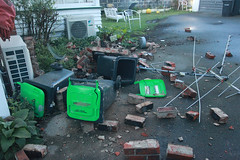
boxes down
Images, eqnz.chch.2010
None
PGC building
Images, eqnz.chch.2010
The CTV collapse is the worst and most devastating, from what I saw of the CBD yesterday.