
Search
found 5912 results
Images for :Christchurch; more images...


Observatory Tower Photograph 25
Images, UC QuakeStudies
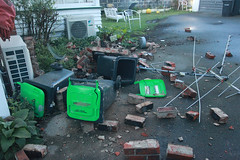
A photograph of the rubble of the Observatory tower in the South Quad of the Christchurch Arts Centre. The tower collapsed during the 22 February 2011 earthquake. A digger was used to clear the rubble away from the building. Scaffolding constructed around the tower has also collapsed and is amongst the rubble. In the background is a shipping container. A red sticker has been placed on the door to the Physics Building.
Jim Baltaxe WEMO Photograph 127
Images, UC QuakeStudies
A photograph of messages attached to the wire fencing around the Christchurch Chinese Methodist Church. A paper heart reads, "'The Lord is close to the broken hearted; He rescues those whose spirits are crushed' Psalm 24:18'. A message from the Japanese Red Cross Psychological Support Team reads, "Thank you, also from us, for your warm support. Our thoughts are with you always".
BeckerFraserPhotos December 2011 photograph 0300
Images, UC QuakeStudies
An aerial photograph of the Christchurch city central. The photograph is captioned by BeckerFraserPhotos, "Provincial Council Chambers in the middle, with Brannigans on the lower left, the Central Library lower middle and the Farmers car park on the lower right".
WEMO ERT Set 1 - March 2011 - Photograph 71
Images, UC QuakeStudies
A photograph of the earthquake damage to the Iconic Bar and the former Christchurch City Council offices on Manchester Street. The outer walls of the Council offices and the top storey of Iconic have collapsed, exposing the insides of the buildings. The bricks and other rubble have been cleared from the footpath in front. USAR codes have been spray-painted next to the entrance of Iconic.
Observatory Tower Photograph 37
Images, UC QuakeStudies
A photograph of the earthquake-damaged Observatory tower at the Christchurch Arts Centre. The photograph was taken using a cellphone camera. The top of the tower collapsed during the 22 February 2011 earthquake. The rubble from the tower has been cleared and a tarpaulin has been placed over the top of the broken tower. Tyres have been placed on the tarpaulin to hold it down. A temporary roof has also been constructed over the tower to keep out the rain.
Design and location of the Canterbury Earthquake Memorial
Articles, UC QuakeStudies
A PDF copy of a page on the EQ Recovery Learning site which linked to a YouTube video. This short video provides an insight into the design and location of the Canterbury Earthquake Memorial, due to be completed in February 2017. We meet its designer Grega Vezjak, who shares his vision for the Memorial
BeckerFraserPhotos March 2013 photograph 053
Images, UC QuakeStudies
An aerial photograph looking west over the Christchurch CBD, towards Hagley Park. Latimer Square can be seen in the bottom centre of the photograph.
BeckerFraserPhotos March 2013 photograph 107
Images, UC QuakeStudies
An aerial photograph of Hereford Street in the Christchurch CBD with the remains of Te Waiponamu in the centre and the Holiday Inn below.
BeckerFraserPhotos February 2011 photograph 165
Images, UC QuakeStudies
The Hereford Street office of Brendon Burns, Member of Parliament for Christchurch Central. Thin cracks can be seen in the front of the building.
BeckerFraserPhotos September 2011 photograph 010
Images, UC QuakeStudies
Photograph captioned by BeckerFraserPhotos, "The CCC held a road show to gather the citizens' opinions on how Christchurch should be re-developed".
BeckerFraserPhotos March 2013 photograph 054
Images, UC QuakeStudies
An aerial photograph looking west over the Christchurch CBD, towards Hagley Park. Latimer Square can be seen in the bottom centre of the photograph.
BeckerFraserPhotos December 2011 photograph 0351
Images, UC QuakeStudies
An aerial photograph of the Christchurch central city with Gloucester Street running through the centre of the photograph, and Clarendon Towers in the middle.
BeckerFraserPhotos February 2012 photograph 0367
Images, UC QuakeStudies
A photograph showing parts of the interior ChristChurch Cathedral, including the top of a stained glass window, visible through the damaged west wall.
WEMO ERT Set 1 - March 2011 - Photograph 78
Images, UC QuakeStudies
A photograph of members of the Dog Section of the New Zealand Police at the site of an earthquake-damaged building in central Christchurch.
Dan Neely WEMO Photograph 07
Images, UC QuakeStudies
A photograph of cracks along a street in Christchurch. A road cone has been placed over a crack as a warning for road users.
Rebekah Rogers WEMO Photograph 096
Images, UC QuakeStudies
A photograph of the earthquake damage to a house in Christchurch. The house has fallen off its foundations and is on a severe lean.
BeckerFraserPhotos February 2011 photograph 164
Images, UC QuakeStudies
The Hereford Street office of Brendon Burns, Member of Parliament for Christchurch Central. Thin cracks can be seen in the front of the building.
BeckerFraserPhotos March 2013 photograph 062
Images, UC QuakeStudies
An aerial photograph looking south west over the Christchurch CBD with the Avon River visible to the left and Hagley Park in the distance.
BeckerFraserPhotos December 2011 photograph 0335
Images, UC QuakeStudies
An aerial photograph captioned by BeckerFraserPhotos, "Colombo Street beginning at the Copthorne on the left and ending just past the Christchurch Cathedral".
Memorandum of Understanding to create the Horizontal Infrastructure Govern…
Articles, UC QuakeStudies
A document which details the agreement in September 2013 between the Government and the Christchurch City Council over governance of the horizontal infrastructure rebuild.
LINZ Forward Works Viewer Brochure
Articles, UC QuakeStudies
A promotional brochure explaining the Forward Works Viewer and that the tool was a key to cost-effective and efficient project delivery in Christchurch.
Variation to Global Tree Consent
Articles, UC QuakeStudies
A variation to the consent granted by the Christchurch City Council, providing consent to carry out earthquake repair work that may affect protected vegetation.
Earthquake damage - bridge
Images, eqnz.chch.2010
Aftermath of September 4th Earthquake in Canterbury (area covers Christchurch City) NZ. Damage to bridge on Spencerville Road crossing the Lower Styx river.
Liquefaction Evaluation in Stratified Soils
Research papers, University of Canterbury Library
The Canterbury Earthquake Sequence 2010-2011 (CES) induced widespread liquefaction in many parts of Christchurch city. Liquefaction was more commonly observed in the eastern suburbs and along the Avon River where the soils were characterised by thick sandy deposits with a shallow water table. On the other hand, suburbs to the north, west and south of the CBD (e.g. Riccarton, Papanui) exhibited less severe to no liquefaction. These soils were more commonly characterised by inter-layered liquefiable and non-liquefiable deposits. As part of a related large-scale study of the performance of Christchurch soils during the CES, detailed borehole data including CPT, Vs and Vp have been collected for 55 sites in Christchurch. For this subset of Christchurch sites, predictions of liquefaction triggering using the simplified method (Boulanger & Idriss, 2014) indicated that liquefaction was over-predicted for 94% of sites that did not manifest liquefaction during the CES, and under-predicted for 50% of sites that did manifest liquefaction. The focus of this study was to investigate these discrepancies between prediction and observation. To assess if these discrepancies were due to soil-layer interaction and to determine the effect that soil stratification has on the develop-ment of liquefaction and the system response of soil deposits.
Implications of the Canterbury earthquake sequence for Adelaide, South Aus…
Research papers, The University of Auckland Library
The city of Christchurch has experienced over 10,000 aftershocks since the 4th of September 2010 earthquake of which approximately 50 have been greater than magnitude 5. The damage caused to URM buildings in Christchurch over this sequence of earthquakes has been well documented. Due to the similarity in age and construction of URM buildings in Adelaide, South Australia and Christchurch (they are sister cities, of similar age and heritage), an investigation was conducted to learn lessons for Adelaide based on the Christchurch experience. To this end, the number of URM buildings in the central business districts of both cities, the extent of seismic strengthening that exists in both cities, and the relative earthquake hazards for both cities were considered. This paper will report on these findings and recommend strategies that the city of Adelaide could consider to significantly reduce the seismic risk posed by URM buildings in future earthquake.
BeckerFraserPhotos June 2012 photograph 083
Images, UC QuakeStudies
Photograph captioned by BeckerFraserPhotos, "Christ Church Cathedral".
BeckerFraserPhotos October 2011 photograph 609
Images, UC QuakeStudies
Photograph captioned by BeckerFraserPhotos, "Looking south over South Hagley Park".
BeckerFraserPhotos April 2011 photograph 101
Images, UC QuakeStudies
Photograph captioned by BeckerFraserPhotos, "The Arts Centre, Hereford Street".
BeckerFraserPhotos October 2011 photograph 233
Images, UC QuakeStudies
Photograph captioned by BeckerFraserPhotos, "27 Seabreeze Close, Bexley".
BeckerFraserPhotos October 2011 photograph 220
Images, UC QuakeStudies
Photograph captioned by BeckerFraserPhotos, "25 Seabreeze Close, Bexley".