

Search
found 100457 results
Images for NEW-ZEALAND; more images...


Kate De Goldi: love and loss in post-earthquake Christchurch
Audio, Radio New Zealand
One of New Zealand's most celebrated authors, Kate De Goldi's short fiction, novels and picture books engage children, teenagers and adults alike. Novel The 10pm Question was published to critical acclaim, quickly becoming an iconic piece of New Zealand literature. Her latest, Eddy, Eddy is being met with similar excitement.
Christchurch Earthquake Teams in Motion
Articles, UC QuakeStudies
A blog post from US Ambassador to New Zealand and Samoa, David Huebner, titled, "Christchurch Earthquake Teams in Motion".
Dealing with Post-Quake Stress
Articles, UC QuakeStudies
A blog post from US Ambassador to New Zealand and Samoa, David Huebner, titled, "Dealing with Post-Quake Stress".
Canterbury Earthquake - Rachel Graham
Audio, Radio New Zealand
Radio New Zealand reporter Rachel Graham is at the triage centre that has been set up in Latimer Square.
Simon Morton: mucking in
Audio, Radio New Zealand
Host of the Radio New Zealand programme This Way Up, currently assisting friends in Christchurch affected by the earthquake.
Australian police formally farewelled from Christchurch
Audio, Radio New Zealand
Since the February earthquake, three hundred Australian police have travelled across the Tasman to support their New Zealand counterparts.
BeckerFraserPhotos December 2011 photograph 2478
Images, UC QuakeStudies
A photograph captioned by BeckerFraserPhotos, "A damaged window of the Bank of New Zealand building in Kaiapoi".
BeckerFraserPhotos December 2011 photograph 2476
Images, UC QuakeStudies
A photograph captioned by BeckerFraserPhotos, "The Bank of New Zealand building viewed from Williams Street in Kaiapoi".
BeckerFraserPhotos December 2011 photograph 2475
Images, UC QuakeStudies
A photograph captioned by BeckerFraserPhotos, "The Bank of New Zealand building viewed from Williams Street in Kaiapoi".
Sonja Farmer Photograph 55
Images, UC QuakeStudies
A photograph of members of the New Zealand Army demolishing a concrete block fence on a property in Christchurch.
Rebekah Rogers WEMO Photograph 003
Images, UC QuakeStudies
A photograph of a volunteer from the Wellington Emergency Management Office with a member of the New Zealand Army.
US Embassy Photograph 63
Images, UC QuakeStudies
Members of the New Zealand Police lifting a dog in a harness through the window of a damaged building.
None
Images, eqnz.chch.2010
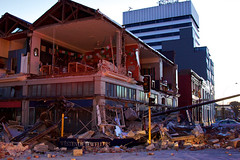
Taken in Christchurch, New Zealand a few days after the 7.1 earthquake that happened on Saturday September 4.
Unreinforced Masonry Churches in New Zealand Towards a Holistic Framework …
Research papers, University of Canterbury Library
Unreinforced masonry churches in New Zealand, similarly to everywhere else in the word have proven to be highly vulnerable to earthquakes, because of their particular construction features. The Canterbury (New Zealand) earthquake sequence, 2010-2011 caused an invaluable loss of local architectural heritage and of churches, as regrettably, some of them were demolished instead of being repaired. It is critical for New Zealand to advance the data collection, research and understanding pertaining to the seismic performance and protection of church buildings, with the aim to:
Insurers worry about dealing with earthquake claims well
Audio, Radio New Zealand
A new survey shows New Zealand insurers are worried the industry's reputation could be ruined if it does not deal well with the huge number of claims from the Christchurch earthquakes.
Fairfax Video, May 2011 (4)
Videos, UC QuakeStudies
A video about the Red Zone in the Christchurch Central City after the 22 February 2011 earthquake. The video includes footage of damaged buildings and cars, the New Zealand Police and Army patrolling the streets, and an interview with Michael Harvey, a squad leader in the New Zealand Urban Search and Rescue.
US Embassy Photograph 70
Images, UC QuakeStudies
Personnel from the Los Angeles County Fire Department, the Singapore Army, the New Zealand Police, the New Zealand Urban Search and Rescue Team, and St John, standing for two minutes of silence outside the Christ Church Cathedral in honour of the people who lost their lives in the 22 February 2011 earthquake.
Nisbet, Alastair, 1958- :Parts of Canterbury still moving and settling...5…
Images, Alexander Turnbull Library
Under the caption, young people carrying their baggage flutter into the air, away from Canterbury and toward 'Oz'. In September GNS Earth Sciences reported that after the earthquakes, the Greendale and associated faults were still moving as they settled into a new configuration. At the same time the young were leaving Canterbury (and New Zealand) for a better future in Australia. The population of New Zealand was moving into a new configuration. Quantity: 1 digital cartoon(s).
Photograph by Jocelyn Kinghorn 2063
Images, UC QuakeStudies
The public at the inaugural New Zealand Sandcastle competition held at New Brighton beach. The organisers of the Christchurch sandcastle competition hope the event will bring cheer to the earthquake-hit city.
Photograph by Jocelyn Kinghorn 2065
Images, UC QuakeStudies
The public at the inaugural New Zealand Sandcastle competition held at New Brighton beach. The organisers of the Christchurch sandcastle competition hope the event will bring cheer to the earthquake-hit city.
Photograph by Jocelyn Kinghorn 2064
Images, UC QuakeStudies
The public at the inaugural New Zealand Sandcastle competition held at New Brighton beach. The organisers of the Christchurch sandcastle competition hope the event will bring cheer to the earthquake-hit city.
The Week in Review - week ending 6 December 2013
Audio, Radio New Zealand
A selection of the week's news including a former New Zealand cricketer demanding answers over how his name has been linked an investigation into match-fixing, the Act Party leader announces he is quitting as party leader and will leave parliament next year, the biggest drug haul in New Zealand history, the Auditor General apologises to Mangawhai locals for Audit New Zealand's failure to identify a 60 million-plus waste-water debacle, the Labour Party says its victory in the Christchurch East by-election is an indictment of the Government's response to the earthquakes, we hear from the author of a book about the building blocks of our words and literature and the national champion who will proudly represent New Zealand at an international competition in Perth.
Housing in Post-Quake Canterbury: Human Rights Fault Lines
Research papers, University of Canterbury Library
The 2010–2011 Canterbury earthquakes and their aftermath have been described by the Human Rights Commission as one of New Zealand's greatest contemporary human rights challenges. This article documents the shortcomings in the realisation of the right to housing in post-quake Canterbury for homeowners, tenants and the homeless. The article then considers what these shortcomings tell us about New Zealand's overall human rights framework, suggesting that the ongoing and seemingly intractable nature of these issues and the apparent inability to resolve them indicate an underlying fragility implicit in New Zealand's framework for dealing with the consequences of a large-scale natural disaster. The article concludes that there is a need for a comprehensive human rights-based approach to disaster preparedness, response and recovery in New Zealand.
John Kelcher
Audio, Radio New Zealand
Radio New Zealand archivist reports on the earthquake recovery operation taking place in Christchurch to preserve this country's broadcasting history.
Umut Akguzel Photograph 138
Images, UC QuakeStudies
A photograph of members from the New Zealand Urban Search and Rescue team and various workers walking along Gloucester Street.
Christchurch Press Infographic: 29 June 2012 (2)
Images, UC QuakeStudies
A page banner promoting an article about how a rupture on the Alpine Fault would affect parts of New Zealand.
Jim Kolbe Remembers February 22nd
Articles, UC QuakeStudies
A blog post from US Ambassador to New Zealand and Samoa, David Huebner, titled, "Jim Kolbe Remembers February 22nd".
Christchurch Press Infographic: 1 October 2011 (6)
Images, UC QuakeStudies
A chart showing the results of a poll, comparing responses from Canterbury to those from the rest of New Zealand.
Canterbury Earthquake - Effect on the sharemarket
Audio, Radio New Zealand
The earthquake has also affected financial markets. The New Zealand dollar has tumbled, and the stockmarket has extended its losses.
New agency to reduce quake impact on international students
Audio, Radio New Zealand
The Government has created an agency to try to lure foreign students back to New Zealand after the Christchurch earthquake.