

Search
found 1452 results
Images for house; more images...
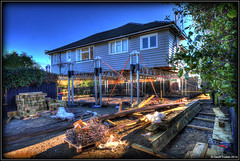


Photograph by Jocelyn Kinghorn 389
Images, UC QuakeStudies
Damage inside a house in St Albans.
Christchurch Press Image: Kirk Hargreaves 2010:10:24 15:32:14
Images, UC QuakeStudies
Photograph captioned by Fairfax, "Locksley Avenue houses in Dallington. Owen Moore, aged 90, and dog Min laugh in the face of this afternoon's aftershock. His house was built on compacted earth alongside the Avon River".
Christchurch Press Image: Kirk Hargreaves 2010:10:24 15:31:51
Images, UC QuakeStudies
Photograph captioned by Fairfax, "Locksley Avenue houses in Dallington. Owen Moore, aged 90, and dog Min laugh in the face of this afternoon's aftershock. His house was built on compacted earth alongside the Avon River".
Piles, bones and marbles: what was under the Godleys’ house?
Articles, Christchurch uncovered
Way back in the winter of 2012, at the height of the post-earthquake demolition, I was pretty excited to learn we were going to get the chance to investigate the site of John and Charlotte Godley’s house in Lyttelton. John … Continue reading →
We Lived Here: Oxford Terrace Photograph 049
Images, UC QuakeStudies
A photograph of one side of the house at 432 Oxford Terrace. The hedges in front have begun to overgrow and weeds are growing in between the concrete pavers.
We Lived Here: Oxford Terrace Photograph 048
Images, UC QuakeStudies
A photograph of the house at 432 Oxford Terrace. Much of the garden has overgrown. A yellow sticker on the front door indicates that access is restricted.
We Lived Here: Oxford Terrace Photograph 047
Images, UC QuakeStudies
A photograph of the house at 432 Oxford Terrace. Much of the garden has overgrown. A yellow sticker on the front door indicates that access is restricted.
We Lived Here: Oxford Terrace Photograph 083
Images, UC QuakeStudies
A photograph of the front porch of Donna Allfrey's house at 406 Oxford Terrace. A sign on the porch reads, "Avon Loop Harvest Market".
We Lived Here: Oxford Terrace Photograph 141
Images, UC QuakeStudies
A photograph of the former site of Siobhan Murphy's house at 436 Oxford Terrace. Murphy's house was demolished after her land was zoned Red. Grass has grown over the site.
Photograph by Jocelyn Kinghorn 477
Images, UC QuakeStudies
A fence around a house has been spray painted after the house was cleared by a USAR team. This system was used following the February earthquake to mark buildings that have been checked. Restricted access tape has been placed across the gates.
Christchurch Press Image: Iain McGregor 2010:10:07 07:30:15
Images, UC QuakeStudies
Photograph captioned by Fairfax, "2010 Canterbury Earthquake. Most houses should be able to be rebuilt on the land they are on. The Crean family at their red-stickered house. From left: Stephen and Nadia Crean".
We Lived Here: Oxford Terrace Photograph 082
Images, UC QuakeStudies
A photograph of the kitchen in Donna Allfrey's house at 406 Oxford Terrace. Graffiti has been scrawled on the walls to the left and right.
Fairfax Video, January 2012 (9)
Videos, UC QuakeStudies
A video of an excavator demolishing a red-zoned property on Seabreeze Close in Bexley. The house is the first to be demolished in the Bexley residential red zone.
We Lived Here: Rees Street Photograph 6
Images, UC QuakeStudies
A photograph of the house at 9 Rees Street. The end of a Weet-Bix cereal box has been placed over the mail slot in the front door.
We Lived Here: Oxford Terrace Photograph 039
Images, UC QuakeStudies
A photograph of the overgrown garden of Siobhan Murphy's house at 436 Oxford Terrace. The photographer comments, "That empty clothesline reflects the emptiness of the house and surrounding properties".
The Performance of House Foundations in the Canterbury Earthquakes
Research papers, University of Canterbury Library
The Canterbury Earthquakes of 2010-2011, in particular the 4th September 2010 Darfield earthquake and the 22nd February 2011 Christchurch earthquake, produced severe and widespread liquefaction in Christchurch and surrounding areas. The scale of the liquefaction was unprecedented, and caused extensive damage to a variety of man-made structures, including residential houses. Around 20,000 residential houses suffered serious damage as a direct result of the effects of liquefaction, and this resulted in approximately 7000 houses in the worst-hit areas being abandoned. Despite the good performance of light timber-framed houses under the inertial loads of the earthquake, these structures could not withstand the large loads and deformations associated with liquefaction, resulting in significant damage. The key structural component of houses subjected to liquefaction effects was found to be their foundations, as these are in direct contact with the ground. The performance of house foundations directly influenced the performance of the structure as a whole. Because of this, and due to the lack of research in this area, it was decided to investigate the performance of houses and in particular their foundations when subjected to the effects of liquefaction. The data from the inspections of approximately 500 houses conducted by a University of Canterbury summer research team following the 4th September 2010 earthquake in the worst-hit areas of Christchurch were analysed to determine the general performance of residential houses when subjected to high liquefaction loads. This was followed by the detailed inspection of around 170 houses with four different foundation types common to Christchurch and New Zealand: Concrete perimeter with short piers constructed to NZS3604, concrete slab-on-grade also to NZS3604, RibRaft slabs designed by Firth Industries and driven pile foundations. With a focus on foundations, floor levels and slopes were measured, and the damage to all areas of the house and property were recorded. Seven invasive inspections were also conducted on houses being demolished, to examine in more detail the deformation modes and the causes of damage in severely affected houses. The simplified modelling of concrete perimeter sections subjected to a variety of liquefaction-related scenarios was also performed, to examine the comparative performance of foundations built in different periods, and the loads generated under various bearing loss and lateral spreading cases. It was found that the level of foundation damage is directly related to the level of liquefaction experienced, and that foundation damage and liquefaction severity in turn influence the performance of the superstructure. Concrete perimeter foundations were found to have performed most poorly, suffering high local floor slopes and being likely to require foundation repairs even when liquefaction was low enough that no surface ejecta was seen. This was due to their weak, flexible foundation structure, which cannot withstand liquefaction loads without deforming. The vulnerability of concrete perimeter foundations was confirmed through modelling. Slab-on-grade foundations performed better, and were unlikely to require repairs at low levels of liquefaction. Ribraft and piled foundations performed the best, with repairs unlikely up to moderate levels of liquefaction. However, all foundation types were susceptible to significant damage at higher levels of liquefaction, with maximum differential settlements of 474mm, 202mm, 182mm and 250mm found for concrete perimeter, slab-on-grade, ribraft and piled foundations respectively when subjected to significant lateral spreading, the most severe loading scenario caused by liquefaction. It was found through the analysis of the data that the type of exterior wall cladding, either heavy or light, and the number of storeys, did not affect the performance of foundations. This was also shown through modelling for concrete perimeter foundations, and is due to the increased foundation strengths provided for heavily cladded and two-storey houses. Heavy roof claddings were found to increase the demands on foundations, worsening their performance. Pre-1930 concrete perimeter foundations were also found to be very vulnerable to damage under liquefaction loads, due to their weak and brittle construction.
We Lived Here: Oxford Terrace Photograph 107
Images, UC QuakeStudies
A photograph of Robin Duff's house at 386 Oxford Terrace. The grass has been mowed, but the dead grass has not been removed. One of the windows has been boarded up with plywood. A yellow sticker on the door indicates that the access to the house is restricted. The number 386 has been spray-painted on the footpath in front of the house. The photographer comments, "The lawn was mowed as part of the maintenance project on red-zoned properties. The numbers were spray-painted in front of all the properties in the Avon Loop in order to keep track of the property number after the mailboxes were lost or removed".
Christchurch Press Infographic: 9 August 2011 (1)
Images, UC QuakeStudies
An infographic comparing house sale prices in Christchurch.
Photograph by Jocelyn Kinghorn 1970
Images, UC QuakeStudies
Steel reinforcements supporting the side of a house.
Photograph of 118 Cashel Street (2)
Images, UC QuakeStudies
A photograph of Worcester House on Cashel Street
Photograph by Jocelyn Kinghorn 2440
Images, UC QuakeStudies
Close up detail of the damaged Gough House.
Photograph by Jocelyn Kinghorn 627
Images, UC QuakeStudies
Earthquake damage inside a house in St Albans.
Photograph by Jocelyn Kinghorn 626
Images, UC QuakeStudies
Earthquake damage inside a house in St Albans.
Photograph by Jocelyn Kinghorn 1953
Images, UC QuakeStudies
A house being demolished in a residential area.
Photograph by Jocelyn Kinghorn 1951
Images, UC QuakeStudies
A house being demolished in a residential area.
Photograph by Jocelyn Kinghorn 1952
Images, UC QuakeStudies
A house being demolished in a residential area.
Photograph by Jocelyn Kinghorn 2118
Images, UC QuakeStudies
A pile of bricks from a damaged house.
Photograph by Jocelyn Kinghorn 2218
Images, UC QuakeStudies
The ground of The Pump House in Linwood.
Photograph by Jocelyn Kinghorn 2369
Images, UC QuakeStudies
The Volunteer Canterbury house located on Barbadoes Street.
Photograph of 118 Cashel Street (1)
Images, UC QuakeStudies
A photograph of Worcester House on Cashel Street