
Search
found 4556 results
Images for Earthquake Christchurch; more images...


Photograph by Neil Macbeth 504
Images, UC QuakeStudies
A collection of shovels from the Student Volunteer Army in the car park of the USCA. The shovels have been returned by students after a day of clearing liquefaction from Christchurch properties. Behind them the UCSA's "Big Top" tent can be seen, which was erected to provide support for students at the University of Canterbury in the aftermath of the 22 February 2011 earthquake.
Mark Lincoln Photograph 179
Images, UC QuakeStudies
Shoppers and tourists in the Re:Start mall. The photographer comments, "The new temporary city mall has been open in Christchurch now for a week. Buildings damaged in the earthquake have been demolished and replaced with cargo containers to create a new, temporary, Cashel Mall. I visited the mall yesterday and was quite impressed with what they have done. The cargo containers have been nicely converted, brightly painted and smartly branded to create some good looking stores".
Rebekah Rogers WEMO Photograph 047
Images, UC QuakeStudies
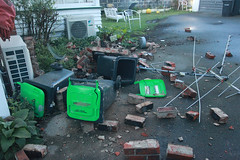
A photograph of a portaloo outside a residential property in Christchurch. After the 22 February 2011 earthquake, many houses had no running water and were forced to use chemical toilets or portaloos placed along the street. There is flooding and liquefaction on the street in the foreground. Liquefaction silt has been piled on the side of the road and a road cone placed in front.
Mark Lincoln Photograph 182
Images, UC QuakeStudies
Shoppers and tourists in the Re:Start mall. The photographer comments, "The new temporary city mall has been open in Christchurch now for a week. Buildings damaged in the earthquake have been demolished and replaced with cargo containers to create a new, temporary, Cashel Mall. I visited the mall yesterday and was quite impressed with what they have done. The cargo containers have been nicely converted, brightly painted and smartly branded to create some good looking stores".
Mark Lincoln Photograph 185
Images, UC QuakeStudies
Shoppers and tourists in the Re:Start mall. The photographer comments, "The new temporary city mall has been open in Christchurch now for a week. Buildings damaged in the earthquake have been demolished and replaced with cargo containers to create a new, temporary, Cashel Mall. I visited the mall yesterday and was quite impressed with what they have done. The cargo containers have been nicely converted, brightly painted and smartly branded to create some good looking stores".
Mark Lincoln Photograph 186
Images, UC QuakeStudies
Shoppers and tourists in the Re:Start mall. The photographer comments, "The new temporary city mall has been open in Christchurch now for a week. Buildings damaged in the earthquake have been demolished and replaced with cargo containers to create a new, temporary, Cashel Mall. I visited the mall yesterday and was quite impressed with what they have done. The cargo containers have been nicely converted, brightly painted and smartly branded to create some good looking stores".
Mark Lincoln Photograph 176
Images, UC QuakeStudies
Shoppers and tourists in the Re:Start mall. The photographer comments, "The new temporary city mall has been open in Christchurch now for a week. Buildings damaged in the earthquake have been demolished and replaced with cargo containers to create a new, temporary, Cashel Mall. I visited the mall yesterday and was quite impressed with what they have done. The cargo containers have been nicely converted, brightly painted and smartly branded to create some good looking stores".
Mark Lincoln Photograph 177
Images, UC QuakeStudies
Shoppers and tourists in the Re:Start mall. The photographer comments, "The new temporary city mall has been open in Christchurch now for a week. Buildings damaged in the earthquake have been demolished and replaced with cargo containers to create a new, temporary, Cashel Mall. I visited the mall yesterday and was quite impressed with what they have done. The cargo containers have been nicely converted, brightly painted and smartly branded to create some good looking stores".
Mark Lincoln Photograph 180
Images, UC QuakeStudies
Shoppers and tourists in the Re:Start mall. The photographer comments, "The new temporary city mall has been open in Christchurch now for a week. Buildings damaged in the earthquake have been demolished and replaced with cargo containers to create a new, temporary, Cashel Mall. I visited the mall yesterday and was quite impressed with what they have done. The cargo containers have been nicely converted, brightly painted and smartly branded to create some good looking stores".
Photograph by Neil Macbeth 503
Images, UC QuakeStudies
A collection of wheelbarrows from the Student Volunteer Army in the car park of the USCA. The wheelbarrows have been returned by students after a day of clearing liquefaction from Christchurch properties. Behind them the UCSA's "Big Top" tent can be seen, which was erected to provide support for students at the University of Canterbury in the aftermath of the 22 February 2011 earthquake.
Mark Lincoln Photograph 178
Images, UC QuakeStudies
Shoppers and tourists in the Re:Start mall. The photographer comments, "The new temporary city mall has been open in Christchurch now for a week. Buildings damaged in the earthquake have been demolished and replaced with cargo containers to create a new, temporary, Cashel Mall. I visited the mall yesterday and was quite impressed with what they have done. The cargo containers have been nicely converted, brightly painted and smartly branded to create some good looking stores".
Mark Lincoln Photograph 181
Images, UC QuakeStudies
Shoppers and tourists in the Re:Start mall. The photographer comments, "The new temporary city mall has been open in Christchurch now for a week. Buildings damaged in the earthquake have been demolished and replaced with cargo containers to create a new, temporary, Cashel Mall. I visited the mall yesterday and was quite impressed with what they have done. The cargo containers have been nicely converted, brightly painted and smartly branded to create some good looking stores".
A simple and rapid approach to post-earthquake assessment of bridge condit…
Research papers, The University of Auckland Library
The paper proposes a simple method for quick post-earthquake assessment of damage and condition of a stock of bridges in a transportation network using seismic data recorded by a strong motion array. The first part of the paper is concerned with using existing free field strong motion recorders to predict peak ground acceleration (PGA) at an arbitrary bridge site. Two methods are developed using artificial neural networks (a single network and a committee of neural networks) considering influential parameters, such as seismic magnitude, hypocentral depth and epicentral distance. The efficiency of the proposed method is explored using actual strong motion records from the devastating 2010 Darfield and 2011 Christchurch earthquakes in New Zealand. In the second part, two simple ideas are outlined how to infer the likely damage to a bridge using either the predicted PGA and seismic design spectrum, or a broader set of seismic metrics, structural parameters and damage indices.
Rebekah Rogers WEMO Photograph 037
Images, UC QuakeStudies
A photograph of paper hearts pegged on the cordon fence around the Chinese Methodist Church on Papanui Road. Quotes on the hearts read, "'Even though I walk through the valley of the shadow of death, I will fear no evil for you are with me.' Psalm 23", "'We can do no great things; only small things with great love.' Mother Teresa, and, "'Peace begins with a smile,' Mother Teresa". In the background, the earthquake damage to the Christchurch Chinese Methodist Church can be seen. The wall of the gable has crumbled, the bricks spilling onto the grass below.
Rockfall in the Port Hills of Christchurch: Seismic and non-seismic fatali…
Research Papers, Lincoln University
Numerous rockfalls released during the 2010–2011 Canterbury earthquake sequence affected vital road sections for local commuters. We quantified rockfall fatality risk on two main routes by adapting a risk approach for roads originally developed for snow avalanche risk. We present results of the collective and individual fatality risks for traffic flow and waiting traffic. Waiting traffic scenarios particularly address the critical spatial-temporal dynamics of risk, which should be acknowledged in operational risk management. Comparing our results with other risks commonly experienced in New Zealand indicates that local rockfall risk is close to tolerability thresholds and likely exceeds acceptable risk.
WEMO ERT Set 1 - February 2011 - Photograph 23
Images, UC QuakeStudies
A photograph of the earthquake damage to the Cathedral of the Blessed Sacrament on Barbadoes Street. The tower on the right has crumbled and the masonry has fallen to the pavement below. A car has been crushed by the fallen rubble. The dome of the left tower has collapsed and the cross at the top of the building is on a lean.
WEMO ERT Set 1 - February 2011 - Photograph 16
Images, UC QuakeStudies
A photograph of the earthquake-damaged buildings and rubble on Colombo Street near the intersection of St Asaph Street. The walls of the top storey of the buildings to the left have crumbled, and bricks and other rubble have fallen onto the footpath and road below. Wire fencing and police tape have been placed across the street as a cordon.
New Zealand Defence Force photograph 660
Images, UC QuakeStudies
The On-Site Operations Coordination Centre (OSOCC) in Latimer Square. After the 22 February 2011 earthquake, emergency service agencies set up their headquarters in Latimer Square. The OSOCC is set up by the United Nations Emergency Relief Coordinator. It helps to coordinate the local emergency response as well as advocate for humanitarian issue in political bodies such as the United National Security Council.
Performance of Underground Electricity Cables During the 2010-2011 Canterb…
Research papers, University of Canterbury Library
Asset management in power systems is exercised to improve network reliability to provide confidence and security for customers and asset owners. While there are well-established reliability metrics that are used to measure and manage business-as-usual disruptions, an increasing appreciation of the consequences of low-probability high-impact events means that resilience is increasingly being factored into asset management in order to provide robustness and redundancy to components and wider networks. This is particularly important for electricity systems, given that a range of other infrastructure lifelines depend upon their operation. The 2010-2011 Canterbury Earthquake Sequence provides valuable insights into electricity system criticality and resilience in the face of severe earthquake impacts. While above-ground assets are relatively easy to monitor and repair, underground assets such as cables emplaced across wide areas in the distribution network are difficult to monitor, identify faults on, and repair. This study has characterised in detail the impacts to buried electricity cables in Christchurch resulting from seismically-induced ground deformation caused primarily by liquefaction and lateral spread. Primary modes of failure include cable bending, stretching, insulation damage, joint braking and, being pulled off other equipment such as substation connections. Performance and repair data have been compiled into a detailed geospatial database, which in combination with spatial models of peak ground acceleration, peak ground velocity and ground deformation, will be used to establish rigorous relationships between seismicity and performance. These metrics will be used to inform asset owners of network performance in future earthquakes, further assess component criticality, and provide resilience metrics.
WEMO ERT Set 3 - February 2011 - Photograph 050
Images, UC QuakeStudies
A photograph of the earthquake damage to the Cycle Trading store on Manchester Street. The gable of the store has collapsed, and bricks and other rubble have fallen onto the footpath in front. A car parked on the street has been crushed by the fallen rubble. The word "Clear" has been spray-painted on the front of the car. Wire fencing has been placed around the building as a cordon.
Post-earthquake assessment of damaged and repaired reinforced concrete wal…
Research papers, The University of Auckland Library
High demolition rates were observed in New Zealand after the 2010-2011 Canterbury Earthquake Sequence despite the success of modern seismic design standards to achieve required performance objectives such as life safety and collapse prevention. Approximately 60% of the multi-storey reinforced concrete (RC) buildings in the Christchurch Central Business District were demolished after these earthquakes, even when only minor structural damage was present. Several factors influenced the decision of demolition instead of repair, one of them being the uncertainty of the seismic capacity of a damaged structure. To provide more insight into this topic, the investigation conducted in this thesis evaluated the residual capacity of moderately damaged RC walls and the effectiveness of repair techniques to restore the seismic performance of heavily damaged RC walls. The research outcome provided insights for developing guidelines for post-earthquake assessment of earthquake-damaged RC structures. The methodology used to conduct the investigation was through an experimental program divided into two phases. During the first phase, two walls were subjected to different types of pre-cyclic loading to represent the damaged condition from a prior earthquake, and a third wall represented a repair scenario with the damaged wall being repaired using epoxy injection and repair mortar after the pre-cyclic loading. Comparisons of these test walls to a control undamaged wall identified significant reductions in the stiffness of the damaged walls and a partial recovery in the wall stiffness achieved following epoxy injection. Visual damage that included distributed horizontal and diagonal cracks and spalling of the cover concrete did not affect the residual strength or displacement capacity of the walls. However, evidence of buckling of the longitudinal reinforcement during the pre-cyclic loading resulted in a slight reduction in strength recovery and a significant reduction in the displacement capacity of the damaged walls. Additional experimental programs from the literature were used to provide recommendations for modelling the response of moderately damaged RC walls and to identify a threshold that represented a potential reduction in the residual strength and displacement capacity of damaged RC walls in future earthquakes. The second phase of the experimental program conducted in this thesis addressed the replacement of concrete and reinforcing steel as repair techniques for heavily damaged RC walls. Two walls were repaired by replacing the damaged concrete and using welded connections to connect new reinforcing bars with existing bars. Different locations of the welded connections were investigated in the repaired walls to study the impact of these discontinuities at the critical section. No significant changes were observed in the stiffness, strength, and displacement capacity of the repaired walls compared to the benchmark undamaged wall. Differences in the local behaviour at the critical section were observed in one of the walls but did not impact the global response. The results of these two repaired walls were combined with other experimental programs found in the literature to assemble a database of repaired RC walls. Qualitative and quantitative analyses identified trends across various parameters, including wall types, damage before repair, and repair techniques implemented. The primary outcome of the database analysis was recommendations for concrete and reinforcing steel replacement to restore the strength and displacement capacity of heavily damaged RC walls.
Photograph by Neil Macbeth 527
Images, UC QuakeStudies
University of Canterbury Vice-Chancellor Rod Carr addressing a local musician inside the UCSA's "Big Top" tent. The tent was erected in the UCSA car park to provide support for students in the aftermath of the 22 February 2011 earthquake. The audience is made up of students who have spent the day clearing liquefaction from Christchurch properties as part of the Student Volunteer Army.
Room to Breathe: Designing a framework for medium density housing in Ōtaut…
Research papers, Victoria University of Wellington
<b>Ōtautahi-Christchurch faces the future in an enviable position. Compared to other New Zealand cities Christchurch has lower housing costs, less congestion, and a brand-new central city emerging from the rubble of the 2011 earthquakes. ‘Room to Breathe: designing a framework for medium density housing (MDH) in Ōtautahi-Christchurch’ seeks to answer the timely question how can medium density housing assist Ōtautahi-Christchurch to respond to growth in a way that supports a well-functioning urban environment? Using research by design, the argument is made that MDH can be used to support a safe, accessible, and connected urban environment that fosters community, while retaining a level of privacy. This is achieved through designing a neighbourhood concept addressing 3 morphological scales- macro- the city; meso- the neighbourhood; and micro- the home and street. The scales are used to inform a design framework for MDH specific to Ōtautahi-Christchurch, presenting a typological concept that takes full advantage of the benefits higher density living has to offer.</b> Room to Breathe proposes repurposing underutilised areas surrounding existing mass transit infrastructure to provide a concentrated populous who do not solely rely on private vehicles for transport. By considering all morphological scales Room to Breathe provides one suggestion on how MDH could become accepted as part of a well-functioning urban environment.
People in Disasters Conference - Putting People at the Heart of the Rebuild
Videos, UC QuakeStudies
A video of a presentation by Ian Campbell, Executive General Manager of the Stronger Christchurch Rebuild Team (SCIRT), during the third plenary of the 2016 People in Disasters Conference. The presentation is titled, "Putting People at the Heart of the Rebuild".The abstract for this presentation reads: On the face of it, the Stronger Christchurch Infrastructure Rebuild Team (SCIRT) is an organisation created to engineer and carry out approximately $2B of repairs to physical infrastructure over a 5-year period. Our workforce consists primarily of engineers and constructors who came from far and wide after the earthquakes to 'help fix Christchurch'. But it was not the technical challenges that drew them all here. It was the desire and ambition expressed in the SCIRT 'what we are here for' statement: 'to create resilient infrastructure that gives people security and confidence in the future of Christchurch'. For the team at SCIRT, people are at the heart of our rebuild programme. This is recognised in the intentional approach SCIRT takes to all aspects of its work. The presentation will touch upon how SCIRT communicated with communities affected by our work and how we planned and coordinated the programme to minimise the impacts, while maximising the value for both the affected communities and the taxpayers of New Zealand and rate payers of Christchurch funding it. The presentation will outline SCIRT's very intentional approach to supporting, developing, connecting, and enabling our people to perform, individually, and collectively, in the service of providing the best outcome for the people of Christchurch and New Zealand.
Exploring the Acceptability, Feasibility, and Effectiveness of a Digital P…
Research papers, The University of Auckland Library
Background: Up to 6 years after the 2011 Christchurch earthquakes, approximately one-third of parents in the Christchurch region reported difficulties managing the continuously high levels of distress their children were experiencing. In response, an app named Kākano was co-designed with parents to help them better support their children’s mental health. Objective: The objective of this study was to evaluate the acceptability, feasibility, and effectiveness of Kākano, a mobile parenting app to increase parental confidence in supporting children struggling with their mental health. Methods: A cluster-randomized delayed access controlled trial was carried out in the Christchurch region between July 2019 and January 2020. Parents were recruited through schools and block randomized to receive immediate or delayed access to Kākano. Participants were given access to the Kākano app for 4 weeks and encouraged to use it weekly. Web-based pre- and postintervention measurements were undertaken. Results: A total of 231 participants enrolled in the Kākano trial, with 205 (88.7%) participants completing baseline measures and being randomized (101 in the intervention group and 104 in the delayed access control group). Of these, 41 (20%) provided full outcome data, of which 19 (18.2%) were for delayed access and 21 (20.8%) were for the immediate Kākano intervention. Among those retained in the trial, there was a significant difference in the mean change between groups favoring Kākano in the brief parenting assessment (F1,39=7, P=.012) but not in the Short Warwick-Edinburgh Mental Well-being Scale (F1,39=2.9, P=.099), parenting self-efficacy (F1,39=0.1, P=.805), family cohesion (F1,39=0.4, P=.538), or parenting sense of confidence (F1,40=0.6, P=.457). Waitlisted participants who completed the app after the waitlist period showed similar trends for the outcome measures with significant changes in the brief assessment of parenting and the Short Warwick-Edinburgh Mental Well-being Scale. No relationship between the level of app usage and outcome was found. Although the app was designed with parents, the low rate of completion of the trial was disappointing. Conclusions: Kākano is an app co-designed with parents to help manage their children’s mental health. There was a high rate of attrition, as is often seen in digital health interventions. However, for those who did complete the intervention, there was some indication of improved parental well-being and self-assessed parenting. Preliminary indications from this trial show that Kākano has promising acceptability, feasibility, and effectiveness, but further investigation is warranted. Trial Registration: Australia New Zealand Clinical Trials Registry ACTRN12619001040156; https://www.anzctr.org.au/Trial/Registration/TrialReview.aspx?id=377824&isReview=true
WEMO ERT Team Set 1 - June 2011 - Photograph 1
Images, UC QuakeStudies
A photograph of Celia Wade-Brown, Mayor of Wellington, speaking at a graduation ceremony for more than 40 new civil defence volunteers in the Wellington Town Hall. Members of the Wellington Emergency Management Office team were presented certificates of appreciation during this event. The certificates were presented to the members to honour their involvement in the emergency response to the 22 February 2011 earthquakes in Christchurch.
Photograph by Neil Macbeth 522
Images, UC QuakeStudies
University of Canterbury Vice-Chancellor Rod Carr conferring with former Chancellor Rex Williams, inside the UCSA's "Big Top" tent. The tent was erected in the UCSA car park to provide support for students in the aftermath of the 22 February 2011 earthquake. Around them students have gathered to watch a local musician play. The student have spent the day clearing liquefaction from Christchurch properties as part of the Student Volunteer Army.
Photograph by Jennifer Middendorf 284
Images, UC QuakeStudies
The "Tree of Hope" at the River of Flowers event held in Riccarton Bush, commemorating the second anniversary of the 22 February earthquake. The photographer comments, "Luggage labels and pens were supplied, and people were encouraged to write a message of hope for Christchurch and tie it to the tree. Although the turn-out this year was just as big as last year's, there were not as many messages tied to the tree - perhaps we're all feeling less hopeful this year".
Mark Lincoln Photograph 187
Images, UC QuakeStudies
Shoppers and tourists outside the Simply New Zealand shop in the Re:Start mall. The photographer comments, "The new temporary city mall has been open in Christchurch now for a week. Buildings damaged in the earthquake have been demolished and replaced with cargo containers to create a new, temporary, Cashel Mall. I visited the mall yesterday and was quite impressed with what they have done. The cargo containers have been nicely converted, brightly painted and smartly branded to create some good looking stores".
Mark Lincoln Photograph 183
Images, UC QuakeStudies
A sign above the 3 Wise Men shop in the Re:Start mall, reading "Re:Start, supported by ASB". The photographer comments, "The new temporary city mall has been open in Christchurch now for a week. Buildings damaged in the earthquake have been demolished and replaced with cargo containers to create a new, temporary, Cashel Mall. I visited the mall yesterday and was quite impressed with what they have done. The cargo containers have been nicely converted, brightly painted and smartly branded to create some good looking stores".