
Search
found 4556 results
Images for Earthquake Christchurch; more images...


Photograph by Neil Macbeth 514
Images, UC QuakeStudies
A local musician entertaining University of Canterbury students inside the UCSA's "Big Top" tent. The tent was erected in the UCSA car park to provide support for students in the aftermath of the 22 February 2011 earthquake. The students have spent the day clearing liquefaction from Christchurch properties as part of the Student Volunteer Army.
Photograph by Neil Macbeth 511
Images, UC QuakeStudies
A local musician entertaining University of Canterbury students inside the UCSA's "Big Top" tent. The tent was erected in the UCSA car park to provide support for students in the aftermath of the 22 February 2011 earthquake. The students have spent the day clearing liquefaction from Christchurch properties as part of the Student Volunteer Army.
Rebekah Rogers WEMO Photograph 105
Images, UC QuakeStudies
A photograph of a portable shower unit set up in Hagley Park for the emergency management personnel who travelled to Christchurch after the 22 February 2011 earthquake. A clothes line has been set up by tying ropes to the shower unit and a digger. To the right, a number of portaloos can also be seen.
Photograph by Neil Macbeth 510
Images, UC QuakeStudies
A local musician entertaining University of Canterbury students inside the UCSA's "Big Top" tent. The tent was erected in the UCSA car park to provide support for students in the aftermath of the 22 February 2011 earthquake. The students have spent the day clearing liquefaction from Christchurch properties as part of the Student Volunteer Army.
Photograph by Neil Macbeth 508
Images, UC QuakeStudies
UCSA President Kohan McNab addressing students inside the UCSA's "Big Top" tent. The tent was erected in the UCSA car park to provide support for students in the aftermath of the 22 February 2011 earthquake. The students have spent the day clearing liquefaction from Christchurch properties as part of the Student Volunteer Army.
Photograph by Neil Macbeth 509
Images, UC QuakeStudies
UCSA President Kohan McNab introducing a musician inside the UCSA's "Big Top" tent. The tent was erected in the UCSA car park to provide support for students in the aftermath of the 22 February 2011 earthquake. The students have spent the day clearing liquefaction from Christchurch properties as part of the Student Volunteer Army.
The Undrained Cyclic Response of Monterey Sand in Direct Simple Shear
Research papers, University of Canterbury Library
In 2010 and 2011 a series of earthquakes hit the central region of Canterbury, New Zealand, triggering widespread and damaging liquefaction in the area of Christchurch. Liquefaction occurred in natural clean sand deposits, but also in silty (fines-containing) sand deposits of fluvial origin. Comprehensive research efforts have been subsequently undertaken to identify key factors that influenced liquefaction triggering and severity of its manifestation. This research aims at evaluating the effects of fines content, fabric and layered structure on the cyclic undrained response of silty soils from Christchurch using Direct Simple Shear (DSS) tests. This poster outlines preliminary calibration and verification DSS tests performed on a clean sand to ensure reliability of testing procedures before these are applied to Christchurch soils.
WEMO ERT Team Set 3 - April 2011 - Photograph 09
Images, UC QuakeStudies
A photograph of the back page of a Christchurch City Council form. The form allowed contractors to apply for the authorisation to enter the Christchurch Red Zone after the 22 February 2011 earthquake. Information on the back reads, "What does this authorisation mean for me? I am wearing appropriate personal protection clothing and equipment. At all times DO NOT enter any red placarded building. You may enter a yellow placarded building for a period of time (no longer than 30 minutes) and follow the instruction of the escorts. A green placarded building may be accessed for longer periods. Please note: do not enter any buildings which are not for the purpose of your authorisation".
WEMO ERT Set 1 - February 2011 - Photograph 26
Images, UC QuakeStudies
A photograph of the earthquake damage to the Provincial Hotel on the corner of Barbadoes and Cashel Streets. The second storey walls have crumbled, and the bricks have fallen onto the ground below. Scaffolding erected in front of the building is now on a lean. Wire fencing has been placed around the building as a cordon.
Elizabeth Ackermann Photograph 333
Images, UC QuakeStudies
A photograph of three drawings stuck to a bus timetable in the Christchurch central city. The drawings depict Roger Sutton, the CEO of CERA, with a band-aid over his mouth; Warwick Isaacs, the Deputy Chief Executive of CERA, with hearing protection over his ears; and Gerry Brownlee, Minister for Canterbury Earthquake Recovery, with a blindfold over his eyes.
Photograph by Neil Macbeth 528
Images, UC QuakeStudies
University of Canterbury Vice-Chancellor Rod Carr addressing students inside the UCSA's "Big Top" tent. The tent was erected in the UCSA car park to provide support for students in the aftermath of the 22 February 2011 earthquake. The students have spent the day clearing liquefaction from Christchurch properties as part of the Student Volunteer Army.
Photograph by Neil Macbeth 516
Images, UC QuakeStudies
A collection of wheelbarrows from the Student Volunteer Army in the car park of the USCA. The wheelbarrows have been returned by students after a day of clearing liquefaction from Christchurch properties. Behind them the UCSA's "Big Top" tent can be seen, which was erected to provide support for students at the University of Canterbury in the aftermath of the 22 February 2011 earthquake.
Diary of the Canterbury Cultural Collections Recovery Centre Intern: Mont…
Articles, UC QuakeStudies
A blog post from Moya Sherriff about her sixth month as Intern for the Canterbury Cultural Collections Recovery Centre (CCCRC). In this post Sherriff interviews Jane Teal, the Archivist of the Anglican Diocese of Christchurch, about her experiences rescuing the archive after the earthquakes and moving in to the Recovery Centre. This blog post was downloaded on 18 November 2014.
Photograph by Neil Macbeth 513
Images, UC QuakeStudies
University of Canterbury students watching a local musician perform inside the UCSA's "Big Top" tent. The tent was erected in the UCSA car park to provide support for students in the aftermath of the 22 February 2011 earthquake. The students have spent the day clearing liquefaction from Christchurch properties as part of the Student Volunteer Army.
Kim Wright WEMO Photograph 041
Images, UC QuakeStudies
A photograph of a map of Christchurch in a temporary Civil Defence headquarters set up at the Mainland Foundation Ballpark after the 4 September 2010 earthquake. Red, green and blue markings on the map indicate where flooding, sand and closures are located. Post-it notes and a key with a tag reading, "Manchester" are attached to the map.
Photograph by Neil Macbeth 512
Images, UC QuakeStudies
University of Canterbury students watching a local musician perform inside the UCSA's "Big Top" tent. The tent was erected in the UCSA car park to provide support for students in the aftermath of the 22 February 2011 earthquake. The students have spent the day clearing liquefaction from Christchurch properties as part of the Student Volunteer Army.
Rebekah Rogers WEMO Photograph 033
Images, UC QuakeStudies
A photograph of an earthquake-damaged building in Christchurch. The wall on the side of the house has crumbled, and the bricks have fallen onto the fence and damaged it. Wooden planks have been used to brace the wall towards the back of the property. A red sticker on the front window indicates that the house is unsafe to enter.
The Effects of a Major Disaster on the Musical Life of a City
Articles, UC QuakeStudies
A paper submitted by Andrew Moore in partial fulfilment of the degree of Bachelor of Music with Honours, covering the effects of the Canterbury earthquakes on the musical life of Christchurch. Dissertation supervised by Dr Elaine Dobson, University of Canterbury School of Music. All photographs from The Press are copyright Fairfax Media and are used with permission.
Photograph by Neil Macbeth 529
Images, UC QuakeStudies
University of Canterbury Vice-Chancellor Rod Carr addressing students inside the UCSA's "Big Top" tent. The tent was erected in the UCSA car park to provide support for students in the aftermath of the 22 February 2011 earthquake. The students have spent the day clearing liquefaction from Christchurch properties as part of the Student Volunteer Army.
Who Pays for a Managed Retreat? Lessons from the Christchurch Residential …
Research papers, University of Canterbury Library
After the Christchurch earthquakes, the government declared about 8000 houses as Red Zoned, prohibiting further developments in these properties, and offering the owners to buy them out. The government provided two options for owners: the first was full payment for both land and dwelling at the 2007 property evaluation, the second was payment for land, and the rest to be paid by the owner’s insurance. Most people chose the second option. Using data from LINZ combined with data from StatNZ, this project empirically investigates what led people to choose this second option, and what were the implications of these choices for the owners’ wealth and income.
Artificial neural networks approach to predict principal ground motion par…
Research papers, The University of Auckland Library
Having a quick but reliable insight into the likelihood of damage to bridges immediately after an earthquake is an important concern especially in the earthquake prone countries such as New Zealand for ensuring emergency transportation network operations. A set of primary indicators necessary to perform damage likelihood assessment are ground motion parameters such as peak ground acceleration (PGA) at each bridge site. Organizations, such as GNS in New Zealand, record these parameters using distributed arrays of sensors. The challenge is that those sensors are not installed at, or close to, bridge sites and so bridge site specific data are not readily available. This study proposes a method to predict ground motion parameters for each bridge site based on remote seismic array recordings. Because of the existing abundant source of data related to two recent strong earthquakes that occurred in 2010 and 2011 and their aftershocks, the city of Christchurch is considered to develop and examine the method. Artificial neural networks have been considered for this research. Accelerations recorded by the GeoNet seismic array were considered to develop a functional relationship enabling the prediction of PGAs. http://www.nzsee.org.nz/db/2013/Posters.htm
WEMO ERT Set 1 - March 2011 - Photograph 58
Images, UC QuakeStudies
A photograph of members of the Wellington Emergency Management Office Emergency Response Team in the hanger of a Royal New Zealand Air Force Hercules. The ERT members are travelling to Christchurch to help out in the emergency response to the 22 February 2011 earthquake. Blankets, tent poles, and other supplies have been stacked in the centre of the hanger.
Natalie Kerschner WEMO Photograph 117
Images, UC QuakeStudies
A photograph of a sign from the Christchurch City Council, ECan and the Canterbury District Health Board warning people over the contamination in the rivers after the September earthquake. The sign reads, "Warning, contaminated water. Due to sewage overflows this water is unsafe for human contact and activity and is a Public Health Risk. Please keep all people and pets out of contact with the water and do not consume any seafood or shellfish collected from this area". In the background, workers from Treetech clean up wood and leaves from felled trees.
Image - A Helping Hand in a Disaster Zone
Images, UC QuakeStudies
An image from an Army News March 2011 article titled, "A Helping Hand in a Disaster Zone". The image is of the Cathedral of the Blessed Sacrament on Barbadoes Street, severely damaged after the 22 February 2011 earthquake. The domes on either side of the Cathedral have collapsed and are lying in the area in front.
New Zealand Defence Force photograph 664
Images, UC QuakeStudies
A member of the Los Angeles County Fire Department Search and Rescue Team, talking to a New Zealand Police Officer in Latimer Square. In the background is a wire fence with Search and Rescue Team equipment tied to it. After the 22 February 2011 earthquake, emergency service agencies set up their headquarters in Latimer Square.
New Zealand Defence Force photograph 662
Images, UC QuakeStudies
A member of the Los Angeles County Fire Department Search and Rescue Team, talking to a New Zealand Police Officer in Latimer Square. In the background is a wire fence with Search and Rescue Team equipment tied to it. After the 22 February 2011 earthquake, emergency service agencies set up their headquarters in Latimer Square.
3D Ground Motion Simulations for the Christchurch Area Including the Surfa…
Research papers, University of Canterbury Library
We present initial results from a set of three-dimensional (3D) deterministic earthquake ground motion simulations for the northern Canterbury plains, Christchurch and the Banks Peninsula region, which explicitly incorporate the effects of the surface topography. The simu-lations are done using Hercules, an octree-based finite-element parallel software for solving 3D seismic wave propagation problems in heterogeneous media under kinematic faulting. We describe the efforts undertaken to couple Hercules with the South Island Velocity Model (SIVM), which included changes to the SIVM code in order to allow for single repetitive que-ries and thus achieve a seamless finite-element meshing process within the end-to-end ap-proach adopted in Hercules. We present our selection of the region of interest, which corre-sponds to an area of about 120 km × 120 km, with the 3D model reaching a depth of 60 km. Initial simulation parameters are set for relatively high minimum shear wave velocity and a low maximum frequency, which we are progressively scaling up as computing resources permit. While the effects of topography are typically more important at higher frequencies and low seismic velocities, even at this initial stage of our efforts (with a maximum of 2 Hz and a mini-mum of 500 m/s), it is possible to observe the importance of the topography in the response of some key locations within our model. To highlight these effects we compare the results of the 3D topographic model with respect to those of a flat (squashed) 3D model. We draw rele-vant conclusions from the study of topographic effects during earthquakes for this region and describe our plans for future work.
Simulation and Validation of Topographic Effectds on Mt Pleasant, Christch…
Research papers, University of Canterbury Library
Damage distribution maps from strong earthquakes and recorded data from field experiments have repeatedly shown that the ground surface topography and subsurface stratigraphy play a decisive role in shaping the ground motion characteristics at a site. Published theoretical studies qualitatively agree with observations from past seismic events and experiments; quantitatively, however, they systematically underestimate the absolute level of topographic amplification up to an order of magnitude or more in some cases. We have hypothesized in previous work that this discrepancy stems from idealizations of the geometry, material properties, and incident motion characteristics that most theoretical studies make. In this study, we perform numerical simulations of seismic wave propagation in heterogeneous media with arbitrary ground surface geometry, and compare results with high quality field recordings from a site with strong surface topography. Our goal is to explore whether high-fidelity simulations and realistic numerical models can – contrary to theoretical models – capture quantitatively the frequency and amplitude characteristics of topographic effects. For validation, we use field data from a linear array of nine portable seismometers that we deployed on Mount Pleasant and Heathcote Valley, Christchurch, New Zealand, and we compute empirical standard spectral ratios (SSR) and single-station horizontal-to-vertical spectral ratios (HVSR). The instruments recorded ambient vibrations and remote earthquakes for a period of two months (March-April 2017). We next perform two-dimensional wave propagation simulations using the explicit finite difference code FLAC. We construct our numerical model using a high-resolution (8m) Digital Elevation Map (DEM) available for the site, an estimated subsurface stratigraphy consistent with the geomorphology of the site, and soil properties estimated from in-situ and non-destructive tests. We subject the model to in-plane and out-of-plane incident motions that span a broadband frequency range (0.1-20Hz). Numerical and empirical spectral ratios from our blind prediction are found in very good quantitative agreement for stations on the slope of Mount Pleasant and on the surface of Heathcote Valley, across a wide range of frequencies that reveal the role of topography, soil amplification and basin edge focusing on the distribution of ground surface motion.
WEMO ERT Set 1 - March 2011 - Photograph 82
Images, UC QuakeStudies
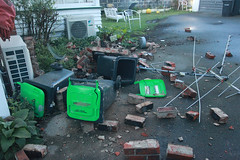
A photograph of the earthquake-damaged to a house in Christchurch. The far wall has collapsed and many of the concrete blocks have spilled into the garden in front. Emergency tape has been draped in front of the wall as a cordon. A red sticker has also been stuck on the furthest window, indicating that the house is unsafe to enter.
Photograph by Neil Macbeth 368
Images, UC QuakeStudies
Labour Party leader Phil Goff speaking to members of the Student Volunteer Army in the UCSA car park outside the UCSA's "Big Top" tent. The tent was erected to provide support for students at the University of Canterbury in the aftermath of the 22 February 2011 earthquake. Behind them members of the Student Volunteer Army are assembling wheelbarrows which will be used to clear liquefaction from Christchurch properties.