
Search
found 4556 results
Images for Earthquake Christchurch; more images...


Sam Butcher's LEGO Cathedral, Photograph 48
Images, UC QuakeStudies
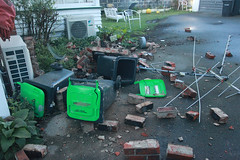
A photograph of components of a model of the ChristChurch Cathedral being built from LEGO by Sam Butcher. Sam comments "Fixing a large variety of bits that were wrong/annoying/cheating (not purist) about the last model. The new one is set AFTER the Feb 22 earthquake. This newer, and much stronger model is also completely modular for easier transport. Obviously still a WIP, I'm currently waiting for a pretty large bricklink order at the moment, and will probably need to place a couple more after that too. The new base, which breaks into two sections each 48x70 studs".
Sam Butcher's LEGO Cathedral, Photograph 49
Images, UC QuakeStudies
A photograph of components of a model of the ChristChurch Cathedral being built from LEGO by Sam Butcher. Sam comments "Fixing a large variety of bits that were wrong/annoying/cheating (not purist) about the last model. The new one is set AFTER the Feb 22 earthquake. This newer, and much stronger model is also completely modular for easier transport. Obviously still a WIP, I'm currently waiting for a pretty large bricklink order at the moment, and will probably need to place a couple more after that too. The new base, which breaks into two sections each 48x70 studs".
Christchurch Cathedral of the Blessed Sacrament: Lessons Learnt on the Sta…
Research papers, The University of Auckland Library
The Catholic Cathedral of the Blessed Sacrament is a category 1 listed heritage building constructed largely of unreinforced stone masonry, and was significantly damaged in the recent Canterbury earthquakes. The building experienced ground shaking in excess of its capacity leading to block failures and partial collapse of parts of the building, which left the building standing but still posing a significant hazard. In this paper we discuss the approach to securing the building, and the interaction of the structural, heritage and safety demands involved in a dynamic seismic risk environment. We briefly cover the types of failures observed and the behaviour of the structure, and investigate the performance of both strengthened and un-strengthened parts of the building. Seismic strengthening options are investigated at a conceptual level. We draw conclusions as to how the building performed in the earthquakes, comment on the effectiveness of the strengthening and securing work and discuss the potential seismic strengthening methods.
Soil-Foundation-Structure Interaction in the Earthquake Performance of Mul…
Research papers, The University of Auckland Library
The influence of nonlinear soil-foundation-structure interaction (SFSI) on the performance of multi-storey buildings during earthquake events has become increasingly important in earthquake resistant design. For buildings on shallow foundations, SFSI refers to nonlinear geometric effects associated with uplift of the foundation from the supporting soil as well as nonlinear soil deformation effects. These effects can potentially be beneficial for structural performance, reducing forces transmitted from ground shaking to the structure. However, there is also the potential consequence of residual settlement and rotation of the foundation. This Thesis investigates the influence of SFSI in the performance of multi-storey buildings on shallow foundations through earthquake observations, experimental testing, and development of spring-bed numerical models that can be incorporated into integrated earthquake resistant design procedures. Observations were made following the 22 February 2011 Christchurch Earthquake in New Zealand of a number of multi-storey buildings on shallow foundations that performed satisfactorily. This was predominantly the case in areas where shallow foundations, typically large raft foundations, were founded on competent gravel and where there was no significant manifestation of liquefaction at the ground surface. The properties of these buildings and the soils they are founded on directed experimental work that was conducted to investigate the mechanisms by which SFSI may have influenced the behaviour of these types of structure-foundation systems. Centrifuge experiments were undertaken at the University of Dundee, Scotland using a range of structure-foundation models and a layer of dense cohesionless soil to simulate the situation in Christchurch where multi-storey buildings on shallow foundations performed well. Three equivalent single degree of freedom (SDOF) models representing 3, 5, and 7 storey buildings with identical large raft foundations were subjected to a range of dynamic Ricker wavelet excitations and Christchurch Earthquake records to investigate the influence of SFSI on the response of the equivalent buildings. The experimental results show that nonlinear SFSI has a significant influence on structural response and overall foundation deformations, even though the large raft foundations on competent soil meant that there was a significant reserve of bearing capacity available and nonlinear deformations may have been considered to have had minimal effect. Uplift of the foundation from the supporting soil was observed across a wide range of input motion amplitudes and was particularly significant as the amplitude of motion increased. Permanent soil deformation represented by foundation settlement and residual rotation was also observed but mainly for the larger input motions. However, the absolute extent of uplift and permanent soil deformation was very small compared to the size of the foundation meaning the serviceability of the building would still likely be maintained during large earthquake events. Even so, the small extent of SFSI resulted in attenuation of the response of the structure as the equivalent period of vibration was lengthened and the equivalent damping in the system increased. The experimental work undertaken was used to validate and enhance numerical modelling techniques that are simple yet sophisticated and promote interaction between geotechnical and structural specialists involved in the design of multi-storey buildings. Spring-bed modelling techniques were utilised as they provide a balance between ease of use, and thus ease of interaction with structural specialists who have these techniques readily available in practice, and theoretically rigorous solutions. Fixed base and elastic spring-bed models showed they were unable to capture the behaviour of the structure-foundation models tested in the centrifuge experiments. SFSI spring-bed models were able to more accurately capture the behaviour but recommendations were proposed for the parameters used to define the springs so that the numerical models closely matched experimental results. From the spring-bed modelling and results of centrifuge experiments, an equivalent linear design procedure was proposed along with a procedure and recommendations for the implementation of nonlinear SFSI spring-bed models in practice. The combination of earthquake observations, experimental testing, and simplified numerical analysis has shown how SFSI is influential in the earthquake performance of multi-storey buildings on shallow foundations and should be incorporated into earthquake resistant design of these structures.
Photograph by Neil Macbeth 337
Images, UC QuakeStudies
An earthquake-damaged road in north-east Christchurch. The manhole in the centre of the road has risen and a road cone has been placed in the centre to warn road users. Residents have piled liquefaction from their properties on the side of the road where it will be collection by road maintenance contractors.
WEMO ERT Set 1 - March 2011 - Photograph 75
Images, UC QuakeStudies
A photograph of the earthquake damage to a building in central Christchurch. Broken glass and other rubble litters the courtyard in front of the building. There is a large crack in the brick wall to the right. A red sticker on the glass door indicates that the building is unsafe to enter.
Photograph by Neil Macbeth 530
Images, UC QuakeStudies
Former Chancellor Rex Williams addressing students inside the UCSA's "Big Top" tent. The tent was erected in the UCSA car park to provide support for students in the aftermath of the 22 February 2011 earthquake. The students have spent the day clearing liquefaction from Christchurch properties as part of the Student Volunteer Army.
BeckerFraserPhotos June 2011 photograph 442
Images, UC QuakeStudies
Water tanks on the Sumner Esplanade. Both have prominent notices advising that water must be boiled before use. On one tank is a notice advertising a community hub where residents can get assistance, and on the other is written "Free use of for Christchurch earthquake. Please return to Wymers Domestic Water Carriers, Hamilton".
Performance of Masonry Buildings in the Canterbury Earthquakes and Corresp…
Research papers, The University of Auckland Library
It is well known that buildings constructed using unreinforced masonry (URM) are susceptible to damage from earthquake induced lateral forces that may result in partial or full building collapse. The 2010/2011 Canterbury earthquakes are the most recent New Zealand example of destructive earthquakes, which have drawn people's attention to the inherent seismic weaknesses of URM buildings and anchored masonry veneer systems in New Zealand. A brief review of the data collected following the 2010 Darfield earthquake and more comprehensive documentation of data that was collected following the 2011 Christchurch earthquake is presented, along with the findings from subsequent data interrogation. Large stocks of earthquake prone vintage URM buildings that remain in New Zealand and in other seismically active parts of the world result in the need for minimally invasive and cost effective seismic retrofit techniques. The principal objective of the doctoral research reported herein was to investigate the applicability of near surface mounted (NSM) carbon fibre reinforced polymer (CFRP) strips as a seismic improvement technique. A comprehensive experimental program consisting of 53 pull tests is presented and is used to assess the accuracy of existing FRP-to-masonry bond models, with a modified model being proposed. The strength characteristics of vintage clay brick URM wall panels from two existing URM buildings was established and used as a benchmark when manufacturing replica clay brick test assemblages. The applicability of using NSM CFRP strips as a retrofitting technique for improving the shear strength and the ductility capacity of multi-leaf URM walls constructed using solid clay brick masonry is investigated by varying CFRP reinforcement ratios. Lastly, an experimental program was undertaken to validate the proposed design methodology for improving the strength capacity of URM walls. The program involved testing full-scale walls in a laboratory setting and testing full-scale walls in-situ in existing vintage URM buildings. Experimental test results illustrated that the NSM CFRP technique is an effective method to seismically strengthen URM buildings.
The Breathe Urban Village competition: Why did it fail to deliver?
Research papers, Lincoln University
Successful urban regeneration projects generate benefits that are realised over a much longer timeframe than normal market developments and benefits well beyond those that can be uplifted by a market developer. Consequently there is substantial evidence in the literature that successful place-making and urban regeneration projects are usually public-private partnerships and involve a funder, usually local or central government, willing to contribute ‘patient’ capital. Following the 2010 and 2011 earthquakes that devastated the centre of Christchurch, there was an urgent need to rebuild and revitalise the heart of the city, and increasing the number of people living in or near the city centre was seen as a key ingredient of that. In October 2010, an international competition was launched to design and build an Urban Village, a project intended to stimulate renewed residential development in the city. The competition attracted 58 entrants from around world, and in October 2013 the winning team was chosen from four finalists. However the team failed to secure sufficient finance, and in November 2015 the Government announced that the development would not proceed. The Government was unwilling or unable to recognise that an insistence on a pure market approach would not deliver the innovative sustainable village asked for in the competition brief, and failed to factor in the opportunity cost to government, local government, local businesses and the wider Christchurch community of delaying by many years the residential development of the eastern side of the city. As a result, the early vision of the vitality that a thriving residential neighbourhood would bring to the city has not yet been realised.
WEMO ERT Set 1 - February 2011 - Photograph 24
Images, UC QuakeStudies
A photograph of the earthquake damage to the Cathedral of the Blessed Sacrament on Barbadoes Street. The tower on the right has crumbled, and the masonry has fallen to the pavement below. A car has been crushed by the fallen rubble. Windows in the tower behind are broken.
US NZ Relationship Enters a New Generation
Articles, UC QuakeStudies
A press release from the United States Embassy New Zealand about the US-NZ Partnership Forum which was interrupted by the 22 February 2011 earthquake in Christchurch. Two months later, delegates from both New Zealand and the United States met in a video conference session designed to conclude the forum.
WEMO ERT Set 1 - February 2011 - Photograph 05
Images, UC QuakeStudies
A photograph of a group of tents set up in Latimer Square next to the Singapore Rescue Team's store and equipment area. Plastic mesh and tape has been placed around the tents as a fence. The tents were used as temporary accommodation for emergency management personnel after the 22 February 2011 earthquake.
The Effects of Earthquakes on Wastewater Pipelines in New Zealand: Evaluat…
Research papers, The University of Auckland Library
Utility managers are always looking for appropriate tools to estimate seismic damage in wastewater networks located in earthquake prone areas. Fragility curves, as an appropriate tool, are recommended for seismic vulnerability analysis of buried pipelines, including pressurised and unpressurised networks. Fragility curves are developed in pressurised networks mainly for water networks. Fragility curves are also recommended for seismic analysis in unpressurised networks. Applying fragility curves in unpressurised networks affects accuracy of seismic damage estimation. This study shows limitations of these curves in unpressurised networks. Multiple case study analysis was applied to demonstrate the limitations of the application of fragility curves in unpressurised networks in New Zealand. Four wastewater networks within New Zealand were selected as case studies and various fragility curves used for seismic damage estimation. Observed damage in unpressurised networks after the 2007 earthquake in Gisborne and the 2010 earthquake in Christchurch demonstrate the appropriateness of the applied fragility curves to New Zealand wastewater networks. This study shows that the application of fragility curves, which are developed from pressurised networks, cannot be accurately used for seismic damage assessment in unpressurised wastewater networks. This study demonstrated the effects of different parameters on seismic damage vulnerability of unpressurised networks.
New Zealand Defence Force photograph 673
Images, UC QuakeStudies
A member of the Los Angeles County Fire Department Search and Rescue Team looking at the maps at the entrance to 'Camp Hollywood', the headquarters of the American Civil Defence Forces in Latimer Square. After the 22 February 2011 earthquake, emergency service agencies set up their headquarters in Latimer Square.
New Zealand Defence Force photograph 671
Images, UC QuakeStudies
A member of the Los Angeles County Fire Department Search and Rescue Team looking at the maps at the entrance to 'Camp Hollywood', the headquarters of the American Civil Defence Forces in Latimer Square. After the 22 February 2011 earthquake, emergency service agencies set up their headquarters in Latimer Square.
New Zealand Defence Force photograph 672
Images, UC QuakeStudies
A member of the Los Angeles County Fire Department Search and Rescue Team with an Australian Police Officer at the entrance to 'Camp Hollywood', the headquarters of the American Civil Defence Forces in Latimer Square. After the 22 February 2011 earthquake, emergency service agencies set up their headquarters in Latimer Square.
WEMO ERT Set 2 - February 2011 - Photograph 07
Images, UC QuakeStudies
A photograph of the earthquake-damaged Cathedral of the Blessed Sacrament on Barbadoes Street. Rubble from the collapsed tower is lying on the ground in front. A car has been crushed under this rubble. Wire fencing, shipping containers, and road cones have been placed around the building as a cordon.
WEMO ERT Set 3 - February 2011 - Photograph 051
Images, UC QuakeStudies
A photograph of the earthquake-damaged Cathedral of the Blessed Sacrament on Barbadoes Street. Rubble from the collapsed tower is lying on the ground in front. A car has been crushed under this rubble. Wire fencing, shipping containers, and road cones have been placed around the building as a cordon.
WEMO ERT Set 3 - February 2011 - Photograph 052
Images, UC QuakeStudies
A photograph of the earthquake-damaged Cathedral of the Blessed Sacrament on Barbadoes Street. Rubble from the collapsed tower is lying on the ground in front. A car has been crushed under this rubble. Wire fencing, shipping containers, and road cones have been placed around the building as a cordon.
New Zealand Defence Force photograph 055
Images, UC QuakeStudies
Damage to Christchurch city following the 22 February earthquake 2011. A collapsed building on the corner of Ferry Road and Lancaster Street. The brick walls of the building have crumbled, bringing the roof down with them. The wall of the building opposite has been exposed, and there is now a doorway to nowhere.
Photograph by Neil Macbeth 506
Images, UC QuakeStudies
Members of the Student Volunteer Army helping themselves to free snacks inside the UCSA's "Big Top" tent. The tent was erected to provide support for students at the University of Canterbury in the aftermath of the 22 February 2011 earthquake. The volunteers have returned from a day of clearing liquefaction from Christchurch properties.
Photograph by Neil Macbeth 515
Images, UC QuakeStudies
Volunteers dispensing energy drinks, soft drinks and snacks inside the UCSA's "Big Top" tent. The tent was erected in the UCSA car park to provide support for students in the aftermath of the 22 February 2011 earthquake. The students have spent the day clearing liquefaction from Christchurch properties as part of the Student Volunteer Army.
Minimising Public Health Risk from Human Waste after a large Wellington Fa…
Research papers, University of Canterbury Library
The greater Wellington region, New Zealand, is highly vulnerable to large earthquakes. While attention has been paid to the consequences of earthquake damage to road, electricity and water supply networks, the consequences of wastewater network damage for public health, environmental health and habitability of homes remain largely unknown for Wellington City. The Canterbury and Kaikōura earthquakes have highlighted the vulnerability of sewerage systems to disruption during a disaster. Management of human waste is one of the critical components of disaster planning to reduce faecal-oral transmission of disease and exposure to disease-bearing vectors. In Canterbury and Kaikōura, emergency sanitation involved a combination of Port-a-loos, chemical toilets and backyard long-drops. While many lessons may be learned from experiences in Canterbury earthquakes, it is important to note that isolation is likely to be a much greater factor for Wellington households, compared to Christchurch, due to the potential for widespread landslides in hill suburbs affecting road access. This in turn implies that human waste may have to be managed onsite, as options such as chemical toilets and Port-a-loos rely completely on road access for delivering chemicals and collecting waste. While some progress has been made on options such as emergency composting toilets, significant knowledge gaps remain on how to safely manage waste onsite. In order to bridge these gaps, laboratory tests will be conducted through the second half of 2019 to assess the pathogen die-off rates in the composting toilet system with variables being the type of carbon bulking material and the addition of a Bokashi composting activator.
A Value Case for Seismic Isolation of Residential Buildings
Research papers, University of Canterbury Library
Seismic isolation is an effective technology for significantly reducing damage to buildings and building contents. However, its application to light-frame wood buildings has so far been unable to overcome cost and technical barriers such as susceptibility to movement during high-wind loading. The precursor to research in the field of isolation of residential buildings was the 1994 Northridge Earthquake (6.7 MW) in the United States and the 1995 Kobe Earthquake (6.9 MW) in Japan. While only a small number of lives were lost in residential buildings in these events, the economic impact was significant with over half of earthquake recovery costs given to repair and reconstruction of residential building damage. A value case has been explored to highlight the benefits of seismically isolated residential buildings compared to a standard fixed-base dwellings for the Wellington region. Loss data generated by insurance claim information from the 2011 Christchurch Earthquake has been used by researchers to determine vulnerability functions for the current light-frame wood building stock. By further considering the loss attributed to drift and acceleration sensitive components, and a simplified single degree of freedom (SDOF) building model, a method for determining vulnerability functions for seismic isolated buildings was developed. Vulnerability functions were then applied directly in a loss assessment using the GNS developed software, RiskScape. Vulnerability was shown to dramatically reduce for isolated buildings compared to an equivalent fixed-base building and as a result, the monetary savings in a given earthquake scenario were significant. This work is expected to drive further interest for development of solutions for the seismic isolation of residential dwellings, of which one option is further considered and presented herein.
Sam Butcher's LEGO Cathedral, Photograph 46
Images, UC QuakeStudies
A photograph of components of a model of the ChristChurch Cathedral being built from LEGO by Sam Butcher. Sam comments "Fixing a large variety of bits that were wrong/annoying/cheating (not purist) about the last model. The new one is set AFTER the Feb 22 earthquake. This newer, and much stronger model is also completely modular for easier transport. Obviously still a WIP, I'm currently waiting for a pretty large bricklink order at the moment, and will probably need to place a couple more after that too. Here you can see a couple of aspects of how the model is put together. The technique used proved - from what I tried - to be the best and strongest way to do it".
Sam Butcher's LEGO Cathedral, Photograph 47
Images, UC QuakeStudies
A photograph of components of a model of the ChristChurch Cathedral being built from LEGO by Sam Butcher. Sam comments "Fixing a large variety of bits that were wrong/annoying/cheating (not purist) about the last model. The new one is set AFTER the Feb 22 earthquake. This newer, and much stronger model is also completely modular for easier transport. Obviously still a WIP, I'm currently waiting for a pretty large bricklink order at the moment, and will probably need to place a couple more after that too. Here you can see a couple of aspects of how the model is put together. The technique used proved - from what I tried - to be the best and strongest way to do it".
Sam Butcher's LEGO Cathedral, Photograph 45
Images, UC QuakeStudies
A photograph of components of a model of the ChristChurch Cathedral being built from LEGO by Sam Butcher. Sam comments "Fixing a large variety of bits that were wrong/annoying/cheating (not purist) about the last model. The new one is set AFTER the Feb 22 earthquake. This newer, and much stronger model is also completely modular for easier transport. Obviously still a WIP, I'm currently waiting for a pretty large bricklink order at the moment, and will probably need to place a couple more after that too. Here you can see a couple of aspects of how the model is put together. The technique used proved - from what I tried - to be the best and strongest way to do it".
The Christchurch Urban Design Panel: Its role and influence on residential…
Research papers, Lincoln University
During the 21st century, New Zealand has experienced increasing public concern over the quality of the design and appearance of new developments, and their effects on the urban environment. In response to this, a number of local authorities developed a range of tools to address this issue, including urban design panels to review proposals and provide independent advice. Following the 2010 and 2011 Canterbury earthquake sequence, the commitment to achieve high quality urban design within Christchurch was given further importance, with the city facing the unprecedented challenge of rebuilding a ‘vibrant and successful city’. The rebuild and regeneration reinforced the need for independent design review, putting more focus and emphasis on the role and use of the urban design panel; first through collaboratively assisting applicants in achieving a better design outcome for their development by providing an independent set of eyes on their design; and secondly in assisting Council officers in forming their recommendations on resource consent decisions. However, there is a perception that urban design and the role of the urban design panel is not fully understood, with some stakeholders arguing that Council’s urban design requirements are adding cost and complexity to their developments. The purpose of this research was to develop a better understanding on the role of the Christchurch urban design panel post-earthquake in the central city; its direct and indirect influence on the built environment; and the deficiencies in the broader planning framework and institutional settings that it might be addressing. Ultimately, the perceived role of the Panel is understood, and there is agreement that urban design is having a positive influence on the built environment, albeit viewed differently amongst the varying groups involved. What has become clear throughout this research is that the perceived tension between the development community and urban design well and truly exists, with the urban design panel contributing towards this. This tension is exacerbated further through the cost of urban design to developers, and the drive for financial return from their investments. The panel, albeit promoting a positive experience, is simply a ‘tick box’ exercise for some, and as the research suggests, groups or professional are determining themselves what constitutes good urban design, based on their attitude, the context in which they sit and the financial constraints to incorporate good design elements. It is perhaps a bleak time for urban design, and more about building homes.
Post-Earthquake Residual Capacity of Reinforced Concrete Plastic Hinges
Research papers, The University of Auckland Library
Reinforced concrete buildings that satisfied modern seismic design criteria generally behaved as expected during the recent Canterbury and Kaikoura earthquakes in New Zealand, forming plastic hinges in intended locations. While this meant that life-safety performance objectives were met, widespread demolition and heavy economic losses took place in the aftermath of the earthquakes.The Christchurch central business district was particularly hard hit, with over 60% of the multistorey reinforced concrete buildings being demolished. A lack of knowledge on the post-earthquake residual capacity of reinforced concrete buildings was a contributing factor to the mass demolition.Many aspects related to the assessment of earthquake-damaged reinforced concrete buildings require further research. This thesis focusses on improving the state of knowledge on the post earthquakeresidual capacity and reparability of moderately damaged plastic hinges, with an emphasis on plastic hinges typical of modern moment frame structures. The repair method focussed on is epoxy injection of cracks and patching of spalled concrete. A targeted test program on seventeen nominally identical large-scale ductile reinforced concrete beams, three of which were repaired by epoxy injection following initial damaging loadings, was conducted to support these objectives. Test variables included the loading protocol, the loading rate, and the level of restraint to axial elongation.The information that can be gleaned from post-earthquake damage surveys is investigated. It is shown that residual crack widths are dependent on residual deformations, and are not necessarily indicative of the maximum rotation demands or the plastic hinge residual capacity. The implications of various other types of damage typical of beam and column plastic hinges are also discussed.Experimental data are used to demonstrate that the strength and deformation capacity of plastic hinges with modern seismic detailing are often unreduced as a result of moderate earthquake induced damage, albeit with certain exceptions. Special attention is given to the effects of prior yielding of the longitudinal reinforcement, accounting for the low-cycle fatigue and strain ageing phenomena. A material-level testing program on the low-cycle fatigue behaviour of grade 300E reinforcing steel was conducted to supplement the data available in the literature.A reduction in stiffness, relative to the initial secant stiffness to yield, occurs due to moderate plastic hinging damage. This reduction in stiffness is shown to be correlated with the ductility demand,and a proposed model gives a conservative lower-bound estimate of the residual stiffness following an arbitrary earthquake-type loading. Repair by epoxy injection is shown to be effective in restoring the majority of stiffness to plastic hinges in beams. Epoxy injection is also shown to have implications for the residual strength and elongation characteristics of repaired plastic hinges.