
Search
found 4556 results
Images for Earthquake Christchurch; more images...


Sonja Farmer Photograph 54
Images, UC QuakeStudies
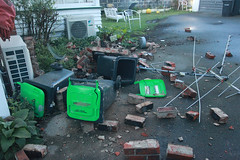
A photograph of the earthquake damage to a house in Christchurch. The outer-side wall has crumbled, the bricks spilling onto the ground and buckling the fence.
Observatory Tower Photograph 12
Images, UC QuakeStudies
A photograph of parts of the Townsend Telescope recovered from the rubble of the Observatory tower. The telescope was housed in the tower at the Christchurch Arts Centre. It was severely damaged when the tower collapsed during the 22 February 2011 earthquake.
Observatory Tower Photograph 14
Images, UC QuakeStudies
A close-up photograph of parts of the Townsend Telescope recovered from the rubble of the Observatory tower. The telescope was housed in the tower at the Christchurch Arts Centre. It was severely damaged when the tower collapsed during the 22 February 2011 earthquake.
Deb Robertson's Blog 19/11/2012: Christchurch: Trying to make sense of liv…
Articles, UC QuakeStudies
An entry from Deb Robertson's blog for 19 November 2012 entitled, "Christchurch: Trying to make sense of living here....".
Homage to the Lost Spaces Photograph 4
Images, UC QuakeStudies
A photograph of Mike Hewson's installation 'Homage to the Lost Spaces' being installed on plywood covering the earthquake-damaged Cranmer Courts building.
Homage to the Lost Spaces Photograph 5
Images, UC QuakeStudies
A photograph of Mike Hewson's installation 'Homage to the Lost Spaces' being installed on plywood covering the earthquake-damaged Cranmer Courts building.
Homage to the Lost Spaces Photograph 1
Images, UC QuakeStudies
A photograph of Mike Hewson's installation 'Homage to the Lost Spaces' being installed on plywood covering the earthquake-damaged Cranmer Courts building.
Homage to the Lost Spaces Photograph 3
Images, UC QuakeStudies
A photograph of Mike Hewson's installation 'Homage to the Lost Spaces' being installed on plywood covering the earthquake-damaged Cranmer Courts building.
Homage to the Lost Spaces Photograph 2
Images, UC QuakeStudies
A photograph of Mike Hewson's installation 'Homage to the Lost Spaces' being installed on plywood covering the earthquake-damaged Cranmer Courts building.
Cylic Undrained DSS Testing of Christchurch Sands
Research papers, University of Canterbury Library
Earthquake-triggered soil liquefaction caused extensive damage and heavy economic losses in Christchurch during the 2010-2011 Canterbury earthquakes. The most severe manifestations of liquefaction were associated with the presence of natural deposits of clean sands and silty sands of fluvial origin. However, liquefaction resistance of fines-containing sands is commonly inferred from empirical relationships based on clean sands (i.e. sands with less than 5% fines). Hence, existing evaluation methods have poor accuracy when applied to silty sands. Also, existing methods do not quantify appropriately the influence on liquefaction resistance of soil fabric and structure, which are unique to a specific depositional environment. This study looks at the influence of fines content, soil fabric (i.e. arrangement of soil particles) and structure (e.g. layering, segregation) on the undrained cyclic behaviour and liquefaction resistance of fines-containing sandy soils from Christchurch using Direct Simple Shear (DSS) tests on soil specimens reconstituted in the laboratory with the water sedimentation technique. The poster describes experimental procedures and presents early test results on two sands retrieved at two different sites in Christchurch.
Crowd on The Grassy
Images, eqnz.chch.2010
Photos taken at the Lyttelton Community briefing held on March 7 2011 following the magnitude 6.3 earthquake on 22 February 2011. File Ref: CCL-2011-03-07-Lyttelton-Community-Briefing-P1110625 From the collection of Christchurch City Libraries.
TV3 reporter Ali Ikram
Images, eqnz.chch.2010
Photos taken at the Lyttelton Community briefing held on March 7 2011 following the magnitude 6.3 earthquake on 22 February 2011. File Ref: CCL-2011-03-07-Lyttelton-Community-Briefing-P1110622 From the collection of Christchurch City Libraries.
Large crowd at community briefing
Images, eqnz.chch.2010
Photos taken at the Lyttelton Community briefing held on March 7 2011 following the magnitude 6.3 earthquake on 22 February 2011. File Ref: CCL-2011-03-07-Lyttelton-Community-Briefing-P1110619 From the collection of Christchurch City Libraries.
Photographer in the crowd
Images, eqnz.chch.2010
Photos taken at the Lyttelton Community briefing held on March 7 2011 following the magnitude 6.3 earthquake on 22 February 2011. File Ref: CCL-2011-03-07-Lyttelton-Community-Briefing-P1110621 From the collection of Christchurch City Libraries.
Smaller businesses and the Christchurch earthquakes: A longitudinal study …
Research papers, University of Canterbury Library
This study explores the nature of smaller businesses’ resilience following two major earthquakes that severely disrupted their place of doing business. Data from the owners of ten smaller businesses are qualitative and longitudinal, spanning the period 2011 through 2018, providing first-hand narrative accounts of their responses in the earthquakes’ aftermath. All ten owners showed some individual resilience; six businesses survived through to 2018, of which three have recovered strongly. All three owned their premises; operated business-tobusiness models; and were able to adapt and continue to follow path-extension strategies. All the other businesses had direct business-to-customer models operating from leased premises, typically in major retail malls. Four eventually recognised path-exhaustion at different times and so did not survive through to 2018. We conclude however that post-disaster recovery is best explained in terms of business model resilience. Even the most resilient of individual owners will struggle to survive if their business model is either not resilient or cannot be made so. Individual resilience is necessary but not sufficient.
A System Dynamic Model of Post-Earthquake Reconstruction pathways
Research papers, University of Canterbury Library
Objectives • To develop a system dynamics model of Christchurch post-quake reconstruction process that captures all the critical dynamics influencing its pathway • To investigate the implications of current rebuild pathway • To build a reconstruction module to be integrated in MERIT (Measuring the Economics of Resilient Infrastructure Tool)
Seismic performance of a six storey reinforced masonry building during the…
Research papers, The University of Auckland Library
During the Christchurch earthquake of February 2011, several midrise buildings of Reinforced Concrete Masonry (RCM) construction achieved performance levels in the range of life safety to near collapse levels. These buildings were subjected to seismic demands higher than the building code requirements of the time and higher than the current New Zealand Loadings Standard (NZS-1170.5:2004). Structural damage to these buildings has been documented and is currently being studied to establish lessons to be learned from their performance and how to incorporate these lessons into future RCM design and construction practices. This paper presents a case study of a six story RCM building deemed to have reached the near collapse performance level. The RCM walls on the 2nd floor failed due to toe crushing reducing the building’s lateral resistance in the east-west direction. A nonlinear dynamic analysis on a 3D model was conducted to simulate the development of the governing failure mechanism. Preliminary analysis results show that the damaged walls were initially under large compression forces from gravity loads which caused increase in their lateral strength and reduced their ductility. After toe crushing failure developed, axial instability of the model was prevented by a redistribution of gravity loads.
Elizabeth Ackermann Photograph 342
Images, UC QuakeStudies
A photograph of a laminated image tied to the fencing around Cathedral Square. The image depicts the Citizen's Memorial as it looked before the Canterbury earthquakes.
Nic Johns and Mark Osborne WEMO Photograph 066
Images, UC QuakeStudies
A photograph of a map at the temporary Civil Defence headquarters which was set up at the Christchurch Art Gallery after the 4 September 2010 earthquake. The map shows areas of the city that have flooded and roads that have closed.
Nic Johns and Mark Osborne WEMO Photograph 063
Images, UC QuakeStudies
A photograph of a map at the temporary Civil Defence headquarters which was set up at the Christchurch Art Gallery after the 4 September 2010 earthquake. The map shows areas of the city that have flooded and roads that have closed.
Jim Baltaxe WEMO Photograph 015
Images, UC QuakeStudies
A photograph of emergency management staff meeting outside the Christchurch Art Gallery. The art gallery was used as the temporary Civil Defence headquarters after the 22 February 2011 earthquake. In the background, a New Zealand Fire Service truck can be seen.
sand volcano tours
Images, eqnz.chch.2010
Yes, it was a joke. The tours, that is, not the yard filled with earthquake-caused sand volcanos. They were very real. You can see one covering the driveway in this photo. The signs read as follows. "Tours run 1/2 hourly. $5.25 admission. Eftpos unavailable." "If you think this is bad... you should see the back!"
picture frames askew
Images, eqnz.chch.2010
None
Message from Timor for the people of Christchurch
Videos, UC QuakeStudies
A video about the service held in East Timor for personnel in the New Zealand and Australian Defence Force and the police. The service was held in honour of the people who lost their lives in the 22 February 2011 earthquake, as well as to acknowledge the people providing relief back in Christchurch.
WEMO ERT Set 1 - February 2011 - Photograph 53
Images, UC QuakeStudies
A photograph of the earthquake damage to the back of the Canterbury Provincial Chambers, taken from Oxford Terrace across the Avon River.
Jim Baltaxe WEMO Photograph 021
Images, UC QuakeStudies
A photograph of campervans parked in Hagley Park. The campervans served as temporary accommodation for emergency management personnel who travelled to Christchurch after the 22 February 2011 earthquake.
New Zealand Defence Force photograph 113
Images, UC QuakeStudies
A doctor from the Royal New Zealand Air Force and a Medical Team Leader preparing to evacuate Christchurch rest home residents affected by the 22 February 2011 earthquake.
WEMO ERT Set 1 - March 2011 - Photograph 10
Images, UC QuakeStudies
A photograph of the earthquake damage to a house in Christchurch. The roof of the house has collapsed, bringing the top of the front wall down with it.
Jim Baltaxe WEMO Photograph 040
Images, UC QuakeStudies
A photograph of the earthquake damage to a house in Christchurch. Bricks from the demolished house next door still lie on the roof and against the side wall.
Ray Whelan WEMO Photograph 10
Images, UC QuakeStudies
A photograph of the earthquake damage to a building in the Christchurch central city. Some of the windows have been broken, and blinds are hanging out of them.