
Search
found 1452 results
Images for house; more images...
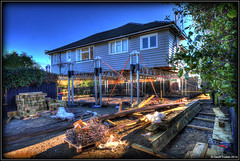


Christchurch Earthquake 2011 - Brickworks House II
Images, eqnz.chch.2010
Known by the locals as the "Owner's House" of the large Farnley Brick and Tile Works which was situated nearby. Established by the Austin brothers in 1863 the brickworks were named after the town of Farnley in Yorkshire England, from where the family had come. I remember the brickworks as a child and I think they were demolished in the 1970's. V...
Class, wealth & power
Articles, Christchurch uncovered
The challenge for this week’s blog was to consider class and buildings – more specifically: houses. When I decided to write this post, I thought it’d be relatively straightforward – I have a really interesting house to tell you about, … Continue reading →
Christchurch Press Image: Kirk Hargreaves 2011:02:10 13:35:31
Images, UC QuakeStudies
Photograph captioned by Fairfax, "David Palmer's Stewarts Gully house is ruined and he has no insurance. Liquefaction has sprung up everywhere and the house needs jacking up and new piles".
Fairfax Video, August 2012 (7)
Videos, UC QuakeStudies
A video of the demolition of the Radio Network House on Worcester Street. The building was demolished by Controlled Demolition Inc using a controlled implosion.
We Lived Here: Oxford Terrace Photograph 046
Images, UC QuakeStudies
A photograph of a blossoming tree and letterbox at 450 Oxford Terrace. In the background is the house at the same address.
We Lived Here: Oxford Terrace Photograph 109
Images, UC QuakeStudies
A photograph of the house at 390 Oxford Terrace. Grass and other weeds have grown up through the cracks between the pavers in front.
We Lived Here: Bangor Street Photograph 02
Images, UC QuakeStudies
A photograph of the house at 58 Bangor Street. A green sticker on the door indicates that it has been inspected and is safe to enter.
We Lived Here: Bangor Street Photograph 03
Images, UC QuakeStudies
A photograph of the house at 58 Bangor Street. A green sticker on the door indicates that it has been inspected and is safe to enter.
We Lived Here: Oxford Terrace Photograph 028
Images, UC QuakeStudies
A photograph of the house at 396 Oxford Terrace. The hedges at the front have begun to overgrow. Plastic sheeting is lying over the path.
Christchurch Press Image: Kirk Hargreaves 2011:02:10 13:33:03
Images, UC QuakeStudies
Photograph captioned by Fairfax, "David Palmer's Stewarts Gully house is ruined and he has no insurance. Liquefaction has sprung up everywhere and the house needs jacking up and new piles".
Quake Art
Images, UC QuakeStudies
A stall selling mosaics of broken mirrors in the shape of houses, crosses and cathedrals. The photographer comments, "The Quake Art on sale at the AandP Show in Christchurch".
We Lived Here: Bangor Street Photograph 13
Images, UC QuakeStudies
A photograph looking north along the footpath of Bangor Street. To the right there are the former sites of several houses. The houses were demolished after the land was zoned Red.
Fireplaces I have known
Articles, Christchurch uncovered
They’re one of the most ubiquitous aspects of 19th century houses, a feature that functions as both a source of warmth and light and a decorative element in the interior design of the house (as so many things do). We … Continue reading →
On-sold nightmare: EQC offers $48,000 despite $260,000 repair bill
Audio, Radio New Zealand
Georgina Hanafin says EQC has offered her $48,000 to fix her house, which has a repair bill of $260,000. She also has a mortgage of $300,000 for the house she purchased after the Christchurch earthquakes.
Photograph by Jocelyn Kinghorn 2183
Images, UC QuakeStudies
Damaged house in an overgrown site.
Photograph by Jocelyn Kinghorn 059
Images, UC QuakeStudies
Liquefaction outside a house in Parklands.
Photograph by Jocelyn Kinghorn 060
Images, UC QuakeStudies
Liquefaction outside a house in Parklands.
20130610_7556_EOS M-22 HireQuip toilet (Day 161/365)
Images, eqnz.chch.2010
Sitting on the concrete in front of what was my model railway room - a single car garage at the rear of our house in Pacific Park. Reason it is here - one of the houses behind my old house is going to be trucked out. See previous photo.
Future seismic performance expectations of the wooden-framed houses by hom…
Research papers, University of Canterbury Library
New Zealand has a long tradition of using light timber frame for construction of its domestic dwellings. After the most recent earthquakes (e.g. Canterbury earthquakes sequence), wooden residential houses showed satisfactory life safety performance which aligns with New Zealand design codes requirements. However, poor performance was reported in terms of their seismic resilience that can be generally associated with community demands. Future expectations of the seismic performance of wooden-framed houses by homeowners were assessed in this research. Homeowners in the Wellington region were asked in a survey about the levels of safety and expected possible damage in their houses after a seismic event. Findings bring questions about whether New Zealand code requirements are good enough to satisfy community demands. Also, questions whether available information of strengthening techniques to structurally prepare wooden-framed houses to face future major earthquakes can help to make homeowners feel safer at home during major seismic events.
We Lived Here: Oxford Terrace Photograph 118
Images, UC QuakeStudies
A photograph of Robin Duff's house at 386 Oxford Terrace. The grass has been recently mowed but the dead grass has not been removed. One of the windows has been boarded up with plywood. A yellow sticker on the door indicates that access to the house is restricted. The photographer comments, "The lawn was mowed as part of the maintenance project on red-zoned properties".
Fairfax Video, December 2013 (3)
Videos, UC QuakeStudies
A video telling the story of a Dallington house which was built by Bill Cooper in 1957. The house was demolished last month as part of the clearance of the Christchurch residential red zone. The story of the house is used to illustrate what is happening in many Christchurch suburbs. The video also includes the story of a sea elephant that lived in the Avon River in the 1970s and 1980s.
Sagging in the Middle
Images, UC QuakeStudies
A wooden house in Wainoni has visibly bowed inwards towards its centre. The photographer comments, "During the numerous earthquakes in Christchurch the land which ran alongside the Avon river on Avonside Drive slumped towards the waterway. In a line parallel to the road the road, but around 20m away a ground movement occurred which caused some houses to rise up or sink down".
Photograph by Jocelyn Kinghorn 210
Images, UC QuakeStudies
Damage inside a house in St Albans.
Photograph by Jocelyn Kinghorn 1937
Images, UC QuakeStudies
An overgrown garden surrounds a damaged house.
Photograph by Jocelyn Kinghorn 206
Images, UC QuakeStudies
Damage inside a house in St Albans.
Photograph by Jocelyn Kinghorn 015
Images, UC QuakeStudies
Damage inside a house in St Albans.
Photograph by Jocelyn Kinghorn 055
Images, UC QuakeStudies
Cracks inside a house in St Albans.
Photograph by Jocelyn Kinghorn 001
Images, UC QuakeStudies
Damage inside a house in St Albans.
Photograph by Jocelyn Kinghorn 1931
Images, UC QuakeStudies
An overgrown garden surrounds a damaged house.
Photograph by Jocelyn Kinghorn 388
Images, UC QuakeStudies
Damage inside a house in St Albans.