

Search
found 918 results
Images for CANTERBURY; more images...
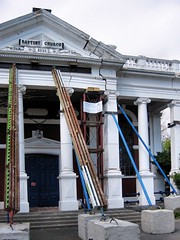
NZi3 - Temporary HQ - Photograph 20
Images, UC QuakeStudies
Members of the University of Canterbury's E-Learning team in their temporary office in the NZi3 building. The photographer comments, "E-learning group had one bay of desks to work from for 3 weeks".
UC Restarts - Photograph 06
Images, UC QuakeStudies
University of Canterbury ICT staff members prepare to be escorted to buildings by Civil Defence members in order to retrieve computers from offices. The photographer comments, "ICT staff head out to retrieve computers from buildings".
UC Restarts - Photograph 16
Images, UC QuakeStudies
University of Canterbury students walk along University Drive to get to lectures, after most pathways through campus were cordoned off while buildings were structurally tested. The photographer comments, "Lawns beside University Drive became main walkways".
Investigation of Systematic Ground Motion Effects through Ground Motion Si…
Research papers, University of Canterbury Library
1. Background and Objectives This poster presents results from ground motion simulations of small-to-moderate magnitude (3.5≤Mw≤5.0) earthquake events in the Canterbury, New Zealand region using the Graves and Pitarka (2010,2015) methodology. Subsequent investigation of systematic ground motion effects highlights the prediction bias in the simulations which are also benchmarked against empirical ground motion models (e.g. Bradley (2013)). In this study, 144 earthquake ruptures, modelled as point sources, are considered with 1924 quality-assured ground motions recorded across 45 strong motion stations throughout the Canterbury region, as shown in Figure 1. The majority of sources are Mw≥4.0 and have centroid depth (CD) 10km or shallower. Earthquake source descriptions were obtained from the GeoNet New Zealand earthquake catalogue. The ground motion simulations were performed within a computational domain of 140km x 120km x 46km with a finite difference grid spacing of 0.1km. The low-frequency (LF) simulations utilize the 3D Canterbury Velocity Model while the high-frequency (HF) simulations utilize a generic regional 1D velocity model. In the LF simulations, a minimum shear wave velocity of 500m/s is enforced, yielding a maximum frequency of 1.0Hz.
UC Restarts - Photograph 07
Images, UC QuakeStudies
Members of the University of Canterbury's E-Learning team in their temporary office space in the NZi3 building. The photographer comments, "E-Learning group meeting; Jess Hollis, Antoine Monti, Susan Tull, Alan Hoskin, Herbert Thomas".
UC Restarts - Photograph 20
Images, UC QuakeStudies
Tents set up in the Fine Arts car park at the University of Canterbury, used for teaching while lecture theatres were closed for structural testing. The photographer comments, "The 'tent city' on the Arts car park".
Townsend Telescope Visitors' Book Page 044
Images, UC QuakeStudies
A scan of page 44 of the Townsend Telescope Visitors' Book.
Townsend Telescope Visitors' Book Page 089
Images, UC QuakeStudies
A scan of page 89 of the Townsend Telescope Visitors' Book.
Townsend Telescope Visitors' Book Page 222
Images, UC QuakeStudies
A scan of page 224 of the Townsend Telescope Visitors' Book.
Townsend Telescope Visitors' Book Page 237
Images, UC QuakeStudies
A scan of page 240 of the Townsend Telescope Visitors' Book.
Townsend Telescope Visitors' Book Page 136
Images, UC QuakeStudies
A scan of page 138 of the Townsend Telescope Visitors' Book.
Townsend Telescope Visitors' Book Page 118
Images, UC QuakeStudies
A scan of page 120 of the Townsend Telescope Visitors' Book.
Townsend Telescope Visitors' Book Page 268
Images, UC QuakeStudies
A scan of page 271 of the Townsend Telescope Visitors' Book.
Townsend Telescope Visitors' Book Page 271
Images, UC QuakeStudies
A scan of page 274 of the Townsend Telescope Visitors' Book.
Townsend Telescope Visitors' Book Page 182
Images, UC QuakeStudies
A scan of page 184 of the Townsend Telescope Visitors' Book.
Townsend Telescope Visitors' Book Page 188
Images, UC QuakeStudies
A scan of page 190 of the Townsend Telescope Visitors' Book.
Townsend Telescope Visitors' Book Page 139
Images, UC QuakeStudies
A scan of page 141 of the Townsend Telescope Visitors' Book.
Townsend Telescope Visitors' Book Page 040
Images, UC QuakeStudies
A scan of page 40 of the Townsend Telescope Visitors' Book.
Townsend Telescope Visitors' Book Page 003
Images, UC QuakeStudies
A scan of page 3 of the Townsend Telescope Visitors' Book.
Townsend Telescope Visitors' Book Page 142
Images, UC QuakeStudies
A scan of page 144 of the Townsend Telescope Visitors' Book.
Townsend Telescope Visitors' Book Page 216
Images, UC QuakeStudies
A scan of page 218 of the Townsend Telescope Visitors' Book.
Townsend Telescope Visitors' Book Page 001
Images, UC QuakeStudies
A scan of page 1 of the Townsend Telescope Visitors' Book.
Townsend Telescope Visitors' Book Page 177
Images, UC QuakeStudies
A scan of page 179 of the Townsend Telescope Visitors' Book.
Townsend Telescope Visitors' Book Page 107
Images, UC QuakeStudies
A scan of page 109 of the Townsend Telescope Visitors' Book.
Townsend Telescope Visitors' Book Page 220
Images, UC QuakeStudies
A scan of page 222 of the Townsend Telescope Visitors' Book.
Townsend Telescope Visitors' Book Page 025
Images, UC QuakeStudies
A scan of page 25 of the Townsend Telescope Visitors' Book.
Townsend Telescope Visitors' Book Page 133
Images, UC QuakeStudies
A scan of page 135 of the Townsend Telescope Visitors' Book.
Townsend Telescope Visitors' Book Page 191
Images, UC QuakeStudies
A scan of page 193 of the Townsend Telescope Visitors' Book.
Townsend Telescope Visitors' Book Page 054
Images, UC QuakeStudies
A scan of page 54 of the Townsend Telescope Visitors' Book.
Townsend Telescope Visitors' Book Page 196
Images, UC QuakeStudies
A scan of page 198 of the Townsend Telescope Visitors' Book.